The Jan de Jong Martial Arts Fitness (an offshoot of the Jan de Jong Self Defence School) website explains: 'There is a direct relationship between the armed and the unarmed
self-defence arts and these unique techniques will be explained and
demonstrated during the course of the classes.'
They are
not alone in suggesting there is a direct relationship between armed and
unarmed self-defence arts. Aikido is an obvious example where some
practitioners focus on the supposed direct relationship between armed and
unarmed self-defence arts.
I'll refer to Shihan Jan de Jong OAM 9th Dan (posthumously 10th Dan) who used to criticise those martial arts that suggested their tactics and techniques were based on the fighting tactics and techniques of animals. As he would say, we are not animals. We are not tigers, eagles, preying mantis , or any other animal. Even though we are related to monkeys, we are not monkeys. Monkeys cannot form a fist, we can, and studies have shown that the ability to form a fist is a distinct survival advantage over monkeys and apes. Why give away that survival advantage for a principal?
In like manner, our limbs are not weapons made of steel. They do not have the ability to cut, slice, or stab. Juxtaposed to that is that the sword does not have the ability to unbalance an opponent other than to directly oppose their force. Why would you base your self-defence tactics on techniques on a method that is clearly not representative of your resources?
The Jan de Jong Jujutsu grading system included a grading, Ken Tai Ichi no Kata. The kata of sword and body. It's supposed to demonstrate the similarities between sword techniques and unarmed techniques.
The explanation of the purpose of the kata is flawed.
The core of all learning is the identification of similarities and differences. The kata should be demonstrating the similarities AND THE DIFFERENCES between armed and unarmed defences.
There are similarities between certain tactics and techniques but there are also differences, BECAUSE OUR UPPER LIMBS ARE NOT SWORDS.
A classic case in point is that it is very difficult to unbalance an opponent with a sword other than to directly oppose them. This resulted in some 'shoe-horning' by the instructors at the JDJSDS when they attempted to reconcile the physical unbalancing methods in the unarmed defences with those of the armed defences.
Only in the martial arts would this discussion ever arise.
Friday, 24 October 2014

Saturday, 18 October 2014
Lineage
I had cause to study the lineage of the jujutsu taught by Jan de Jong recently.
Tsutsumi Hozan Ryu is supposedly the jujutsu taught by the Saito brothers who were Jan de Jong's original instructors.
Jan de Jong didn't start referring to THR until the mid 70s and every grading certificate of Jujutsu-kan and the Jan de Jong Self Defence School only refers to Tsutsumi Ryu, technically a completely different school to THR.
In 1999, Jan de Jong graded Peter Clarke 4th dan and referred to Jan de Jong Jujutsu for the first time on the certificate. Until his death all other certificates continued to refer to TR but those of the highest grades - Peter Clarke, Rob Hymus, Paul Connolly, and Greg Palmer - all referred to Jan de Jong Jujutsu.
After Jan de Jong's death, all the senior instructors went their own way.
Rob Hymus of Indian Ocean Dojo refers to THR. Hans de Jong of the Hans de Jong Self Defence School also refers to THR.
Peter Clarke of Southern Cross Bujutsu has a very good explanation of how he founded Jugo Tsutsumi Ryu on his website. Whether 'jugo' is actually translated as 'Australian' is a contentious issue according to various Japanese sources, however, it's saving grace is that it could be a clever rearrangement of 'goju' (hard-soft and referring to Goju Ryu karate) to 'jugo' (soft-hard) to emphasise the association with the philosophical construct that supposedly underlies jujutsu.
Greg Palmer also founded his own school and changed the name of the jujutsu he taught to Keikai Ryu which is supposed to translate to Gregory. Unfortunately the lineage of Jan de Jong to Greg Palmer and Keikai Ryu died with Greg. It may have died with him but it is not to be forgotten and forms part of the lineage that is the jujutsu taught by Jan de Jong.
Most interesting of all is the jujutsu taught by Jan de Jong Martial Arts and Fitness. The school's (not to be confused with school of thought or tradition) principal is Maggie de Jong with Paul Connolly being the 'seniour instructor' of the school. The JdJMAF website does not refer to a style of jujutsu by name but rather to the jujutsu taught by the school as being 'based' on THR. A no-name brand of jujutsu.
Pat Harringon in Principles of Jujitsu describes the lineage of Australian jujutsu. She has the successor of Jan de Jong and THR as being Graham Dunn. Graham was a devotee of Jan de Jong's teachings and his association with Jan de Jong influenced his teachings and his style of jujutsu, however, you'd need a dotted line at best to include his teachings with the lineage of the jujutsu that Jan de Jong taught. Harrington is guilty of poor research, a not uncommon feature of the martial arts literature.
What about Jan de Jong Jujutsu or Jan de Jong Ryu? It would appear it had it's moment in the sun for a twinkling of an eye. Even though Jan de Jong considered that he'd changed what he'd learnt so much that it was no longer THR, it would appear that THR possesses more currency than JdJR.
Tsutsumi Hozan Ryu is supposedly the jujutsu taught by the Saito brothers who were Jan de Jong's original instructors.
Jan de Jong didn't start referring to THR until the mid 70s and every grading certificate of Jujutsu-kan and the Jan de Jong Self Defence School only refers to Tsutsumi Ryu, technically a completely different school to THR.
In 1999, Jan de Jong graded Peter Clarke 4th dan and referred to Jan de Jong Jujutsu for the first time on the certificate. Until his death all other certificates continued to refer to TR but those of the highest grades - Peter Clarke, Rob Hymus, Paul Connolly, and Greg Palmer - all referred to Jan de Jong Jujutsu.
After Jan de Jong's death, all the senior instructors went their own way.
Rob Hymus of Indian Ocean Dojo refers to THR. Hans de Jong of the Hans de Jong Self Defence School also refers to THR.
Peter Clarke of Southern Cross Bujutsu has a very good explanation of how he founded Jugo Tsutsumi Ryu on his website. Whether 'jugo' is actually translated as 'Australian' is a contentious issue according to various Japanese sources, however, it's saving grace is that it could be a clever rearrangement of 'goju' (hard-soft and referring to Goju Ryu karate) to 'jugo' (soft-hard) to emphasise the association with the philosophical construct that supposedly underlies jujutsu.
Greg Palmer also founded his own school and changed the name of the jujutsu he taught to Keikai Ryu which is supposed to translate to Gregory. Unfortunately the lineage of Jan de Jong to Greg Palmer and Keikai Ryu died with Greg. It may have died with him but it is not to be forgotten and forms part of the lineage that is the jujutsu taught by Jan de Jong.
Most interesting of all is the jujutsu taught by Jan de Jong Martial Arts and Fitness. The school's (not to be confused with school of thought or tradition) principal is Maggie de Jong with Paul Connolly being the 'seniour instructor' of the school. The JdJMAF website does not refer to a style of jujutsu by name but rather to the jujutsu taught by the school as being 'based' on THR. A no-name brand of jujutsu.
Pat Harringon in Principles of Jujitsu describes the lineage of Australian jujutsu. She has the successor of Jan de Jong and THR as being Graham Dunn. Graham was a devotee of Jan de Jong's teachings and his association with Jan de Jong influenced his teachings and his style of jujutsu, however, you'd need a dotted line at best to include his teachings with the lineage of the jujutsu that Jan de Jong taught. Harrington is guilty of poor research, a not uncommon feature of the martial arts literature.
What about Jan de Jong Jujutsu or Jan de Jong Ryu? It would appear it had it's moment in the sun for a twinkling of an eye. Even though Jan de Jong considered that he'd changed what he'd learnt so much that it was no longer THR, it would appear that THR possesses more currency than JdJR.
Monday, 6 October 2014
Jan de Jong's Bastard Child
I've had occassion to study Ken Tai Ichi no Kata which is a part of De Jong's grading system. The following demonstration was posted on YouTube and the participants are students of Hans de Jong, the son of Jan de Jong.
There is also a demonstration that has been posted of the original Ken Tai Ichi no Kata by Mochizuki's school.
The core of all learning is the identification of similarities and differences. There is much to learn from the comparision of the two kata. One of the things that came out of my exploration is the identification of Jan de Jong's bastard child.
This kata and much else is taken directly from Mochizuki's Yoseikan Budo, however, De Jong until 1999 and all of the offshoot schools still identify with Tsutsumi Hozan ryu. In the 1950s, De Jong only had the first four kyu gradings in his grading system. If there is any Tsutsumi Hozan ryu influence in the jujutsu taught by De Jong it would be contained in those grades. Thereafter, his grading system was significantly influenced by his time with Minoru Mochizuki in Japan and through his involvement with one of his instructors, Yoshiaki Unno, who he sponsored to come to Australia and who he and his son trained with each morning for a few years.
What style of jujutsu did De Jong teach and by extension what style of jujutsu do the schools that succeeded him teach?
Even if a case could be made that De Jong learnt Tsutsumi Hozan ryu jujutsu by his original instructors, the Saito brothers, that tradition has long since been changed beyond recognition by the influence of Mochizuki's teachings. However, technically you cannot say they are teaching Yoseikan Budo because De Jong was never graded in Yoseikan Budo. The jujutsu that De Jong taught and that all his instructors teach is the bastard child of the different influences that shaped the school of Jan de Jong.
In 1999, De Jong graded Sensei Peter Clarke (now of Southern Cross Bujutsu)fourth dan and the certificate referred for the first time to 'Jan de Jong Jujutsu.' It is interesting that while everyone identifies with Tsutsumi Hozan ryu jujutsu, not one of De Jong's certificates awarded to students refers to that system. Instead, they all refer to Tsutsumi ryu, an entirely different school. The reference by De Jong to his self-named style of jujutsu was the result of my campaign over many years, however, the four main instructors who have succeeded De Jong refuse to identify with Jan de Jong Jujutsu.
The identification with Tsutsumi Hozan ryu does a grave disservice to De Jong's life work. His legacy is kaizen. Kaizen is a Japanese word written with two characters meaning ‘to change’ and ‘for the better’ and has come to mean ‘continuous improvement’ in business circles.
De Jong continually tried to improve his knowledge and his jujutsu system. He didn't collect books for the sake of them. They were his professional development in an age and environment when professional development through personal contact was not available to him. In his fifties he ventured over to Japan to continue his professional develepmont with Mochizuki and even further by sponsoring one of his instructors, Unno, to come to Australia so he could learn from him.
All the schools that were derived from De Jong's - Jan de Jong's Martial Arts and Fitness, Southern Cross Bujutsu, Indian Ocean Dojo, and Hans de Jong Self Defence School - all continue to identify with the legend/myth that is the Tsutsumi Hozan ryu origins. Jan de Jong worked his entire life right up until his passing developing a body of work and rather than some spurious link to the past, his efforts should be acknowledged and celebrated.
I am proud to say that I teach the bastard child that is Jan de Jong jujutsu.
There is also a demonstration that has been posted of the original Ken Tai Ichi no Kata by Mochizuki's school.
The core of all learning is the identification of similarities and differences. There is much to learn from the comparision of the two kata. One of the things that came out of my exploration is the identification of Jan de Jong's bastard child.
This kata and much else is taken directly from Mochizuki's Yoseikan Budo, however, De Jong until 1999 and all of the offshoot schools still identify with Tsutsumi Hozan ryu. In the 1950s, De Jong only had the first four kyu gradings in his grading system. If there is any Tsutsumi Hozan ryu influence in the jujutsu taught by De Jong it would be contained in those grades. Thereafter, his grading system was significantly influenced by his time with Minoru Mochizuki in Japan and through his involvement with one of his instructors, Yoshiaki Unno, who he sponsored to come to Australia and who he and his son trained with each morning for a few years.
What style of jujutsu did De Jong teach and by extension what style of jujutsu do the schools that succeeded him teach?
Even if a case could be made that De Jong learnt Tsutsumi Hozan ryu jujutsu by his original instructors, the Saito brothers, that tradition has long since been changed beyond recognition by the influence of Mochizuki's teachings. However, technically you cannot say they are teaching Yoseikan Budo because De Jong was never graded in Yoseikan Budo. The jujutsu that De Jong taught and that all his instructors teach is the bastard child of the different influences that shaped the school of Jan de Jong.
In 1999, De Jong graded Sensei Peter Clarke (now of Southern Cross Bujutsu)fourth dan and the certificate referred for the first time to 'Jan de Jong Jujutsu.' It is interesting that while everyone identifies with Tsutsumi Hozan ryu jujutsu, not one of De Jong's certificates awarded to students refers to that system. Instead, they all refer to Tsutsumi ryu, an entirely different school. The reference by De Jong to his self-named style of jujutsu was the result of my campaign over many years, however, the four main instructors who have succeeded De Jong refuse to identify with Jan de Jong Jujutsu.
The identification with Tsutsumi Hozan ryu does a grave disservice to De Jong's life work. His legacy is kaizen. Kaizen is a Japanese word written with two characters meaning ‘to change’ and ‘for the better’ and has come to mean ‘continuous improvement’ in business circles.
De Jong continually tried to improve his knowledge and his jujutsu system. He didn't collect books for the sake of them. They were his professional development in an age and environment when professional development through personal contact was not available to him. In his fifties he ventured over to Japan to continue his professional develepmont with Mochizuki and even further by sponsoring one of his instructors, Unno, to come to Australia so he could learn from him.
All the schools that were derived from De Jong's - Jan de Jong's Martial Arts and Fitness, Southern Cross Bujutsu, Indian Ocean Dojo, and Hans de Jong Self Defence School - all continue to identify with the legend/myth that is the Tsutsumi Hozan ryu origins. Jan de Jong worked his entire life right up until his passing developing a body of work and rather than some spurious link to the past, his efforts should be acknowledged and celebrated.
I am proud to say that I teach the bastard child that is Jan de Jong jujutsu.
Tuesday, 30 September 2014
Examination
A requirement of Jan de Jong's jujutsu shodan grading is an examination grading. The candidate is required to sit on a grading table as an 'assistant examiner' for 40 hours with at least 20 hours being with Jan de Jong.
While this requirement is good in theory it was not effective in practice as the candidate did not learn much about examining a student for their grading. They just sat there racking up the hours.
I took this as an opportunity to learn how to grade to Jan de Jong's standard. I'd mentally grade each aspect of the grading and compare it to the grade that Jan de Jong awarded. I got to the point where I'd be within one or two points of Jan de Jong's grades.
I've recently advised an offshoot of the Jan de Jong Self Defence School that this examination should require candidates to complete a supplementary grading sheet to be compared to the chief examniner's grading sheet, thus making this grading more effective.
I recently had coffee with an instructor before my seniour instructors who informed me that this is exactally what was required in the past. What happened to change it?
While this requirement is good in theory it was not effective in practice as the candidate did not learn much about examining a student for their grading. They just sat there racking up the hours.
I took this as an opportunity to learn how to grade to Jan de Jong's standard. I'd mentally grade each aspect of the grading and compare it to the grade that Jan de Jong awarded. I got to the point where I'd be within one or two points of Jan de Jong's grades.
I've recently advised an offshoot of the Jan de Jong Self Defence School that this examination should require candidates to complete a supplementary grading sheet to be compared to the chief examniner's grading sheet, thus making this grading more effective.
I recently had coffee with an instructor before my seniour instructors who informed me that this is exactally what was required in the past. What happened to change it?
Saturday, 3 August 2013
Silat Master O'ong and Silat generally
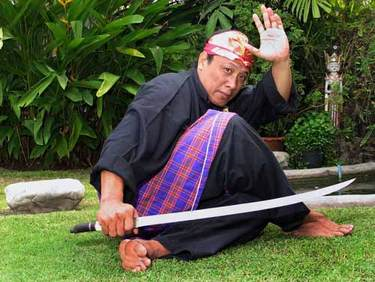
How is O'ong related to De Jong? He was part of the De Jong story in that he along with other Indonesian martial artists were guests of De Jong in the late 1970s or early 1980s. And he was dedicated to the martial arts as De Jong was.
O'ong was also an academic of pencak silat, as I am of the martial arts generally. His website with his articles is very interesting. 'The Militarisation of Pencak Silat during the Japanese Occupation and the Era of Revolution' is particularly interesting.
In the above article, O'ong writes about a homogenous training package of pencak silat. When I was living in London I came to train Perisai Deri (PD). PD was developed from different indigenous styles of pencak silat. In my mind, it follows the Tae Kwon Do model of developing a generic martial art from the indigenous martial arts to be taught en masse, such as the military.

PD didn't have the pencak silat feel that I'd come to love. I'd trained pencak silat at De Jong's school, in Indonesia and Holland, and PD was far too rigid. I went and trained with an Indonesian teaching a style from Sulawesi. Loved it. After a few training sessions he told me I had to continue training PD with the other instructor for six months and then if I wanted to I could continue training with him. This is in London in the 1990s!
I was not keen on training PD. It didn't have the pencak silat feel. So I started training with Richard De Bordes. Hardest training I've ever done. They knew who I was (an instructor of Jan de Jong) so I got 'special' attention. Also, I was the only Caucasian in the class, which made me stand out somewhat. Fantastic experience though.
I've advised others to train with O'ong in Bangkok. Sadly this is no longer an option.
Saturday, 22 June 2013
Jan de Jong The Innovator
To the best of my knowledge, I am the only person who has studied Shihan Jan de Jong OAM 9th Dan's history and his grading system. Five have completed the technical requirements of the grading system, including myself, and others have completed up to various grades, but I am the only one who has studied the system itself. And do you know what arises from that study? A far greater respect for Shihan de Jong as an innovator.
Shihan de Jong is not given enough respect for being an innovator. Sadly, for many, his work has to be the product of the Tsutsumi Hozan ryu which was transmitted through the Saitos (his instructors) to him. If that is the case, he was merely a librarian. But my study of his history and his system tells me he was much, much more than a librarian. He was an innovator.
De Jong adopted the most Japanese of traits. He didn't just adopt from others, he adopted and adapted. Tempura was adopted by the Japanese from the Portuguese and then adapted to become uniquely Japanese. As was Buddhism, but not from the Portuguese.
I know for a fact that De Jong developed the mon and dan gradings. These gradings have more in common with each other than the kyu gradings, which tend to not quite fit with the mon and dan grades. The kyu grades came first, and were based on his Saito experience and exposure to judo and jujutsu in WWII Europe. The mon and dan grades came after his training with Minoru Mochizuki and when Yoshiaki Unno trained with him in Perth, and they reflect that experience.
The mon grades reflect a graduated approach to learning skills. Inherent in the mon grades is an analytical approach to teaching and learning skills. It involves breaking defences down into phases. De Jong said he developed the mon grades based on his experience developing a close combat system for the Australian Army. How do the army teach skills? They break skills down into phases. De Jong found this increased the knowledge and skill acquisition of his students.
This analytical method was not fully appreciated by De Jong and his instructors. It is a powerful tool, not just for learning his methods but for understanding and studying the methods of any martial art. An explicit understanding of this analytical method means it can be used deliberately rather than casually or accidentally.
One senior instructor has dropped the mon system from his grading system. Why? He suggested to return to the 'traditional' Tsutsumi system. That is very short sighted and possibly based on a need to be associated with a centuries old tradition originating in Japan. The dan grades have far more in common with the mon grades than the kyu grades, so does he drop the dan grades as well? You lose the analytical method by dropping the mon grades. Does this analytical method now form part of the 'secrets' of the system which only dan grades are privy too (if they are even understood)?
De Jong's dan grades are designed to produce instructors, and De Jong was justified in being proud of his instructors. They are world class. But they can be better if they understand the lessons the dan (and mon) grades teach.
I'll go out on a limb and say he developed the entire grading system. He adopted elements from other systems (particularly Yoseikan), but he made sure they fit within the overall structure of his school of thought. He adopted a systems approach, and everything he adopted had to fit within that system. It was a good first attempt, but it has to be remembered it was a first attempt. It should not be considered written in stone.
To be true to De Jong's legacy, we should likewise aspire to be innovators. We should adopt a kaizen mind set, continuous improvement. We should look outside our school and not just inside it. But we should adopt or change with a clear understanding of what we are trying to achieve, and that should be for the betterment of our students.
One instructor has dropped the sword grading developed by Sensei Greg Palmer to prepare the students for the dan sword gradings. This grading taught and tested their ability to use a sword which prepares them for sword kata with an opponent in the dan grades. It's a logical, graduated process. Why drop it? If the answer is to reduce the onerous requirements of the grading system on students (it is one of the most comprehensive I have ever seen), then why did he introduce 10 new sword kata?
There are improvements that can be made to De Jong's grading system. We are living up to De Jong's legacy if we make those improvements. If we don't make those improvements, we are not following in his footsteps. But first we have to study the grading system, understand it, and understand what we are trying to achieve.
I am a huge fan of Isaac Newton's quote: if I have seen further it is by standing on the shoulders of giants. My aim is to see further than Shihan Jan de Jong. Far from being arrogant, this is following in the tradition set by De Jong. If any instructor is not aspiring to be better than de Jong, in practice or understanding, they are doing him a disservice.
Shihan de Jong is not given enough respect for being an innovator. Sadly, for many, his work has to be the product of the Tsutsumi Hozan ryu which was transmitted through the Saitos (his instructors) to him. If that is the case, he was merely a librarian. But my study of his history and his system tells me he was much, much more than a librarian. He was an innovator.
De Jong adopted the most Japanese of traits. He didn't just adopt from others, he adopted and adapted. Tempura was adopted by the Japanese from the Portuguese and then adapted to become uniquely Japanese. As was Buddhism, but not from the Portuguese.
I know for a fact that De Jong developed the mon and dan gradings. These gradings have more in common with each other than the kyu gradings, which tend to not quite fit with the mon and dan grades. The kyu grades came first, and were based on his Saito experience and exposure to judo and jujutsu in WWII Europe. The mon and dan grades came after his training with Minoru Mochizuki and when Yoshiaki Unno trained with him in Perth, and they reflect that experience.
The mon grades reflect a graduated approach to learning skills. Inherent in the mon grades is an analytical approach to teaching and learning skills. It involves breaking defences down into phases. De Jong said he developed the mon grades based on his experience developing a close combat system for the Australian Army. How do the army teach skills? They break skills down into phases. De Jong found this increased the knowledge and skill acquisition of his students.
This analytical method was not fully appreciated by De Jong and his instructors. It is a powerful tool, not just for learning his methods but for understanding and studying the methods of any martial art. An explicit understanding of this analytical method means it can be used deliberately rather than casually or accidentally.
One senior instructor has dropped the mon system from his grading system. Why? He suggested to return to the 'traditional' Tsutsumi system. That is very short sighted and possibly based on a need to be associated with a centuries old tradition originating in Japan. The dan grades have far more in common with the mon grades than the kyu grades, so does he drop the dan grades as well? You lose the analytical method by dropping the mon grades. Does this analytical method now form part of the 'secrets' of the system which only dan grades are privy too (if they are even understood)?
De Jong's dan grades are designed to produce instructors, and De Jong was justified in being proud of his instructors. They are world class. But they can be better if they understand the lessons the dan (and mon) grades teach.
I'll go out on a limb and say he developed the entire grading system. He adopted elements from other systems (particularly Yoseikan), but he made sure they fit within the overall structure of his school of thought. He adopted a systems approach, and everything he adopted had to fit within that system. It was a good first attempt, but it has to be remembered it was a first attempt. It should not be considered written in stone.
To be true to De Jong's legacy, we should likewise aspire to be innovators. We should adopt a kaizen mind set, continuous improvement. We should look outside our school and not just inside it. But we should adopt or change with a clear understanding of what we are trying to achieve, and that should be for the betterment of our students.
One instructor has dropped the sword grading developed by Sensei Greg Palmer to prepare the students for the dan sword gradings. This grading taught and tested their ability to use a sword which prepares them for sword kata with an opponent in the dan grades. It's a logical, graduated process. Why drop it? If the answer is to reduce the onerous requirements of the grading system on students (it is one of the most comprehensive I have ever seen), then why did he introduce 10 new sword kata?
There are improvements that can be made to De Jong's grading system. We are living up to De Jong's legacy if we make those improvements. If we don't make those improvements, we are not following in his footsteps. But first we have to study the grading system, understand it, and understand what we are trying to achieve.
I am a huge fan of Isaac Newton's quote: if I have seen further it is by standing on the shoulders of giants. My aim is to see further than Shihan Jan de Jong. Far from being arrogant, this is following in the tradition set by De Jong. If any instructor is not aspiring to be better than de Jong, in practice or understanding, they are doing him a disservice.
Wednesday, 29 May 2013
Theory Grades
Shihan Jan de Jong OAM 9th Dan appears to agree with Gracie and Gracie in Brazilian Jiu-jitsu: Theory and Practice when they suggest that a black belt denotes a depth of knowledge and skill that makes the yudansha (black belt holder)a fully qualified teacher. That in addition to knowing how to perform the techniques, yudansha should also know why a given technique works.
De Jong included theory grades in the dan grades of his jujutsu system. A typical question was, what are the forces involved in a tai gatame ude kujuki (body set arm breaking)? The grading candidates were required to verbally explain rather than physically demonstrate the answer.
De Jong had an intuitive understanding that forces explains the why of techniques, however, he nor the grading candidates did not have an understanding of forces. This meant that the answers to the question were often convoluted and included irrelevant details.
Forces cause the change in motion or shape of all things in the environment. A change in motion, which forces cause, refers to something starting, stopping, speeding up, slowing down, or changing direction. A change in shape, which forces cause, refers to deformation. Deformation of bodily tissues can cause pain or injury. All the techniques taught by all martial arts involve forces - forces are what makes them work.
The beauty of it all is that forces are easy for the layperson to understand and apply.
How would you go about answering the above question?
1. Identify all points of contact between the two parties. This is were forces can be applied.
2. Forces are a push or a pull. That is it! Determine at each point of contact whether the force being applied is a push or a pull.
3. Determine the direction of the push or pull.
4. Determine the relative magnitude of the push or pull.
5. Determine the objective of the combined forces - pushes and pulls. Are they designed to cause a change in motion or a change in shape?
That is how easy it is to explain every technique taught in any martial art.
With respect to #5 above, different objectives of a technique require forces to be applied in different directions and maybe with different magnitudes even though they have the same points of contact.
For example, kansetsu waza (joint techniques) are used for multiple purposes. The can be used to restrain, inflict pain, incapacitate, as a takedown or a throw. They have the same points of contact but the forces at those points of contact are applied in different directions to achieve different objectives.
Congratulations. You have just nailed your theory grading (even if your examiner is not up to speed on the concept of forces).
De Jong included theory grades in the dan grades of his jujutsu system. A typical question was, what are the forces involved in a tai gatame ude kujuki (body set arm breaking)? The grading candidates were required to verbally explain rather than physically demonstrate the answer.
De Jong had an intuitive understanding that forces explains the why of techniques, however, he nor the grading candidates did not have an understanding of forces. This meant that the answers to the question were often convoluted and included irrelevant details.
Forces cause the change in motion or shape of all things in the environment. A change in motion, which forces cause, refers to something starting, stopping, speeding up, slowing down, or changing direction. A change in shape, which forces cause, refers to deformation. Deformation of bodily tissues can cause pain or injury. All the techniques taught by all martial arts involve forces - forces are what makes them work.
The beauty of it all is that forces are easy for the layperson to understand and apply.
How would you go about answering the above question?
1. Identify all points of contact between the two parties. This is were forces can be applied.
2. Forces are a push or a pull. That is it! Determine at each point of contact whether the force being applied is a push or a pull.
3. Determine the direction of the push or pull.
4. Determine the relative magnitude of the push or pull.
5. Determine the objective of the combined forces - pushes and pulls. Are they designed to cause a change in motion or a change in shape?
That is how easy it is to explain every technique taught in any martial art.
With respect to #5 above, different objectives of a technique require forces to be applied in different directions and maybe with different magnitudes even though they have the same points of contact.
For example, kansetsu waza (joint techniques) are used for multiple purposes. The can be used to restrain, inflict pain, incapacitate, as a takedown or a throw. They have the same points of contact but the forces at those points of contact are applied in different directions to achieve different objectives.
Congratulations. You have just nailed your theory grading (even if your examiner is not up to speed on the concept of forces).
Subscribe to:
Posts (Atom)