Ian's son, Mike, provided a wonderful eulogy at Ian's funeral. He is a credit to his father in every way. Given my current interests, a couple of stories his son regaled the mourning masses with came to mind.
Mike told of the time when he held a party at his father's house and some male guests were throwing bottles at the wall of the house. Ian approached the lads and explained that he hoped that they had had a good time at the party but if they continued with their current actions, damage would ensue on their bodies. The lads decided that discretion was the better part of valor.
Mike also told of the time when his father stopped when being tailgated by some lads. Three lads got out of the car and approached Ian. Without Ian saying a word, the lads decided that discretion was the better part of valor.
How did Ian influence these testosterone fueled, societal motivated aggressive males who outnumbered this older man on each occasion?
Appraisal theory tells us that emotions (and subsequent behaviours) are evoked based on an unconscious, or conscious, assessment of our resources and abilities to deal with a threat. If we assess that our resources and abilities are sufficient to deal with a threat then we are confident and a particular emotion is evoked which is accompanied by a particular behaviour.
Was Ian confident in his resources and abilities to deal with the threat? In my unprofessional opinion, I would say that that was not a consideration.
I suspect that Ian had a resolve. A steely resolve. If this 'thing' was going to happen then he would engage in the process. There would have been no thought of outcome. He didn't weigh, consciously or unconsciously, whether or not he would prevail.
Confidence is a tricky thing. When you compare your resources and abilities to a threat, if the former outweighs the latter, you are confident which influences your actions. If your assessment falls short, you lack confidence and your actions reflect that lack of confidence. During a violent encounter, there is a constant reappraisal of your resources and abilities versus the threat. A steely resolve does not engage in that appraisal process.
There is another senior instructor at the school that was the Jan de Jong Self Defence School. He emphasises the 'warrior spirit' in both word and action. He is very proficient, physically strong and fast, and very aggressive. Who would I prefer to engage with, Ian or the unnamed senior instructor? The latter. Every day of the week. Why? Because I had a chance of defeating the unnamed senior instructor psychologically. That opportunity did not exist with Ian. Ian had a resolve. He didn't think about winning or losing, and therefore did not weigh resources and abilities against threats. He was going to engage to the best of his abilities, if he had to, and that was the end of the assessment process.
I believe this is the lesson you want to instill in your students. Forget confidence. Forget bravado. It's simply a steely resolve. Not to win or lose, but simply to engage with all of your resources and abilities. Let the outcome take care of itself.
... Interestingly enough, writing this post and reflecting on Ian's lesson is giving me the resolve to deal with a very intimidating issue that is currently having a major impact on my life. Thanks Lloydo. You continue to help me.
Friday, 24 August 2012

Friday, 3 August 2012
Ave Atque Vale Ian Lloyd

Catullus 101
Through many peoples and many seas have I travelledI prefer the modern translation of ave atque vale: I salute you ... and goodbye.
to thee, brother, and these wretched rites of death
I bring a last gift but can speak only to ashes
Since Fortune has taken you from me
Poor brother! stolen you away from me
leaving me only ancient custom to honour you
as it has been from generation to generation
Take from my hands these sad gifts covered in tears
Now and forever, brother, Hail and farewell (ave atque vale).
Ian first stepped onto the mats of the Jan de Jong Self Defence School in 1965.
He was the third longest serving member of the school. He is only preceded by Hans de Jong (officially 1955) and Paul Connolly (1964).
Ian was one of the first jujutska to be awarded shodan by Shihan Jan de Jong in 1982. He was a very proficient jujutsu practitioner, but that proficiency pales into insignificance when you consider the man.
Ian holds the record, by far, for teaching the same class. He commenced teaching the Wednesday night class in 1979 and continued to do so until the restructuring of the school after Jan de Jong's passing in 2003. The third Wednesday in April, 1983 was my first class of jujutsu, and I was privileged to attend Ian's class for many years.
'I speak to everyone in the same way, whether he is the garbage man or the president of the university' - Albert Einstein. Einstein may as well as have been speaking for Ian. Ian treated one and all, young and old, male and female, from all walks of life in the same manner. Always, always with respect.
'Respect' is a word that is often bandied around these days. It is often demanded but the simple rule expressed by R.G. Risch seems to have been lost by many: 'Respect is a two-way street, if you want to get it, you've got to give it.' Ian gave respect to one and all with no expectation of anything in return. You didn't have to earn Ian's respect, it was freely given. All you could do was lose it through your own demerit. And even then, Ian wouldn't hold it against you.
'Being humble means recognising that we are not on earth to see how important we can become, but to see how much difference we can make in the lives of others' - G.B. Hinckley. By definition, Ian was humble. He didn’t teach to gain status or to impress anyone. His teaching was not driven by ego. He didn’t teach for financial reward. He taught because he enjoyed it. He taught for his students, for his love of the art, and for his deep and abiding friendship with Jan de Jong.

Ian asked those he met to just walk beside him and be his friend. Many accepted that invitation. 'Count your age by friends, not years. Count your life by smiles, not tears' - John Lennon. In this case, Ian was far older than his 66 years and the calculation of his life reaches towards infinity.
Ian, ave atque vale, I salute you ... and goodbye.
Tuesday, 24 July 2012
The Perfect Storm

Sensei Taylor's post gave me cause to consider the set of circumstances that had to come together in order for him to develop a passion for aikido which led to his founding of his school. It included colonialism, two wars, the force of nature, climate, language, politics, scarce resources, immigration, a dysfunctional relationship, and a 20 year old man who, in 1940, wanted to become a pilot.
The 20yo man was Jan de Jong and he lived in the Dutch colony of Indonesia pre-1940. In 1940 he travelled to Holland to fulfill his ambition of becoming a pilot. Unfortunately he got caught up in WWII, which fortunately meant he had to turn to teaching jujutsu in order to earn money and survive.
The end of WWII saw nature impose a harsher winter than normal on Holland. This winter came to be known as the 'Hunger Winter' because of the deprivations the occupation and the weather imposed on the Dutch.
In order to escape the deprivations of Holland at that time, De Jong returned to equatorial Indonesia. He returned to a nation which was violently struggling for independence.
After 10 years of war (WWII followed by the Indonesian War of Independence), De Jong decided to relocate to a more peaceful environment. His Hunger Winter experience disinclined him to consider the northern hemisphere, so the options were reduced to Argentina, South Africa, and Australia. Argentina was rejected on language grounds; South Africa was rejected on political grounds (apartheid); so through the process of elimination Australia was chosen. Perth was selected because of its proximity to Indonesia.
In Perth, De Jong started teaching work colleagues jujutsu during their breaks and after work which led to his founding of the Jan de Jong Self Defence School. This would eventually become his full-time occupation.
I have argued throughout this blog that De Jong developed his jujutsu system. He would tell us that the Dutch would think him insane because he would always run to his apartment during an air raid to retrieve his suitcase of martial arts books which he would take with him to the shelter. I now appreciate that this was in no way a collector's idiosyncrasy. These books were the source of his continued professional development. De Jong was the epitome of a life long commitment to continuous improvement.
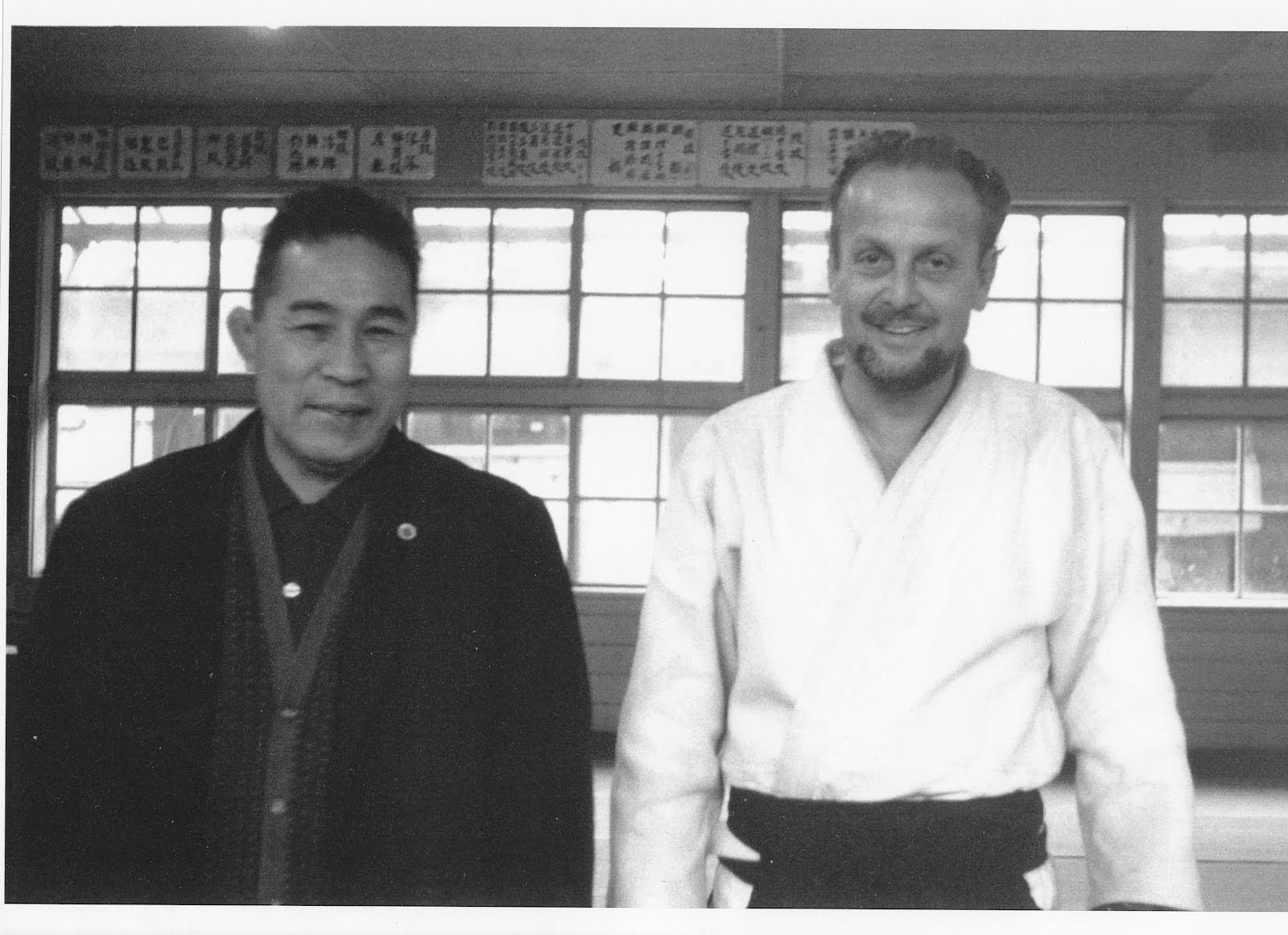
Wishing to continue his professional development, De Jong petitioned Mochizuki to send an instructor to Perth to teach in his school. Mochizuki sent Yoshiaki Unno.
Unno teaching for De Jong was always going to end in tears. Unno held the grades of 7th dan aikido, 7th dan karate, 6th dan kobudo (weapons), 4th dan bojutsu and 2nd dan judo. He also taught kenjutsu. At that time, De Jong was only graded 3rd dan jujutsu and 1st dan aikido (in addition to his pencak silat qualification). The inevitable happened and Unno left the employ of De Jong to establish his own school.
One of Unno's many students was Ross Taylor who then went on to found his own school. Quite amazing. But I suppose it is just one amazing story of many associated with people's involvement in the martial arts.
Monday, 9 July 2012
Rokkyu (6th kyu) Kiiro Obi (Yellow Belt)
Sensei Craig Mahar posted the following on YouTube. It is the majority of techniques included in yellow belt of the Jan de Jong jujutsu grading system.
Kudos to
Kudos to Sensei Mahar. Not only for his efforts in publicly sharing the Jan de Jong jujutsu teachings with others, but also in his proficiency. He is a credit to himself, Sensei Hans de Jong, his instructor since the passing of Shihan Jan de Jong, and of course Shihan Jan de Jong.
Sensei Mahar was a student while I was a student at the Jan de Jong Self Defence School. He was always humble, proficient, and very, very fast. He suffered a debilitating injury when his knee was dislocated during a pre-shodan grading, but he obviously persisted. He has had his share of disappointments in life, but he continues to train, grade, and share his jujutsu with others. It is my conviction that he is exactly the sort of instructor that Shihan Jan de Jong would be very proud of.
Sensei Mahar has been graded sandan by Sensei Hans de Jong, the highest technical grade in the Jan de Jong jujutsu grading system. This is a credit to both Sensei Hans de Jong and Sensei Mahar. Sensei Mahar for achieving that grading and Sensei Hans de Jong for continuing to encourage and advance people in the Jan de Jong jujutsu tradition.
Lets hope many more of these posts are made available to the public.
Monday, 7 May 2012
Vale Soke Robert Clark 1946 - 2012

Another influential figure in the Western world of jujutsu has passed away.
Clark founded the World Ju-Jitsu Federation (WJJF) in 1976:
Clark had a lot to do with the internationalisation of Jan de Jong. In 1978, Clark offered and De Jong accepted the position of Australian representative for the WJJF. Four years later, De Jong attended the WJJF conference accompanied by a team of his instructors. The team entered the demonstration competition and if I recall correctly they placed second. They did, however, impress, and De Jong's international reputation was established. This then led to many offers to teach in Europe and to an annual teaching tour of Europe where De Jong would be accompanied by instructors from his own school as well as those from other schools on occasion.Clark founded the World Ju-Jitsu Federation (WJJF) in 1976:
The World Ju-Jitsu Federation (WJJF) is a martial arts organisation based in the north-west of England. The Federation was founded in 1976 in Fazakerley, a suburb of Liverpool, where the Federation's headquarters are still located. It was established with the aim of promoting the study of jujitsu and to help organise, control and develop the art in the United Kingdom and later throughout the world. The WJJF currently operates in 17 countries.
Clark visited Perth, Western Australia in the late 80s I think it was. The purpose of the visit to 'the most isolated capital in the world' was to visit De Jong and his school. I heard he took some of the instructor's classes while he was here. Even though I was instructing at the time, I was not attending the instructors class because I wasn't sufficiently graded (a practice I would now discourage).
Following Clark's visit, De Jong was offered and accepted the position of Vice President of the WJJF.
I recall an article I wrote for the Jan de Jong Self Defence School 1987 year book, entitled Hakusho, concerning the benefits of WJJF membership. I was writing about my experiences when doing the Australian rite of passage that is the backpacking tour of Europe.
Membership in the WJJF enabled me to train in Dojo's all over Europe. It was an excellent reference and provided me with an introduction to many new friends and experiences in the martial art sphere.
Armed with my WJJF membership and association with O Sensei de Jong, I approached various Dojos throughout Europe. A common theme I encountered was unstinting generosity and friendship. A warm welcome was awaiting me at each Dojo and offers of accommodation, meal, drinks, training, etc were always generously given. When I departed I always did so with small mementos from the clubs and more importantly memories of their friendship and hospitality.

Mr Bertolletti in Milan, Italy, president of the WJJF and publisher of Martial Art magazines including Banzai took time out of his busy timetable to welcome me and make me feel at home. The impracticality of his gift of aftershave became apparent when it leaked all through my backpack. For a while I had the best smelling backpack, clothes, shoes, toothbrush, etc. I still believe he was not suggesting anything about my appearance by this gift.Clark is a very important part of the De Jong story. The WJJF sought to promote and improve jujutsu through an international organisation that operates in 17 countries. In doing so they also promoted De Jong which led to his much loved annual teaching tours of Europe. I'm sure De Jong would be passing on his condolences if he were alive today.
Monday, 16 April 2012
Ju-Jutsu-Kan Profile
 I've been going through some of the paperwork that Peter Canavan and Geoff Emery so generously gave me. They were students and instructors for Jan de Jong before my instructors time. I came across this wonderful piece of history written by the club.
Ju-Jutsu-Kan Profile.
The original name of De Jong's school was jujutsu-kan. Kodokan is the name of Jigoro Kano's judo school. Ko meaning to study, do the way, and kan the place - so it translates to the place to study the way. De Jong simply went for jujutsu-kan, presumably meaning the school of jujutsu.
The Ju-Jutsu-Kan was first formed in 1951 with just a handful of students. After some time the club moved to the Swan River Rowing Club, where the membership then rose to approximately 60 members. In 1961 we were fortunate to obtain more central premises in Hay Street, which also had the advantage of being available throughout the week. The number of members increased in three years to 260 and we soon outgrew those clubrooms.The author of this document is not recorded.In 1964, we moved to the present building [(996 Hay Street)], where we have about five times the previous area. Of course, with much better training facilities and greater mat-area more and more people were anxious to joining the club, and in July, 1965 the 500 mark was reached.
Jan de Jong: Studied jujutsu under the Saito brothers. Commenced professional teaching in 1941 in Europe. After the war he opened a schools in Djakarta and Semarang. Came to Perth in 1951 and has been teaching here ever since.
George Clarke: Recently appointed full time instructor, he joined the club in the early days. George was also a part time instructor at the Cottesloe Youth Club.
Margaret de Jong: Has been secretary of the club since 1957 and an instructor for some years.
Bob Russell-Browne: First started jujutsu in Sydney. Bob joined the club a few years ago, and has been teaching for some time.

History is important because it builds a strong culture. Culture is about telling stories around the campfire. I only heard about the instructors before my instructors mainly through Greg Palmer. It's important that we remember those who came before and instructed the senior instructors of De Jong who went on to form their own schools. They were also their instructors.
Note the number of students. Very impressive by any standards. The number exceed 1,000 in the 1970s, but that can be partly attributed to being in the right place at the right time. That was when the Bruce Lee/martial arts phenmenon took of in the movies. But 500 hundred pre martial arts boom has to speak volumes for De Jong and his Ju-Jutsu-Kan.
Tuesday, 10 April 2012
Suwariwaza no Kata aka Kime no Kata
Jan de Jong's jujutsu shodan grading includes suwariwaza no kata. This is a kata of five defences where both tori and uke are in seiza. I am currently using suwariwaza no kata as a learning tool.
Suwariwaza no kata is judo's kime no kata, or at least the first five techniques of that kata. This is a fact that was never disclosed within the Jan de Jong Self Defence School, probably because the only person who was aware of it was De Jong himself. When I discovered this fact while studying Jigoro Kano's Kodokan Judo (1986) and brought it to my instructors' attention, (a) it was largely ignored, and (b) it was suggested by some that this was Tsutsumi's contribution to Kano's judo. The latter suggestion, I would suggest, is an example of shoehorning.
The fact that the instructors did not know this kata was judo's kime no kata highlights a paradoxical difference between De Jong and his senior instructors. De Jong was constantly studying other systems and martial arts. He incorporated this research into his own style of jujutsu. His instructors on the other hand did not look without, they only looked within. De Jong was the source of all knowledge. If De Jong made an error, it was passed down religiously.
 The not looking without by the instructors is highlighted in that every year the same question would be debated in the instructors class. It remained unresolved at the time of De Jong's death. Which leg do you throw back in the fifth technique when throwing uke? The definitive answer was there all along, however, not once was Kano's book, or any judo reference for that matter, consulted.
An understanding of the biomechancis of balance would also have answered the question. Throwing one leg back reduces tori's base of support to one knee. If the left leg is thrown back while trying to throw uke over the left shoulder, tori's weight has to be transferred over the right knee to remain balanced. This weight transference works against the technique.
 There is a question that was never asked, and it should have been. The first technique involves uke holding tori's hands down on their thighs.
 We were taught to unbalance uke by sliding the hands off the thighs and pulling slightly to either side of tori's body. 'Divide and conquer' as the unbalancing was referred to when standing and both wrists were grabbed by uke. Tori rises to their knees and kicks uke. Why does tori kick uke? To unbalance uke. But isn't uke unbalanced by the divide-and-conquer unbalancing?
I used to divide tactics into three phases: bodymovement (taisabaki), unbalancing (kuzushi), and technique (waza). This division is based on De Jong's division seen in the mon grades he developed. The use of these terms has proven to be a little confusing, so now I refer to: evasion phase, facilitation phase, and execution phase.
Strikes and kicks are often used to facilitate the execution of a technique. It is often referred to as 'mental unbalancing' as compared to physical unbalancing. If you physically unbalance uke using divide-and-conquer, you don't need to mentally unbalance them with the kick, and vice versa.
We always had trouble getting the kick in after we'd unbalanced uke. The reason we had trouble is because you are not suppose to physically unbalance uke. That simply results in uke leaning forward and obstructing the kick. All those doing this kata in any of the schools teaching De Jong's jujutsu - do not physically unbalance uke when executing this technique.
This highlights an important issue. If you see a strike or kick being used to facilitate the execution of a technique, and you see physical unbalancing method being used as well, ask why. It may be that the strike or kick is being used to facilitate the physical unbalancing, but I cannot think of an instance where physical unbalancing methods are used to facilitate a strike or kick to facilitate the execution of a technique.
It should be noted that aikido teaches a similar technique but uses physical unbalancing rather than a kick to facilitate the execution of the technique. This is more akin to what we do when standing, a defence included in yellow belt.
 The second technique is a punch to the stomach which tori evades by raising one knee and pivoting to the side. At the same time they execute a brushing block and a strike. Was an evasive bodymovement used to evade the attack? Yes. It was nagashi taisbaki, or flowing bodymovment. If a bodymovement was used to evade the attack, what is the purpose of the brushing block? This should always be your question when a bodymovement is used to evade an attack and a block is also used. You don't need the block to stop from getting hit or kicked, the bodymovement took care of that. So what is the brushing block used for? The same question can be raised with regards to many standing techniques where a bodymovment is used to evade the attack and a brushing block is also used. What is the purpose of the brushing block?
Our brushing blocks were sometimes referred to as deflection blocks. I asked a student training this technique to explain it to me and he referred to a deflection block - and that is exactly what he used. He was accurate in his description, but inaccurate in actually executing the technique. A deflection changes the direction of a strike or kick. If you've evaded the strike or kick using a bodymovement, why do you then change the direction of the strike, in this case pushing it away from you when you then want to bring it back to apply the stomach-set-arm-breaking technique?
 The third technique involves a strike to the forehead and no evasive bodymovement is used. A block is used to change the direction of the strike. We were always taught that it was also to physically unbalance uke. However, a kick is also used to facilitate the execution of the technique. We can immediately see, given the above rule, that their is a problem here. The unbalancing with the hand was always problematic as it physically unbalanced uke backward and then they were brought forward onto their stomach. The answer lies in the fact that the block is not used to unbalance.
You could use the block to unbalance. Aikido does. But then the kick is not used and the technique is usually executed to uke's rear rather than their front, although, it can be executed to their front using a robuse (arm rowing), which is a feature of Mochizuki's Yoseikan aikido. The latter technique and the influence of Mochizuki's teachings on De Jong might possibly explain why the block was thought to be unbalancing uke - but why then use the kick?
To recap, divide tactics into phases. My division is evasion, facilitation, and execution. If a bodymovement is used to evade an attack and a block is also used, ask what the purpose of the block is If a bodymovement is not used to evade an attack, a block has to be used to stop or change the direction of the attack. If both a strike or kick and physical unbalancing methods are used to facilitate the execution of a technique, ask why both methods are used.
Subscribe to:
Posts (Atom)