Showing posts with label Harry Hartman. Show all posts

Saturday, 1 August 2020

Jan de Jong Side-Drive Kick

You will recall from my last post that Sensei Dan Newcombe, founder of Self Defence Central Dojo and Tsutsumi Hozan Ryu International, forwarded a number of photographs taken in the 1950s when his father and uncle trained under JDJ to me. This is the latest installment.


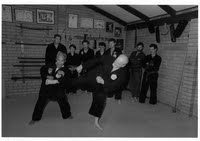
JDJ executing a side-drive kick. JDJ was never keen on the knife-edge for the foot, preferring instead to use the heel with the body weight behind the kick.

The other person's posture is interesting. It appears to be silat-like, however, JDJ had not formally begun to teach silat at that time. It may be a flowing bodymovement (nagashi) with a brushing block but JDJ had not traveled to Japan to train under Mochizuki where the taisabaki taught in his system originated.

The dojo is the Swan River Rowing Club. The mat is handmade by JDJ's first wife, as were the gis, as no martial arts products were available for purchase at that time.

JDJ often told the story of how when he first started teaching at the SRRC, they trained on floorboards and that after the first session or two, and when a student put both feet through the floorboards when executing a bridge fall, the class shrank to a few people. Obviously this mat was then brought out to encourage students to continue with their jujutsu.

Harry Hartman trained at this dojo and he informed me that the mat was rolled up and stored in a storeroom at the SRRC.

This is a photo for comparison over the years. The first photo was taken in the 1950s while the above photo was taken in the late 1980s. JDJ was in his 30s in the first photo and in his 60s in the second. The person executing the defence is JDJ's Indonesian pencak silat guru, Soehadi. This photo is taken in JDJ's home dojo with his silat senior students in the background, including Peter Clarke, fourth from the right.

Wednesday, 17 June 2015

WHFSC Grandmaster's Council: a compendium of the world's leading Grandmasters

Shihan Jan de Jong OAM 9th Dan is included by the World Head of Family Sokeship Council in their book published in 2013 as one of the world's Grandmasters.

Many of the photographs featured in their book have been featured on this blog (consequently, I'm not sure if they accessed those photographs from this blog or elsewhere). One photograph I will draw your attention to is that presented to the right because it has a story of its own.

That photo was included in a post which incorrectly suggested the dojo was 870 Hay Street. In a quirk of fate, that photo was responsible for me connecting with a student of De Jong's from the 50s who then sent me various memorabilia from that time which I subsequently presented to Hans, De Jong's son, for his birthday.

Margaret de Jong, Jan's wife, contacted me with certain issues she had regarding my reporting of the 'Jan de Jong story.' I addressed the majority of her concerns, however, possibly in an act of defiance, I refused to change the description of that photo. As it turned out, Harry Hartman, the good looking young man to the right, the one executing the technique in the photo, contacted me to correct my description of the location of the dojo - and from there a friendship grew. See this post for more information of Harry's contribution to the Jan de Jong story on this blog.

I'm sure Harry is going to be chuffed that his image is now published in a book. At least he has an image published of him executing a technique; the vast majority of images available of me is being the one whom techniques are executed on.

The entry in the WHFSC book reflects the history of the jujutsu that De Jong taught that is popularly espoused. As my research has explained, there is no corroboration of that history other than that De Jong trained under the Saito brothers.

What do we know of the Saito brothers other than that they taught jujutsu in Semarang, Indonesia pre-WWII and that one was a photographer and the other a florist?

De Jong showed me a photographic book that featured a photo of Semarang, Indonesia that was attributed to a Saito around that time. There is another reference that may refer to the photographer Saito:

Many Japanese businessmen appeared on the scene in the years leading up to the Japanese invasion of Java. They were planted there on purpose to get ready for the forthcoming invasion. Our friendly Japanese photographer turned out to be a spy too. He was the most popular photographer in Semarang and he had taken several of our photos. While these people had been bowing and smiling at us, they had been preparing for our destruction!
Jan Ruff-O'Herne, 50 Years of Silence

There is also a photo included of the late, great, Sensei Ian Lloyd that I posted in a tribute to him. A timely reminder to remember those we've loved, lost, by have not forgotten.


Tuesday, 4 October 2011

Jan de Jong Pt 18 - Logo

A big part of the Jan de Jong story is his logo. His logo was based on an ex libris he commissioned during WWII. An Ex libris, or bookplate, is a small graphic label or print that is glued to the inside cover of a book with the purpose of identifying its owner. The Latin phrase 'Ex libris ...', means 'the books of...', and is usually followed by the name of the owner of the book. The designer De Jong commissioned to design his ex libris was Wim Zwiers. In researching this blog, and yes, I do research these blogs, I came across this explanation of why an ex libris is made:
Ex-libris have been a constant tradition for over five hundred years. They are a challenge to an artist to produce a small graphic art work for a friend, for a customer or for himself with a special purpose: identifying the owner of a book. Pasting a beautiful ex-libris in one's books not only discourages theft and reminds borrowers that a book must be returned, but is also a way of paying tribute to the book, which despite modern communication technology remains a primary vehicle for the transmission of knowledge and a constant source of pleasure and interest. As an object of collection, ex-libris are a wonderful way of acquiring, with time and patience and without being a millionaire, a small-format art museum which reflect the artist's skills and the collector's taste.
The theme or image of De Jong's ex libris speaks volumes. It is a graphic representation of his original jujutsu instructors, and reflects his love of, and identification with, the art of jujutsu. The image is based on a photo taken of his original instructors, the Saito brothers.

Zwiers was born in 1922, and would have been in his late teens when De Jong commissioned his ex libris. He went on to become a teacher of fine arts after WWII and is a respected artist utilising many mediums. There are so many stories like this associated with De Jong. Zwiers reconnected with De Jong through an amazing coincidence. They had not had any contact with each other since WWII, but, for whatever reason, in the mid 1990s, Zwiers was visiting Perth, 'the most isolated capital in the world'. He was on a train and saw a van through the window. The van had the ex libris image he'd designed 50 years ago on it, along with a phone number. He phoned the number, and, he and De Jong were reconnected nearly 50 years after their initial meeting, and half a world apart. De Jong would always try and visit Zwiers each year he visited Europe to conduct his seminars. I had the absolute pleasure of meeting Zwiers. He showed me how he created his copper engraved ex libris. He engraves them into a copper plate, backwards, and uses a hand cranked press to print off a limited edition.

The image above of De Jong's ex libris was taken from the ex libris Harry Hartman generously sent me. The fact that the ex libris are printed in a limited edition, by necessity, tells me the esteem with which De Jong held Hartman.

Zwiers is an amazing character. He looks like your traditional grandfather, albeit your traditional Dutch grandfather. But five minutes with him will tell you he is different. He is a true artist in that he has a different view of the world, but, he doesn't have to dress or act different to advertise his different perspective. He lives in this great old house, with a basement that is built into a dyke. The art on the wall of his main living room, a two story affair without the second story, was split 50:50 between his art and those that had been gifted to him by fellow artists when his wife passed away. Those artists had drawn, painted, etc their expressions of grief for a fellow artist. Amazing! And his art ... he told me the story behind many of the pieces he'd chosen to hang on his wall, the art was incredible, but the stories even more so. Obviously, I am a fan ... and I'm proud to say that I have a piece of his work taking pride of place in my home.

De Jong used his ex libris-based logo for his school from when he first started teaching in the early 1940s until 2002. He used it on his badges, as the badge that Hartman sent me shows.


He used it on the membership cards as Hartman's membership card shows from the 1950s when De Jong first started teaching in Australia.


He used it on his badges which signified his gradings rather than belts (see previous blog).


Hartmen sent me a photo where I think that De Jong is attempting to replicate the original Saito photograph.


Given I'm a business/strategy professional, I find it interesting that the new management of the Jan de Jong Self Defence School rebranded the school with a new name and identifying logo. It is now called Jan de Jong Martial Arts Fitness and thier website explains that this change was introduced in 2002 to reflect a new direction. The new direction is not expanded upon. Possibly, the new direction is reflected in the new name, Martial Arts Fitness. De Jong was only ever interested in the practicality of what he taught; fitness only facilitated the practical. I recall De Jong questioning the idea of going to the gym to become better at what you were doing. His opinion was, do what you do, and you'll become fit doing what you do by doing what you do.

It is most definitely a coincidence that the new logo is very similar to the woolblend logo; which symbolises a blend between 50% wool and synthetics. Having said that, is this an unintentional symbol of the new direction that the new management of De Jong school has taken? A blend between self defence and fitness.

Why would you change your logo when your logo has equity? Would you consider changing the Coca Cola logo? You would, if you were persuing a new direction. Putting some distance between yourself and your origins. While De Jong was present at the 2002 meeting, I would suggest that he supported rather than initiated the new direction and the symbols thereof. I recall the many discussions I had with him concerning succession planing. I'm a business/strategy professional, so of course I talked to him about succession planning. He wasn't interested. The way he saw it, what happened after he passed, happened. He lived for the moment. As I've discussed with Hartman, that's not a perspective that is uncommon for those who have experienced war.

'Don't walk behind me, I may not lead. Don't walk in front of me, I may not follow. Just walk beside me and be my friend.' That to me was De Jong, and it reflects his perspective on succession planning. He wasn't in the game to be followed; to inflate his ego. If you ever had the privilege of talking to De Jong or his former students/instructors, you'll find friendship is the concept that most often comes up. All of the old guys I've had the privilege of speaking to, focus on the relationships, the experiences, and not the quality of the instruction. This reinforces my argument that culture is the key to a successful martial arts school.

It seems appropriate that when De Jong died, the 996 Hay Street dojo was demolished. The name of his school, and his logo/symbol, his ex libris Saito brothers logo/symbol, was replaced. He wanted those who came after him, did so uniquely. He was not in the business of creating clones or librarians; he was in the business of creating teachers of a unique school of thought. But it also seems appropriate that his son, Hans de Jong, went on to use a very similar name and the symbol/logo of his father's school. After all, Hans is probably the longest serving student of his father having commenced training with him in 1955.

Jan de Jong Pt 17 - Kyu Grades & Coloured Belts

Harry Hartman's photographs and other memorabilia arrived. It is an amazing contribution to the Jan de Jong history and the history of his school of thought. I asked Harry to review my blog with the view to confirming I'd not gotten anything wrong, and, that it didn't contain anything he was uncomfortable with. Harry emailed me and, very satisfyingly, told me he was very happy with the blog and was going to refer his family to it. Thank you Harry, and, the photographs suggest you were a very capable and enthusiastic practitioner of the art. The photograph to the right is a wonderful photo of training at Edgehill Street, Scarborough. Harry is the person at the front applying the technique to the opponent on the ground. It is interesting that the technique being applied in the standing couple to the right was very much later included in the third dan practical grading.

As I'm finding, the school of Jan de Jong is becoming a classic case study for the evolution of the Japanese martial arts in the 20th century.

The previous blog included an image of Harry's 1954-55 membership card that refers to only four gradings - red, yellow, white, and green; in that order (see right).

His 1958 membership card increased the number of gradings to red, yellow, white, green, and, orange, purple, and black and white (see right). Were these new gradings De Jong developed? Or is this an administrative thing where the additional gradings existed but were not included on the 1954 membership card?

Where this discussion becomes interesting is when the history of the coloured kyu belts is included in the analysis. Jigoro Kano, the founder of judo, is often attributed with the introduction of coloured belts to judo, and thereafter the rest of the martial arts world. Incorrect. Kano introduced the kyu/dan system in the 1880s, and he introduced the black belt for the dan grades. The white belt was used for all the kyu grades. From Neil Ohlenkamp (http://judoinfo.com/obi.htm):
Mikonosuke Kawaishi is generally regarded as the first to introduce various colored belts in Europe in 1935 when he started to teach Judo in Paris. He felt that western students would show greater progress if they had a visible system of many colored belts recognizing achievement and providing regular incentives. This system included white, yellow, orange, green, blue, and purple belts before the traditional brown and black belts.
1935! De Jong is still training with the Saito brothers in Semarang, Indonesia. He commenced training with the Saito's in 1928, so, the Saito's have been in Indonesia for a number of years prior to 1928. The Saito's and De Jong would, in all likelihood, never have been exposed to the coloured belt system ... until De Jong does a little training in Holland during the WWII years. He then becomes relatively isolated when he returns to Indonesia before he emigrates to the 'most isolated capital in the world', Perth, Western Australia in 1952. Then within a year a coloured belt kyu grading system appears.

De Jong was a voracious collector of martial arts books. He would tell the story that in the air raids on Rotterdam, Holland, during WWII, he would be considered mad because the only possessions he'd take into the air raid shelter was his suit case of martial arts books. Having said that, these books would have been very few and very limited.

This is pure conjecture, albeit based on logic and reason. De Jong may have been exposed to the kyu coloured belt system, but only superficially. He develops his own kyu coloured belt system in Australia in 1952 without a full understanding of the coloured belt system. Hence, the inclusion of the white belt mid-way through his grading system. When I say belt, I mean symbol as they didn't use belts in the 1950s. They used badges. The image to the right is of Harry's red and yellow badges. I'm not sure how white embroidery on a white badge affixed to a white uniform would have worked. I'd be interested to hear from anyone who graded white belt/badge and received a white badge just to see how it worked. Seems a little inconsidered from a purely practical point of view.

Most use white belt for the complete novice. After a bit of research, I found some actually use it for the sixth kyu belt. If so, what does one wear when starting out and before the first grading? Kawaishi's purple belt seems to be the least adopted colour. The six kyus come from Kano, and De Jong followed suit. If you adopt Kawaishi's coloured system and take out purple, you're left with white which then becomes an actual grade.

De Jong later changed his kyu grade colours to yellow, blue, green, orange, purple, and black and white. It has been suggested that Kawaishi's system went from light to dark symbolising a progression from novice to experienced. De Jong, like many others, do not appear to adopt the same progression to the same degree. I am so intrigued as to the motive behind De Jong's choice of colours. You hear so much nonsence associated with the colours of the belts these days. Much of it is 'shoe-horning'; making something fit.

Why does De Jong's jujustu system have a black and white belt? It is a black belt with a white stripe running the length of the belt. Judo used this belt for women yudansha (black belts). Is the inclusion of this belt because De Jong did not know it was used by the Kodokan only for women? A senior instructor in my time would explain that black and white signified black but without becoming an instructor. The black grades included instructor type of grades (theory grades) which turned the fighter into an instructor. Maybe it is a considered decision by De Jong, or maybe it is an example of shoe-horning by the senior instructor.

I asked Harry about the gradings he did. He provided the following response: 'At the exams the students got on the mat and did not know what attack was coming. Sometimes it was surprising and we had lots of laughs.' I haven't pressed him todate to explain further. What I'm hearing though is (a) the shinken shobu no kata (see previous blogs) method is being employed, and (b) there are no specific techniques included in these early gradings. This then starts to lend weight to the suggestion that De Jong developed the entire grading system.

When I referred to this as being a case study; there are those that need what they are teaching to be a direct transmission from the warriors of the past. They were warriors. They were not necessarily teachers. And they didn't have the benefit of modern teaching methods. Instead of suggesting otherwise, as possibly De Jong did himself at times, I think his prestige is enhanced immeasurably if the entire grading system is a product of his own design.

This is a moving feast. I'm to have dinner with an instructor who was my instructors' instructor. He's going to give me a complete set of the grading sheets that existed before my grading sheets. I'm also going to be discussing these issues with Hans de Jong as he commenced training in 1955 and would be a living history resource, albeit untapped.

Do you have a detailed history of your school or style? Has anyone actually studied your school or style, or are 'stories' passed down from generation to generation with no real study of the subject matter? I appear to be the first to do so with respect to the school of Jan de Jong.

Thursday, 22 September 2011

Jan de Jong pt 16

This blog was initially established to inform the public of my work on the science behind the tactics and techniques of the martial arts, and to hopefully generate some interest in my work. For the past couple of months, that mission has deviated a little with the story of Jan de Jong and his school of thought. This blog was also a means by which to improve my writing skills: 'If you want to be a writer, you must do two things above all others: read a lot and write a lot' (Stephan King). A pleasant, albeit unintended, consequence of this blog is that a former student of De Jong's from the 1950s has contacted me and provided me with tales and photos of his time with him. He has given his kind and generous permission for me to share these with you.

Jan was a good teacher very enthusiastic, and always explaining the meaning of what he was teaching.

Harry Hartman trained with De Jong from 1954 to 1958. He emigrated to Australia from Holland in 1954, and was put in contact with De Jong by another Dutch immigrant. He returned to Holland in 1958 and lost contact with De Jong shortly thereafter. Nearly 50 years later, here he is fondly reminiscing with me about his time with De Jong. He kept photographs, his membership booklet, and various badges all these years. Harry contacted me after seeing the photo to the right that was including in a previous blog. He corrected me (thank you Harry) in that the photograph was taken at the Edgehill Street, Scarborough dojo and not the 870 Hay Street, Perth dojo. Harry is the person on the right executing the technique; De Jong is centre back.


Dear John, I met Jan deJong in 1954. He than lived at 17 Edgehill Street. We used to practice in the 'sleepout' of the house wich was a long and narrow space with a brick wall on one side and timber and hardboard on the other. Every Monday at 8pm we had class with the team of students. After lessons we were invited into the house to drink ice tea. Jan's wife used to make our suits and belts by hand and on the sewing machine. With our team we gave various demonstrations all over Perth. Some of the photographs made at City Beach were used to show between pictures in theatres like 'The Ambassadors' to promote our school. I remember the 'sleepout' in Edgehill Street where photographs were taken, came loose from the main building due to the bumps made by the students thrown on the mat. Later Jan moved to the suburb Innaloo and the school to the Swan River Rowing Club where we had plenty of space. Training nights: Mon.- Wed.- Thurs.at 8pm.
Hans de Jong started jujutsu in 1955. He told me of students being thrown over balconies and partially through walls at the 'sleepout dojo'. Not only were the uniforms and belts handmade, so was the mat, as you will see in the photographs. Harry's reference to theatres concerns advertising at cinemas between movies to promote the school (Ju-Jutsu-Kan), in provincial Perth where everything associated with the school had to be handmade by his wife. De Jong was a true trail blazer.

While Harry talks of belts, they were not used as symbols of rank. In these days, at Ju-Jutsu-Kan, they used badges. There were only four grades - red, yellow, white, and green - as Harry's grading record to the right shows. Later on, and I don't know when, the Jan de Jong jujutsu kyu system was yellow, blue, green, orange, purple, black and white, black. Then the mon system was introduced at the front end of the kyu system, with the final mon grading being red. White as an actual grade? White belt is usually used as a belt for someone who is an absolute novice and has not undergone any grades. This becomes interesting when you understand when the kyu/dan system was introduced by Jigoro Kano and when the coloured belt system was introduced for the kyu grades, often incorrectly attributed to Kano. I'll explore this issue in my next blog.

I tried to find out if De Jong was using the shinken shobu no kata format back in those days. Harry wrote that no grading sheets were available and expanded with the following:
On training sessions it went as follows. Jan asked for instance: 'what would you do if somebody attacked you diving head forward to your stomach. He than showed us what to do. We,Jan and I,entered the mat and I had to perform the attack and Jan showed step by step what to do. Then every student in turn did the attack and defence until all knew how to perform. This was the procedure of all the different throws and locks and grips. At the exams the students got on the mat and did not know what attack was coming. Sometimes it was surprising and we had lots of laughs.
Only 10 students trained at the sleepout dojo, all of them male. Females joined the class when the dojo was relocated to the Swan River Rowing Club, and the class expanded. Harry remembers the time De Jong put both feet through the floor into the river when landing in a bridefall (demonstrated in the photo to the right taken at the 'sleepout' dojo); and he remembers the subsequent discussion concerning the advisability of using mats.

Harry was 19 when he emigrated to Perth and joined De Jong's school. He lived in Rotterdam during WWII, as did De Jong, and shared some of his experiences of this terrible time with me, as did De Jong. Their first-hand stories bring a poignancy to what would otherwise be a history lesson or the setting of a movie or a novel. They both remember the 'Hunger Winter' (see blog concerning De Jong's war years) when 20,000 Dutch died from starvation and exposure in the last few months of the war. Harry wrote, 'You'll never forget'. De Jong didn't.

The photo to the right is included just because its a wonderful photo. It looks like Harry is now on the recieving end of what looks like a painful technique. Note his face is firmly planted against the wall of the sleepout dojo. Harry is generously sending me the originals of all the photos and his other memorabilia to me. Thank you Harry for sharing your tales and memorabilia with me.

Sunday, 7 August 2011

Jan de Jong Pt 5 - The Perth Years

In the last blog we left Jan de Jong and his young family emigrating to Perth, Western Australia in 1952. There are various subjects of interest during this period until his death in 2003 which will be discussed in detail in future blogs.

De Jong arrived in a very provincial Perth in 1952. When discussing this subject he would use as an example that Perth had only one Chinese restaurant at that time. His physiotherapist qualifications weren't recognised in Australia so he initially worked as a labourer. It wasn't long before his work colleagues started to ask him to teach them martial arts. He initially taught them during his lunchtime break for no charge on what has now become the site of the West Australian parliament. This then laid the seed of an ambition to teach martial arts as a full-time profession. In the forward to my Jan de Jong: The man, his school, and his ju jitsu system, De Jong explains:

Looking back at my own early years in Australia (1952-1963), self defence was often considered a rather peculiar and odd thing to do. The term 'judo' was known by some, but most people had not even heard of 'karate' or 'kung fu,' let alone 'jujutsu'. My expressed intention to make the teaching of this art into my living was almost always met with doubt, if not ridicule. The idea that anyone could teach an oriental self defence professionally was not considered possible. However, I had the confidence that I could and would do this. When I did make it my full-time occupation in 1963, to the best of my knowledge I was the only full-time martial arts instructor in Australia.
Later that year he took his first steps in realising that ambition by offering classes in a premises located in North Perth. That same year he relocated his school to Victoria Park and then finally to his residence in Scarborough. Hans de Jong, his son, who would go on to make teaching jujutsu his full-time profession as well, recalls students being inadvertently thrown over balconies and through walls during lessons held at the Scarborough residence.

In 1955, De Jong's school was relocated to Swan River Rowing Club located on the city's foreshore. Attending the first class were ten students. After demonstrating a bridgefall and putting both his feet through the floorboards into the river, only three students returned for the next lesson. It was suggested that the use of mats may encourage more people to take up jujutsu, so, as mats were not available in those days, they made some mats by hand. Rodney Miller, a student in the 1960s and later an instructor, recollects training on these home-made mats: 'Can you imagine training on canvas mats? Well, that's what we had in the early days. They were especially good for mat burns and broken toes.'


In 1960, the school was relocated to 870 Hay Street, Perth, which is located in the Perth central business district. The photograph to the right is of training at the 870 Hay Street dojo. You might note how thin the room is. One can only imagine the difficulties this imposed on training. Also look closely and you'll see the home-made mats that Miller was so fond of. De Jong is kneeling centre.


In 1963 the school was moved to 996 Hay Street where it remained until De Jong's death in 2003. The building was full of character ... which is another way of saying it was a dodgy old building. It was a large building with four (five in the earlier years) separate large matted areas.


It was around this time that De Jong imported a large number of tatami from Japan. Towards the end they were moved around and tapped up due to the wear and tear they sustained over the decades. The photograph to the right was taken around 1963 according to Warwick Jaggard (aka Zak), a colourful character who went on to become an instructor for De Jong. He joined the school in that year and said that he 'always always loved the smell of the tatami as you walked in off the street.'

The building only had a ceiling in the upper area. Down stairs in the main training areas there was no ceiling, only a tin roof. On hot summer days when it was 30 degrees plus outside, it was another 5 or 10 degrees hotter inside. On some Saturdays you could not stand still in one place on the mats because of the heat radiating off the mats onto your bare feet.

Classes were held at the 996 Hay Street dojo six days a week. The dojo was open from morning until late at night so there was always somewhere to train. For whatever reason, when I commenced training in 1983 I attended two lessons a day, six days a week and took the opportunity of also doing training at the dojo in addition to the classes.

In 1965 the first branch was opened and over the years there would be many more branches opened throughout the Perth metropolitan area. In 1975 the name of the school was changed to 'Jan de Jong’s Self Defence School'. The school grew to, at its peak, having 800 to 1,000 students, without sensationalisation nor inflated promotion. Standards were never lowered as De Jong had a qualitative rather than an economic imperative when it came to his teachings.

From 1955, attendance at De Jong's pencak silat classes was by invitation only. In 1968 he offered classes in pencak silat to the public for the first time. Given the informal nature of pencak silat, De Jong would have to develop an entire grading system which he did. He placed an age restriction on admittance to the class as he considered jujitsu, and later aikido, provided a more appropriate ethical foundation for young people as they emphasised acceptance and control rather than initially teaching a child to punch or kick another person.

In 1968, De Jong was introduced to aikido by Phillipe Boiron. Boiron was a student of Minoru Mochizuki and taught his Yoesikan style of aikido. De Jong said that he was very impressed with Boiron's technique and Boiron began teaching for him in that year. After training with Boiron, De Jong developed an ambition to visit Japan to train. Professional development if you will. In 1969, age 48, he realised that ambition. While he was in Japan he visited a number of schools before finally becoming a live-in student with Mochizuki. More will be said of the 'Mochizuki influence' on the 'school of Jan de Jong' in a future blog.

Two more children were born in Australia before De Jong was divorced. Only Hans, born in Indonesia as explained in the previous blog, would go on to make teaching martial arts his full-time profession. De Jong remarried a few years later. Margaret, his wife, would go on to become his partner in establishing a thriving business teaching martial arts and selling martial arts supplies in Perth. Their first born, Maggie, would go on to make teaching martial arts her full-time profession and become principal of his school when he passed away. Maggie would accompany De Jong on most of his European teaching tours in the 1990s. Maggie would be followed by a brother who trained martial arts but never took it up to the same extent as his sister.

Jan de Jong began teaching aikido when he returned to Australia. In 1974, he sponsored Yoshiaki Unno from Mochizuki’s Yoseikan to become an Australian resident and to teach aikido and karate at his school. More will be said of Unno in a future blog.

Accompanied by his family, De Jong returned to Europe for a holiday in 1978. He took this opportunity to make contact with various jujutsu instructors throughout Europe and to peruse the jujutsu scene. The European jujutsu community was impressed with him, his knowledge and his expertise, and were quick to embrace and court him. When he returned home he was lobbied to become the Australian representative for the World Ju Jitsu Federation (WJJF) which he eventually accepted.

This began, what appeared to be, the political life of De Jong. In 1985, through General Eddy Nalapraya of the Indonesian Army, the man responsible for the promotion of pencak silat on behalf of the Indonesian Government, De Jong was appointed the Australian representative for the International Pencak Silat Federation. This was followed by his appointment as President and National Coach for the Australian Ju Jitsu Association (AJJA) in 1987, and Vice President of the WJJF in 1989. Whilst these were political offices, De Jong was anything but political. His focus was always on improving techniques and 'on strengthening both jujutsu itself and the image it holds'. Briely Baily OAM, National Secretary of the AJJA, credits the presence of De Jong within the AJJA as having brought jujutsu together around Australia and moved it forward in world circles. His achievements were officially recognised by the Australian Government when he was awarded the Order of Australia Medal in 1990.

De Jong had been graded third dan in jujutsu since 1939. After his initial visit and subsequent involvement with the hierarchy of the WJJF, he was awarded fourth dan in 1980. Following his first teaching tour of Europe in 1982, the WJJF awarded him sixth dan and then eighth dan in 1989. I've been advised that the AJJA also awarded De Jong eighth day in the same year though I am yet to verify this fact.

Actually, De Jong was 'awarded' numerous higher gradings from various individuals and organisation including a number of tenth dans. I was present when he and Margaret were both awarded tenth dans by a German instructor (who was not invited to the seminar but proceeded to take it over anyway). Margaret should have been chuffed because she never graded first dan under De Jong or anyone else for that matter. These certificates were put in the draw along with so many others.

De Jong wasn't concerned about higher grades for himself and lamented the increasing frequency with which higher grades were being awarded. In an interview published in 2002, De Jong said:

I never worried about [accepting the higher grade], you just know what you know. That's all you do, you do not worry about Dan grades very much. Dan grades don’t say very much anymore. In my time it said something. … I'm still learning too. Dan grades are not important – it is what you can give the people, that is what is important.
Following his initial visit, De Jong received many invitations to conduct seminars throughout Europe. In 1982, he returned with a team of his instructors for what became an annual tour. Over the next two decades, he would conduct seminars in Austria, Belgium, Denmark, England, France, Germany, Holland, Indonesia, Italy, Malaysia, New Zealand, Norway, Poland, Spain, Sweden, the United States of America, as well as throughout Australia. As a consequence of his increasing international reputation, students/instructors from around Australia and Europe would travel to Perth in order to train with De Jong and his instructors. More will be said of these tours in a later blog.

Another watershed in De Jong’s professional life was his appointment as the Chief Instructor and Adviser to the Australian Special Air Service Regiment ('SAS') in 1979. Major Greg Mawkes MBE had been tasked with updating the Australian Army’s capability for unarmed combat training and after considerable research had identified De Jong as the man that could help him fulfil his mission.

I had very firm ideas of what was required. I needed a man with a vast knowledge of and skill in several martial arts. Someone who knew that unarmed combat has both offensive and defensive applications. A man who understood that aggression has to be developed but controlled. A man who could appreciate what works in the dojo may not be effective on the battlefield. And if possible, a man who had experienced combat. I approached several martial arts schools in Perth, but although they were willing to help, none could offer the total solution I was seeking. Without exception though, they felt that Jan de Jong was my man. In de Jong Sensei I found a man who was not only genuinely interested in helping me solve the problem, but a man with exceptional skill and knowledge. Before I even set foot on a tatami mat we spent many hours discussing the likely situations that SAS men could face in hostile environment. When training actually commenced I found him to be flexible in both mind and approach to the task, but above all patient.
The 1999 tour of Europe was the last tour for De Jong. He suffered heart problems during that tour and was hospitalised. From that time he was plagued with ill health until he passed away on 5 April 2003, coincidently, a couple of months before Mochizuki passed away.

PS: I have since been advised the photograph included above which was identified as being the 870 Hay Street school was not in fact that school. To date the location is unidentified and it would be greatfully appreciated if anyone can identify the location. This is one of purposes of this blog, albeit not originally intended, for the Jan de Jong story to be 'filled in' with other people's information which I have not contacted as yet.