Showing posts with label Minoru Mochizuki. Show all posts

Wednesday, 13 March 2024

The Development of the Jan de Jong Jujutsu Grading System 5.0: Sandan Part 1

The final technical grading in the Jan de Jong (JDJ) jujutsu grading system is sandan.

This fits with the narrative that the final technical grading in the Tsutsumi Hozan Ryu (THR) jujutsu grading system that JDJ was involved in with his original jujutsu instructors, the Saito brothers, was sandan.

There are only five people who have completed the technical grading system of the jujutsu taught by JDJ under JDJ, and which is apparently part of the THR tradition, are Peter Clarke, Robert Hymas, Paul Connolly, Greg Palmer, and myself. Me - their student. The only 'student' to complete the JDJ jujutsu grading system under JDJ.

Left to right: Peter Clarke, JDJ, Robert Hymas, and Paul Connolly.

Standing and not standing, Greg Palmer and me respectively.

There are some other 'students' that have been graded sandan, and higher, in the JDJ tradition through a JDJ ryuha, however, that grading system is compromised in relation to JDJ's grading system because the head of that ryuha did not grade above shodan under JDJ. Consequently, their nidan and sandan grades contain less and are different to that taught by JDJ. And even in that ryuha's shodan grading, there are mistakes.

You will recall from previous posts that Clarke, Hymas, and Connelly were the first through the nidan and sandan gradings because they were to be JDJ's legacy. Greg and I came through after the first trio. It is important to remember that fact because, among other things, it gave JDJ a chance to review the nidan and sandan gradings that he had developed and to change (improve) upon them. 

This post will be done in two parts because the sandan grading contains 12 parts, whereas shodan and nidan were long enough with nine parts.

You will recall from previous posts that the structure of the dan grades was set with JDJ's initial grading system, the kyu grades, with ikkyu being the instructor grade. 

Note: There is no shinken shobu no kata part in sandan. This is the only grading in JDJ's grading system that does not contain a reflex/shinken shobu no kata part to the grading.

The grading requirements and description of the different parts are taken from Jan de Jong: the man, his his school and his ju jitsu system (Jan de Jong Self Defence School, 1997 (p.52)).

Part 1 Kime no Kata

'Explain the theory and answer questions on demonstrated defences.'

You will recall from previous posts that kime no kata is generally considered to be a revision grading within the JDJ jujutsu grading system. According to the glossary in the abovementioned book, it means 'form of agreement (attack and defences are agreed upon and so form a demonstration)' (p.58).

This grading consists of 57 attack-defence combinations, none of which have been included in any other grading within the JDJ jujutsu grading system; they are all new attack-defence combinations.

When Greg and I did this grading, JDJ asked no questions. Greg was disappointed because he was prepared and wanted to discuss the theory behind the defences. He asked JDJ why he hadn't asked us any questions. JDJ said that he didn't have to because he knew that we know the theory.

I would have liked to have heard any questions that he asked of Clarke, Hymas, and Connolly, and their answers.

Part 2 Ju Jitsu no Jitsuen

'Arrange a 10 minute demonstration on a topic given by Shihan Jan de Jong using only yudansha. Twenty minutes preparation time will be allowed.'

This part follows on from the ju jitsu no jitsuen part in the nidan grading.

The way JDJ conducted this grading was, during the Friday night instructor's class, he'd simply inform the candidate (Clarke, Hymas, Connolly, Palmer, or myself) that they would be putting on a demonstration using yudansha that were attending the class that night. Literally, only 20 minutes to prepare on a subject of JDJ's choosing with the performers present that night.

It was an interesting grading for me as I was instructing my former instructors what to do. I was assessing their capabilities in terms of what they could perform adequately. That was a challenge in itself.

Part 3 Taisabaki no Kata

'Prepare a kata to show the different variations of the body movements.'

The five body-movements are the five main body-movements (taisabaki) taught by Yoseikan Budo (YB).

I did a bit of 'teach the teacher' in this grading. You will recall from a previous post:

The dodging body-movement was included in this grading due to Greg Palmer's lobbying. I argued that dodging was simply a variation of either flowing or sliding body-movements, which I went on to demonstrate in my taisabaki no kata grading in sandan. It was a 'teach the teacher' moment, however, even though they agreed with me, it is still retained in this grading.

Part 4 Sutemiwaza no Kata and Taoshiwaza no Kata

Sutemiwaza no Kata: 'Demonstration and full explanation of the theory of 20 different sacrifice throws and their variations.'

Taoshiwaza no Kata: 'Demonstration and full explanation of the theory of 20 different takedown techniques and their variation.'

This part of the grading is pure YB. 

You will recall from a previous post that I obtained a copy of Minoro Mochizuki's book, Nihonden Jujutsu, from Jan-Erik Karlsson while assisting JDJ teaching for him in Sweden. I gave a copy of that book to JDJ.

The book has many hand-drawn images of techniques. JDJ photocopied 20 of those techniques for each part of this part of the grading and handed them out in the instructors class on a Friday night. This was this part of the sandan grading - taken straight from Mochizuki's book.

The abovementioned JDJ ryuha does not include the taoshiwaza no kata section in their sandan grading. I would suggest that it is because the principal of that ryuha did not learn or grade this part of the grading. On the other hand, the YB sutemiwaza had been taught and trained ad nauseum within the Jan de Jong Self Defence School (JDJSDS).

A joint element of this grading is the theory behind the techniques. What is the first theory question that should be asked?

Given that the two parts are sacrifice throws and takedown techniques, the first question that should be asked is: what is the difference between a throw and a takedown?

As I discuss in my as yet unpublished book, The Science Behind All Fighting Techniques, there is no definitive distinction between throwing and takedown techniques in the martial arts literature or teachings, except the one that I provide based on biomechanics. Based on that definition and classification, about 25% of the takedown techniques in the takedown techniques section of this part of the grading are in fact throws.

There is one technique in the takedown section of this part of the grading: oshi otoshi. JDJ said that it meant 'aggressive push-down.' Every time JDJ taught it in the instructors class, he taught it differently. I was confused, not the least because none of what JDJ was teaching worked. I asked Clarke and Hymas separately, 'What are we supposed to be doing here?' They both replied that they didn't know.

At that time, the priority for JDJ and Clarke, Hymas, and Connolly was to get through the grading system so that JDJ could promote them with honorary grades. One technique that did not work - what does it matter.

Mea culpa: I too adopted the same approach as Clarke, Hymas, and Connolly, and did something in the grading, not knowing what I was supposed to be doing, knowing that it was one technique, and it would not affect my overall makes in the grading. I, like them, were going to pass this grading with or without this technique.

After JDJ passed away, and when YouTube came online, I finally saw oshi otoshi being performed by a YB school in Belgium. It is an amazing YB technique, and one which nobody in the JDJSDS has ever performed correctly, even though it is in the grading system.

JDJ did not know how to perform oshi otoshi. It looked similar to other techniques, but it wasn't that technique, and in this instance, it did not work. It was ineffective. 

A similar situation can be found in JDJ's shodan shinken shobu no kata grading with te nage. When I was taught this technique, way back when, I said even then that it did not make sense. Unbalance forward and down, and then up and back to the opposite rear corner, and then forward and down again, and then around the corner - there are so many changes in direction that you get dizzy. And why? It's because it looks like hand-set arm breaking, but that is not the takedown technique. 

When I was assisting two prospective yudansha for the abovementioned ryuha to prepare for their shinken shobu no kata grading, I again encountered JDJ's te nage and its teaching by the instructors of the ryuha. And after all these years, I still thought it was ridiculous, but this time, when searching for an answer, there are so many more resources available. JDJ's te nage should be aikido's ikkyo or nikyo. It is a great technique, when performed correctly, and one that I could perform even in my physical condition.

Part 5 Kodachi no Kata

'Demonstration of kodachi (wakizashi) techniques against katana.'

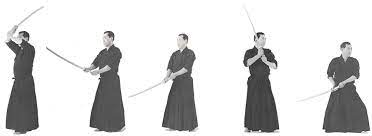
The kata is taken straight from Michael Finn's Kendo-no-Kata (1986). No deviations whatsoever, and the order is the same.


Part 6 Hojo Jutsu

'Demonstrate use of rope to tie up an opponent.'


This was an interesting grading, and an impractical grading. The techniques were taken from various sources and consisted of tying up a person in intricate ways. The impractical aspect was that the grading did not involve restraining uke before the tying up commenced. They just stood there. It was like a demonstration of wrapping a gift.

Next Post

The next post will discuss the final six parts to the sandan grading.


Monday, 11 March 2024

Answers to Questions on Nidan Grading Facebook Sharing Post

The following is a series of questions received on my Facebook post sharing the previous blog post on the nidan grading. I found the questions interesting and insightful, and the answers would be a useful contribution to the discussion concerning the development of the Jan de Jong (JDJ) jujutsu grading system.

I am genuinely curious. Were any jujutsu candidates ever required to open Happoken no kata by, after the rei, shifting into an open stance, as often seen in formal demonstrations of other karate kata?

From Jan de Jong: the man, his school and his ju jitsu system (1997): 'Happoken no Kata (Kate of Eight Fists) ... Open by stepping into  kiba-dachi with the left then right leg then punch both fists down in front stopping at hip level' (p. 53).

The opening to JDJ's 'version' of happoken no kata is not as elaborate as that in Yoseikan, which reflects JDJ's focus on the practical.  

And were any jujutsu candidates required to open and close their demonstrations of Kentai ichi no kata with formal, kneeling rei to pass their grading?

The linked post is to the kata being performed by two of Hans de Jong's (HDJ) yudansha. It shows the formal opening and closing of the kata in seiza.

And, not to be too contrarian, but in the spirit of adding information. I was told by JDJ that he would not teach a particular Yoseikan kata of changing techniques because "it set bad habits:" The kata consists of a lengthy series of "changes" in an unrealistic chain. He said that you might need to adjust your intentions once, but that expecting further chances was unrealistic. (Or, maybe more accurately, that's how I interpreted what he said.)

Not sure how the author of the above comment is being contrarian as their comment is in line with mine in the previous post where I stated that JDJ included a 'changing techniques' section in his nidan grading even though he was opposed to the teaching of changing techniques because it initially trained ineffective technique.

The particular Yoseikan kata to which the author refers is Hyori no Kata (form of front and back). See this link for video of the kata

The first time I saw this kata was in a copy of Minoru Mochizuki's book that I obtained from Jan-Erik Karlsson and shared with JDJ (see linked post). The next time was in a two-disk DVD, Yoseikan Sogo Budo by Mochizuki.

I initially found the hyori no kata very interesting, however, I quickly came to the same point of view as JDJ. Why train poor technique? 

Why not train changing techniques, like everyone else does. The rationale, as explained above, is that you initially train poor technique, however, the rationale is also a samurai/warrior approach to combat. Your defensive technique is fully committed, and if that doesn't work, your next defensive technique is fully committed. 100% all the time, every time.

I remember my first introduction to changing techniques and how they were in fashion. It was at a seminar in southern Germany in the late 1980s. I was part of a group of instructors that accompanied JDJ as he was teaching at that seminar. I was ikkyu at that stage. JDJ had not included any changing techniques in his grading system at that stage. Even then I didn't appreciate the methodology. I successfully applied the initial technique to which the other person could not defend against. He said, 'You're not supposed to do that. You're supposed to let me get out of it' (or words to that effect). Yeah, that's not the approach to combat that I had been taught.

And, if asked 'Why is the final sword technique in ken tai ichi no kata that was taught to you, which you graded, and which you now teach, result in a mutual slaying?' my answer would have to be 'It doesn't.' (1. the tenth technique certainly does not result in a mutual slaying. 2. Neither does the fifth technique "as I was taught it." For other readers and for some clarity, I agree with what John has previously said about the fifth technique performed the way he describes it. I did learn the kata, for the first time as a whole set rather than simple sword exercises, from JdJ as he was teaching John and Garth. The 'requirement' to enter directly when performing the fifth technique was not mentioned until several years later.

Don't quite understand what is being said there, however, the fifth sword technique in ken tai ichi no kata as JDJ taught (see above linked post), it was a downwards strike defended with specific instructions. The specific instructions were no evasive body-movement and tori's sword to never be raised higher than uke's neck. This results in a mutual slaying. This should be obvious even without observing the attack and defence.

JDJ was specific in his instructions, and he was right, at least in that regard. It's just that he misremembered the attack. The attack is a straight thrust, as I learned when acquiring the abovementioned Mochizuki videos. 

Watch the abovementioned HDJ yudansha ken tai ichi no kata with the technique in question on slow motion. How does tori avoid being slayed? Through the use of an evasive body-movement. This is how most of the instructors at the Jan de Jong Self Defence School performed the defence, even though JDJ was specific in his instructions - no evasive body-movement. The instructors did not teach the defence as including an evasive body-movement, even though they would employ an evasive body-movement when performing the defence or kata.

All just FWIW.

I am not familiar with this initialism.

Friday, 26 January 2024

The Development of the Jan de Jong Jujutsu Grading System Part 1.2: Historic Ikkyu Part 1: Basics and Current Nikyu Part 1: Kime no Kata

This post follows on from the post, Part 1: The Kyu System.

You will recall from that post that the original Jan de Jong (JDJ) grading system consisted of only the kyu grades, which was a one-off grading system when it was developed. Start to finish, nothing else to follow or precede. That is it! Done and dusted (in the voice of Al Pacino in The Heat).

The image to the right is of a historic grading sheet regarding the requirements of the ikkyu grade which the recipient of my gifting of historical records was kind enough to forward to me based on this series of posts.

In the above linked post, I argued that the ikkyu grading was an instructor grading. That argument is supported by the heading to the above historic grading sheet: Ikkyu (Kyoshi) Instructor. 

All those that attained ikkyu are instructors in JDJ's original grading system, and it could/should be argued that they are instructors under the current system which includes the dan grades. It could/should be argued that they should be referred to as sensei rather than sempai as they are now, given that that is how the ikkyu grading was developed.

Part 1: Basics in the above ikkyu grading requirements reflects the Yoseikan Budo (YB) influence introduced into the grading system, therefore, this grading was introduced post 1969 when JDJ trained for a short time at the YB dojo in Japan (also see below). 

At some stage, the ikkyu Part 1: Basics became nikyu Part 1: Kime no Kata. 

Kime no kata is referred to as 'revision' in JDJ's jujutsu grading system. So the ikkyu Part 1: Basics became a revision grading when it was moved to nikyu, but what is it revising? It is revising the YB inspired mon grades with the ikkyu Part 2: Kime no Kata in the above image being a true revision of the kyu grades. That grading requires the grading candidate to select defences from the kyu grades in the nominated sections in that gradings. 

All of the techniques in Part 1: Basics are YB techniques, including Itsutsu no Kata, Happoken, and Sambogeri. When ikkyu Part 1: Basics becomes nikyu Part 1: Kime no Kata, Happoken and Sambogeri were replaced by Wakai no Kata.

Happoken is a YB kata designed to teach striking and blocking skills.


Sambogeri is a YB kata/exercise designed to teach kicking skills (see image right from Mochizuki's book). In future posts, I will be suggesting that Sambogeri and derivations thereof be introduced into the mon grades to improve the kicking skills of JDJ jujutsuka, which are generally substandard unless the student trained in a percussion based martial art.

Wakai no Kata is a kata that JDJ developed to teach striking, blocking, and kicking skills, along with different stances. Wakai no Kata will be the subject of a future post when exploring the mon system. In that post I will explain why it tends to be poorly performed in the JDJ tradition, even by the majority of instructors.

The abovementioned generous provider of the historic grading sheets also commented:

After doing the nikyu revision, Greg Palmer came up to me and said "you have me to thank for that grading". The Boss has tasked him with developing an assessment for those who hadn't done the mons. Further cementing the case for Greg to have been a yondan on completion of sandan.

I argued in the first post of this series that Greg Palmer was the best teacher at the school because he was a trained and qualified teacher, and I don't mean in a martial arts system which is basically amateurish. I was unaware that Greg developed this grading, however, it makes sense because it is a coherent introduction, not revision as suggested above, to the YB system that forms the basis of the mon grades.

With regards to Greg and the awarding of yondan upon completion of the 'technical' grades in the JDJ jujutsu grading system. I would go further than the above commentor and argue that Greg was entitled to be graded rokudan along with the anointed trio

Greg's contribution to the grading system far exceeded that of any of the trio, including introducing JDJ to a mindset of progressive gradings. It is generally acknowledged that his understanding of techniques and how to teach them exceeded that of the trio. He also selflessly taught for JDJ for nearly 40 years with no remuneration, unlike two of the trio. He was also the first and only to have established a branch outside the metropolitan area for JDJ.

You will recall in a previous post that I shared an insight that I had gained through studying the development of the JDJ jujutsu grading system, and that is that the instructors teaching the mon grades may not have actually gone through the mon grades. The above comment would appear to confirm that.

In that case, the nikyu revision, as the above provider described it, was not a revision grading for those that did not go through the mon system. It is an introduction to the mon system. It features the YB division of a defence into phases: taisabaki, kuzushi, waza (body-movement, unbalancing, technique). It features the five basic YB taisabaki, their basic kuzushi from hand grips, and their nine basic kansetsu waza (joint-locking techniques) as waza

Did the instructors who did not go through the mon system understand that these were phases in a defence? Did JDJ? This might explain some/many of the issues that I have and will be raising in connection with the mon grades and the teaching thereof.


Monday, 8 January 2024

The Development of the JDJ Jujutsu Grading System Part 3.2: 1st Mon

As Maria says in The Sound of Music, let's start at the very beginning, a very good place to start. The beginning, now, in Jan de Jong's (JDJ) jujutsu grading system is 1st mon.

The first grading in the mon system is a good place to start because it reveals/raises some of the issues associated with the mon grades.

You will recall from the previous chapter that the age requirement for 1st mon is under 12 years. It is the first grading for new students aged five and six years old.

The following is the grading reproduced in Jan de Jong: The Man, His School and His Ju Jitsu System (Jan de Jong Self Defence School, 1995):


1ST MON: YELLOW AND WHITE BELT

Breakfalls (Ukemi)

Forwards roll

Backwards roll

Body Movements (Taisabaki)

Flowing

Entering

Basic Blocks and Attacks (Uke and Atemi)

Punch - with kick

Front snap kick

Unbalancing (Kuzushi)

Normal single wrist grip - Normal unbalancing

Locking Techniques (Kansetsu Waza)

Two attackers

Top strike - Wrist twist

Low punch - Wrist twist

The use of Japanese terminology can be seen coming into play in the very first grading, which is part of the reason why there is a terminology grading in ikkyu and shodan. JDJ introduced the use of Japanese terminology, as he explained, so that his students could understand the use of it in texts about Japanese martial arts that use Japanese terminology. JDJ being an avid collector and reader of martial arts texts, and which were a great source of his continuous professional development as previously explained.

You will recall from the previous post, the advice in Gary Carr's Sports Mechanics for Coaches to divide the skill into phases and the reasons why to do so. This grading, and the following mon grades, reflect that advice.

Yoseikan Budo (YB) divides their defences into the following phases: taisabaki, kuzushi, waza (body-movement, unbalancing, technique). You can see that this grading, and all of the mon grades, is based on the YB defence phase division. The specific elements in those sections are also taken from YB (see below).

The idea of the division of skills into phases by Minoru Mochizuki, founder of YB, was probably taken from Jigoro Kano, founder of Kodokan Judo (KJ), Mochizuki being an acolyte of Kano's. 

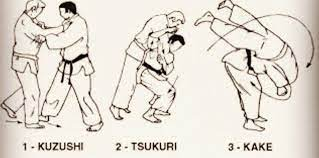
Kano divided his throwing techniques into the follow phases: kuzushi, tsukuri, kake (unbalancing, fitting-in, execution). 


When including the comments of various judo masters in Judo Formal Techniques: A Complete Guide to Kodokan Randori no Kata, T. Otaki and D.F. Draeger (1983), some recognise taisabaki but are not sure where to put it into Kano's division of phases in throwing techniques.

Otaki and Draeger also suggest that grappling include a comparable set of components. Grappling meaning those techniques that end with joint-locking techniques (kansetsu waza).

One of the things that sets KJ apart is Kano's teachings, which involves the division of judo skills into phases. This conceptualisation of techniques and the teaching thereof is relatively unique in the martial arts. This unique conceptualisation and teaching of martial arts techniques was probably due to Kano being a professional teacher. Mochizuki, being an acolyte of Kano's, adopted the same approach when developing his YB.

An issue that arises within the mon grades is that this systems approach, this division of a defence/technique into phases, does not appear to have been fully understood by JDJ and the senior instructors at the Jan de Jong Self Defence School (JDJSDS).

With the senior instructors, a part of the problem might have been that they did not go through the mon system. They are products of the original kyu system, which is a totally different system, in that the mon system is based on systems thinking and the kyu system is based on 'tricks.'

Taisabaki (Body-Movements)

 Flowing (nagashi): the following image of nagashi is taken from Mochizuki's book(Giho Nihonden Jujutsu (Traditional Japanese Jujutsu)).


I was going to make a point about how JDJ had the right idea drawn from YB but his execution was flawed, and then I went and got the above image from Mochizuki's book to include in this post. As it turns out, the demonstration of nagashi in this grading is similar to the YB demonstration and so my point was not made.

I thought I had mentioned it in another (previous) post, but I cannot find any such mention. Some/many of the issues associated with the mon grades come to light when attempting to write a book based on or about JDJ's grading system, or producing videos of the requirements of the grading system to aid those engaged in the grading system. I have been involved in both processes.

You will recall the Tsutsumi and Higashi book discussed in a previous post. All of the defences/techniques in that book are referred to as 'tricks.' They are described/explained in full, wholly independent of all other defences/techniques. They are described/explained in terms that do not refer to any similarities or differences (the core of all learning) with other defences/techniques. But what happens when there are commonalities in defences/techniques? At the very least, it is inefficient to have to describe/explain the same thing over and over again.

When adopting a systems approach, such as that adopted by YB, it is more efficient to describe/explain the common elements once and then refer to that description/explanation. A glossary, if you will. Whenever nagashi is used in a defence/technique, it would be more efficient to refer to the one defining example of nagashi, a 'protypical' example of nagashi in this case. Even when the nagashi is different in another defence/technique, it is still more efficient to refer to the one prototyical example and then refer to the differences, e.g., it is the same except that ...  

The problem here is that the nagashi is demonstrated as a defence in-and-of itself (see image above). It is not a demonstration of the prototypical nagashi that forms part of many other defences/techniques in the YB system. This is an example of teaching 'tricks' rather than teaching a 'system' of defences/techniques. This is an example of not understanding that demonstrating taisabaki (and kuzushi) is not demonstrating a defence.

The same is true of entering (irimi) in this grading.


The taisabaki is part of the taisabaki-kuzushi-waza phase division of defences/techniques (see above). These taisabaki are used time and time again in defences. Imagine making videos of the elements in the grading system. Would it not be smart/efficient,to provide a glossary of these common elements in their prototypical form that could be explained in detail once rather than doing so with each and every defence where they are present? If not a glossary, than when they are demonstrated in the mon grades. 

Kuzushi (Unbalancing)

The second phase in the YB division of techniques after taisabaki is kuzushi (unbalancing). 

The demonstration of unbalancing in the mon grades is done from hand grips. There are four basic unbalancings from four basic handgrips, however, there is an element of confusion as they are referred to by the same name. 

Jun katate dori (normal single handgrip), dosoku katate dori (same side single handgrip), gyaku katate dori (reverse single handgrip), and ushiro ryote dori (rear both hands handgrip). The prototypical unbalancings are jun kuzushi (normal unbalancing) from jun katate dori, dosoku kuzushi (same side unbalancing) from dosoku katate dori, gyaku kuzushi (reverse unbalancing) from gyaku katate dori, and ushiro kuzushi (rear unbalancing) from ushiro ryote dori.

There are variations of these basic unbalancings as examined in the kime no kata grading in the nikyu grading.    

In his later years, JDJ taught these forms of unbalancing using a kuzushi-hazushi dichotomy. The basic idea was the kuzushi type was where uke held on whereas the hazushi (disengagement, release) was where the hold was disengaged. 

This kuzushi-hazushi dichotomy was used in relation to the nine basic kansetsu waza (joint-locking techniques). Kuzushi involved the elbow being turned upwards during the unbalancing which facilitated ude kujuki (arm breaking), tekubi hishigi (wrist crush), and yoko tekubi hishigi (side wrist lock). The hazushi variant involved the elbow being turned during the unbalancing facilitating the other six basic kansetsu waza to be executed. The kuzushi and hazushi variations could be used with any of the abovementioned basic handgrips and was demonstrated and taught as such.

But here again, this element in this grading is taught and demonstrated as a defence in-and-of itself. Taught and demonstrated as a 'trick' and not as a prototypical example of a technique used in multiple defences/techniques.

Kansetsu Waza (Locking Techniques)

Given that it's just after Xmas, I'll refer to Love Actually and Rufus (Rowan Atkincson) when wrapping the present for the cheating Harry (Alan Rickman): 'Oh, this isn't a bag sir. This is so much more than a bag.'  

The final element in the YB phase division of defences is waza (taisbaki, kuzushi, waza). This section of the grading ostensibly examines a particular type of waza, kansetsu waza (joint-locking techniques), but it examines so much more than the kansetsu waza.

The following is from an interview with Hans de Jong (HDJ) published in the Blitz magazine:

While people tend to focus on techniques, tactics are also an important part of jujutsu training. Without employing the correct tactics, there's often no opportunity to use the techniques successfully, at least. Our very first grading involves dealing with two attackers, who attack one by one in quick succession, or simultaneously. The student is not only examined on technique, but how they are able to avoid the second attacker while dealing with the first. So how the body movement is used and how the attacker is placed in front of the other is looked at during the grading ...

HDJ's explanation of this format in the mon grades is an accurate explanation of its use in the JDJSDS. This is how the instructors described this section in the mon grades. But really????

A five or six year old, in their very first grading, and they are going to be assessed on their tactical abilities in relation to two attackers. Really?

This is JDJ's attempt at introducing randori into his grading system.

Randori is a term used in various martial arts, particularly in disciplines like Judo and Aikido. It refers to a training exercise where a person or a group of people face multiple opponents in a relatively free-form manner. The word 'randori' is of Japanese origin, where 'ran' means chaos or disorder, and 'dori' means taking or grasping.

Without going into a detailed discourse on the concept of randori, it is a form of stress training. The kyu grades employ shinken shobu no kata as the form of stress training with no demonstration of techniques under non-stress conditions. JDJ became aware of randori as a form of training/stress training and given that shinken shobu no kata was used in the kyu grades, he included this form of training in the mon grades without any real understanding of this form of training.

What do you think is more stressful, more reminiscent of 'real' fighting: two attackers in a free-form manner or shinken shobu no kata? If the former, why include the more 'stressful' form of training for beginners then ease off for the adult kyu and dan grades?

In terms of progression, where is the one attacker free-form training before jumping to two attackers?

How would you go about developing this grading (and the other mon grades) based on this analysis and the fact that it is based on the taisabaki, kuzushi, waza phase division approach? You would include a demonstration of the taisabaki, and then the kuzushi, and then the waza, separately. You would then include a demonstration of the three phases put together, and then, and only then, you might include a stress element.

Not only is this section flawed because of the absurdity of the two attackers and its purpose, the defence involving the wrist twist from a top strike and a low punch involve irimi senkai (entering rotation) taisabaki and a 'grabbing block' (see future post on blocks) as a form of unbalancing used in conjunction with the body-movement, both of which are not demonstrated in the taisabaki and kuzushi sections.

If a five- or six-year-old grading candidate is struggling with this section of the grading, is it because of the stress element or is it because they cannot perform the wrist twist? Taking the grading as it is, we don't even know if the student can perform a wrist twist technique.

When I asked what was supposed to be taught and examined in this section of the grading, the answer by the senior instructors was the same as HDJ's explanation above. I ignored that instruction. Even way back when, I recognised it was a nonsense. All I wanted to see from the five- and six-year-old grading candidates was that they could perform the kansetsu waza, wrist twist. The same was true of the taisabaki and kuzushi techniques. All I wanted to see is if they could perform those techniques and not if they could perform a defence involving some variant of those techniques.


Saturday, 30 December 2023

The Development of the JDJ Jujutsu Grading System Part 2.5: Shodan (Part 4.3: Ken Tai Ichi no Kata)

This post looks at the individual attack-defence sequences in ken tai ichi no kata taught by Jan de Jong (JDJ).

From the post 'Part 2.3: Shodan 4.1 Ken Tai Ichi no Kata': 

The JDJ jujutsu grading sheet reads:

1. Yoko Tekubi Hishigi: Tori – Seigan Kamae, Uke – Seigan Kamae
2. Ude Kujiki: Tori – Seigan Kamae, Uke – Gedan Kamae
3. Tekubi Te Nage: Tori – Seigan Kamae – Gedan Kamae, Uke – Jodan Kamae
4. Ude Hiji Nage: Tori – Hasso Kamae, Uke – Hasso Kamae
5. Ura Tai Otoshi: Tori – Gedan Kamae, Uke – Gedan Kamae

The first phrase represents the unarmed technique that is being demonstrated. The tori and uke kamae description refer to the ‘combat engagement posture’ (see Donn Dreager) for the sword attack-defence sequence.


An example of the JDJ kata was posted on YouTube by the Hans de Jong Self Defence School (HDJSDS), a JDJ ryuha.

We saw in the post titled ‘Ken Tai Ichi no Kata Example’ that ken tai ichi no kata is a Yoseikan Budo (YB) kata. An example of the YB kata was posted on YouTube as part of a larger video taken from the Yoseikan Sogo Budo DVD set by Minoru Mochizuki, the founder of YB. The ken tai ichi no kata is located at the 22:40 mark in the aforementioned YouTube video. 

The order between the JDJ and YB kata is different as reconciled in this post.

The YB kata consists of five sword v. sword, five unarmed v. sword, and five unarmed v. unarmed attack-defence sequences. The subtitles on that video refer to these sequences as ken (sword) and tai (unarmed), thus: ken-ken, tai-ken, and tai-tai. Those are the terms that will be used in this post.

JDJ did not include the tai-ken sequence in his ken tai ichi no kata. The reasoning behind that omission was explored in this post.

The following commentary will be initially based on the HDJSDS Jan de Jong Self Defence School (JDJSDS) representative video (see above). 

The core of all learning - the identification of similarities and differences - will be used in order to provide insights that can lead to a new and better understanding through asking, 'What's going on here?' (see Klein).

Nomenclature
The first thing to note is that JDJ sometimes uses a different nomenclature than that commonly used in the Japanese martial arts. For instance, most use kote to refer to wrist whereas JDJ uses tekubi. JDJ's tekubi te nage (wrist hand throw) is more commonly known as shiho nage (four corner throw) in aikido. What's going on here? Exploring why JDJ uses different nomenclature is another anomaly and a potential rabbit hole that I am going to avoid at this time.

1. Yoko Tekubi Hishigi (Side Wrist Crush): Tori – Seigan Kamae, Uke – Seigan Kamae
Tori
assumes seigan kamae, which a previous post explained is a totally defensive posture. This means that uke has to either move tori's sword off-line in order to attack down the line or to move off the line to attack in order to attack. In this case, uke moves tori's sword off the line in order to attack down the line. This is a tactical lesson that if generally not shared/taught. Why not?

This kata is generally learned and taught solely as a requirement of the shodan grading. It is not used as a teaching-learning tool for broader insights and understanding. Nobody studies this kata (other than me) other than in relation to satisfying a performance requirement in the shodan grading. It will be seen through the following analysis that a great deal can be learned from the study of this kata, which includes the flaws in the kata.


Tai-tai
- the technique is called kote kudaki (wrist crush) in the YB video. The attack is a wrist grab which is then countered, recountered, and countered again. Back, forward, back, forward ... JDJ's yoko tekubi hishigi (side wrist lock) is applied more directly without the toing and froing. Was this a deliberate change by JDJ to make the tai-tai technique more efficient and effective/practical?

The JDJ technique involves an initial unbalancing (kuzushi) move; one that is actually taught in YB. Giving tori the benefit of the doubt in the HDJSDS video in terms of unbalancing uke before applying the technique, the unbalancing is different to the ken-ken technique. With the ken-ken technique, there is a deflection of the sword, however, with the tai-tai technique, there is a physical unbalancing of uke which is unavailable in ken-ken. Rather than attempting to demonstrate the similarities between sword and unarmed techniques, would a more complete understanding of tactics and techniques be provided by identifying the similarities and differences between sword and unarmed techniques? 

2. Ude Kujiki (Arm Crush/Breaking): Tori – Seigan Kamae, Uke – Gedan Kamae
The HDJSDS video reflects the tori ken kamae as described above, which is as per the grading sheet, however, we saw in a previous post that (a) the grading sheet was not complete, and (b) uke would not advance on a ken seigan kamae without deflecting the sword first. At the very least, the instructor and the candidates should have said, 'That can't be right,' which is Klein's operationalisation of the contradiction path to gaining insight. The candidates might justify their performance in terms of doing what they've been taught, even if they question such teachings, however, that does not excuse the instructor's lack of understanding. This situation was also present in the JDJSDS at times, e.g., the JDJ misremembering the attack in the final ken-ken sequence discussed in a previous post dedicated to that issue.

The ken defence involves an evasive body-movement (EBM) and a 'brushing block' in the JDJ and YB demonstrations. What is the purpose of the brushing block? It's not to avoid injurious contact with the body because the EBM takes care of that problem. Why not just use an EBM and a strike? This is an issue that appears time and time again, in JDJ techniques and that of other jujutsu schools and martial arts. Sometimes there are answers, sometimes there are reasons, but more often than not there is shoehorning.

This issue will be explored more thoroughly, including the concept of 'blocks', in a future post when discussing the mon system.

A final comment. Tori finishes the defensive performance with a dramatic flourish of the sword. JDJ would, quite rightly, not approve. Tori is training to miss the target. With enough training, they will become expert at ... missing the target. This is an issue that is reflected in weapon attacks within the JDJSDS and the JDJ ryuha. A poor weapon attack affects the distancing and thus the student is training poor distancing that will negatively affect the effectiveness of the defence against a real attack.

Think of the sword training scenes in The Last Samurai were Ujio and Cpt Algren finish with their bokkens placed on each other's necks when they draw in their contest.

3. Tekubi Te Nage: Tori – Seigan Kamae – Gedan Kamae, Uke – Jodan Kamae
JDJ's tekubi te nage is aikido's shiho nage

In the YB ken-ken and tai-tai sequences, tori move to the inside of uke. In the HDJSDS/JDJSDS tai-tai sequence, tori move to the inside of uke but in the ken-ken sequence they move to the outside of uke. 'What's going on here?'

The YB sequences demonstrate the similarities between the armed and unarmed techniques by moving the same way. What is the JDJ sequence demonstrating?

Did JDJ deliberately change the ken-ken sequence? If so, why? Maybe it was a tactical decision. Maybe he considered tori moving to the inside and turning their back on uke was not tactically the best move and thus changed to moving on the outside instead. But doesn't that negate the similarities demonstration purpose of the kata?

Is there a need to change the ken-ken sequence back to the original? Or should we, instead of focusing on similarities, also be considering differences. Differences between ken and tai techniques. Differences between JDJ and YB techniques. Not just identifying the differences but exploring possible explanations for those differences. Exploring answers to the 'What's going on here?' question that may give rise to insights that provide a new and better understanding.

Btw, I identified this difference when I was being taught the kata for my grading and raised the issue with my instructors, the senior instructors in the JDJSDS. I received no answers, and so I did what I was taught for the sole purpose of passing the grading.

The same issue regarding the dramatic flourish with the sword when finishing the technique in the HDJSDS video is present in this demonstration. It's training to miss the target.

Finish Here
I'll finish here as to complete a full analysis would entail an even lengthier post where a lot of the same ideas emerge. Many of the same issues arise in the analysis of the remaining two sequences. 

For instance, in the final sequence, there was an error in the teaching of the ken-ken sequence that was discussed in this post. There is also a difference in the tai-tai sequence between (a) the HDJSDS/JDJSDS and YB tai-tai technique, and (b) the ken-ken and tai-tai techniques in the JDJ demonstration.

The effectiveness of the YB tai-tai technique is questionable. The technique should probably cause uke's back to arch 'limbo' style as tori's hand is driven down and behind tori thus lifting uke's head with the crook of their elbow. JDJ would have no 'truck' with that technique. 

For JDJ, there was only one way to perform mukae daoshi (known in aikido as irimi nage), and that was for tori to project their hand-arm upward, never downward. What this means is that JDJ's mukae daoshi relies 100% on the momentum of uke, which is facilitated by tori's unbalancing technique. The unbalancing is around the corner in the tai-tai case for this technique but is not required in the ken-ken case. 

Through the above analysis, the reader should now be able analyse the kata using the identification of similarities and differences as the base of that analysis. They should also be encouraged to question teachings when 'What's going on here?' or 'That can't be right' reactions are experienced, if they are experienced that is. The reader should now be aware of the tendencies to shoehorn answers when possessing no insights and real understanding of their own. 

What to Do?
What should be done? Should the JDJ kata be changed to reflect the original YB kata? Should the errors in the JDJ and YB kata be corrected? Should the kata be eliminated from the grading system as it seems to serve no useful function*? After all, JDJ's grading system is overly burdensome and overly cumbersome as has previously been explained. Would the student be better or worse off if the kata was not included in the grading system?

Here's the thing though. If the errors are eliminated; if the differences are eliminated; then so is the opportunity of gaining insights and a new and better understanding. There are numerous lessons that a study of the JDJ kata can teach, but the most important lessons are in the apparent faults and flaws, the differences. Those differences include those between different interpretations, different martial arts of the same genre, and different martial arts.
_______________________________________

*In a previous post, I speculated over the purpose of JDJ's inclusion of this kata in his shodan grading. One of the reasons may have been/probably was to be able to demonstrate some weapon techniques when teaching in Europe. You will recall that the sole purpose for developing the shodan grading was so that JDJ could have black belt instructors accompany him on his teaching tours in Europe.

JDJ shared with me that there were no, or very little, weapon techniques being taught in jujutsu in Europe before he began teaching in Europe. After that, there started to appear more and more weapon techniques being taught, particularly in World Ju Jitsu Federation affiliated schools as it was those schools that he primarily taught for.

Marketing 101 - differentiate the product. Everyone taught a hip throw, but nobody taught sword techniques. Jujutsu is supposed to be the product of the samurai, whose primary weapon was the sword. The link to the past, the link to the warrior tradition were sword techniques. And there was the supposed lesson of demonstrating the similarities between sword and unarmed techniques in these warrior arts, suggesting a deriving origin of the unarmed techniques. As a marketing tool, it was genius as the target audience had not been exposed to YB. 
    

Friday, 22 December 2023

The Development of the JDJ Jujutsu Grading System Part 2.4: Shodan (Part 4.2: Ken Tai Ichi no Kata)

The post before last looked at Part 4 of the Jan de Jong (JDJ) jujutsu shodan grading. That Part includes suwari waza no kata and ken tai ichi no kata. The aforementioned post looked at suwari waza no kata (which is part of Kodokan Judo’s kime no kata). The previous post began looking at ken tai ichi no kata. That post focused on the purpose of the kata and kata in general in JDJ’s jujutsu grading system. This post begins to look at the specific attack-defence sequences in the kata and the lessons that can be learned from their study.

Background
‘Previously’ ...

The name ken tai ichi no kata has been translated as, ‘form of sword and body as one.’

The description of this kata in Jan de Jong: The man, his school, and his ju jitsu system is: ‘Demonstration of katana and the unarmed applications’ (Jan de Jong Self Defence School, 1997, p. 50).

The kata as taught within the JDJ jujutsu shodan grading consists of five sword v. sword and five unarmed v. unarmed attack-defence sequences.

The grading sheet reads:

1. Yoko Tekubi Hishigi: Tori – Seigan Kamae, Uke – Seigan Kamae
2. Ude Kujiki: Tori – Seigan Kamae, Uke – Gedan Kamae
3. Tekubi Te Nage: Tori – Seigan Kamae – Gedan Kamae, Uke – Jodan Kamae
4. Ude Hiji Nage: Tori – Hasso Kamae, Uke – Hasso Kamae
5. Ura Tai Otoshi: Tori – Gedan Kamae, Uke – Gedan Kamae

The first phrase represents the unarmed technique that is being demonstrated. The tori and uke kamae description refer to the ‘combat engagement posture’ (see Donn Dreager) for the sword attack-defence sequence.


An example of the JDJ kata was posted on YouTube by the Hans de Jong Self Defence School (HDJSDS), a JDJ ryuha.

We saw in the post titled ‘Ken Tai Ichi no Kata Example’ that ken tai ichi no kata is a Yoseikan Budo (YB) kata. An example of the YB kata was posted on YouTube as part of a larger video taken from the Yoseikan Sogo Budo DVD set by Minoru Mochizuki, the founder of YB. The ken tai ichi no kata is located at the 22:40 mark in the aforementioned YouTube video.

The YB kata consists of five sword v. sword, five unarmed v. sword, and five unarmed v. unarmed attack-defence sequences. The subtitles on that video refer to these sequences as ken (sword) and tai (unarmed), thus: ken-ken, tai-ken, and tai-tai. Those are the terms that will be used in this post.

JDJ did not include the tai-ken sequence in his ken tai ichi no kata (see above). Interestingly, when looking for video examples to assist the readers of this post, I came across a YouTube video of Mochizuki demonstrating this kata in which he also does not include the tai-ken sequence. 'What's going on here?'

‘What’s going on here?’ is how cognitive psychologist Gary Klein operationalises the curiosity path to gaining insight that can lead to a new and better understanding. It is a new understanding because it did not exist before, and it is a better understanding because it is more accurate, more comprehensive, and more useful than the one that existed before.

The ‘What’s going on here?’ reaction does not contain the insight, but it can start the person on the road to gaining the insight if they go looking for an answer to their question. This can never happen if teachings are never questioned.

JDJ had a different attack-defence order to that of the kata demonstrated in the YB videos:

JDJ's #1 = YB's #2
JDJ's #2 = YB's #1
JDJ's #3 = YB's #5
JDJ's #4 = YB's #4
JDJ's #5 = YB's #3

This ordering is provided for those that want to visually compare like-with-like as I discuss the kata in JDJ's system and that of YB.

Core of All Learning
In Classroom Instruction That Works: Research Based Strategies for Increasing Student Achievement, Marzano, Pickering, and Pollock (2001) explain that the ‘core of all learning’ is the identification of similarities and differences. They go on to explain that the four proven highly effective ways of identifying similarities and differences are classification, comparison, creating metaphors, and creating analogies. I devote a chapter in my book on the science behind all fighting techniques to this subject providing examples within the martial arts of the use of these ways of identifying similarities and differences to teach techniques.

Identifying similarities and differences provides the opportunity for gaining insights that can lead to a new and better understanding (see above). It behoves all teachers and learners to understand and apply this concept. Teachers will be better teachers and learners will be better learners, in addition, learners will not be as reliant on their teachers being good teachers.

The core of all learning – the identification of similarities and differences – will be used here when studying the ken tai ichi no kata attack-defence sequences and which can provide insights that lead to a new and better understanding not only of the kata itself but of principles in general.

Comparing Tori Kamae
‘What is the difference between the kamae of tori in the first ken-ken defence and that of the other four?’ That is a question that I posed/pose to those learning this kata.

Answer: the tori kamae in the first ken-ken defence is seigan no kamae (see image below) which is totally defensive. The tip of the blade is pointed at uke’s throat or eyes and if uke attacks straight down the line they will be impaled on tori’s sword if tori does not move.


In the other four kamae of tori, they are not seigan no kamae and invite an attack. It is a genuine invitation as tori is providing a genuine opening, however, they are also setting up with an attacking kamae of their own. If uke is good enough, their attack may prove successful as the opening is a genuine opening.

This comparison (identification of similarities and differences) provides a strategic lesson which is not forthcoming for those that simply train what they are taught without question in order to pass a grading. Ditto for those that teach what they are taught without question because it is part of the curriculum. No, or very little, insight is achieved in those circumstances.

Tori Kamae #2
Another path to insight is contradictions. Klein explains that, ‘Contradictions are different from curiosity insights. Curiosities make us wonder what’s going on, whereas contradictions make us doubt— "That can’t be right."' (2013, p.61).

When researching this post and attending to the detail, I noticed that the JDJ grading sheet for the ken tai ichi no kata grading included seigan no kamae for both #1 and #2 ken-ken sequences. ‘That can’t be right.’ It isn’t.

I studied the Jan de Jong Self Defence School (JDJSDS) representative HDJSDS video (see above) and found that tori in that video did in fact assume seigan no kamae and uke attacked down the line thus risking being impaled on tori’s sword if tori did not execute a block/deflection or an evasive body-movement (see future post about the 'dog's breakfast' that is the blocking sections in the mon gradings). ‘That can’t be right.’ It isn’t.

I studied the YB video and found that tori assumed seigan no kamae before lowering to gedan no kamae to invite at overhead attack. That is how it was taught in the JDJSDS, although that is not how it is described on the grading sheet.

While misremembering an attack can be forgiven (also see JDJ misremembering the attack for the final ken-ken sequence). While not providing an accurate description on the grading sheet can be forgiven. While being misled by an incomplete instruction on the grading sheet can be forgiven. What cannot be forgiven is the teaching and/or performing techniques, defence and/or attack, that are clearly flawed. It shows an astonishing lack of understanding ... or indifference.

Insight Applied
The insight gained from the above analysis applies to the te nage defence from ryo te dori in the shinken shobu no kata grading in shodan (JDJ misinterpreted/did not understand the aikido/YB technique). It applies to the irimi uke, te gatame ude kujuki defence from jodan tsuki in the 5th kyu grading (see previous). It applies to the oshi otoshi technique in the taoshi waza no kata grading in sandan (JDJ did not understand the YB technique taken from a single hand-drawn image from Mochizuki's book; see future post re sandan grading). It applies to the belt drop, back fist defence from rear body-hold over elbows in the HDJSDS shinken shobu no kata grading in their shodan (misremembered the attack taught in the JDJ grading).    

Next Post
These posts are long; longer than intended. I will be trying to break them up into more 'bitesize' portions. The next post(s) will commence analysing each of the individual attack-defence and which will include a comparison with those taught by YB from whence they were appropriated.

PS: It would appear that this is part of my JDJ martial arts legacy. I doubt that I'll ever teach again, so, I am sharing some of my unique insights and understanding through these posts. 

Thursday, 21 December 2023

The Development of the JDJ Jujutsu Grading System Part 2.3: Shodan (Part 4.1: Ken Tai Ichi no Kata)

The previous post looked at Part 4 of the Jan de Jong (JDJ) jujutsu shodan grading. That part includes suwari waza no kata and ken tai ichi no kata. The previous post looked at suwari waza no kata (which is part of Kodokan Judo’s kime no kata). This post looks at ken tai ichi no kata.

The name ken tai ichi no kata has been translated as, ‘form of sword and body as one.’

The description of this kata in Jan de Jong: The man, his school, and his ju jitsu system is: ‘Demonstration of katana and the unarmed applications’ (Jan de Jong Self Defence School, 1997, p. 50). 

This kata as taught within the JDJ jujutsu shodan grading consists of five sword v. sword and five unarmed v. unarmed attack-defence sequences.                                                                  

The grading sheet reads:

1. Yoko Tekubi Hishigi: Tori – Seigan Kamae, Uke – Seigan Kamae

2. Ude Kujiki: Tori – Seigan Kamae, Uke – Gedan Kamae

3. Tekubi Te Nage: Tori – Seigan Kamae – Gedan Kamae, Uke – Jodan Kamae

4. Ude Hiji Nage: Tori – Hasso Kamae, Uke – Hasso Kamae

5. Ura Tai Otoshi: Tori – Gedan Kamae, Uke – Gedan Kamae

The first phrase represents the unarmed technique that is being demonstrated. The tori and uke kamae description refer to the ‘combat engagement posture’ (see Donn Dreager) for the sword attack-defence sequence.


Video Examples

An example of the JDJ kata was posted on YouTube by the Hans de Jong Self Defence School, a JDJ ryuha.

We saw in the post titled ‘Ken Tai Ichi no Kata Example’ that ken tai ichi no kata is a Yoseikan Budo (YB) kata. An example of the YB kata was posted on YouTube as part of a larger video taken from the Yoseikan Sogo Budo DVD set by Minoru Mochizuki, the founder of YB. 

The acquisition of these two DVDs by myself was the second step in my developing an understanding of just how much of JDJ’s jujutsu and aikido teachings were taken from YB. 

The ken tai ichi no kata is located at the 22:40 mark in the abovementioned YouTube video. 

The YB kata consists of five sword v. sword, five unarmed v. sword, and five unarmed v. unarmed attack-defence sequences. 

JDJ did not include the unarmed v. sword attack-defence sequence in his ken tai ichi no kata (see above). Interestingly, when looking for video examples to assist the readers of this post, I came across a YouTube video of Mochizuki demonstrating this kata in which he does not include the unarmed v. sword attack-defence sequence. 'What's going on here?'

Attack-Defence Order

JDJ had a different attack-defence order to that of the kata demonstrated in the YB videos:

JDJ's #1 = YB's #2

JDJ's #2 = YB's #1

JDJ's #3 = YB's #5

JDJ's #4 = YB's #4

JDJ's #5 = YB's #3

This ordering is provided for those that want to visually compare like-with-like as I discuss the kata in JDJ's system and that of YB.

Purpose

What is the purpose of this kata? What are the lessons to be learned from this kata? What benefits are the students supposed to derive from learning this kata, other than progression in the grading system?

I suggested in a previous post, based on what my instructors told me, that it was to demonstrate the similarities between sword and unarmed techniques. Why? What is the point?

A comment that I received to a post on Facebook that provided a link to my latest blog posts suggested that the three different parts of the YB kata represent kenjutsu, jujutsu, aikido: kenjutsu – sword v. sword, jujutsu – unarmed v. sword, and aikido – unarmed v. unarmed. Now that is a very interesting proposition, and one that I had never heard before.

The commentary on the above linked YB ken tai ichi no kata video explains that: 

The founder of Aikido Ueshiba, used to tell his followers that the principles of Aiki-jutsu came from those of Kenjutsu. But how the techniques were modified from Ken (saber) to Tai (empty hand) is not known precisely. ... Mochizuki acquired Kendo and Koryu-kenpo before learning Aiki-jutsu therefore he could figure out the technical relations between Kenjutsu and Taijutsu (Jujutsu). These kata represent his completed work out of many years of training and simple techniques that define the transition process from Ken to Tai. 

Ken tai ichi no kata in this instance would appear to suggest that Mochizuki is attempting to demonstrate the evolution from ken-ken to tai-tai, kenjutsu to aikido, and that he found the missing link: tai-ken, jujutsu.

Why would JDJ not include the 'missing link', jujutsu, in his ken tai ichi no kata in his jujutsu shodan grading?

Then, of course, the abovementioned premise has to be questioned. Did the principles of aiki-jutsu come from those of kenjutsu, or is it some attempt to link the tai with the samurai ken for some sense of superiority and credibility? And what does that have to do with JDJ's jujutsu?

Even if it is meaningless, the argument might be made that the kata is included in YB due to tradition because Mochizuki developed and taught the kata, however, can the same argument be made for the jujutsu taught by JDJ?

Eliminating Tai v. Ken

There are some possible reasons that might explain why JDJ eliminated the tai v. ken element of this kata

JDJ was above all else, for the most part*, a practical man. He was all about practical, effective techniques, for the most part*. When you see the tai v. ken element demonstrated in the above YB video, the kamae (tenchi no kamae (Guard of Heaven and Earth)) assumed by tori is, well, to be diplomatic, it does not look good. It doesn't look good and is clearly impractical in defending against an opponent armed with a sword. To the best of my knowledge, this kamae is only assumed in this kata in YB teachings and is not assumed anywhere else, even against other weapons. Would any instructor in the JDJ or YB tradition teach a practitioner to assume that kamae against an opponent armed with a sword or any other weapon, or even unarmed? If not, what is the point in teaching it?

Another Facebook comment suggested that the tai v. ken element was included in the kata in the JDJ aikido grading system. If so, why would he not include it in the kata in his jujutsu shodan grading? Was it because he was looking to make his aikido look more Yoseikan? Was it because he was just trying to populate his shodan grading given that the ikkyu grading was designed as a one-off, ultimate, instructor's grading?

A Facebook comment that was received, but which unfortunately I cannot locate, was that JDJ explained to a highly ranked aikidoka in his school that the original YB kata which included the three phases took two hours to perform. JDJ was more action oriented (not very patient) and may not have included the tai v. ken attack-defence sequence in order to reduce the time spent performing, and grading, the entire YB kata.

*The 'for the most part' will be discussed when the te nage (hand throw)/robuse (rowing throw) defence from ryo te dori (two hand grab) is discussed in a future post. 

Kata

In line with the above action orientation of JDJ comment; a senior JDJ jujutsu instructor suggested that JDJ was not a fan of kata full stop. Why not? It was suggested that it was because kata was a major form of training under his original instructors, the Saito brothers, and he was 'sick of it.'  If that is true, it raises a raft of questions (besides the question as to whether this is an example of 'shoehorning'). Why are there no Tsutsumi Hozan Ryu kata in his grading system? Why did JDJ have to go looking to other Japanese martial art traditions in order to find kata to include in his grading system? Why did he include kata in his grading system at all?

There is happoken no kata in 8th kyu (part of the mon system; see future post). Happoken no kata is another YB kata which JDJ included in his grading system to teach and train striking and blocking techniques - a practical training purpose. 

JDJ developed wakai no kata which he included in 7th kyu (part of the mon system: see future post) for the same practical purpose (also see 2nd kyu). 

The newly added revision grading in 2nd kyu included itsitsu no kata, another YB kata. It is a YB kata teaching the five basic taisabaki (evasive body-movements) of YB. This kata supported the taisabaki taught within the newly introduced mon system, which is largely based on YB teachings, as we will see in a future post.

What is the purpose of ken tai ichi no kata, and suwari waza no kata in the JDJ jujutsu grading system? Were they included in shodan simply to 'pad out' the grading given that ikkyu was designed to be a one-off instructor grading, as speculated upon in the previous post? Was it to introduce some 'traditional' teachings into his practically oriented system that was his kyu system?

Kata - Rokkyu to Sankyu

Speaking of the introduction of kata into the JDJ grading system, at the end of the 6th-3rd kyu gradings, there is a kata section: 'Examined on technical analysis and kata presentation. Refer to page 55' (Jan de Jong: the man, his school and his ju jitsu system, 1997).

Page 55: Kata - Rokkyu to Sankyu

'[JDJ] supported the AJJA by introducing the competition kata (refer page 18) into his grading system.'


Page 18: Australian Ju Jitsu Association

The Australian Ju Jitsu Association (AJJA) was founded in Brisbane in 1985 with the aim of:

... providing activity for the affiliated state ju jitsu associations on both an instructional and competitive basis;

organising and participating in both national and international seminars and competitions ...

[JDJ] and his instructors have made significant contributions to the AJJA. In 1987 [JDJ] was invited to fill the positions of President and National Coach which he accepted and held unopposed ever since.

In an effort to achieve the aims of the organisation the AJJA executive approached [JDJ] for his advice concerning the development of some form of competition. He advised that a kata competition rather than any form of free fighting would be the preferred option as it encourages good technique whilst introducing the desired competitive element. The kata competition he subsequently developed was adopted by the AJJA and has been used as the national competition ever since.

Page 55 continued:

The techniques are quite advanced and after several years use, he concluded that they imposed an additional hurdle for his students who are already engaged in a very challenging grading system. However, he had observed the students were receiving benefits from training kata. The solution he devised was to keep the kata format in the gradings but allow the students to choose the techniques.

Students are required to demonstrate five techniques in Rokkyu and Gokyu and ten techniques in Yonkyu and Sankyu. The aim of these kata is to gain the benefits of the disciplines of kata training, and to gain experience in demonstrating ju jitsu techniques.

Students select the techniques themselves from any previous grade, including their current grade. No atemi techniques are to be selected and locking to finish is required. Atemi to finish can be used once in the first two grades and twice in the next two grades but only when a lock is not appropriate.

Now that was a stroll down memory lane :).

I was the sole author of the book which was fact-checked ad nauseam by JDJ at my instance because it was representing/promoting him and his school both internally and externally.


Page 2: Acknowledgements

This book has been researched, written and edited by John Coles B.Comm., ACA, MBA, one of [JDJ's] senior instructors, to whom thanks are due for the considerable time and effort he has spent in fact-finding and writing this eagerly awaited book.

The contributions of Robert Hymas, Maggie de Jong, Greg Palmer, Paul Connelly, Peter Clarke, Debbie Clarke and Hans de Jong, all of whom are also instructors of [JDJSDS], are acknowledged and appreciated.

The other instructors' contributions primarily consisted of 'signing-off' on the content, however, Peter Clarke did provide some background on the contributions to the AJJA as he was responsible for those contributions on behalf of JDJ.

The Jan de Jong: the man, his school and his ju jitsu system book was written primarily to promote JDJ and his teachings, thus, certain license was taken with the content. For instance, the reference to JDJ concluding that the kata imposed an additional hurdle for his students who are already engaged in a very challenging grading system - that was 100% me, and the reference to the 'challenging' grading system is reference to an over cumbersome and over burdensome grading system as I have described the JDJ jujutsu grading system in a previous post

JDJ included the kata in his grading system for one reason, and one reason only - to support the AJJA kata competition that Peter Clarke had developed on his behalf (see above), even though no JDJ students participated in the competition, there was no competition in the JDJSDS, the AJJA quickly abandoned the concept, and JDJ resigned and removed his school from the AJJA, yet JDJ retained the gradings. Why? 

JDJ is a 'set and forget' sort of fellow, not prone to reflection, as I explained in a previous post. I lobbied for the removal of these kata gradings from the grading system altogether for the reasons explained above. I lobbied for a number of years for the benefit of the students. A concession was that as described above, however, the reasoning was a concession on my behalf. JDJ did not see any benefits in kata training but was reluctant to change what had been introduced in the past because he was a set-and-forget sort of person. 

Why didn't the other instructors lobby likewise for the benefit of the students? Was it a matter of teaching what is taught without question? 

My lobbying was successful, although in all honesty I did not remember that the compromise was included in the grading system. And I don't remember if I was eventually 100% successful and the entire idea was given the kibosh. I don't know if the kata gradings are included in the JDJ ryuha grading systems in whatever form.

'Those that cannot learn from history are doomed to repeat it.' 

I do know of one JDJ ryuha that has reinstated the original AJJA competition kata within their kyu grading system as per JDJ's original introduction. While it has been introduced with the intent of introducing kata training in the grading system given their association with karate, I'm hoping that an understanding of the development and change of this aspect of JDJ's grading system might make them rethink the re-introduction of an element in the grading system that simply increases the burden on the student which far outweighs any benefits that they may receive.

Next Post

These posts are lengthy, and apparently these days, reading anything beyond a few sentences is not popular (modern attention span of a brick). I was going to include a review of the attack-defence sequences in this post, however, it quickly turned out that a general discussion of the kata and kata in general in the JDJ grading system was already producing a lengthy post. The next post will consider the attack-defence sequences in detail and the lessons that can be learned from such an analysis.