

This blog is part two of the Jan de Jong Story. Unfortunately, reference to the 'pre-war' years now needs to be clarified given the number of conflicts that it is possible for a man of De Jong's age to have been involved in. The pre-war years refer to pre World War II. Much of the Jan de Jong story was derived from extensive interviews I conducted with Jan de Jong in the last 90s. I still have hours of tape recordings of these interviews which take on a poignancy now that he has passed away.
Jan de Jong was born to Dutch parents on 6 February 1921 – though where he was born is another matter. His parents told him he was born in Gorkum, Holland, however his first Netherlands Indies passport disclosed Indonesia as his place of birth. At that time there was a certain stigma to being born in the colonies. In Malaysia for instance, the British would often give birth on board a British ship in order to record a British place of birth against the infant’s name. In any case, Semarang, a sea port on the northern coast of central Java, was where he grew up.
The colonial Dutch were known for assimilating into the local culture and De Jong immersed himself in the Indonesia culture which became a large part of who he was for the rest of his life. He would often be seen around his home wearing a sarong (which he later taught us how to use as a weapon). If you were a De Jong instructor you developed an appreciation for Indonesian cuisine, of which he was well accomplished at preparing. Garlic was forever associated with his diet. Who could ever forget, as much as they tried, his 'satay' sandwiches consisting of bread, peanut butter, and slices of garlic. No need to mention his home brewed garlic wine which was occasionally inflicted upon his instructors. Always consumed in minute doses because it tasted very much as you'd think. I always imagined it was a test to see how gullible people can be when they follow someone.
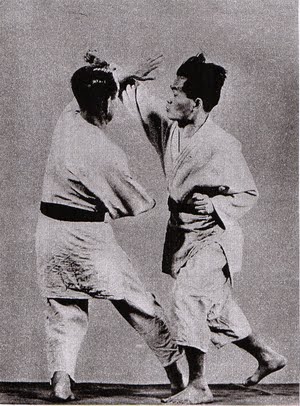
De Jong commenced training jujutsu under the Saito brothers at the age of seven. The 'Saito brothers' as he never knew their first names, always referring to them individually as 'Saito Sensei'. The Saito brothers very rarely taught non-Japanese students and De Jong was only afforded the opportunity of joining their classes through his father's relationship with them. His father, an engineer, befriended one of the brothers whilst building a shed at the flower nursery of one of the brothers in the hills above Semarang. This friendship led to an invitation for both father and son to train under them. The chief instructor was a professional photographer, whilst his brother was a florist who spent most of his time at his nursery.
The above photographs are of the Saito brothers circa 1930. These are the only three photographs of them that De Jong had. He used the last photograph as the inspiration for Wim Zwiers to develop an ex libras which then went on to become the logo of his school. Zwiers would go on to become a famous artist in Holland and his work, mainly ex libras, is much sought after. I had the pleasure of meeting him and visiting his home where he worked and displayed his and other artist's art work. I am fortunate enough to have been given an ex libras he'd made of my zodiac birth sign and which is now hanging on my loungeroom wall.
Not much is known of the Saito brothers. De Jong would say the main instructor was eighth dan while his brother was seventh dan. Given dan grades were instituted by Jigoro Kano, it would be interesting to know how these grades were awarded. Did they, like so many, go over to the Kano system? The Saito's told De Jong that the style of jujutsu they were teaching was Tsutsumi Hozan Ryu. During his training with them, the
dojo was visited by
jujutsuka (jujutsu exponent) who were said to be training Tsutsumi Hozan Ryu in Japan.
The
dojo was a small room with bamboo walls, off an alley in the centre of the town. Classes were always small in number, never having more than fifteen students at any one time and, as said before, very rarely including any non-Japanese students. Classes were conducted for two to three hours a day; seven days a week; 365 days a year. Apart from the rare bout of illness, De Jong only missed classes when his family returned to Holland for a six month holiday every five years. This occurred twice during his training under the Saitos.
The classes were conducted during the afternoon, the hottest part of the day in equatorial Indonesia. De Jong would recall that his
gi (uniform) was often soaked with sweat before he even stepped onto the mats, and that sometimes during the class he would have to change into a spare
gi which he’d brought along for just such a purpose.
Everyone trained together in the same class. All the students trained the same techniques, though the experienced students received more attention from the instructor than the novice. Repetition was the preferred method of instruction with the students being told to 'train slow', and that 'speed will come'. There was no enforced discipline, but rather respect and self discipline was expected and willingly accorded due to the times and culture.
An amusing anecdote De Jong shared demonstrated his attitude towards his training. His father visited his school one day to check up on his son’s academic progress only to find he hadn’t been attending school for the past six months. School hours were between 7am and 12am or 1pm and he had been using this time to do extra training before attending the jujutsu class. With a rye smile, De Jong would say that his father was not pleased.
De Jong would also say his father was not pleased when he got their pet monkey drunk on his father's best liquor. He was obviously a spirited lad. He'd tell of how they would give visiting soccer teams coconut milk at half time which would then slow them down for the second half of the game.
De Jong was in the boy scouts. He gave me a copy of his list of contacts and I wrote to people who had known him before and during WWII. I received a reply from one who also sent me a couple of small photographs of De Jong in his pre-WWII Indonesian days. There is a young De Jong in his boy scouts uniform (complete with shorts and knee high white socks) attending a jamboree in front of a hut surrounded by a tropical jungle.
De Jong said he received his third dan grading from the Saitos just before he left for Holland in 1939. This was apparently the highest technical grade and all higher grades were honorary and based on, among other things, certain age requirements. De Jong, at the age of eighteen, had some time to go before meeting those age requirements.
He left Indonesia by boat in late 1939 arriving in Holland in February 1940. He travelled to Holland in order to further his ambitions of becoming a pilot. Three months later the Nazis put paid to that ambition by invading Holland and ruthlessly occupying the country for the next five years.
In the 1994-5 I accompanied De Jong, along with his wife and daughter, on a visit to Java (the subject of a future blog itself). He took the opportunity of travelling to the places of his childhood. We found the street but no trace of the Saito dojo exists as it has been built over.
When De Jong returned to Indonesia after WWII, he tried to locate his instructors but no trace of them was ever found. This could be explained because they may have been Japanese spies. De Jong would suggest they may have been in the Japanese Army pre-WWII. This story is given a little more support when Jan Ruff-O'Hearne (
50 Years of Silence) writes about her time growing up in pre-WWII Semarang: 'Our friendly Japanese photographer turned out to be a spy too. He was the most popular photographer in Semarang.' Given the time the Saitos spent in Semarang, it may be they were former military and were called upon, as islikely of all nationals living in a country which is at war with their homeland, by the Japanese military prior to their invasion.
During the Java trip, we were invited to dine at an old colonial restaurant. It was truly old colonial world with open bay doors and black and white checkered tiles on the floor. Our host knew of De Jong's fondness for Indonesian cuisine and organised a traditional rijsttafel for us. Rijsttafel is translated as 'rice table' in Dutch and it is an elaborate meal where dishes are brought to the table for the diners to choose portions from. At this time a dozen Indonesian women all dressed alike came to our table holding different dishes and filed pasted us. The setting, the rijsttafel, and the food brought back many fond memories that moved De Jong to tears. He later told me he'd actually worked in just such a restaurant in his youth.
In the years just prior to his death, De Jong would reminisce about his life with me after I'd taken him to the movies or out to dinner. It was a real 'Tuesdays with Morrie' moment (book about a former teacher reminiscing with a former student each Tuesday before dieing; and Jack Lemmon's last movie). He talked often, and lovingly, of his father and one thing always stuck with me. He'd say how he'd turned out very much like his father.