Showing posts with label SAS. Show all posts

Thursday, 14 March 2024

The Development of the Jan de Jong Jujutsu Grading System 5.1: Sandan Part 2

Previously ...

This post will be done in two parts because the sandan grading contains 12 parts, whereas shodan and nidan were long enough with nine parts.

You will recall from previous posts that the structure of the dan grades was set with JDJ's initial grading system, the kyu grades, with ikkyu being the instructor grade. 

Note: There is no shinken shobu no kata part in sandan. This is the only grading in JDJ's grading system that does not contain a reflex/shinken shobu no kata part to the grading.

The grading requirements and description of the different parts are taken from Jan de Jong: the man, his his school and his ju jitsu system (Jan de Jong Self Defence School, 1997 (p.52)).

This is part two of the two parts discussing the Jan de Jong (JDJ) jujutsu sandan grading.

Part 7 Taiho Jutsu

'Demonstrate various arresting techniques from standing and sitting positions.'

'Taiho' is defined in the abovementioned book as 'arrest, apprehend, seize.'

There are six techniques to this grading. Six.

Part 8 Toshu Kakuto Jutsu

'Demonstrate searching and hand cuffing techniques.'

JDJ said that he included this part in the sandan grading to share with his instructors what he taught the Special Air Service Regiment (SAS). 

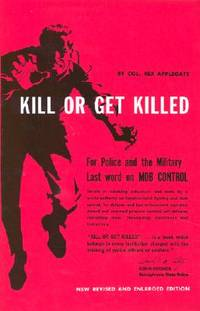
The Australian Defence Force (ADF) could have saved themselves some money by buying Kill or Get Killed: Riot Control Techniques, Manhandling, and Close Combat for Police and the Military by Rex Applegate (1976) because all of the techniques in this part of the sandan grading are taken straight from this book. Even the order of the techniques is the same.

I alone, among the instructors, found this out because I alone did not rely wholly and solely on the teachings of JDJ. I came to research the subject matter of the gradings.


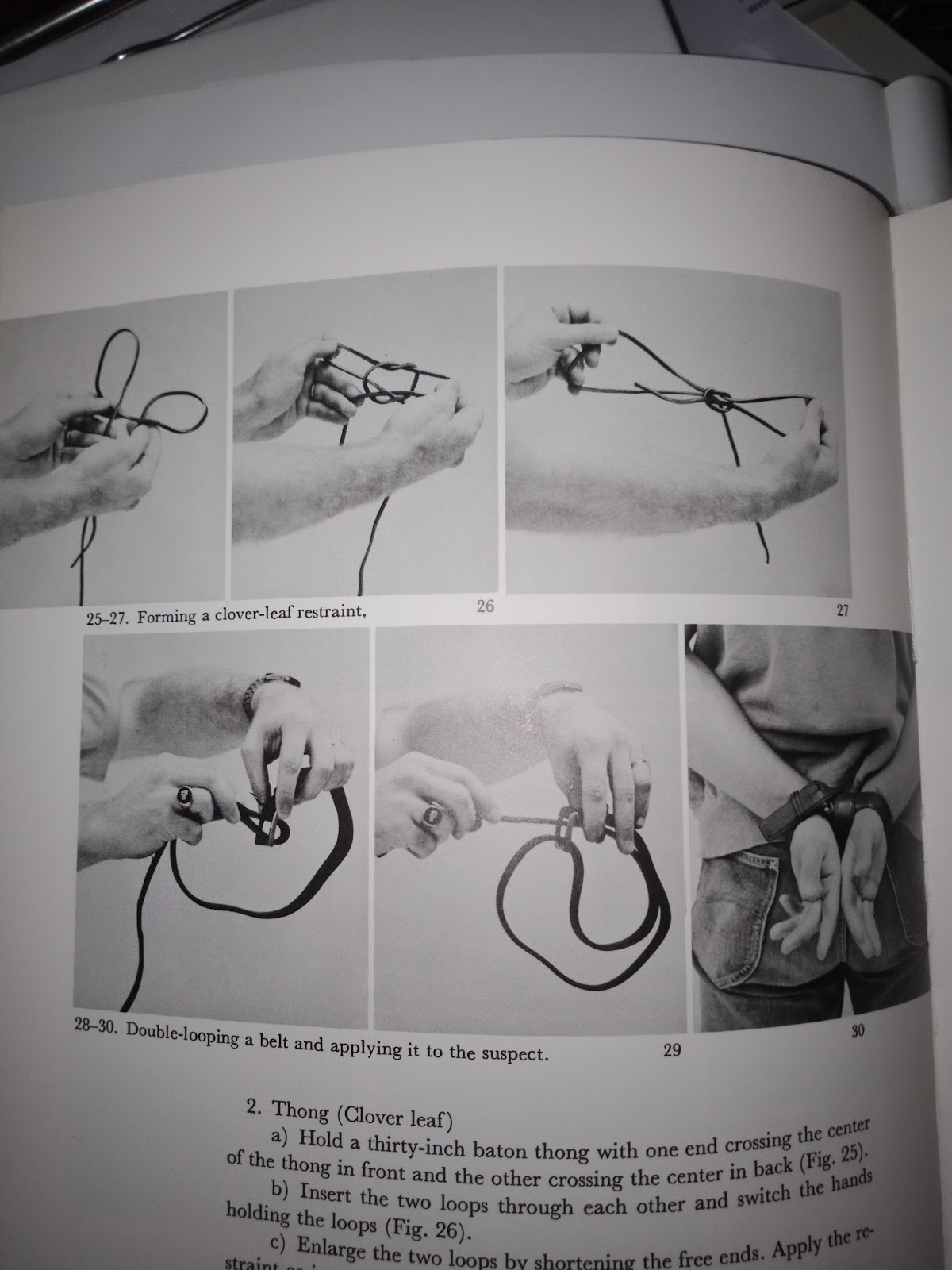
I found a book, Techniques of Vigilance: A Textbook for Police Self-Defence by Kevin Parsons (1980). The photographs are 'interesting' given that the 'models' are dressed like the motorcycle cops in the TV series CHiPs with Eric Estrada. That having been said, it is still a very authoritative book. 

In that book there is a technique to restrain a suspect with a belt by securing their wrists (see bottom sequence in photo to the right). When Greg Palmer and I were training for this part of the sandan grading, I showed him this alternative to that in the grading/Kill or Get Killed. Easy as, but we found that we might have to get a knife to cut the belt in order to release the hands. Which is a good thing when restraining someone.

I showed this to JDJ during the grading. He wasn't interested, even though it was a far superior technique to the one he was teaching.

The top sequence of images in the photograph to the right is also a very simple and effective use of a shoelace or string/rope to make a pair of handcuffs. It is also included in the sandan grading via Kill or Get Killed. I taught this technique to my neighbour's young daughter, who would go on to become my stepdaughter. This then became her 'show and tell' at primary school where she handcuffed one of her fellow primary school students. Needless to say, her mother was called in for a parent-teacher conference.

Part 9 Jo Jutsu

'Demonstrate the use of tobitanbo and jo against various attacks.'

Tobi tanbo is defined/translated in the glossary of the abovementioned JDJ book as being 'jumping stick.' I will let the late Greg Palmer provide the description:

The short answer to your question is perhaps. The Tsutsumi Ryu Ju Jutus (sic) has a set of techniques in which the jo is used to catch and lock or throw the attacker. We do not use it for striking at all pretty much.

We also train techniques with the keibo (keijo) - about 22" long which, our sensei told us, were originally police techniques. These we refer to as Tobitanbo (Jumping Stick) techniques. The stick is held downwards along the leg and as a person punches the stick is flicked up to hit the inside of the wrist or elbow, locks or strangles are then done from this position. The hanbo is used in a similar manner but some of the jo techniques are possible with the hanbo. We generally never strike with any of the sticks we use - tanbo, hanbo, keibo and jo. I was shown one or two locking techniques with the yawara stick but our sensei passed away before he taught them to us.

Whether or not these techniques are taught or used by Japanese police I don't know. Apparently the ones we learnt were used by the equivilant of the police in the past.

Hope this answers your question about the possibility of locks etc being done with sticks of various lengths.

Greg Palmer

Tsutsumi Ryu Ju Jutsu

(E-Budo forum, 16 August, 2006)

The use of this weapon in this way, I have never seen before. It would appear unique to JDJ's teachings. It would be interesting to know where it came from.

Btw, note Greg's use of 'Tsutsumi Ryu' and not 'Tsutsumi Hozan Ryu.' The badges for JDJ's school also referred to Tsutsumi Ryu, as did the grading certificates. Why not Tsutsumi Hozan Ryu?

There are nine defences with tobi tanbo against a backhand strike (haishu), 16 against jodan tsuki (high punch), and two against a front kick. There are 14 defences with jo against jodan tsuki and five against a front kick.

The photograph to the right is JDJ demonstrating a jo technique on a '(apparently) hapless instructor John Coles' as Jenny Armstrong described me in an article published in Blitz.

There was also the time that JDJ was demonstrating defences with a jo at the end of a Norway summer camp (or what passes for summer in Norway) where JDJ fractured the hyoid bone in my throat which could have had fatal consequences. He missed the initial deflection and so applied the final technique to my throat a little too vigorously to make up for it.

A JDJ ryuha includes this part in their sandan grading, however, the participants have to make up their own defences against the same attacks for a good part of the grading because the head of that ryuha did not grade nidan nor sandan under JDJ and did not train this grading to any great degree.

Part 10 Manriki-gusari Jutsu

'Demonstrate the use of manriki-gusari defences against various attacks.'

In the grading there are defences against tehodoki, kitori, kubitsukamshime, tsuki, tsuki-mawashi tsuki, uraken, and keri, and there is a section for sutemiwaza.

Many of the defences were not specified; the candidates had to make them up for themselves.

Criticisms of this grading would be, (a) there are no striking techniques, therefore, the candidate is not learning to 'fight' with this weapon but just todemonstrate a series of 'tricks,' and (b) the weapon is held in a ready position rather than concealed in one hand as it should be. Having said that, it was a fun grading to train for.

When we accompanied JDJ to a three-day seminar in Germany, organised by Herr Teichmann (?) who was reportedly later involved in some diamond smuggling operation that was investigated by the legal authorities, and who provided the diamond for the fund-raising raffle at the seminar, Peter Clarke was the designated manriki-gusari demonstrator.

When we arrived at Hamburg airport, I, being the lowest ranked among our group (ikkyu), carried the weapons bag - a very large bag with swords, bokken, jo, tanbo, knives, replica guns, etc., through the airport, without question. Imagine doing that today. 

Peter Clarke, he would walk down the main streets of Munich twirling his manriki-gusari around, as a women emerged from a secured jewelry shop with a monkey wearing a nappy on her shoulder. As John Lennon said, 'strange days indeed.'

When Peter Clarke went to board the plane to return home via Bangkok, which is a whole other story, he took his manriki-gusari out of the pocket in his jacket and put it in the tray as he walked through the metal detector and then picked it up on the other side, put it in his pocket and boarded the airplane. Again, imagine doing that these days.

Part 11 Shiai

'Free fight with tanbo vs tanto.'

The issue of the free fighting gradings in the JDJ jujutsu grading system has been discussed ad nauseum, including in this previous post.

Again, the candidates in this grading were not how to fight with a tanbo or a tanto and there was no instruction as what is expected of the candidates or what is supposed to be learned from this part of the sandan grading.

Typically, if the candidates were actual 'fighters,' the one with the tanbo would beat the living daylights out of the one with the tanto. Was that the supposed lesson?

Part 12 Ju Jitsu Keikaku

'Candidates are assigned a project by Shihan Jan de Jong which will be of benefit for the students of the dojo, ryu, or ju jitsu.'

I was credited with the writing of Jan de Jong: the man, his school and his ju jitsu system for this part of the sandan grading.


Wednesday, 7 March 2012

Michael Clarke and Jan de Jong

Michael Clarke (not the Australian cricket captain) is a noted karateka and a published author. He's had articles published in magazines both in Australian and abroad, and has published a number of books, all to do with the martial arts.

Clarke writes a very informative and interesting blog titled Shinseidokan Dojo (shinseidokandojo.blogspot.com.au)

Remembering the past, but heading for the future - a conversation with jujitsu master Jan de Jong, 8th dan. Australasian Fighting Arts. 1991. 14(6): 11-16.
By anyone's standards Sensei Jan de Jong ... is an impressive man. Not because of his physical build or an overly forceful character, but because of his presence. he is an easy man to relax with and this is due, in part, to his age ... and the fact that he goes out of his way to make you feel welcome.
De Jong describes how he met Rienier Hulsk in Holland in 1940 which started his lifelong jujutsu teaching career.
At that time I was graded 3rd dan by my Sensei, Mr Saito, who lived back in Java. I really needed the money and so that's how I started teaching. Then after a year I decided I would open my own school and within a couple of months I had about 300 students!
Regarding the war:
De Jong: it's not a time I really like to talk about. Because war is such a stupid thing and it turns people into creatures that do the most horrible things to other human beings.
De Jong describes his response to a question posed by his pencak silat teacher, Suhadi:
'Why do you want to do silat? You're a white boy; you should be doing tennis or something like that.' I told him that it was my heart that wants to do silat. I had always been very interested in Indonesian art and the culture, and to me this was a part of that.
De Jong on training silat in Indonesia in late 1940s:
To me it was playing. Things then were not like it is now. You did not have the strict discipline that there is in martial arts classes today. But you know, I think that sometimes you can take discipline too far. For instance, I had a couple of English guys training with me once and they said how nice it was that they could actually talk to me. I asked them what they meant by that, and they told me that in England they could not talk to the Shihan directly unless he spoke to them. Now that's ridiculous, I think. In all the time I was in Japan training I never had rules like that to contend with. I think that's taking things too far.
I actually experienced this when I trained in England, and saw it evident in some instructors on various seminars we presented at in Europe. Not only were you not suppose to talk to the instructor on the mats, but also in the dojo generally, and even outside the dojo. I kid you not.

We often liked to think we were immune to this way of thinking. Generally that was true, but not always. I recall a senior instructor instructing me not to question De Jong during an instructor's class. De Jong taught us very well. If what he was teaching went against the principles he taught us, I suggest it is disrespectful not to question the teaching.

De Jong demonstrating his lifelong love of food in his description of Perth when he emigrated in 1952:
Perth was not a big, modern city it is now. In fact, in many ways it was a backward place. ... Do you know I could not even get a Chinese meal in Perth at that time? Nor could I get an Indonesian meal either. There were three Italian restaurants and that was it!
De Jong explains that he originally didn't teach silat to the general public. Attendance to closed-door training sessions was by invitation only, and only after De Jong had determined the prospective student was of 'good character and attitude.' In the mid sixties there was a large demand for karate instruction, so he relented and advertised classes in the newspaper:
To my surprise, on the day of the classes there were queues of people all the way down the road. Many of the top karate people in Perth started with me around that time. Brian Mackie - who is with Goju Kai now - he stared with me at that time. Also Denis Purvis got to yellow belt in jujutsu before he left me and went his own way.
Mackie is director and chief instructor of the IKGA in Australia, 7th Dan Kyoshi Shihan, and has been teaching at the Karate Academy of Japan in Perth since 1966. Purvis went on to form the Denis Purvis Karate Academy. There was also Branco Bratich who is now Chief Instructor for Yoseikan Ryu Karate Australia.

De Jong explains how he changed the Indonesian way of teaching to fit the Australian culture. Clarke asks if De Jong thought it was a good idea to change the system to suit the students.
Yes, I know what you're saying, but you know you can learn all the time. And if the results are better one way than the other, why carry on in a way that gives poorer results? I'll give you an example. In 1978 a Major Greg Mawkes MBE asked me if I would go and teach the army self-defence. I said okay and soon afterwards found myself teaching members of the SAS and the Commandoes. Shortly after I had started to do this the Major and I had a discussion about things. He told me that he thought the method of fighting was really good and he was pleased with that. But he said the men were having some difficulty understanding it all. I said this was the usual way of things and that my students were the same. He then explained the army did not have unlimited time to spend on this and that what he needed was quick results.

So it was at that point I had to think things through and see what I cold come up with. I looked at the usual way the army taught things and decided I would alter the way I was teaching and come more in line with the army way of doing things. Well, do you know, the people started to pick things up much faster than before, and they could do the techniques much better than before! So I had a talk with my Instructors and said I thought that we should change things so that we were teaching everyone like this. And at that time we changed the way we taught the students. The techniques were still the same, it was only the method of teaching them that was different. And since then things have been much better.

A bit on Mawkes (not included in Clarke's article):
Major Mawkes (Retd) served in the Regular Army for 22½ years including two tours of Vietnam with 1 SAS Squadron. He was appointed as a Member of the Order of the British Empire for services to SAS in the 1982 New Year’s Honours list, specifically for establishing Australia’s military counter-terrorist capability.
De Jong's explanation is very telling. It shows that he was results oriented; results being defined in practical terms. It shows his leadership style was often consultative. It also shows his never ending quest for finding better ways to teach.

What's not included in the explanation is the influence of Mochizuki's Yoseikan in De Jong's army-inspired new way of teaching. What was this new way of teaching? As we've seen above, De Jong was not a fan for an 'army style' discipline way of teaching. No, what it was was to divide a tactic into phases in order to be able to better teach, learn, and analyse it. A very readable book on this approach is Gerry Carr's Sport Mechancis for Coaches. This division into phases can be seen in Mochizuki's Nihonden Jujutsu. You can check for yourself. A copy of this book is available for sale on ebay, for US$4,000.

The next few blogs will be devoted to Clarke's works on De Jong.

Saturday, 28 January 2012

Stories

Anyone who was ever involved with Jan de Jong for any length of time has a story to tell about him. He was that sort of character. I asked Harry Hartman, a former student that has featured quite often in previous blogs, if he had any stories about De Jong, and if he'd be OK with me sharing them. He did, and he is.
Any story I share with you about Jan you can use and share with whoever you like.

I remember me attacking Jan with a sword and I holding back, afraid to slice his skull. He just stepped aside and said: 'the meaning is to hit me,not to wave it [the sword] like a flag.' The same story when we used a bludgeon.'Don't hold back,the thing is made for hitting' Jan himself never held back.
That most definitely sounds like De Jong.

I remember seeing him in his 70s or maybe 80s, demonstrating kusurigama (sickle and chain) defences against a katana (sword). The katana was wielded by Robert Hymus, a senior instructor of De Jong's who was very 'warrior-like' in his approach to martial arts. What you saw was this 'old guy' with an inferior weapon 'stalking' a fitter, younger, aggressive, trained warrior armed with a sword, who was slowly retreating through the sheer will that was De Jong.

Hymus tells the tale of a session he had with De Jong when preparing for the knife vs unarmed free fighting shodan grading. He, the younger, fitter, aggressive, trained warrior was armed with the knife; and De Jong was unarmed. Straight out of the blocks, De Jong kicks Hymus' hand and the knife ricochets off the ceiling. Hymus is confounded: 'You've always instructed us never to kick when confronted with a knife. Why did you do that?' De Jong explains: 'Because I could.'

De Jong and myself were doing some training for a demonstration at a Norway summer camp (though their idea of summer and mine are quite different). He was armed with the kusurigama, and this time I was the katana wielding adversary. I'd attack with a downwards strike, which he would sidestep while ensnaring the blade with the chain and attacking the side of my neck with the sickle. I'd lean to the side a little, which De Jong was unhappy about. He explained that it didn't look good. So, using sheer willpower to overcome my sense of self preservation, I attacked and did not lean to the side. I then felt a trickle of blood running down my neck. 'That's why I lean to the side', I exclaimed. 'That time I thought you were going to lean to the side', De Jong explained.

Oh, and who can forget De Jong's massages? De Jong is a qualified physiotherapist. In my formative training years, an inexperienced student took me across his bended knee so that my back went from convex to concave in milliseconds. De Jong took me into the instructors changeroom which had a massage table. 'Dear God in heaven', I thought, 'what have I ever done to you to deserve this.' His massage could be legally classified as assault. However, he might of thought he was one hell of a masseuse because when he asked if the injury is feeling better I'm quite sure that 100% of his 'patent's' would have enthusiastically replied in the affirmative (simply to avoid any further punishment).
The way he threw you on the mat!! One day we did a demo at an institution for juvenile delinquents. Outside the building on the grass we demonstrated some throws and locks. Some smartaleck reckoned he could free himself out of a certain lock and make a counter attack, so Jan invited him to try. Can you imagine what happened?
Hymus tells the story when De Jong went to instruct the Australian Special Air Service Regiment (SAS) that the troopers were not all that convinced about this 'old guy' telling them what to do. So, the very first trooper looked to put this old guy in his place, much to his personal distress. Needless to say, respect was paid following that painful demonstration.
Once we did a demo in a dancehall.Jan asked me to attack him [any attack] So I dived [with a yell] forward aming for his legs,the next thing that happened I landed between chairs and tables.I still remembered that the other day.
We were conducting a seminar in Holland once and De Jong was explaining something to the participants - in Dutch. I don't speak Dutch. He then turned and faced me to demonstrate a technique that he had been talking to the participants about - in Dutch. I had no idea what attack he wanted, let alone what defence he was going to demonstrate. He gestured his impatience, so, I figured, what the hell. I rushed forward with a high punch, and promptly found myself on my back looking up at De Jong, who asked: 'Why did you try and hit me?' 'Because I don't speak Dutch', I explained. He then laughed and shared the story with the seminar participants, who also laughed at my expense. This is part and parcel of being an uke, so I'm told.

De Jong was never aloof. I recall a seminar in Aalborg, Denmark, where one particular instructor was celebrating some milestone. The head instructor approached De Jong for his help in a particular tradition. De Jong 'decided' to teach handcuffing techniques in the next session, with the aforementioned instructor being accepted as the willing volunteer. When De Jong had handcuffed the aforementioned instructor, he stepped aside while the other instructors took the handcuffed instructor outside and pelted him with pepper. Some strange Danish tradition, so I'm told.

Much like the Gammel Dansk (Old Danish) tradition. Gammel Dansk is a Danish alcoholic beverage. Our host informed us that a Danish tradition is to start the day with a shot of Gammel Dansk. I hate spirits. So, I knocked the shot back in one take, and my displeasure was evident in my face - much to our host's amusement. He then informed me/us that I had to have another shot otherwise I would be walking around in circles because only one leg had been filled. I can see a certain logic in the argument, but ...

I always loved the story about De Jong grading Peter Clarke his wakizashi grading for third dan. Now Peter is the consummate martial artist. At the end of the grading, De Jong congratulates Peter for passing the grading, but, he explained he had to fail him for the first technique because it wasn't the right defence. Peter was confused: 'What do you mean? That's the defence you taught us.' 'Yes, I know,' said De Jong, 'but I taught you the wrong technique.' ... De Jong could afford to do those sorts of things in gradings because it was never ever a question of whether a candidate would pass with his instructors, it was only a matter of by how much.

If anyone has a story to share and wouldn't mind sharing it with the world, please write to me.

Thursday, 19 January 2012

Blocking Techniques

This blog is inspired by one I read on japanesejiujitsu.blogspot.com entitled 'Block This!' It's also inspired by the use of blocks within Jan de Jong jujutsu (JDJJJ).
'Every strike is a block, and every block is a strike.'

A good block can be quite jarring and can cause damage or stun your opponent. A good block is actually the initial set up or entry into the next technique. More accurately, it can be thought of as being part of the technique itself, whatever that may be.

Most times, an effective block does just enough to move the incoming strike off its target or line.

A good block, especially for in-close systems like Jiu Jitsu, only needs to redirect the incoming force slightly. Quite often, we don’t meet the attack with any force whatsoever, we just re-direct or guide it off to the side or past us as we shift out of the path, using your opponent’s strength and momentum against them.

Ultimately, everything you do in the martial arts should reduce/protect you from injury, put you in a better position, or put your opponent in a worse one. Ideally, you’ll do all three at the same time. Effective blocking is one tool in achieving these goals.
I do not disagree with anything the author writes. The goal of my work is to provide the means by which to analyse and better understand the methods taught by all martial arts and those activities associated with preparing a person to survive a violent encounter.

The author's comments are not only reflective of most jujutsu, but most martial arts. If a block is used to protect oneself from injury, what does that imply?

Jan de Jong introduced the mon system at the front end of his grading system to introduce the student to the 'basics' of the system before tackling the more practically oriented kyu system. The development of the mon system, as explained by De Jong, was influenced by his work with developing a close quarter combat system for the Australian Army, and in particular the Special Air Service (SAS). Thus, 'he divided the skills into phases', as is the standard teaching method adopted by the army.

The comment - divide the skill into phases - comes direct from Gerry Carr's Sport Mechanics for Coaches:
Divide the skill you're interested in coaching into phases. This process is important because it makes your job much easier when you look for errors in your athlete's performance. Quite simply, it stops you from becoming confused by trying to watch too much of the skill at the same time.
Carr, in this description, seriously underestimates the benefits of adopting this approach to analyse, teach, assess, train, and correct martial arts students.

Explicitly dividing the skill into phases is very, very rare in the martial arts. Jigoro Kano, the found of judo, is one notable exception. He divided judo techniques into kuzushi-tsukuri-kake, unbalancing-fitting in-technique execution. Nakayama, in the classic, Dynamic Karate, divides a skill into pre-, during, and post- execution of a karate technique when analysing and explaining stances. (So does injury science in terms of analysing an injury event)

De Jong intuitively understood the phases in the defences taught by JDJJJ. These are reflected in the mon grades, although it takes some extrapolating then to adopt the process to analyse defences. One which was not commonly adopted by most of the instructors, preferring instead to continue with the traditional approach. The division is:

Taisabaki-kuzushi-waza; bodymovement-unbalancing-technique.

Taisabaki/bodymovement - I now refer to that as a 'phase' rather than as a specific technique, or movement. Different bodymovements may be used during all three phases, however, the taisabaki phase refers to the evasive movement. These phases DO NOT imply that these methods are used in each defence. If so, this method could not be used to analyse defences taught within ALL activities associated with preparing a person to survive a violent encounter.

Was a bodymovement used to evade the attack? If so, which bodymovement (a discussion for another time)? If not, how did you avoid being hit? The obvious answer is: you used a block.

The explanation of blocks by the above author in terms of protecting oneself implies that bodymovements are not being used to evade an attack. If they were, the blocks would not be needed for this purpose. Aikido, and JDJJJ rely on bodymovements to a great extent as part of their tactics. They rely on bodymovements to evade an attack. So, when a block is used, you have to ask, 'What is the purpose of that block?' It's no longer to protect you because the bodymovement did that.

'Blocks are unbalancing' - this was an explanation I received when I asked the question, if an answer was proffered. It was suggested by some instructors that blocks are (a) unbalancing, and (b) are categorised as pushing, pulling, hard, soft, grabbing, or empty.

PHYSICAL unbalancing requires applying a force to the opponent to stop, start, speed up, slow down, or change direction of their 'weapon'. That is undeniable as that is the mechanical definition of a force. And a force is simply defined as a push or a pull. So, pushing and pulling blocks - unbalancing? OK. Grabbing, ditto. Hard blocks are the impact types of blocks the above author refers to. Unbalancing? Hmmm. Soft blocks are deflection blocks, or as JDJJJ refers to them as, brushing blocks. Unbalancing? Empty blocks refers to no blocks at all (remembering that bodymovements are used to evade the attack). Unbalancing? Not likely. The 'shoehorn' answer for soft and empty blocks is that the attacker would stumble because they didn't meet the resistance they expected. Really? It can happen, no doubt, but are you going to base your defence on the fact that the opponent will fall off balance because they didn't hit you?

The answer to the dilemma is that (a) the categorisation of blocks was used by De Jong in pencak silat, with no link to unbalancing, and (b) it was adopted as theory by some in jujutsu. The theory did not explain the practice, so, the solution is to 'shoehorn' an explanation, or, worst of all, is to change effective technique is to fit with defective theory.

This discussion leads to the heart of the matter: 'What are your blocks used for?' Protection, then bodymovements are not being used to evade an attack. If bodymovements are used to evade an attack, and a block is used, what is its purpose? It, by definition cannot be to protect from the initial attack. It can be used to unbalance, as in pushing, pulling, and grabbing blocks. Therefore, these blocks are unbalancing in the kuzushi phase. If they don't unbalance an opponent, but they are used in the kuzushi phase, this then leads us to look at what the kuzushi phase is. This leads to the question, 'What is the purpose of kuzushi?'

What is the purpose of kuzushi? A question long debated. The simple answer is; it facilitates the execution of a technique. It makes it easier to do a technique. So, when a block, or even a strike, is used in order to enable you to execute a technique, it is also a facilitator. Thus, it could be argued that the kuzushi phase is more accurately thought of as the facilitator phase. What, if anything, is being used to facilitate the execution of a technique? Unbalancing, a block, a strike? A jab in boxing could be considered to facilitate the execution of the knockout right cross.

Two final points. Firstly, what is the point of 'deflection', or brushing, blocks when a bodymovement is used, such as commonly used in pencak silat? Secondly, a comment on the abovementioned blog explains that uke (receiver) refers to the attacker that receives the technique in jujutsu, judo, and aikido, but refers to the defender who receives the techniques from the attacker in karate. It reflects different ways of looking at the violent experience, but does the different viewpoints reflect anything about the 'perspectives' of the different martial arts? These questions are only raised for speculative purposes only.

Thursday, 25 August 2011

Jan de Jong Pt 11 - His Grading System Pt 3

Recall from part two of the blogs dedicated to Jan de Jong's jujutsu grading system that his system can be divided into three parts: the mon system, kyu system, and dan system. They are not only system divisions, but, I argue, also evolutionary divisions in the development of the 'school of Jan de Jong' (see previous blog on the concept of 'school' discussed in the context of the school of Jan de Jong).

De Jong only graded students in the kyu system until the late 1970s. Apart from De Jong, all the instructors were either purple belt (2nd kyu) or black and white belt (1st kyu). He graded Piet Hesselink 1st dan during WWII, but in what is unclear. He did not grade anyone 1st dan in Perth until Robert Hymus in the late 1970s.

Why didn't De Jong grade any of the other instructors in his school 1st dan prior to Hymus? It definitely wasn't because they were not of sufficient ability. Hymus and Greg Palmer often referred to the ability of their instructors. Hymus would motivate/chastise us based on the technical excellence and efforts of his instructors. I've had the good fortune to train with some of these instructors - Warwick (Zak) Jaggard, Tony Chiffings, and Peter Canavan - and they are as good as Hymus and Palmer (and De Jong) suggested. Given my current interest in being the unoffical historian of the 'school of Jan de Jong' (until someone else would like to assume the role), I've taken the opportunity of exploring these resources when I can. Zak visited the 'land of Oz' in the mid 90s and attended an instructors class for the first time in 20 odd years. Apart from being extremely sore the next day (and impressing those who were currently training), I asked Zak if what we were doing was the same as when he was training. He said it was, apart from this 'circular shit'. A recent conversation with Hymus suggests that he has devolved De Jong's teachings to a more 'direct approach' which presumably means he has turned away from this 'circular shit'.

There are a number of people from the pre-dan days that are a little bitter and a little disillusioned. They put in as much work and were as good, if not better (according to many), as those in later years who were awarded dan grades. These jujutsuka were not even given the opportunity of attempting dan grades. Why? Various theories abound as to De Jong's motives. Economic imperative is a frequently espoused explanation. De Jong didn't want to grade anyone black because they might leave and set up their own school in competition to his, which was his livelihood after all. Some suggest it was in connection with keeping the 'secrets' of the school secret as they were contained in the dan grades. That he didn't want to relinquish his monopoly of the 'knowledge well'.

These theories/explanations do not reconcile with the man I knew as De Jong. And remember, I'm a qualified accountant, so I am big on reconciliations. After much research, analysis, and deliberation, I propose an alternate theory. De Jong didn't grade anyone black because ... he didn't have any dan grades.

This, I am sure, will be controversial. I've already received criticism from some about my chronicling of De Jong's life and work, but this is the first time I'm referring to any criticism of De Jong, and, I am looking at a 'sacred cow' - the grading system.

Some need for what we do, including the grading system, to be predominantly handed down from at the very least the Saito brothers, if not the Tsutsumi family. This need is not unprecedented as so many in the martial arts need to associate their teachings with those of the past to gain credibility and/or authority. What I'm suggesting is that we don't need this link. In fact, what I'm suggesting is that one of De Jong's greatest achievements, one of his greatest legacies, is his grading system. It is a thing to celebrate, to study, and not simply something to be taken for granted (as it is).

De Jong's kyu grading system is only remarkable in that it uses the shinken shobu no kata method. What we refer to as the 'reflex' method. The use of shinken shobu no kata is a major 'point of differentiation' with other schools/systems. Most gradings/teachings are demonstration (technique or kata) based and/or randori (free fighting, sparring) based. Shinken shobu no kata combines elements of both. The kyu gradings contain specified defences against specified attacks, hence the kata element. However, where the uniqueness comes in, where the 'reality based' element comes in that so many emphasise these days, is that the attacks are randomly presented. This is the randori element.

During the grading, the student stands with their back to the examiner(s). The chief examiner signals an attack which is then executed. The candidate must defend themselves against the attack. Minimum, the candidate must defend themselves. If the candidate defends themselves with the required response, marks are awarded based on technical merit. If the candidate defends them self with another defence, the attack will come again. If the candidate fails to defend them self, they fail that 'question'.

Shinken shobu no kata is not just used as a grading method. It also used as a training method. Brazilian jiu-jitsu refer to 'drills' in which they train techniques, and then they rely on randori to train a person for combat. Jan de Jong jutsu uses 'drills' but then rely on shinken shobu no kata to train a person for combat. Each class usually ends with shinken shobu no kata, except that unlike a grading, no defence is specified against any specified attack. This method is also used in many different ways to train the student. It is modified by specifying an attack but requiring the student to respond with only one specified response. Alternatively, the response is specified but the attack is chosen at random. This is not unlike the story told in The Fighting Spirit of Japan were the jujutsuka/judoka would go into the red light district to confront individual yokuza and limit themselves to only one technique.

Major Greg Mawkes MBE (retired) had this to say on this method of training when working with De Jong to develop a close combat system, including training system, for the Australian Army including the SAS (Special Air Service Regiment):
What was created during the months of early morning starts and hard work is a system of unarmed combat that has Tsutsumi ju jitsu as its cornerstone. The reflex method of training and testing is particularly appropriate to the instinctive reactions that must be developed in unarmed combat exponents. (Jan de Jong: the man, his school, and his ju jitsu system)
Given the limited attention span that most of us are suppose to have in this electronic/world wide web age, and given what I consider to be one of De Jong's major legacies, this subject will be continued in future blogs.

Sunday, 7 August 2011

Jan de Jong Pt 5 - The Perth Years

In the last blog we left Jan de Jong and his young family emigrating to Perth, Western Australia in 1952. There are various subjects of interest during this period until his death in 2003 which will be discussed in detail in future blogs.

De Jong arrived in a very provincial Perth in 1952. When discussing this subject he would use as an example that Perth had only one Chinese restaurant at that time. His physiotherapist qualifications weren't recognised in Australia so he initially worked as a labourer. It wasn't long before his work colleagues started to ask him to teach them martial arts. He initially taught them during his lunchtime break for no charge on what has now become the site of the West Australian parliament. This then laid the seed of an ambition to teach martial arts as a full-time profession. In the forward to my Jan de Jong: The man, his school, and his ju jitsu system, De Jong explains:

Looking back at my own early years in Australia (1952-1963), self defence was often considered a rather peculiar and odd thing to do. The term 'judo' was known by some, but most people had not even heard of 'karate' or 'kung fu,' let alone 'jujutsu'. My expressed intention to make the teaching of this art into my living was almost always met with doubt, if not ridicule. The idea that anyone could teach an oriental self defence professionally was not considered possible. However, I had the confidence that I could and would do this. When I did make it my full-time occupation in 1963, to the best of my knowledge I was the only full-time martial arts instructor in Australia.
Later that year he took his first steps in realising that ambition by offering classes in a premises located in North Perth. That same year he relocated his school to Victoria Park and then finally to his residence in Scarborough. Hans de Jong, his son, who would go on to make teaching jujutsu his full-time profession as well, recalls students being inadvertently thrown over balconies and through walls during lessons held at the Scarborough residence.

In 1955, De Jong's school was relocated to Swan River Rowing Club located on the city's foreshore. Attending the first class were ten students. After demonstrating a bridgefall and putting both his feet through the floorboards into the river, only three students returned for the next lesson. It was suggested that the use of mats may encourage more people to take up jujutsu, so, as mats were not available in those days, they made some mats by hand. Rodney Miller, a student in the 1960s and later an instructor, recollects training on these home-made mats: 'Can you imagine training on canvas mats? Well, that's what we had in the early days. They were especially good for mat burns and broken toes.'


In 1960, the school was relocated to 870 Hay Street, Perth, which is located in the Perth central business district. The photograph to the right is of training at the 870 Hay Street dojo. You might note how thin the room is. One can only imagine the difficulties this imposed on training. Also look closely and you'll see the home-made mats that Miller was so fond of. De Jong is kneeling centre.


In 1963 the school was moved to 996 Hay Street where it remained until De Jong's death in 2003. The building was full of character ... which is another way of saying it was a dodgy old building. It was a large building with four (five in the earlier years) separate large matted areas.


It was around this time that De Jong imported a large number of tatami from Japan. Towards the end they were moved around and tapped up due to the wear and tear they sustained over the decades. The photograph to the right was taken around 1963 according to Warwick Jaggard (aka Zak), a colourful character who went on to become an instructor for De Jong. He joined the school in that year and said that he 'always always loved the smell of the tatami as you walked in off the street.'

The building only had a ceiling in the upper area. Down stairs in the main training areas there was no ceiling, only a tin roof. On hot summer days when it was 30 degrees plus outside, it was another 5 or 10 degrees hotter inside. On some Saturdays you could not stand still in one place on the mats because of the heat radiating off the mats onto your bare feet.

Classes were held at the 996 Hay Street dojo six days a week. The dojo was open from morning until late at night so there was always somewhere to train. For whatever reason, when I commenced training in 1983 I attended two lessons a day, six days a week and took the opportunity of also doing training at the dojo in addition to the classes.

In 1965 the first branch was opened and over the years there would be many more branches opened throughout the Perth metropolitan area. In 1975 the name of the school was changed to 'Jan de Jong’s Self Defence School'. The school grew to, at its peak, having 800 to 1,000 students, without sensationalisation nor inflated promotion. Standards were never lowered as De Jong had a qualitative rather than an economic imperative when it came to his teachings.

From 1955, attendance at De Jong's pencak silat classes was by invitation only. In 1968 he offered classes in pencak silat to the public for the first time. Given the informal nature of pencak silat, De Jong would have to develop an entire grading system which he did. He placed an age restriction on admittance to the class as he considered jujitsu, and later aikido, provided a more appropriate ethical foundation for young people as they emphasised acceptance and control rather than initially teaching a child to punch or kick another person.

In 1968, De Jong was introduced to aikido by Phillipe Boiron. Boiron was a student of Minoru Mochizuki and taught his Yoesikan style of aikido. De Jong said that he was very impressed with Boiron's technique and Boiron began teaching for him in that year. After training with Boiron, De Jong developed an ambition to visit Japan to train. Professional development if you will. In 1969, age 48, he realised that ambition. While he was in Japan he visited a number of schools before finally becoming a live-in student with Mochizuki. More will be said of the 'Mochizuki influence' on the 'school of Jan de Jong' in a future blog.

Two more children were born in Australia before De Jong was divorced. Only Hans, born in Indonesia as explained in the previous blog, would go on to make teaching martial arts his full-time profession. De Jong remarried a few years later. Margaret, his wife, would go on to become his partner in establishing a thriving business teaching martial arts and selling martial arts supplies in Perth. Their first born, Maggie, would go on to make teaching martial arts her full-time profession and become principal of his school when he passed away. Maggie would accompany De Jong on most of his European teaching tours in the 1990s. Maggie would be followed by a brother who trained martial arts but never took it up to the same extent as his sister.

Jan de Jong began teaching aikido when he returned to Australia. In 1974, he sponsored Yoshiaki Unno from Mochizuki’s Yoseikan to become an Australian resident and to teach aikido and karate at his school. More will be said of Unno in a future blog.

Accompanied by his family, De Jong returned to Europe for a holiday in 1978. He took this opportunity to make contact with various jujutsu instructors throughout Europe and to peruse the jujutsu scene. The European jujutsu community was impressed with him, his knowledge and his expertise, and were quick to embrace and court him. When he returned home he was lobbied to become the Australian representative for the World Ju Jitsu Federation (WJJF) which he eventually accepted.

This began, what appeared to be, the political life of De Jong. In 1985, through General Eddy Nalapraya of the Indonesian Army, the man responsible for the promotion of pencak silat on behalf of the Indonesian Government, De Jong was appointed the Australian representative for the International Pencak Silat Federation. This was followed by his appointment as President and National Coach for the Australian Ju Jitsu Association (AJJA) in 1987, and Vice President of the WJJF in 1989. Whilst these were political offices, De Jong was anything but political. His focus was always on improving techniques and 'on strengthening both jujutsu itself and the image it holds'. Briely Baily OAM, National Secretary of the AJJA, credits the presence of De Jong within the AJJA as having brought jujutsu together around Australia and moved it forward in world circles. His achievements were officially recognised by the Australian Government when he was awarded the Order of Australia Medal in 1990.

De Jong had been graded third dan in jujutsu since 1939. After his initial visit and subsequent involvement with the hierarchy of the WJJF, he was awarded fourth dan in 1980. Following his first teaching tour of Europe in 1982, the WJJF awarded him sixth dan and then eighth dan in 1989. I've been advised that the AJJA also awarded De Jong eighth day in the same year though I am yet to verify this fact.

Actually, De Jong was 'awarded' numerous higher gradings from various individuals and organisation including a number of tenth dans. I was present when he and Margaret were both awarded tenth dans by a German instructor (who was not invited to the seminar but proceeded to take it over anyway). Margaret should have been chuffed because she never graded first dan under De Jong or anyone else for that matter. These certificates were put in the draw along with so many others.

De Jong wasn't concerned about higher grades for himself and lamented the increasing frequency with which higher grades were being awarded. In an interview published in 2002, De Jong said:

I never worried about [accepting the higher grade], you just know what you know. That's all you do, you do not worry about Dan grades very much. Dan grades don’t say very much anymore. In my time it said something. … I'm still learning too. Dan grades are not important – it is what you can give the people, that is what is important.
Following his initial visit, De Jong received many invitations to conduct seminars throughout Europe. In 1982, he returned with a team of his instructors for what became an annual tour. Over the next two decades, he would conduct seminars in Austria, Belgium, Denmark, England, France, Germany, Holland, Indonesia, Italy, Malaysia, New Zealand, Norway, Poland, Spain, Sweden, the United States of America, as well as throughout Australia. As a consequence of his increasing international reputation, students/instructors from around Australia and Europe would travel to Perth in order to train with De Jong and his instructors. More will be said of these tours in a later blog.

Another watershed in De Jong’s professional life was his appointment as the Chief Instructor and Adviser to the Australian Special Air Service Regiment ('SAS') in 1979. Major Greg Mawkes MBE had been tasked with updating the Australian Army’s capability for unarmed combat training and after considerable research had identified De Jong as the man that could help him fulfil his mission.

I had very firm ideas of what was required. I needed a man with a vast knowledge of and skill in several martial arts. Someone who knew that unarmed combat has both offensive and defensive applications. A man who understood that aggression has to be developed but controlled. A man who could appreciate what works in the dojo may not be effective on the battlefield. And if possible, a man who had experienced combat. I approached several martial arts schools in Perth, but although they were willing to help, none could offer the total solution I was seeking. Without exception though, they felt that Jan de Jong was my man. In de Jong Sensei I found a man who was not only genuinely interested in helping me solve the problem, but a man with exceptional skill and knowledge. Before I even set foot on a tatami mat we spent many hours discussing the likely situations that SAS men could face in hostile environment. When training actually commenced I found him to be flexible in both mind and approach to the task, but above all patient.
The 1999 tour of Europe was the last tour for De Jong. He suffered heart problems during that tour and was hospitalised. From that time he was plagued with ill health until he passed away on 5 April 2003, coincidently, a couple of months before Mochizuki passed away.

PS: I have since been advised the photograph included above which was identified as being the 870 Hay Street school was not in fact that school. To date the location is unidentified and it would be greatfully appreciated if anyone can identify the location. This is one of purposes of this blog, albeit not originally intended, for the Jan de Jong story to be 'filled in' with other people's information which I have not contacted as yet.