Showing posts with label Training. Show all posts

Tuesday, 2 January 2024

The Development of the JDJ Jujutsu Grading System Part 2.6: Shodan (Part 5: Shiai)

SHODAN PART 5: SHIAI

Part 5 of Jan de Jong's (JDJ) jujutsu shodan grading is shiai

The translation of shiai in Jan de Jong: The man, his school and his ju jitsu system (Jan de Jong Self Defence School, 1995) is 'a game, match, or contest.' 

There are a number of shiai gradings in the higher grades (ikkyu to sandan inclusive). Insights, or greater insights, (see Klein) may be gained that lead to a new and better understanding by studying these shiai gradings together rather than separately.

Why Shiai Gradings?

The first question that has to be asked is, why did JDJ include shiai gradings in his jujutsu grading system? That question needs to be asked in the context of the fact that JDJ did not see much of value in shiai as a training method. 

I know this for a fact because he specifically told me so and discouraged the practice when I was 'sparring' with a training partner when orange or purple belt. It was reinforced by Robert Hymas, a senior jujutsu instructor at the Jan de Jong Self Defence School (JDJSDS) and who was one of the three that JDJ ultimately awarded Rokudan, when he reiterated JDJ's views from the JDJ perspective.

So why did JDJ introduce shiai gradings into his jujutsu grading system? 

One explanation is that he was unfamiliar with grading systems, as has previously been mentioned, and he saw others were including shiai-type gradings into their grading systems. Kodokan Judo for instance. Then there was Tomiki Aikido/Shodokan Aikido and their competition aikido. Karate. Kyokushin karate and their x-man kumite. All of those forms of training were to be found in books, which as previously stated, were a great source of JDJ's 'continuous professional development.' And, of course, the Australian Ju Jitsu Association were lobbying for him to develop a competition format for the organisation given his role as President and National Coach of the organisation.

Given all of that, the second question is, did JDJ know what he was trying to teach or assess in the shiai gradings? What was the purpose of those gradings, other than including them because others were and, of course, to populate the higher grades given his one-off development of the kyu grades as his grading system?

I suggest that JDJ did not know what he was trying to teach or assess in these types of gradings. Sacrilege, I know, however, as will be seen below, that view is supported by the fact that there was virtually no instruction provided by JDJ nor his senior instructors as to what to do in these gradings; what they are trying to teach the student; what is being assessed. This is also supported by the fact that JDJ saw very little of value in this type of training. In this, I agree, which will also be seen below.

But, as always, there is a lot to learn by studying JDJ's shiai-type grades and their introduction, even if they serve no useful purpose ... other than to provide those lessons (see conclusion below).

Ikkyu: Futari Dori

At the end of the ikkyu shinken shobu no kata grading (practical grading) there is a section titled Futari Dori (attacks featuring two opponents). The description of the grading refers to two attackers, five attacks in total, and unarmed vs unarmed.

When looking for an image for this section (see left), it appears that futari dori is very much an aikido term and an aikido form of training, albeit very different to JDJ's grading referred to by the same name.

First question: did the senior instructors of the Jan de Jong Self Defence School (JDJSDS), those that graded shodan before I did, grade this section of the grading? Was it part of the original ikkyu grading? Or was it introduced when Jan de Jong (JDJ) introduced the shodan grading which led to additional gradings being added to the nikyu and ikkyu gradings? I might have been able to tell you, however, I no longer have access to the old grading sheets that I was gifted and which I regifted for the noblest of reasons. It appears that no good deed does go unpunished.

I recently saw a video posted on Facebook by a JDJ ryuha showing a nikkyu training/demonstration of this grading. (a) It was a mess, and (b) I would fail the candidate based on that performance, today.

The candidate in question should not be disheartened by those comments. Their performance was reflective of all who preceded them in this section of the grading. It was reflective of their instructor's performance in their grading, and reflective of their instructor's instructor's performance in their grading. In this case, the fault most definitely lays with the instructor, as it did in the JDJSDS.

Why is the performance in this grading always a mess. It is because the grading candidates abandon all of their training when engaged in this section of the grading. They start moving around all over the place, crouched in anticipation of an attack, and they are more inclined to move backward rather than forward in response to an attack. Was this their actions in any of the many shinken shobu no kata (practical) gradings that came before, and even the shinken shobu no kata grading that this section is a part of? The answer is a resounding, No!

George S. Patton: 'You fight like you train.' That would not appear to be the case within the JDJ tradition when the shiai-type grades are attempted. This raises a question as to the practicality of the shinken shobu no kata method of training. 


When I teach or discuss this grading, I suggest the person think Cpt Algren in The Last Samurai when he is confronted by three assailants armed with swords while he is unarmed. He stands his ground and waits for the attackers to attack, to come to him, and then he responds. The application of the 'mind of no mind' lesson in a life-and-death situation. This is representative of the shinken shobu no kata training.

The above is what should be being looked for in this grading, however, that is what is not being demonstrated in this grading. Why not? Because the instructors do not teach tactics for this grading, other than to place one opponent in front of the other. The same instruction given to 1st mon candidates, aged five or six, in the two-attacker section of their grading. This is an issue that will be taken up when the mon grades are considered.

I was going to share my experience in successfully completing this grading as there is a great deal to learn through the analysis of that experience, however, I'm trying to limit the length of these posts, unsuccessfully so as it appears.

How did I go in this grading? I passed. That is about all I can say about my performance. I, like the abovementioned JDJ ryuha demonstrator, moved 'all over the shop.' My two attackers chased me all over the dojo, and it was a large dojo. Did I execute any successful defensive techniques? A block or two, maybe. No locks, no throws, no takedowns. I didn't land any percussion techniques of my own, but then neither did my attackers. Is a pass in this grading not being hit? Is that what this grading is supposed to teach and assess? Is it simply a game of 'stay away'? I don't know, because my instructors would not appear to have known given their instruction and feedback. 

Shodan Shiai

'Free fight unarmed vs tanto, unarmed vs tanbo, then uke and tori swap roles.'

Tanto refers to a knife; tanbo a short stick.

First, it was a very different time. Occupational health and safety (OHS) did not exist, at least not in these gradings. No safety precautions were taken, other than mats. No restrictions on attacks with weapons. Head, eyes, groin where all acceptable targets for both armed and unarmed participants. No restrictions on techniques. No instructions whatsoever (for the most part).

The tanbo and tanto were usually rolled up newspaper which were then taped. Those makeshift training weapons did inflict a fair 'sting' when hit or stabbed with them, and were capable of causing injury, which they did on occasion.  

Second, this could be seen to be a relatively fair grading in that the attackers were not trained in fighting/attacking with a tanto or tanbo whereas the defender was trained in defending against tanto and tanbo attacks, to some degree.

It could be seen to be a relatively fair grading ... in theory. In practice, the armed attacker annihilates the unarmed defender. When the two candidates swap roles, the same result occurs. In order to pass the grading, the difference between the two scores has to be within a certain range otherwise both fail.

When I asked a senior instructor what the purpose of this grading was, he replied that it was to show that even with training that a person would be annihilated by an armed, relatively untrained in fighting with that weapon, attacker. And that is what the grading does show, time and time again. Good lesson. Good to know. Thanks. Cheers. 

It was a good thing that I did not take that lesson on board when I was confronted by a knife-wielding assailant on two separate occasions (the starting point of my book on a new and better understanding of our natural and learned responses to a threat).

Third, why free fighting unarmed against a knife and unarmed against a short stick? In fact, why one unarmed against two unarmed in the previous grading? Shouldn't the progression be one unarmed against one unarmed, then one against two, and then one unarmed against one armed, and then both armed with the same weapon, etc.? Where is the one unarmed against one unarmed?  
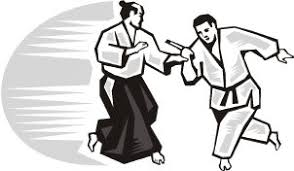
An answer to these questions might be found in Tomiki's explanation of his introduction of shiai (randori) into his aikido.

Tomiki was a student of Jigoro Kano, founder of Kodokan Judo, and was eventually graded 8th dan by the Kodokan. He became fascinated by Morihei Ueshiba’s aikido and became one his early students. In his ‘On Jujutsu and its Modernisation’, Tomiki argues for two forms of randori training:


When we analyse the essence of attacks, they fall into two general categories:
1. An opponent, from close in, tries to topple (taosu) or restrain (osaeru) you.
2. An opponent, from a distance, tries to strike, lunge at, or kick you, or with a weapon tries to cut or stab you.
...
The system of randori practice that Master Kano formulated is for the situations described in point 1 above; it is the category of nage-waza, where from close in you apply a waza at the collar and sleeve of a Japanese style judo jacket. A system of randori practice where you would avoid your opponent's attack from a distance (as in point 2 above) and then apply a technique would utilize the atemi-waza and kansetsu-waza. Against this latter attack, the attack from a distance, there is a need to establish such system of randori training.


Randori practiced in aikido usually involves two or more opponents. It is not 'free fighting' per se but simply a 'free flowing' attack and defence with no continued fighting. JDJ had relatively little experience with randori training.

Tomiki's shiai (randori) involved an attacker armed with a knife. Did JDJ adopt Tomiki's shiai to continue that the shiai form of grading included in his one-off instructor grading, ikkyu? Did he include these types of gradings in terms of introducing a randori type in ikkyu and a Tomiki type in shodan? Did he include a short stick element because of its use in his pencak silat? ... Why aren't the attackers trained in the use of the weapons in attack mode?

Lastly, my grading, or I should say, our grading. Dave Palmer and my grading, it was something that had not been seen before or since. It was a literal blood bath. Maggie de Jong had to scrub the walls and mop the mats after the grading to remove the blood that had been spilled during the grading. There was a lot of blood.

This has to be expected when you get two real fighters, not just mere martial artists, together and there are no rules, no protective equipment, and when weapons are involved, and told to 'free fight.'

Again, a great deal can be learned from an analysis of my/our grading, however, post length considerations prohibit the sharing of my/our experience and its analysis.

How did Dave and I do in our grading? We passed ... even though the grading ended with Dave being taken to emergency after I punched him in the forehead with a standing fist punch and blood cascaded down his face and the front of his gi. He was attempting to retrieve a weapon that I had knocked out of his hand, and I instinctively punched him when he advanced to do so. He was knocked back the length of a tatami and as he attempted to advance, I instinctively punched him.

We passed even though I was rendered unconscious during the grading when I landed on my head/neck from a sacrifice throw by Dave (btw, great execution of the technique, dangerous, but great nonetheless).

In terms of OHS, our weapons were not taped rolled up newspaper. The knife was a wooden training knife and the tanbo was a piece of PVS piping wrapped in cloth and then taped. When you got hit with those 'training' weapons, you got hit, and the risk of injury increased exponentially. But we wanted to test ourselves, and of course there was no guidance or supervision provided by the senior instructors.

OHS-wise, nobody from the instructors table came to see how I was when I landed on my head/neck from Dave's sacrifice throw, and when a crack from my neck was heard 'like a "roo shooter's" shot' across the dojo, and as I laid on the ground unconscious for a bit. They simply waited for me to rise and continue the grading, which I did, albeit initially by backing off as the fight had become unfair with now two armed Daves advancing on me.

There was no feedback provided at the end of the grading, however, Hymas did approach me (us?) later and said that JDJ was not happy with the grading. JDJ never expressed that sentiment to us. Even then, I thought, 'How can any of the examiners be unhappy with the grading given the complete lack of direction provided by the instructors as to the conduct and purpose of the grading. Given the complete lack of indication as to what is supposedly being assessed.'

Nidan Shiai

'Free fight with tanto vs tanto'

This is the only shiai-type grading where there is an equal footing (see above re the absence of one unarmed v one unarmed). It is an equal footing because the two participants are armed with the same weapon. It is also an equal footing because the two participants have not been trained in the use of the knife and knife fighting. 'What is going on here?'

This is indicative of an issue within the JDJ tradition that I will address in a post associated with the mon grades, and that is that the attackers in the JDJ tradition are not taught how to attack properly. This has implications for the training of defensive tactics. 

I prepared for this grading. I learned from the previous shiai-type gradings that I'd undertaken.

The two attackers in my futari dori grading in ikkyu were Hymas and Dave Palmer. I asked Hymas to be one of my attackers because I wanted to test myself against the best. My strategy was to stay away from Hymas and to focus on responding to Dave's attacks or to attack Dave when Hymas attacked me. On the face of it, it was a sound strategy, however, as it turns out, it was a floored strategy. Dave was by far the more dangerous opponent.

Dave committed to his attacks. Hymas knew everything that I knew and knew the defences that I might employ against his attack, so he provided uncommitted attacks with a focus on countering my defence. This is a problem in this type of grading. I know everything you know, and you know everything that I know, and that knowledge impacts on tactics and strategies employed in the grading. It also leads to questions regarding the practicalities of the tactics and strategies thus learned in terms of 'real world' application.

I used this insight in my grading. I would faint an attack and observe the response. I'd faint it again and observe the response. If it was the same response, I'd attack with the anticipation of the response and adjust my attack accordingly. This became a strategy that I shared when engaged in my Master of Business Administration (MBA) degree. If I can discern your strategy, I can develop ways to defeat you.

I hadn't trained the futari dori grading with Hymas and Dave prior to the grading. If I had, I might have discerned Hymas' approach to his attacking role and developed a different strategy going into the grading, e.g., stay away from Dave and focus on Hymas.

In the shodan shiai grading, Dave and I did train the grading together prior to engaging in the grading. I learned that Dave tended to not acknowledge a strike and would walk through it to attack me.

Confidence isn't necessarily everything, but it is a big thing. On a rare occasion that we 'trained' this grading in the instructors class, I was paired with Darryl Cook. Cook is a very good practitioner. He is a contemporary of mine. He is aggressive and he is taller than me, bigger than me, and stronger than me. He was armed with the knife and I was unarmed, but I was 'all over him.' He had no answers. I actually felt physically taller and bigger than him. It was as though I was looking down on him from a height. Hymas took Cook aside to give him some advice since he observed that I was 'kicking his butt,' as the Americans would say. Cook returned and raised his knife to my face. Order was restored in the universe, my perception of my size returned to reality, and there was no more butt kicking.

I knew that Dave gained confidence when he walked through my attacks and 'kicked my butt.' The strategy going into the grading was to not allow that to happen; not to allow him to gain confidence by walking through my attacks and kicking my butt. The first time he tried it, I was ready. I put him on his 'arse', held him by the throat on the ground with my fist raised ready to 'ground and pound.' He covered up and raised both feet-legs ready to kick me. 

'Matte, matte, matte', JDJ shouted as he pounded the grading table. Hymas jumped up from the grading table and pulled me back ... and all the while, Dave and I were smiling at each other. We knew what this was all about. It was setting the 'rules' for this grading. Nobody had lost control, in fact, far from it, unbeknown to JDJ, Hymas, and whoever else was sitting on the grading table.

My nidan grading involved a number of candidates, all of whom had been my instructors. I trained a little with all of them, only to see how they fought. And then I studied knife fighting, given that there was zero instruction in knife fighting provided within the JDJSDS. Then I developed strategies to defeat my opponents, my instructors.

Memorably, when paired up with Debbie Clarke, a great practitioner and a real fighter, there was a standoff, so I provided an opening by lifting my hands. You will recall this strategy when ken tai ichi no kata was discussed in a previous post. It was a genuine opening and if she was good enough, she could 'kill' me. No takers. I raised my hands a little higher to entice her into attacking. No takers. A little higher, she attacked, I 'died.' Fair enough.

You will recall from a previous post that many, and most definitely the senior instructors, did not look outside of JDJ's teachings. In preparation for this grading, I looked outside of JDJ's teachings given that there were no specific teachings regarding knife fighting within JDJ's teachings. I also thought that this might give me a competitive advantage.

Part of my study re knife fighting was reading Col. Rex Applegate's Kill or Get Killed. The description accompanying the image to the right is:

Attack With Knife From Crouch

Beware of the man who holds his knife this way and who attacks from a crouch, with the blade held close to his body and with his free arm out in front to parry or to help create an opening for a slash or thrust.

Beware me. The following was included in the text:

The trained man will use this knife, in the attack, from a crouch, with the left hand forward and the knife held ... close to the body. The outstretched left hand will act as a guard, a foil or a parry, and will help to create the opening for a slash or thrust. The left hand also may be used to distract the adversary's attention - by waving it in his face, by throwing something, or by making sudden darting motions toward him. ...

Beware me and I was a trained man. I was trained in knife fighting by Applegate and not my instructors at the JDJSDS, even though there was a knife fighting grading in the curriculum which the senior instructors (Hymas, Peter Clarke, and Paul Connolly) had successfully completed. 

I adopted Applegate's approach, at times, with one important addition. When a thrusting attack was launched, I would move from the left foot forward staggered stance (han zenkutsu dachi) to a cross-stance. Or more accurately, sempok from pencak silat (see image below).


I was well versed in this stance having trained pencak silat for quite some time. Most importantly, the training was with Richard de Bordes school in London rather that at the JDJSDS as JDJ had, as he said, Westernised his pencak silat so that it would be acceptable for a Western audience. He had in fact Japanised it so that it resembled karate to a fair degree.    

Moving into this stance from a traditional staggered stance is effectively an evasive body-movement, similar to nagashi (flowing) in JDJ and Yoseikan Budo practice. Interestingly, the image accompanying the Tomiki aikido discussion above shows both aikidoka ostensibly assuming the same stance. The same stance is seen in some karate styles, and it is seen in JDJ jujutsu teachings, however, I would argue that there is less understanding of the use and the structure of this stance in all those arenas than in pencak silat.

Another part of the transition into this stance is that it moves the back hand to the front through the turn of the shoulders. This is also used to great effect in pencak silat. 

Part of my strategy was to employ this tactic, moving from a staggered stance into sempok/cross-stance thereby executing an evasive body-movement and moving my rear knife-wielding hand to my front hand and a trusting attack. It was part of my strategy because the other candidates, my instructors, had not seen it before. 

Memorably, this tactic was employed against the abovementioned Debbie Clarke.

Debbie lunged forward and I executed the move. She was going to barrel into the now thrusting knife, which was a molded metal knife, and she was in danger of being 'impaled' on impact. I relaxed my grip and as impact occurred, the knife slide through my hand and fell to the floor. It was beautiful, it was perfect ... and it was missed by JDJ. A clean 'kill', and it was not recorded. 

JDJ took me aside after the grading and told me that I was the best in the grading. But all that meant was that I knew 'how to play the game' better than my instructors. I learned how to knife fight to some degree whereas they did not due to lack of instruction. I learned a fantastic move and had a greater appreciation for the use of sempok as a fighting tactic. But is that what this grading is designed to impart to students?

Before we leave this section, I was present when two JDJ yudansha engaged in this grading. One has since gone on to be awarded Rokudan by a JDJ ryuha principal. The other had his own ryuha and was a 'fighter.' They 'fenced' with the knives, like one would when fencing. Tapping against each other's knives as fencers tap against each other's swords. I was astounded. Why would anyone consider this approach, particularly given that they were supposedly highly experienced and graded martial artists? But here's the thing, how can you fail them, even though the performance was ludicrous, given that no training nor instruction is given in knife fighting even though this is a knife fighting grading in the grading system. 

Sandan Shiai

'Free fight with tanbo vs tanto.'

What is not included in the description of this grading is that the roles are swapped, as in the shodan shiai grading. And as in the shodan shiai grading, the person with the tanbo annihilates the person with the tanto. And as in the nidan shiai grading, the candidates are not trained in the use of fighting with either weapon.

What is the point, other than including shiai-type gradings into the dan grading system and populating the dan grading system given the relatively comprehensive ikkyu grading?

Conclusion

Unlike my instructors, I can teach students how to go about these gradings, but still, what is the point? I can, and have done, train them to defeat the students of other instructors, hands down, but what is the point? 

These gradings in the JDJ grading system are seriously floored, but here's the thing. If they are removed or 'fixed', the lessons learned through the above analysis are lost. The insights that can be gained are lost. The new and better understanding that can be derived from those insights are lost. It is a quandry, conundrum, and other such words to describe this situation.

What would you do?

Thursday, 13 October 2022

JDJ Jujutsu Grading Analysis Series #4: Kubitsukami Shime

This post will take a break from the Jan de Jong jujutsu grading system analysis per se and focus on an element present throughout the shinken shobu no kata (SSnK) gradings: kubitsukami shime.

Kubitsukami shime is a category of attack that is included in JDJ's jujutsu SSnK gradings. 

You will recall from the first post that the format of JDJ's SSnK gradings is primarily based on attack-types, e.g., kubi shime (neck strangle), tsuki (punching), sukui (scooping), keri (kicking), etc. ...  kubitsukami shime. 

You will also recall from that post that the shodan SSnK grading is unique in being based on a matrix of attack and defence types. The kubitsukami shime attack-type category in that grading includes atemi waza, kansetsu waza, and nage waza defence-types. 

NB: There is no kubitsukami shime defence category in that grading.

Google '"kubitsukami shime"' and you will get zero (0) results. Google 'kubitsukami shime' and you will get 66 results, the only one of which is relevant pertains to Yoseikan aikido in which it is translated as 'neck strangle.' 

The more common kubi shime used in the martial arts is translated as neck strangle. What is the difference between kubitsukami shime and kubi shime?

Kubi is translated as 'neck' and tsukami as 'grip' or 'grasp'. Kubitsukami means to grip or grasp a person's neck, in this case with one's hands.


Kubi shime is most often used to refer to a class of technique taught in the martial arts, combat sports, and close combat that does not involve strangling by placing one's hands around another's neck.


The use by JDJ of kubitsukami shime to describe a specific class of attack distinct from the more commonly used kubi shime is (a) unique in the martial arts world, and (b) an illustration of the thought and effort that JDJ put into the development of his grading system. 

There is another difference between kubitsukami shime and kubi shime in this case. Kubi shime techniques are trained as defensive techniques. There are no kubitsukami shime techniques taught as defensive techniques. There are no 'throttling' techniques with the hands taught as defensive techniques.

So what, you may ask? So what indeed.

I observed a class being taught a defence against a straight-arm kubitsukami shime on the ground in the shodan grading to senior students. They were all struggling to perform the defence. 'What's going on here?'*

I was mentoring two of the abovementioned students for their shodan grading. Following the abovementioned class, I asked those two students to demonstrate the defence from yellow (rokkyu, sixth kyu, the first grading in the kyu system) from ostensibly the same attack. They struggled to perform the defence. 'What's going on here?'*

I demonstrated the effective attack for the yellow defense on one of the students and (a) the look of surprise and fear on his face was something to (sadistically) behold, and (b) it facilitated the effective performance of the defensive technique. It made it work and it made it easy to make it work.

In this case it was a straight-arm strangle from the side on the ground. The ineffective attack involved uke sitting back on their heels with their arms at less than 90 degrees and the hands placed half-and-half on tori's neck and triceps. The effective attack involved uke's hands on tori's throat with uke being positioned directly over tori's throat, pushing downward over arms at 90 degrees, thus applying their bodyweight behind the attack. Uke was no longer sitting back on their heels which opened up the area under their body for tori's knee to be inserted.

The ineffective attack prevented tori from executing the defence. The performance problem was not in the defence, it was in the attack. This was a light-bulb, eye-opening moment for these two prospective black belts. It was a revelation; a moment of insight*: performance problems may reside in the attack and not in the defence.

The same was true for the shodan defence, except that the attack was similar but different. The students in the abovementioned class were struggling with the shodan defence because, once again, the attack was ineffective. The question they (and the instructor) should have been asking themselves is, why are they doing a different defence from ostensibly the same attack? In this case it was because the attack, the effective attack for yellow, involves uke's bodyweight being positioned slightly differently in the case of the shodan defence (although they were still making the same mistakes as in the yellow attack).

This is an issue that is present in this particular ryuha. It is present in the ryuha from which this ryuha was derived. It was present in the Jan de Jong Self Defence School. The students did/do not know how to attack properly in these circumstances, and they were/are not taught how to attack properly.

This is not an issue most of the time. The defensive techniques that students are taught are often used as attacking techniques as well. The classic in this case is that the defensive kubi shime techniques students are taught are used as attacking techniques. This of course raises other issues concerning what students are being taught to defend against; an issue that will not be explored here.

Recently I saw a photo on Facebook of a class being taught defences from a standing bent-arm strangle. Sure enough, the hands of the attacker were positioned more towards tori's triceps than around their throat. Great for a massage but not so much for a 'throttling' action intended to do harm. This has implications for the defence as taught and trained in terms of its effectiveness against a 'real' attack. Will the defence as taught and trained against an ineffective attack be effective against a real attack intent on doing harm?

Towards the end of my teaching for JDJ, he said that my students performed the best in the school in their gradings. Part of the reason for that was (a) I identified the above issue, and (b) I taught the attack before I taught the defence. The defence is not only effective in that case, it is also easy to perform because that is what the defence is designed to defend against.

In addition, I taught the student that performance problems can reside in the attack and not the defence and the first place to look to correct performance problems is in the attack. This is insight that leads to a new and better understanding of all of the teachings being taught*.

This same issue is, frustratingly, illustrated in downward strikes with a short stick/baton/tanbo. More times than not, I've seen uke attempting to strike tori with the butt of the weapon closest to their hand rather than the end of the weapon. This at the very least creates a distancing issue. The trained, instinctive, response to the attack will be 'short' of an actual attack meaning that the defence is more than likely to be ineffective in a 'real life' attack.

In this case, this is the odd thing. Get the student to hit an inanimate object and they'll do so properly. Get them to attack another person in the training environment and their attacks are as described above.

The lesson is simple: teach students how to attack properly! The product of this change in teaching will be better students who progress faster and suffer less frustration due to poor teaching. This of course requires instructors to know how to attack properly for the defence being taught. This is a separate issue.

*Insight leads to a new and better understanding. It is a new understanding because it did not exist before, and it is a better understanding because it is more accurate, more comprehensive, and more useful than the one that existed before. 

One of the paths to gaining insight that leads to a new and better understanding is curiosity, which is described in terms of a 'What's going on here?' reaction.

(Klein, G. 2013. Seeing What Others Don’t: The Remarkable Way We Gain Insights. New York: Public Affairs.)


Tuesday, 13 September 2022

JDJ Jujutsu Grading System Analysis Series #2: Shodan Shinken Shobu no Kata #1

This post is the second in a series dedicated to an analysis (or limited exploration) of the Jan de Jong jujutsu grading system.

The core of the JDJ jujutsu grading system is the shinken shobu no kata (SSnK) gradings.

The phrase shinken shobu no kata was probably appropriated from Kodokan judo which has an actual kata that goes by that name*.

Shinken shobu is translated as 'real fighting' and so SSnK is a kata of real fighting, which is the intended purpose of JDJ's SSnK gradings. 

The Kodokan SSnK is a traditional kata where a series of specified attacks and defences are demonstrated. 

JDJ's SSnK in his gradings is a kata in the sense that there are a series of prescribed attacks and defences, however, they are 'demonstrated' in a random order as directed by the examiner without tori's (executor of defence) knowledge (not in a Cato Pink Panther fashion 😀). Tori stands with their back to the examiner who signals a specified attack to uke ('receiver' of defence) at random which tori is expected to respond with the required defence.

This type of grading, and indeed training, is designed to simulate a 'real' attack-defence situation. On a continuum from solo kata to 'free fighting,' this type of training is designed to rest more towards the 'free fighting' end of the spectrum.

Where JDJ got his SSnK format from is a mystery. The closest that I have seen to it is Mas Oyama's Kyokushin karate's one-step sparring. 

The following is an analysis of the JDJ jujutsu grading SSnK attack-defence combinations:


There is a 146% increase in the number of attack-defence combinations from ikkyu to shodan before reverting back to the norm in nidan and sandan. 'What's going on here?'

One possible/probable answer to that question may lay in an understanding of the development of the JDJ jujutsu grading system. 

The JDJ jujutsu grading system was developed piece-meal based on JDJ's needs at the time.

JDJ commenced teaching jujutsu in Perth in the 1950s and needed a grading system, so he developed one from rokkyu to ikkyu. He had no need for a shodan grading because he was the only instructor and his students were a long way off completing the kyu system that he had developed.

As students were graded ikkyu and were instructing in his expanding school ... here we can put to bed an 'urban myth' propagated by some of JDJ's senior students and instructors over the years (I'm still being asked the same question from students and instructors of JDJ's ryuha (branch of the stream) these days). It was/is suggested that JDJ did not grade anyone shodan at that time out of fear that they would go off and teach in competition to his own school. That is ascribing a devious nature to JDJ, which may or may not be true, however, it would also suggest some forethought on JDJ's part which was definitely not part of his psychological makeup. 

JDJ was a product of his experiences during WWII  and his focus was on the here-and-now. The motto he lived by could be expressed in: 'Yesterday is history, tomorrow is a mystery, today is a gift. That's why they call it the present.' JDJ lived in the present.

JDJ visited Europe in the late 1970s to explore the jujutsu scene there. He found a vibrant scene and that many were extremely interested in his teachings, however, he also found that all of the instructors in Europe were black belts and he had none; so he developed a shodan grading to produce black belt instructors that could accompany him to Europe. 

The first black belts (3) were graded in 1981 and the second wave (4) in 1982. JDJ's first teaching tour of Europe was conducted in the European summer of 1982, accompanied by most of his newly minted black belts.

JDJ's shodan grading was developed as a one-off grading with no thought as to a dan grading system. It was also designed to produce instructors

The traditional approach of the Japanese martial arts is that shodan means that the student has mastered the 'basics' and now the 'real' learning begins. That is why in most Japanese martial arts there is relatively few gradings before shodan and then they are relatively basic. This is in complete contrast to JDJ's pre-shodan gradings.

An 'instructor' in the aforementioned martial arts is at least sandan if not godan. JDJ needed black belt instructors so he developed a shodan qualification that might be equated to those martial arts sandan-godan levels, at the very least. A unique feature of the JDJ dan grading system is that it is designed to produce instructors; most if not all other martial arts grading systems are not so designed, in which case, where do their instructors come from?

JDJ's senior instructors were graded shodan whereas mid- to senior level instructors in Europe were more highly graded. JDJ considered his senior instructors to be at least the equivalent of the more highly graded instructors in Europe and so wanted to 'upgrade' his senior instructors. He was, however, hampered by the idea that in the style of jujutsu that he learned from his original instructors, shodan to sandan were technical grades and that all higher grades were awarded on an honorary basis. So JDJ had to develop nidan and sandan grades before he could promote his senior instructors to higher grades. This he did.

The first nidan was awarded in 1991 (10 years after the first shodan) followed by the first sandan in 1999 (nearly 10 years after the first nidan) when JDJ's health was in decline and he needed a sandan grading so that he could award his senior instructors higher honorary grades before he passed away. JDJ awarded his three senior instructors rokudan (sixth dan) in March 2003 and he passed away in April 2003.

Aside from the number of attack-defence combinations in the shodan SSnK grading anomaly which is illustrated in the graph above, there is another anomaly in that grading.

The structure of all of the SSnK gradings, with the sole exception of the shodan grading, is based on attack-type categories, e.g., kubitsukame shime, kubi shime, atemi waza, etc. 

The shodan grading, and only the shodan grading, was structured in the form of a matrix. Attack-type categories were juxtaposed against defence-type categories, e.g., kubitsukame shime attack-type divided into atemi waza, kansetsu waza, nage waza defence-type categories. This matrix needed to be populated with attack-defence combinations. The addition of the defence-type categories to the grading structure necessitated an increase in the number of attack-defence combinations included in the grading, hence the disproportionate 146% increase.

These insights, this new and better understanding that arises from these insights, has significant implications for those who teach in the JDJ tradition, the JDJ ryuha, which will be explored in future posts.

*The Kodokan SSnK is known as kime no kata in Kodokan judo, which is translated as 'kata of decision' or 'forms of decision.' JDJ used the phrase KnK in his dan grading system to refer to revision gradings. 

Sunday, 16 August 2020

The Quandry of Advanced Adolescent Students

The following is another couple of photos in the series of photos that Sensei Dan Newcombe, founder of Self Defence Central Dojo and Tsutsumi Hozan Ryu International, generously contributed to this blog for those interested in the Jan de Jong story.

If I remember correctly, the front row from right to left is, Jan de Jong, Dan's father, and Dan's uncle. I could be wrong (not about JDJ of course) and I expect Dan to correct me if I am. Can anyone identify any of the students in the back line? You will of course notice that the badges on the uniforms are not so uniform.

The photo was taken at the Swan River Rowing Club dojo so the photo was taken mid to late 1950s.

Tori in the above photo is Dan's father from the previous photo and uke is a teenage Margaret Kellond who would go on to become Margaret de Jong.

When I look at that photo, I see a kid executing a good throw on an older and larger opponent. This reminded me of an issue we had at the Jan de Jong Self Defence School. How do you retain advanced adolescent students?

I remember training in Saturday afternoon classes under Sensei Peter Clarke and one of the advanced students was a young lad that resembles Dan's father above. He was orange belt as we all were but he was half our size and a lot younger. His straight punch would hit me, literally, just above my groin he was that short. He ended up leaving the club after becoming frustrated training with adults.

How does an advanced adolescent student continue to advance? Or is it expected that they 'stay put' until their bodies catch up with their advanced grading standing?

I know some schools have a 'kids' system even right up to black belt, but is that the way? Only those in that school would understand a junior black belt is different to a senior black belt.

I taught the only teenager's class in the JDJSDS. It was conducted late on Saturday mornings and had the most consistent and longest serving body of students in the school. They were all small teenagers, male and female (in truth the females were better technically and in terms of fighting attitude), and all were advancing. I didn't just teach them, I trained them. We had good teachers in the school but very few who could train students. The last grading I trained them for, as a class, was blue or green belt. Unheard of in the school, the entire class graded together and excelled together. Jan de Jong was mightly impressed.

I then had to have surgery on both shoulders, separately because I agreed with the surgeon that I did not have any friends who would be prepared to wipe my backside after going to the toilet if I had both shoulders operated on at the same time. Maggie de Jong disbanded the class. Her reasoning was that at that level they should be training in the advanced adult classes ... but their bodies were not ready for it. They would have to have made adjustments to most if not all techniques if they were to train with adults. Within three months, none of the students remained with the school.

It is a dilemma. How do you retain advanced adolescent students?


Wednesday, 22 April 2020

Training and COVID-19 Restrictions

Jujutsu involves contact. Throwing techniques, takedown techniques, joint-locking techniques, strangulation techniques, unbalancing techniques - they all involve physical contact. Does that mean that you cannot train them during the COVID-19 isolation restrictions?No! In fact, you can use this time to become more efficient and effective when you have the opportunity to train with a partner again.

When I reconnected with Shihan John Beckman over Facebook, he remembered me because I was extremely precise in my movements when executing defences. He was not wrong. I was very precise in executing my defences. I'd trained to be very precise. The way I trained was a very efficient training method which did not necessarily involve any other physical presence.

During my work annual leave I would go to the 996 Hay Street dojo and practice by myself. I'd practice the defences without the physical presence of an 'attacker.' Wrist twist from a low punch. Enter rotate rotate. Enter rotate rotate. Enter rotate rotate. Over and over again. By myself.

I built so-called muscle memory of the movements involved. I trained myself to move fluently and precisely. When it came to executing that defence against a physically present attacker, I didn't have to think about those movements. All I had to focus on was fitting in with the attack and applying the force in the right place in the right direction.

It's like learning to drive a car. Everyone should start off with an automatic. That way you can focus on the road without worrying about how to change gears. When you've got driving on the road down pat then you start learning to drive with a manual because you no longer have to think about driving on the road. It's automatic.

Train your grading. Go over each defence over and over again. This way you won't have to try and remember your grading, the defences in your grading. Top to bottom, over and over and over again.

'It's boring.' Training only begins when it is boring. If it is still exciting then you haven't done it enough. If you want to be entertained go and watch Netflix or play on your game console. If you want to train, train until it's boring and then train a lot more. Train until it becomes 'mindlessness.'

Take this opportunity to become better at what you do and to be more efficient and effective in your training when the isolation restrictions are lifted.