In the last blog we'd left Jan de Jong and his new family leaving the Hunger Winter of Holland to return to the warmer climate of Indonesia.
Indonesia had been occupied by the Japanese during World War II. Two days after the Japanese surrender to the Allies, the Indonesians seized the opportunity of the Netherlands situation to declare independence. British forces landed to disarm the Japanese and 'to maintain law and order until the time that the lawful government of the Netherlands East Indies is once again functioning.' Prior to the arrival of the British forces, the Dutch Lieutenant-Governor of the Indies met Lord Mountbatten in Ceylon and asked that Japanese troops still in Indonesia be ordered by the British to suppress the Republican government. Mountbatten agreed but the Japanese delayed. Prior to their repatriation, the Japanese forces did, indeed, fight Republican forces and hand over the territory won to the British forces.
The British forces found themselves in conflict with the fledgling Republic who, when confronted with all out combat from the sea, air and land from the British (assisted at times by the Japanese), decided to withdraw from urban battles and adopt a guerrilla campaign. The Dutch, under the pretext of representing the Allied forces, sent in troops to regain control of their former colony in what was to be their largest military effort in their history. After more than four years of bloody conflict where human rights abuses abounded on both sides, the Dutch formally transferred sovereignty to
Republik Indonesia Serikat (Republic of United States of Indonesia) on 27 December 1949. The Royal Netherlands Indies Army (KNIL) were officially disbanded six months later.
No sooner had Independence been won then the new Republic had to face numerous armed challenges. The Darul Islam terrorised the countryside of West Java in their move to establish an Islamic State. The former Dutch army captain Turco Westerling band claimed the lives of thousands of innocent lives. Outside Java, demobilised ex-colonial armed men who remained loyal to the Dutch crown staged a revolt and proclaimed 'the Republic of South Malaka'. There were also various separatist movements and the Indonesian Communist Party all pushing their separate agendas through violent means.
This was the Indonesia De Jong returned to in 1946 and lived in for the next seven years. He was initially posted to Jakarta but was soon reassigned to his hometown of Semerang. He was mostly unsuccessful in locating people from his past but was fortunately reunited with his parents and brother who had survived the Japanese camps. His father told him that one of the Saito brothers (his former Japanese jujutsu instructors) had helped him when he was interned but no news was ever heard of his former instructors again.
De Jong commenced teaching jujutsu in Jakarta and Semerang, though it was never in any sustained way. The previously mentioned student of De Jong, Kees van Deijk, had ceased training in 1947. He joined the KNIL as a sergeant-major and was posted to Jakarta, Indonesia. Van Deijk wrote to me and described their improbable meeting in Indonesia after WWII:
One day when I was in my office I heard a well-known voice. Who was sitting about five metres next to me? Jan. We looked at each other, astonished, meeting in Indonesia, how was it possible. To make a long story short: after talking with each other for hours, Jan and I decided to give a jujutsu demonstration in the Army hospital at Jakarta. We did it together with my fencing teacher, Dick Trouvatt, and these demonstrations were so successful that we did it twice. Thereafter I lost connection with Jan until 1994.
He went on to say in his correspondence to me:
'Now that I am writing I see Jan before me (often with his smile), who gave me jujutsu lessons, which formed a part of my character in my life. I'll never forget him!'De Jong turned his attention to learning the indigenous martial art of Indonesia,
pencak silat ('silat'). He had been introduced to silat during his school days but had not trained it in any depth.
Just as with his jujutsu instruction, it wasn't simply a matter of locating a school and enrolling for lessons. He asked his barber if he knew of a good teacher, a Guru, who might teach him. The barber told him he knew a man who knew a lot about silat and a little while after that brought him to his house. This man,
Soehadi, visited De Jong on a number of occasions where they would talk about various matters. On one occasion he asked, 'why do you want to do silat? You’re a white boy, you should be doing tennis or something like that.' De Jong replied, 'because it's in my heart to do so.'
On some of the visits to De Jong’s house, Soehadi would be accompanied by other men. Unbeknown to him, they were leaders of the
Suci Hati aliran (
Suci Hati is Indonesian for ‘pure heart,’ and
aliran refers to the same concept as
ryuha). It was usually the custom for the applicant to be brought to the elders, but due to the War of Independence being waged and De Jong being a Dutchman attached to the KILN, Soehadi thought it judicious to go against custom and bring the elders to him. After a number of months, Soehadi informed him that the elders considered him of good character and acceptable to them for inclusion into their
aliran and that he was to be his Guru. As it turned out, Soehadi was the chief guru for all of middle Java, but he had never mentioned that he even trained silat, let alone was a guru of some note.
Training was conducted three times a week in a garage and was initially on a private basis due to the conditions of the times. About a year after he'd started training, Soehadi told De Jong that permission had been granted for him to meet 'the brothers'. The two men journeyed up Mount Ungaran, about 15 miles from Semarang and arrived at a house which had a picture of Sukarno (leader of the Indonesian's struggle for independence) on the wall and 'the brothers' all sporting long hair. He realised he was deep in rebel held territory and the long-haired Indonesians were
persuda (Indonesian for youth), young freedom fighters operating in fierce gangs and who had vowed not to cut their hair until all the Dutch had been driven out of Indonesia. The bond between members of an
aliran is exceedingly strong and appears to transcend nationalistic concerns.
Given the Indonesian culture and temperament, training was a lot more relaxed than under the Saito brothers. De Jong was very fit and very experienced in combative arts so he was able to pick up the skills of silat very fast. Gradings consisted of various senior members of the
aliran observing the training and deciding that a higher grade would be awarded. De Jong said he was awarded the equivalent of sixth degree black belt in 1951.

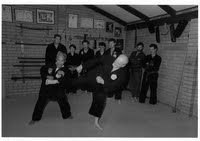
Soehadi and De Jong lost contact when De Jong emigrated to Australia in 1952. Nearly thirty years later Soehadi recognised his former pupil on television giving a jujutsu demonstration in Indonesia. He wrote a letter addressed to: 'Jan de Jong, Perth, Western Australia', and despite the limited address it found its destination. In 1986, De Jong’s students raised the funds to fly Soehadi to Perth for a reunion. The photograph above was taken at De Jong's dojo at his home and has the elderly Soehadi blocking a kick by the elderly De Jong. The photograph to the right is of the same elderly Soehadi demonstrating his silat at the same location. Elderly but ever so sprightly. The person kneeling furthest to the right is
Peter Clarke in the photograph to the right is the Clarke mentioned in the first blog concerning the school of Jan de Jong. In addition to being graded sixth dan in jujutsu, he was also the highest graded pencak silat student/instructor of De Jong (in addition to dan grades in aikido).
During these years, De Jong was practising as a physiotherapist at the hospital in Semerang. His third child and second son,
Hans de Jong, was born at the same hospital (1950 I think). In later years I would have occasion to visit that hospital and the room where De Jong practiced his physiotherapy, but that is a story for another blog.
After living with the risks and stresses associated with
living in a theatre of war for twelve years, and now with the added responsibility of a young family, who had themselves been threatened by armed bandits during a home invasion, De Jong decided to emigrate. Through his aversion to cold climates born of the Hunger Winter, he narrowed his choices to South Africa, South America and Australia. Perth won out due to its political stability, language, and of course, warm climate.