Showing posts with label WJJF. Show all posts

Saturday, 30 December 2023

The Development of the JDJ Jujutsu Grading System Part 2.5: Shodan (Part 4.3: Ken Tai Ichi no Kata)

This post looks at the individual attack-defence sequences in ken tai ichi no kata taught by Jan de Jong (JDJ).

From the post 'Part 2.3: Shodan 4.1 Ken Tai Ichi no Kata': 

The JDJ jujutsu grading sheet reads:

1. Yoko Tekubi Hishigi: Tori – Seigan Kamae, Uke – Seigan Kamae
2. Ude Kujiki: Tori – Seigan Kamae, Uke – Gedan Kamae
3. Tekubi Te Nage: Tori – Seigan Kamae – Gedan Kamae, Uke – Jodan Kamae
4. Ude Hiji Nage: Tori – Hasso Kamae, Uke – Hasso Kamae
5. Ura Tai Otoshi: Tori – Gedan Kamae, Uke – Gedan Kamae

The first phrase represents the unarmed technique that is being demonstrated. The tori and uke kamae description refer to the ‘combat engagement posture’ (see Donn Dreager) for the sword attack-defence sequence.
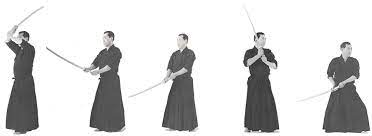


An example of the JDJ kata was posted on YouTube by the Hans de Jong Self Defence School (HDJSDS), a JDJ ryuha.

We saw in the post titled ‘Ken Tai Ichi no Kata Example’ that ken tai ichi no kata is a Yoseikan Budo (YB) kata. An example of the YB kata was posted on YouTube as part of a larger video taken from the Yoseikan Sogo Budo DVD set by Minoru Mochizuki, the founder of YB. The ken tai ichi no kata is located at the 22:40 mark in the aforementioned YouTube video. 

The order between the JDJ and YB kata is different as reconciled in this post.

The YB kata consists of five sword v. sword, five unarmed v. sword, and five unarmed v. unarmed attack-defence sequences. The subtitles on that video refer to these sequences as ken (sword) and tai (unarmed), thus: ken-ken, tai-ken, and tai-tai. Those are the terms that will be used in this post.

JDJ did not include the tai-ken sequence in his ken tai ichi no kata. The reasoning behind that omission was explored in this post.

The following commentary will be initially based on the HDJSDS Jan de Jong Self Defence School (JDJSDS) representative video (see above). 

The core of all learning - the identification of similarities and differences - will be used in order to provide insights that can lead to a new and better understanding through asking, 'What's going on here?' (see Klein).

Nomenclature
The first thing to note is that JDJ sometimes uses a different nomenclature than that commonly used in the Japanese martial arts. For instance, most use kote to refer to wrist whereas JDJ uses tekubi. JDJ's tekubi te nage (wrist hand throw) is more commonly known as shiho nage (four corner throw) in aikido. What's going on here? Exploring why JDJ uses different nomenclature is another anomaly and a potential rabbit hole that I am going to avoid at this time.

1. Yoko Tekubi Hishigi (Side Wrist Crush): Tori – Seigan Kamae, Uke – Seigan Kamae
Tori
assumes seigan kamae, which a previous post explained is a totally defensive posture. This means that uke has to either move tori's sword off-line in order to attack down the line or to move off the line to attack in order to attack. In this case, uke moves tori's sword off the line in order to attack down the line. This is a tactical lesson that if generally not shared/taught. Why not?

This kata is generally learned and taught solely as a requirement of the shodan grading. It is not used as a teaching-learning tool for broader insights and understanding. Nobody studies this kata (other than me) other than in relation to satisfying a performance requirement in the shodan grading. It will be seen through the following analysis that a great deal can be learned from the study of this kata, which includes the flaws in the kata.


Tai-tai
- the technique is called kote kudaki (wrist crush) in the YB video. The attack is a wrist grab which is then countered, recountered, and countered again. Back, forward, back, forward ... JDJ's yoko tekubi hishigi (side wrist lock) is applied more directly without the toing and froing. Was this a deliberate change by JDJ to make the tai-tai technique more efficient and effective/practical?

The JDJ technique involves an initial unbalancing (kuzushi) move; one that is actually taught in YB. Giving tori the benefit of the doubt in the HDJSDS video in terms of unbalancing uke before applying the technique, the unbalancing is different to the ken-ken technique. With the ken-ken technique, there is a deflection of the sword, however, with the tai-tai technique, there is a physical unbalancing of uke which is unavailable in ken-ken. Rather than attempting to demonstrate the similarities between sword and unarmed techniques, would a more complete understanding of tactics and techniques be provided by identifying the similarities and differences between sword and unarmed techniques? 

2. Ude Kujiki (Arm Crush/Breaking): Tori – Seigan Kamae, Uke – Gedan Kamae
The HDJSDS video reflects the tori ken kamae as described above, which is as per the grading sheet, however, we saw in a previous post that (a) the grading sheet was not complete, and (b) uke would not advance on a ken seigan kamae without deflecting the sword first. At the very least, the instructor and the candidates should have said, 'That can't be right,' which is Klein's operationalisation of the contradiction path to gaining insight. The candidates might justify their performance in terms of doing what they've been taught, even if they question such teachings, however, that does not excuse the instructor's lack of understanding. This situation was also present in the JDJSDS at times, e.g., the JDJ misremembering the attack in the final ken-ken sequence discussed in a previous post dedicated to that issue.

The ken defence involves an evasive body-movement (EBM) and a 'brushing block' in the JDJ and YB demonstrations. What is the purpose of the brushing block? It's not to avoid injurious contact with the body because the EBM takes care of that problem. Why not just use an EBM and a strike? This is an issue that appears time and time again, in JDJ techniques and that of other jujutsu schools and martial arts. Sometimes there are answers, sometimes there are reasons, but more often than not there is shoehorning.

This issue will be explored more thoroughly, including the concept of 'blocks', in a future post when discussing the mon system.

A final comment. Tori finishes the defensive performance with a dramatic flourish of the sword. JDJ would, quite rightly, not approve. Tori is training to miss the target. With enough training, they will become expert at ... missing the target. This is an issue that is reflected in weapon attacks within the JDJSDS and the JDJ ryuha. A poor weapon attack affects the distancing and thus the student is training poor distancing that will negatively affect the effectiveness of the defence against a real attack.

Think of the sword training scenes in The Last Samurai were Ujio and Cpt Algren finish with their bokkens placed on each other's necks when they draw in their contest.

3. Tekubi Te Nage: Tori – Seigan Kamae – Gedan Kamae, Uke – Jodan Kamae
JDJ's tekubi te nage is aikido's shiho nage

In the YB ken-ken and tai-tai sequences, tori move to the inside of uke. In the HDJSDS/JDJSDS tai-tai sequence, tori move to the inside of uke but in the ken-ken sequence they move to the outside of uke. 'What's going on here?'

The YB sequences demonstrate the similarities between the armed and unarmed techniques by moving the same way. What is the JDJ sequence demonstrating?

Did JDJ deliberately change the ken-ken sequence? If so, why? Maybe it was a tactical decision. Maybe he considered tori moving to the inside and turning their back on uke was not tactically the best move and thus changed to moving on the outside instead. But doesn't that negate the similarities demonstration purpose of the kata?

Is there a need to change the ken-ken sequence back to the original? Or should we, instead of focusing on similarities, also be considering differences. Differences between ken and tai techniques. Differences between JDJ and YB techniques. Not just identifying the differences but exploring possible explanations for those differences. Exploring answers to the 'What's going on here?' question that may give rise to insights that provide a new and better understanding.

Btw, I identified this difference when I was being taught the kata for my grading and raised the issue with my instructors, the senior instructors in the JDJSDS. I received no answers, and so I did what I was taught for the sole purpose of passing the grading.

The same issue regarding the dramatic flourish with the sword when finishing the technique in the HDJSDS video is present in this demonstration. It's training to miss the target.

Finish Here
I'll finish here as to complete a full analysis would entail an even lengthier post where a lot of the same ideas emerge. Many of the same issues arise in the analysis of the remaining two sequences. 

For instance, in the final sequence, there was an error in the teaching of the ken-ken sequence that was discussed in this post. There is also a difference in the tai-tai sequence between (a) the HDJSDS/JDJSDS and YB tai-tai technique, and (b) the ken-ken and tai-tai techniques in the JDJ demonstration.

The effectiveness of the YB tai-tai technique is questionable. The technique should probably cause uke's back to arch 'limbo' style as tori's hand is driven down and behind tori thus lifting uke's head with the crook of their elbow. JDJ would have no 'truck' with that technique. 

For JDJ, there was only one way to perform mukae daoshi (known in aikido as irimi nage), and that was for tori to project their hand-arm upward, never downward. What this means is that JDJ's mukae daoshi relies 100% on the momentum of uke, which is facilitated by tori's unbalancing technique. The unbalancing is around the corner in the tai-tai case for this technique but is not required in the ken-ken case. 

Through the above analysis, the reader should now be able analyse the kata using the identification of similarities and differences as the base of that analysis. They should also be encouraged to question teachings when 'What's going on here?' or 'That can't be right' reactions are experienced, if they are experienced that is. The reader should now be aware of the tendencies to shoehorn answers when possessing no insights and real understanding of their own. 

What to Do?
What should be done? Should the JDJ kata be changed to reflect the original YB kata? Should the errors in the JDJ and YB kata be corrected? Should the kata be eliminated from the grading system as it seems to serve no useful function*? After all, JDJ's grading system is overly burdensome and overly cumbersome as has previously been explained. Would the student be better or worse off if the kata was not included in the grading system?

Here's the thing though. If the errors are eliminated; if the differences are eliminated; then so is the opportunity of gaining insights and a new and better understanding. There are numerous lessons that a study of the JDJ kata can teach, but the most important lessons are in the apparent faults and flaws, the differences. Those differences include those between different interpretations, different martial arts of the same genre, and different martial arts.
_______________________________________

*In a previous post, I speculated over the purpose of JDJ's inclusion of this kata in his shodan grading. One of the reasons may have been/probably was to be able to demonstrate some weapon techniques when teaching in Europe. You will recall that the sole purpose for developing the shodan grading was so that JDJ could have black belt instructors accompany him on his teaching tours in Europe.

JDJ shared with me that there were no, or very little, weapon techniques being taught in jujutsu in Europe before he began teaching in Europe. After that, there started to appear more and more weapon techniques being taught, particularly in World Ju Jitsu Federation affiliated schools as it was those schools that he primarily taught for.

Marketing 101 - differentiate the product. Everyone taught a hip throw, but nobody taught sword techniques. Jujutsu is supposed to be the product of the samurai, whose primary weapon was the sword. The link to the past, the link to the warrior tradition were sword techniques. And there was the supposed lesson of demonstrating the similarities between sword and unarmed techniques in these warrior arts, suggesting a deriving origin of the unarmed techniques. As a marketing tool, it was genius as the target audience had not been exposed to YB. 
    

Wednesday, 16 October 2019

Jan de Jong's Shodan Grading

I recently had reason to study the Jan de Jong grading system and it proved quite enlightening.

Sensei Greg Palmer (my mentor) often said that in most Japanese martial arts systems, shodan was where you were considered to be a student but in JDJ's system, shoden was a 'master' grading. Greg was of course correct, however, my research now supports and adds substance to that contention.

The traditional 'rank' system in the Japanese martial arts is the menkyo kaiden system. Menkyo kaiden means teaching license and the licenses were awarded at the discretion of the soke of the system.

Jigoro Kano introduced the dan ranking system in 1883 when he awarded dan grades to two of his senior students. There were no formal examinations and they were awarded at  Kano's discretion. While the new dan ranking system retained the discretionary nature of the menkyo kaiden system, it did not signify mastery as the latter system did.

Kano was a professional educator and based on his professional experience he later introduced formal requirements and examinations into his Kodokan Judo grading system. It is not known when Kano introduced the formalised requirements and examinations for gradings in Kodokan Judo.

JDJ was graded sandan by his instructor, S. Saito 8th dan, in the 1930s. Folk lore has it that this grading was the final 'technical grading' in the system, however, there were no formal requirements nor examinations. The awarding was at the discretion of Saito. It was a Kano dan-menkyo kaiden system.

The first grading system for JDJ is seen in his seven kyu grades being taught in 1950. Where he was introduced to a formal examination system for his grades is unknown. It could have been while training with judoka in Holland during WWII. It could have been through the study of martial arts books that he commenced collecting during the same period. Either way, the JDJ grading system consisted of seven kyu gradings in 1950.

In 1978, JDJ introduced the mon system at the front end of his system and significantly modified ikkyu (blac & white). This is what JDJ had to say about that modification to his grading system when he answered Mike Clarke's question whether it was a good idea to change the system to suit students:


Yes, I know what you're saying, but you know you can learn all the time. And if the results are better one way than the other, why carry on in a way that gives poorer results? I'll give you an example. In 1978 a Major Greg Mawkes MBE asked me if I would go and teach the army self-defence. I said okay and soon afterwards found myself teaching members of the SAS and the Commandos. Shortly after I had started to do this the Major and I had a discussion about things. He told me that he thought the method of fighting was really good and he was pleased with that. But he said the men were having some difficulty understanding it all. I said this was the usual way of things and that my students were the same. He then explained the army did not have unlimited time to spend on this and that what he needed was quick results.

So it was at that point I had to think things through and see what I cold come up with. I looked at the usual way the army taught things and decided I would alter the way I was teaching and come more in line with the army way of doing things. Well, do you know, the people started to pick things up much faster than before, and they could do the techniques much better than before! So I had a talk with my Instructors and said I thought that we should change things so that we were teaching everyone like this. And at that time we changed the way we taught the students. ... And since then things have been much better.


In 1978, JDJ had a grading system to 1st kyu with no yudansha (black belts) in his school other than himself. His instructors were graded ikkyu with only JDJ being yudansha. That would be unthinkable in this day and age, however, he built a school of over 1000 students with no person/instructor being yudansha other than himself.

JDJ visited Europe in the late 70s and was invited to return by the WJJF. During that visit he saw that all of the schools had yudansha teaching students. JDJ did not. (a) He realised that his instructors would not be respected if they were not yudansha, and (b) he saw that his instructors were the equal of or better than the European higher graded instructors. So JDJ set about developing a shodan grading so that he could (a) appropriately recognise the expertise of his instructors, and (b) so that he could be accompanied by yudansha when he returned to Europe to teach. The first shodans were awarded in 1981 and JDJ's first European teaching tour was conducted in 1982 where he was accompanied by a number of his newly awarded yudansha.

What has to be understood is that JDJ did not develop his shodan as part of a dan grading system.  There was no thought of developing a dan grading system. The shodan grade was developed as a standalone grading. It was the top of the mountain. It was a teachers grade; a masters grade.

The Japanese marital arts grading system has shodan signifying a mastery of the basics of the system. Sandan (3rd dan) or godan (5th dan) is where the attainment of teacher or mastery was signified. JDJ's shodan was the equivalent of sandan or godan in most (all) other Japanese martial arts systems.

This is but the commencement of an understanding of the JDJ grading system. A study of the system will conclude that it was developed piecemeal by someone who had little or no experience or knowledge of the Japanese grading system approach. Consequently, the resultant grading system is disjointed, laborious, inefficient, and not 'benchmarked' with the Japanese martial arts grading system approach. For all of that, it is a remarkable achievement.

JDJ developed his grading system with no experience of a grading system with formal examinations and requirements. No knowledge of the Japanese grading system approach. He developed it while in occupied Holland during WWII, in Indonesia post WWII, and in Perth, Western Australia, where there were no examples to follow even if other schools would be willing to share their grading system with him. There was no internet to obtain precedents. Imagine if you had to develop a grading system under those circumstances.

What are the implications of this understanding of JDJ's shodan? One is that it could be argued that all of the former instructors who graded ikkyu and all students who did likewise are the equivalent rank of at at least shodan in other schools. Those graded shodan the equivalent of at least sandan in other schools.

Another implication is that if the JDJ dan grading system was to be benchmarked with other Japanese martial arts grading systems, that the formal gradings currently in ikkyu and shodan should be spread over three-five dan grades. There is only one offshoot of the original JDJ school that is currently doing just that so that the fall in line with current practice. Some of the other offshoots are compounding the problems inherent in the dan grading system by adding more and more grades.


Monday, 7 May 2012

Vale Soke Robert Clark 1946 - 2012

Another influential figure in the Western world of jujutsu has passed away.

Clark founded the World Ju-Jitsu Federation (WJJF) in 1976:
The World Ju-Jitsu Federation (WJJF) is a martial arts organisation based in the north-west of England. The Federation was founded in 1976 in Fazakerley, a suburb of Liverpool, where the Federation's headquarters are still located. It was established with the aim of promoting the study of jujitsu and to help organise, control and develop the art in the United Kingdom and later throughout the world. The WJJF currently operates in 17 countries.
Clark had a lot to do with the internationalisation of Jan de Jong. In 1978, Clark offered and De Jong accepted the position of Australian representative for the WJJF. Four years later, De Jong attended the WJJF conference accompanied by a team of his instructors. The team entered the demonstration competition and if I recall correctly they placed second. They did, however, impress, and De Jong's international reputation was established. This then led to many offers to teach in Europe and to an annual teaching tour of Europe where De Jong would be accompanied by instructors from his own school as well as those from other schools on occasion.

Clark visited Perth, Western Australia in the late 80s I think it was. The purpose of the visit to 'the most isolated capital in the world' was to visit De Jong and his school. I heard he took some of the instructor's classes while he was here. Even though I was instructing at the time, I was not attending the instructors class because I wasn't sufficiently graded (a practice I would now discourage).

Following Clark's visit, De Jong was offered and accepted the position of Vice President of the WJJF.

I recall an article I wrote for the Jan de Jong Self Defence School 1987 year book, entitled Hakusho, concerning the benefits of WJJF membership. I was writing about my experiences when doing the Australian rite of passage that is the backpacking tour of Europe.
Membership in the WJJF enabled me to train in Dojo's all over Europe. It was an excellent reference and provided me with an introduction to many new friends and experiences in the martial art sphere.

Armed with my WJJF membership and association with O Sensei de Jong, I approached various Dojos throughout Europe. A common theme I encountered was unstinting generosity and friendship. A warm welcome was awaiting me at each Dojo and offers of accommodation, meal, drinks, training, etc were always generously given. When I departed I always did so with small mementos from the clubs and more importantly memories of their friendship and hospitality.
Mr Bertolletti in Milan, Italy, president of the WJJF and publisher of Martial Art magazines including Banzai took time out of his busy timetable to welcome me and make me feel at home. The impracticality of his gift of aftershave became apparent when it leaked all through my backpack. For a while I had the best smelling backpack, clothes, shoes, toothbrush, etc. I still believe he was not suggesting anything about my appearance by this gift.
Clark is a very important part of the De Jong story. The WJJF sought to promote and improve jujutsu through an international organisation that operates in 17 countries. In doing so they also promoted De Jong which led to his much loved annual teaching tours of Europe. I'm sure De Jong would be passing on his condolences if he were alive today.

Monday, 5 September 2011

Jan de Jong Pt 13 - The Dan Grades

The photograph to the right was taken circa 2000. From left to right are Peter Clarke, Jan de Jong, Robert Hymus, and Paul Connolly. I may be wrong but I think the photograph was taken around the time of their completion of sandan (third dan), the final technical grading in De Jong's jujutsu grading system. Like my MBA (Master of Business Administration), I'd characterise De Jong's grading system, particularly the dan (black belt) grades, as a 'war of attrition' rather than as being particularly difficult.

Hymus can rightfully be said to be the first shodan De Jong graded in his jujutsu. He was awarded this grade in the very late 1970s. De Jong emigrated to Australia in 1952 and it was more than 20 years before he graded anyone shodan. Why so long? Given the calibre of Tony Chiffings, Warwick Jaggard, Peter Canavan, and other instructors, it could not have been because of the lack of commitment or proficiency.

De Jong visited Europe for the first time since WWII in the late 70s. While there he had the opportunity of visiting various jujutsu schools and comparing the standard of his mudansha (kyu grade holder) instructors with the European yudansha (dan grade holder) instructors. In 1978 he accepted the position of Australian representative for the World Ju Jitsu Federation (WJJF). In 1982 he would return to Europe with a team of his instructors to attend and compete in a WJJF seminar and teach at various other European schools. Is the timing of the awarding of dan grades coincidental? Please don't get me wrong, these instructors are world standard. What I am suggesting is that maybe De Jong wasn't aware they were world standard because he'd been teaching in what has been described as the 'most isolated capital in the world', and without the benefit of the 'information highway'. He had no basis for comparison.

Why weren't the previous instructors graded shodan? I'm of the growing opinion that a major part of the reason may be because he didn't have any dan grades, at least any of significance. A contentious opinion, and one I am prepared to be corrected on. Is it a coincidence that the dan grades, which have more than a 'wiff' of Minoru Mochizuki's teachings, were taught for the first time just after Yoshiaki Unno (see a previous blog) had trained with, and taught for, De Jong for two years? This influence becomes even more evident when he developed and introduced the mon grades (see next blog).

De Jong was justifiably proud of his instructors. He's quoted in a number of articles expressing his pride in connection with the compliments he received domestically, nationally, and internationally about their quality. In the last few years of his life he toyed with the idea of listing the gradings that were required to be completed to be awarded a dan grade to indicate what is required to become a yudansha in his school.

Shodan (1st dan) - 9 parts: revision, practical part 1 and 2, kentai ichi no kata (kata of sword body agreement) and suwari waza no kata (kata kneeling down), shiai (contest), oral theory and terminology, history essay, teaching, and examining.

Nidan (2nd dan) - 9 parts: revision, demonstration, practical, hantachi waza no kata (kata one standing one kneeling) and kentai ichi no kata, defences with short stick and defences against jo (short staff), pressure points, shiai, oral theory, essay on topic approved by De Jong.

Sandan (3rd dan) - 12 parts: revision, demonstration, taisabaki no kata (kata of bodymovements), theory grading with sacrifice throws and takedown techniques, kodachi no kata (kata of short sword), hoju jutsu (art of tying), arresting techniques, searching and handcuffing, jo and tobitanbo (jumping stick), manriki-gusari (weighted chain), shiai, and project assigned by De Jong.

Mochizuki's teachings influence can be seen most evidently in the kentai ichi no kata which is also taught by Mochizuki. However, De Jong would not appear to have simply adopted it wholesale. No. It appears he used it as a template and modified it based on his own experience and purposes. The suwari waza no kata is seen in Kodokan Judo. When I raised this issue with some of the senior instructors (not De Jong), the suggestion was that maybe this was one of the contributions to Jigoro Kano's teachings provided by Tsutsumi Hozan ryu (the jujutsu style De Jong's instructors told him they were teaching). A member of the Tsutsumi family is credited with assisting in the development of Kano's teachings. That is a possible explanation. Another is that De Jong adopted it and included it within his grading system to fulfil a particular requirement of his.

There appears to be some gradings that are repeated. They are not. The revision gradings and certain others are not a simple exercise of demonstrating things previously done. No. The candidate has to demonstrate their understanding of principles, tactics, and techniques, and 'flesh out' the outlined grading. For instance, the taisabaki no kata requires the candidate to demonstrate a specified number of variations of the five basic bodymovements taught within the system. Up until this grading only the five basic bodymovements had been specifically identified within the grading system.

These dan grades definetly have a focus on knowledge and understanding, and not just proficiency. There is a major element in these gradings to produce high quality, world class instructors. Not everyone would become, or wants to become, an instructor. De Jong recognised this, along with the extensive requirements of the grading system, and was toying with the idea of having two different 'types' of black belts. One complete and one a modified version for those who would not teach. He didn't resolve the problems associated with implementing this idea before he died.

These gradings formed the basis for the dan grading system developed for and used by the Australian Ju Jitsu Association (AJJA). I confess I do not know if this system is still being employed by the AJJA, but, the format or content of the dan grades, and not the specific tactics and techniques of De Jong's jujutsu, formed the base for the AJJA dan grading system. I know there are other schools/systems in Australia and Europe that have 'improved' their dan grading systems by referring to De Jong's.

According to Greg Palmer, there are only 21 people who have been graded shodan in De Jong's jujutsu. The first, Hymus, and the last Jamie Francis. Both instructors are now principals of their own schools. It is Francis' (and my) intention that he will be No. 6 to have completed sandan within the De Jong jujutsu grading system.

The more I study De Jong's grading system - study it as opposed to simply grading it - I see the hand of 'intelligent design' by De Jong. Not just modifying his teachers' grading system, but developing it totally, or at least a major portion of it. If so, it is a grand achievement as he didn't have a lot of other grading systems to refer to. I would suggest it is one of De Jong's most outstanding legacies if, and only if, he had the type of hand in developing it as I have suggested.

Monday, 8 August 2011

Jan de Jong Pt 8.1 - Filling in the gaps

Recall from my previous blog that I was investigating certain details concerning Jan de Jong's gradings and his involvement with the Australian Ju Jitsu Association (AJJA). Brierley Bailey OAM (7th Dan), Secretary and Treasurer of the AJJA, was kind enough to contact me and fill in some of the gaps. Many thanks Brierley.

De Jong was awarded 4th and 6th Dan by the World Ju Jitsu Federation(WJJF). He was awarded 4th Dan in 1980 and 6th Dan in 1982. The WJJF obviously thought highly of him as Alan Campbell explains:
In February 2002, Alan visited Jan de Jong Self Defence School in Perth who was regarded as a highly respected member of the World Ju-jitsu Federation. Regrettably, Jan de Jong has since passed away but his Self Defence School will continue to be considered an honorary member of the World Ju-Jitsu Federation. Jan de Jong's efforts will always be recognised by the World Ju-Jitsu Federation, in particular his efforts in promoting martial arts within Australia.
Brierley explained that the AJJA did not award De Jong complimentary gradings as had been previously thought by some. He pointed out the AJJA was only formed in 1985. Brierley thought very highly of De Jong as his forward in the Jan de Jong Self Defence School's 1988-89 yearbook (Hakusho) suggests:
My first meeting with Sensei Jan de Jong was at a Victorian dojo in 1985. As I approached the dojo I wondered what I could expect from a man that I had only read about, a man with a worldwide repuation and amongst the finest in the Martial Arts. ...He greeted me with a warm welcome and I felt that we had known each other for years. Sensei de Jong has the uncanny ability to put a person at ease rather quickly. ...

I feel that it is his presence within the Australian Ju Jitsu Association that has brought Ju Jitsu together around this vast country of ours, and also moved Ju Jitsu in Australia forward in world circles.

Sensei de Jong I consider to be a humble man, a man who has set his direction in the best possible way, is always seeking ways of gaining more knowledge through the study of martial arts and also passing on knowledge to Ju Jitsuans who come in contact with him.
Brierley informed me it was the AJJA who awarded De Jong his 8th and 9th Dans in 1989 and 1996 respectively. Mystery solved! ... thanks to Brierley. De Jong had received many higher Dan grades from various individuals and organisations:
I have got several certificates for 10th Dan. The [xxxx] and [yyyy] Associations gave me a 9th Dan. They sent me a belt, it was very nice but I never wore the thing - only in the photographs.('Shihan Jan de Jong: Fifty years of teaching in Australia: 1952-2002' Australian Blitz, Robert Hymus)
I was present at a seminar in Europe when an uninvited '10th Dan' instructor took over the seminar. He awarded De Jong a 10th Dan at the end of the seminar. De Jong did not reject the grading, which is not to say that he accepted it. He was always careful to not cause others to 'lose face' in a very Indonesian/Japanese way. It is quite telling that the only higher grades that he acknowledged were those awarded to him by the WJJF and then the AJJA.

The photograph at the top of this blog is of De Jong performing a stick technique on his son, Hans de Jong. Hans was awarded a 6th Dan by the AJJA in the years since De Jong passed away. The higher grading is in recognisition of the depth of Hans' knowledge and experience. When you read the tributes on his school's website (http://www.hansdejong.biz/sensei.htm) you will quickly see that he is following in his father's footsteps in more ways than just in terms of martial arts expertise.
I have always found Sensei Hans de Jong to be a true practitioner of the art of Ju Jitsu, his knowledge of the Art is remarkable. Sensei Hans de Jong has always been able to impart his knowledge, with a great degree of ease and has the uncanny ability to hold the attention of the lower grades through to the Dan grades in whatever he is demonstrating. This Sensei is a true gentleman of the Art and has the respect of myself and other long time Instructors. Brierley Bailey OAM.
His knowledge of the art, and the way he relates to students of all levels is uncanny. Hans' love for the martial arts is evident by his involvement spanning 50 years to date. He is very highly recommended by senior instructors both Nationally and Internationally. Hans is truly one of nature's gentlemen, and without doubt, one of the finest people I have ever had the pleasure of meeting. John Beckman, AJJA President.
It is clear that he has learned from one of the greatest jujitsuka, his father Jan de Jong. Hans de Jong possess the true spirit of a martial artist which a very rare to find these days. We all know him as a warm, humorous and very skilled jujitsuka. Christian Hvidberg, 3 dan Mizo-no-kokoro ju-jitsu, Chief Instructor Aalborg selvforsvar og ju jitsu klub, Aalborg, Denmark.
Hans had the unique experience of training with his father and Yoshiaki Unno (see a previous blog) while Unno was involved with De Jong. In an interview with Blitz Magazine ('In the name of the father'), Hans explains that they trained with Unno from 7 until 9 every morning, 6 days a week for the 2 years he was involved with De Jong.

Recall from my previous blog that the AJJA logo is based on a photograph taken of three of De Jong's instructors. Brierley explained that De Jong had given permission to use this photograph as the AJJA logo. This would appear to be following the same process De Jong used to develop the logo for his own school. He used one of the photographs of the Saito brothers (see a previous blog) which Wim Zwiers, a well known Dutch artist, turned into an ex-libras which in turn became the logo of his school until shortly before he passed away. That same logo is now being used, fittingly, by Hans for his school, the Hans de Jong Self Defence School.

Jan de Jong Pt 8 - The Political Years

Jan de Jong returned to Europe with his family for a holiday in 1978. While he was there he took the opportunity to make contact with various jujutsu instructors. The European jujutsu community were quick to embrace and court him. He was appointed the Australian representative for the World Ju Jitsu Federation (WJJF)the same year. He would go on to be appointed Vice President of the WJJF in 1991. Alan Campbell, National Coach for WJJF, has this to say on the WJJF Australia website:
In February 2002, Alan visited Jan de Jong Self Defence School in Perth who was regarded as a highly respected member of the World Ju-jitsu Federation. Regrettably, Jan de Jong has since passed away but his Self Defence School will continue to be considered an honorary member of the World Ju-Jitsu Federation. Jan de Jong's efforts will always be recognised by the World Ju-Jitsu Federation, in particular his efforts in promoting martial arts within Australia.
In 1985, through General Eddie Nalapraya of the Indonesian Army, the man responsible for the promotion of pencak silat on behalf of the Indonesian Government, De Jong was appointed the Australian representative for the International Pencak Silat Federation. Nalapraya was one of the founding members of this organisation which goes by the acronym PERSILAT reflecting the Indonesian spelling of the organisation's name. He was appointed President of PERSILAT. In Violence and the State in Suharto's Indonesia (Benedict R. O'G. Anderson ed.), Nalapraya is described as being one of the first commanders of President Suharto's private security detail, holding high staff positions in the Jakarta District Military Command during the 1970s, and serving as Vice-Governor of Jakarta in the 1980s. He is also described as a 'long-time martial arts enthusiast'. In 2010, Nalapraya was one of ten people awarded the prestigious Mahaputra medals of honor for their services for the nation, presented by President Susilo Bambang Yudho-yono. He was awarded the Mahaputra Pratama for his services associated with PERSILAT.

The Australian Ju Jitsu Association (AJJA) was formed in 1985. One of the founding members was De Jong whose office was Director of Coaching. The logo of the AJJA is reproduced at the top of this blog. It is based on a photograph of Mike Boland executing a wrist twist on Hans De Jong and a side kick to Greg Palmer, all of whom were instructors for De Jong at the time. Jan de Jong: The man, his school, and his ju jitsu system, written under the direction of De Jong reports him being appointed President and National Coach for the AJJA in 1987. I'm in the process of confirming this along with the dates.

Brierley Bailey OAM, National Secretary of the AJJA, credits the presence of De Jong within the AJJA as having brought jujutsu together around Australia and moving it forward in world circles.

Whilst associated with the AJJA, De Jong developed a competition format to satisfy the growing desire for competition by some members of the organisation. He was not a fan of competition to any large degree so the competition was based on a kata-type format which he thought would also promote better technique. De Jong, with the assistance of Peter Clarke, developed a Dan grading system for the AJJA. When I say 'assistance', Clarke was probably mostly responsible for these gradings. The aim of this grading system was to facilitate continued learning opportunities and advancement for those wishing to do so, through a credible grading system. The grading system was very clever as it did not impose De Jong's 'style of jujutsu' onto the AJJA schools. What it did do was test their tactics and techniques using particular formats as well as introduce a systemic way of thinking about their jujutsu. A systems thinking approach is a defining feature of De Jong's jujutsu (for those who think about it rather than just 'do' it). This grading approach which De Jong and Clarke developed and which was adopted by the AJJA formed the basis for my business plan to franchise the Jan de Jong Self Defence School in response to a request by an Indonesian-Chinese entrepreneur which will be discussed in a future blog.

De Jong had been awarded 3rd dan by his original instructors (the Saito brothers) in 1939 aged 18. This was the final technical grading and all higher gradings were based on, among other things, age. De Jong had a long way to go before he would have been eligible for any honary grades. Subsequently, he was awarded the equivalent of 6th degree black belt in pencak silat when studying the art in Indonesia (see previous blogs). He was awarded 1st dan in Yoseikan aikido and Shotokan karate while he was studying under Minoru Mochizuki (see previous blogs).

De Jong celebrated 50 years of teaching in Australia in 2002. In an article written by Rob Hymus (a senior instructor of De Jong's) in relation to this milestone ('Shihan Jan de Jong: Fifty years of teaching in Austrlaia: 1952-2002', Australasian Blitz), De Jong had this to say concerning his gradings:
I came here as a 3rd dan and much, much later on people thought 3rd dan was not high enough. In the early 1980s I went to England and people asked why I was a 3rd dan? I said I had been a 3rd dan for 40 years! [(Hymas informs the reader of the age restrictions discussed above)] ... There was nobody else that was a high dan grade, but now everybody is a high dan grade. One fellow in England even said that his pupils had made him a high grade because he was teaching all the time, so they just made him a 6th dan! When I returned to England my instructors and I gave a demonstration at the WJJF conference in London in 1982. There were a lot of different jujutsu styles present and we came second in a demonstration competition. After that the WJJF awarded me a 6th dan. So I never worried about it, you just know what you know. That's all you do, you do not worry about dan grades very much.
He goes on to say that 'dan grades are not important - it is what you can give the people, that is what is important.'

De Jong was awarded 4th dan and 6th dan by the WJJF in 1980 and 1982 respectively. I'm led to believe the same gradings were awarded to De Jong by the AJJA at the same time though I'm in the process of confirming that. In writing the abovementioned book for De Jong, he advised me he was awarded 8th dan and 9th dan in 1989 and 1996 respectively. Reflecting De Jong's attitude to honorary gradings, it never occurred to me to ask who awarded him these gradings. I'm in the process of trying to obtain these details now that I'm writing this unofficial biography.

In 1990, De Jong was awarded the Order of Australia Medal (OAM) by the Governor-General of the Commonwealth of Australia for services to the martial arts.

(PS: See Jan de Jong Pt 8.1 for updated information contained in this blog)

Sunday, 7 August 2011

Jan de Jong Pt 5 - The Perth Years

In the last blog we left Jan de Jong and his young family emigrating to Perth, Western Australia in 1952. There are various subjects of interest during this period until his death in 2003 which will be discussed in detail in future blogs.

De Jong arrived in a very provincial Perth in 1952. When discussing this subject he would use as an example that Perth had only one Chinese restaurant at that time. His physiotherapist qualifications weren't recognised in Australia so he initially worked as a labourer. It wasn't long before his work colleagues started to ask him to teach them martial arts. He initially taught them during his lunchtime break for no charge on what has now become the site of the West Australian parliament. This then laid the seed of an ambition to teach martial arts as a full-time profession. In the forward to my Jan de Jong: The man, his school, and his ju jitsu system, De Jong explains:

Looking back at my own early years in Australia (1952-1963), self defence was often considered a rather peculiar and odd thing to do. The term 'judo' was known by some, but most people had not even heard of 'karate' or 'kung fu,' let alone 'jujutsu'. My expressed intention to make the teaching of this art into my living was almost always met with doubt, if not ridicule. The idea that anyone could teach an oriental self defence professionally was not considered possible. However, I had the confidence that I could and would do this. When I did make it my full-time occupation in 1963, to the best of my knowledge I was the only full-time martial arts instructor in Australia.
Later that year he took his first steps in realising that ambition by offering classes in a premises located in North Perth. That same year he relocated his school to Victoria Park and then finally to his residence in Scarborough. Hans de Jong, his son, who would go on to make teaching jujutsu his full-time profession as well, recalls students being inadvertently thrown over balconies and through walls during lessons held at the Scarborough residence.

In 1955, De Jong's school was relocated to Swan River Rowing Club located on the city's foreshore. Attending the first class were ten students. After demonstrating a bridgefall and putting both his feet through the floorboards into the river, only three students returned for the next lesson. It was suggested that the use of mats may encourage more people to take up jujutsu, so, as mats were not available in those days, they made some mats by hand. Rodney Miller, a student in the 1960s and later an instructor, recollects training on these home-made mats: 'Can you imagine training on canvas mats? Well, that's what we had in the early days. They were especially good for mat burns and broken toes.'


In 1960, the school was relocated to 870 Hay Street, Perth, which is located in the Perth central business district. The photograph to the right is of training at the 870 Hay Street dojo. You might note how thin the room is. One can only imagine the difficulties this imposed on training. Also look closely and you'll see the home-made mats that Miller was so fond of. De Jong is kneeling centre.


In 1963 the school was moved to 996 Hay Street where it remained until De Jong's death in 2003. The building was full of character ... which is another way of saying it was a dodgy old building. It was a large building with four (five in the earlier years) separate large matted areas.


It was around this time that De Jong imported a large number of tatami from Japan. Towards the end they were moved around and tapped up due to the wear and tear they sustained over the decades. The photograph to the right was taken around 1963 according to Warwick Jaggard (aka Zak), a colourful character who went on to become an instructor for De Jong. He joined the school in that year and said that he 'always always loved the smell of the tatami as you walked in off the street.'

The building only had a ceiling in the upper area. Down stairs in the main training areas there was no ceiling, only a tin roof. On hot summer days when it was 30 degrees plus outside, it was another 5 or 10 degrees hotter inside. On some Saturdays you could not stand still in one place on the mats because of the heat radiating off the mats onto your bare feet.

Classes were held at the 996 Hay Street dojo six days a week. The dojo was open from morning until late at night so there was always somewhere to train. For whatever reason, when I commenced training in 1983 I attended two lessons a day, six days a week and took the opportunity of also doing training at the dojo in addition to the classes.

In 1965 the first branch was opened and over the years there would be many more branches opened throughout the Perth metropolitan area. In 1975 the name of the school was changed to 'Jan de Jong’s Self Defence School'. The school grew to, at its peak, having 800 to 1,000 students, without sensationalisation nor inflated promotion. Standards were never lowered as De Jong had a qualitative rather than an economic imperative when it came to his teachings.

From 1955, attendance at De Jong's pencak silat classes was by invitation only. In 1968 he offered classes in pencak silat to the public for the first time. Given the informal nature of pencak silat, De Jong would have to develop an entire grading system which he did. He placed an age restriction on admittance to the class as he considered jujitsu, and later aikido, provided a more appropriate ethical foundation for young people as they emphasised acceptance and control rather than initially teaching a child to punch or kick another person.

In 1968, De Jong was introduced to aikido by Phillipe Boiron. Boiron was a student of Minoru Mochizuki and taught his Yoesikan style of aikido. De Jong said that he was very impressed with Boiron's technique and Boiron began teaching for him in that year. After training with Boiron, De Jong developed an ambition to visit Japan to train. Professional development if you will. In 1969, age 48, he realised that ambition. While he was in Japan he visited a number of schools before finally becoming a live-in student with Mochizuki. More will be said of the 'Mochizuki influence' on the 'school of Jan de Jong' in a future blog.

Two more children were born in Australia before De Jong was divorced. Only Hans, born in Indonesia as explained in the previous blog, would go on to make teaching martial arts his full-time profession. De Jong remarried a few years later. Margaret, his wife, would go on to become his partner in establishing a thriving business teaching martial arts and selling martial arts supplies in Perth. Their first born, Maggie, would go on to make teaching martial arts her full-time profession and become principal of his school when he passed away. Maggie would accompany De Jong on most of his European teaching tours in the 1990s. Maggie would be followed by a brother who trained martial arts but never took it up to the same extent as his sister.

Jan de Jong began teaching aikido when he returned to Australia. In 1974, he sponsored Yoshiaki Unno from Mochizuki’s Yoseikan to become an Australian resident and to teach aikido and karate at his school. More will be said of Unno in a future blog.

Accompanied by his family, De Jong returned to Europe for a holiday in 1978. He took this opportunity to make contact with various jujutsu instructors throughout Europe and to peruse the jujutsu scene. The European jujutsu community was impressed with him, his knowledge and his expertise, and were quick to embrace and court him. When he returned home he was lobbied to become the Australian representative for the World Ju Jitsu Federation (WJJF) which he eventually accepted.

This began, what appeared to be, the political life of De Jong. In 1985, through General Eddy Nalapraya of the Indonesian Army, the man responsible for the promotion of pencak silat on behalf of the Indonesian Government, De Jong was appointed the Australian representative for the International Pencak Silat Federation. This was followed by his appointment as President and National Coach for the Australian Ju Jitsu Association (AJJA) in 1987, and Vice President of the WJJF in 1989. Whilst these were political offices, De Jong was anything but political. His focus was always on improving techniques and 'on strengthening both jujutsu itself and the image it holds'. Briely Baily OAM, National Secretary of the AJJA, credits the presence of De Jong within the AJJA as having brought jujutsu together around Australia and moved it forward in world circles. His achievements were officially recognised by the Australian Government when he was awarded the Order of Australia Medal in 1990.

De Jong had been graded third dan in jujutsu since 1939. After his initial visit and subsequent involvement with the hierarchy of the WJJF, he was awarded fourth dan in 1980. Following his first teaching tour of Europe in 1982, the WJJF awarded him sixth dan and then eighth dan in 1989. I've been advised that the AJJA also awarded De Jong eighth day in the same year though I am yet to verify this fact.

Actually, De Jong was 'awarded' numerous higher gradings from various individuals and organisation including a number of tenth dans. I was present when he and Margaret were both awarded tenth dans by a German instructor (who was not invited to the seminar but proceeded to take it over anyway). Margaret should have been chuffed because she never graded first dan under De Jong or anyone else for that matter. These certificates were put in the draw along with so many others.

De Jong wasn't concerned about higher grades for himself and lamented the increasing frequency with which higher grades were being awarded. In an interview published in 2002, De Jong said:

I never worried about [accepting the higher grade], you just know what you know. That's all you do, you do not worry about Dan grades very much. Dan grades don’t say very much anymore. In my time it said something. … I'm still learning too. Dan grades are not important – it is what you can give the people, that is what is important.
Following his initial visit, De Jong received many invitations to conduct seminars throughout Europe. In 1982, he returned with a team of his instructors for what became an annual tour. Over the next two decades, he would conduct seminars in Austria, Belgium, Denmark, England, France, Germany, Holland, Indonesia, Italy, Malaysia, New Zealand, Norway, Poland, Spain, Sweden, the United States of America, as well as throughout Australia. As a consequence of his increasing international reputation, students/instructors from around Australia and Europe would travel to Perth in order to train with De Jong and his instructors. More will be said of these tours in a later blog.

Another watershed in De Jong’s professional life was his appointment as the Chief Instructor and Adviser to the Australian Special Air Service Regiment ('SAS') in 1979. Major Greg Mawkes MBE had been tasked with updating the Australian Army’s capability for unarmed combat training and after considerable research had identified De Jong as the man that could help him fulfil his mission.

I had very firm ideas of what was required. I needed a man with a vast knowledge of and skill in several martial arts. Someone who knew that unarmed combat has both offensive and defensive applications. A man who understood that aggression has to be developed but controlled. A man who could appreciate what works in the dojo may not be effective on the battlefield. And if possible, a man who had experienced combat. I approached several martial arts schools in Perth, but although they were willing to help, none could offer the total solution I was seeking. Without exception though, they felt that Jan de Jong was my man. In de Jong Sensei I found a man who was not only genuinely interested in helping me solve the problem, but a man with exceptional skill and knowledge. Before I even set foot on a tatami mat we spent many hours discussing the likely situations that SAS men could face in hostile environment. When training actually commenced I found him to be flexible in both mind and approach to the task, but above all patient.
The 1999 tour of Europe was the last tour for De Jong. He suffered heart problems during that tour and was hospitalised. From that time he was plagued with ill health until he passed away on 5 April 2003, coincidently, a couple of months before Mochizuki passed away.

PS: I have since been advised the photograph included above which was identified as being the 870 Hay Street school was not in fact that school. To date the location is unidentified and it would be greatfully appreciated if anyone can identify the location. This is one of purposes of this blog, albeit not originally intended, for the Jan de Jong story to be 'filled in' with other people's information which I have not contacted as yet.