Showing posts with label AJJA. Show all posts

Monday, 25 March 2024

How Long Does It Take to Complete the Jan de Jong Jujutsu Grading System to Sandan?

The recent series of posts have explored the development of the Jan de Jong (JDJ) jujutsu grading system.

JDJ had three grading systems at his school, the Jan de Jong Self Defence School (JDJSDS): jujutsu, aikido, and pencak silat. For the sake of not repeating for the sake of technical specificity, the following will refer to JDJ's jujutsu grading system as JDJ's grading system.

Within those posts, we saw that the technical grades within the JDJ grading system finish at sandan (3rd dan). All higher grades are honorary. 

The idea that the technical grades in JDJ's grading system finish at sandan is based on JDJ's reported experience with his original instructors, the Saito brothers. The narrative is that the technical grades finish at sandan in the Tsutsumi Hozan Ryu grading system that the Saito brothers taught, and that JDJ completed them and was awarded sandan by the Saito brothers in 1939 (Jan de Jong: the man, his school and his ju jitsu system, Jan de Jong Self Defence School, 1997 (JDJ book)).

The adult technical grades in JDJ's final grading system commence with 9th kyu (of the mon system) and finish with sandan. From nikyu (2nd kyu) to sandan, there are multiple parts to the gradings, as the recent series of posts explain and explore.

The total number of gradings and their individual parts from 9th kyu to sandan is 46. Forty-six gradings for an adult to complete the technical grades in JDJ's grading system. 

JDJ recognised that his grading system was far more extensive and comprehensive than any other going around and wanted to acknowledge the efforts of his successful students by including a list of the parts of the gradings on their certificates. I pointed out that the list would only be included on the back of the certificate, which nobody would see, and that in and out of the martial arts, a black belt is perceived as being a black belt no matter the grading system from which it came from. 

A relatively common question that is asked is: how long does it take to get a black belt in JDJ's grading system? The commonly conceived wisdom is 10 years. Where did that number come from?

This post explores the question of, how long does it take to complete the technical grades in JDJ's grading system and to subsequently be awarded sandan?

There are five people who have completed the technical grades in JDJ's grading system and been awarded sandan by JDJ (and those five are also the only ones to have completed nidan (2nd dan) under JDJ): Peter Clarke, Robert Hymas, Paul Connolly, Greg Palmer, and myself, however, there is also JDJ under the Saito brothers.

According to the JDJ book, JDJ commenced training in 1928 and was awarded sandan in 1939 = 12 years. He started training at the age of seven, which makes him 18-19 when he was awarded sandan under the Saito brothers. That timeline raises many questions, which thankfully are beyond the scope of this post.

The following training commencement dates are taken from the JDJ book. The date of the awarding of sandan is taken from Greg Palmer's records:


What can be made of those numbers?

You will recall from a previous post that the original JDJ grading system was the kyu system. The shodan grading was developed so that JDJ could have some black belt instructors accompany him to Europe to advance his European teaching ambitions. I don't know the date of the introduction of the shodan grading(s), but it has to have been in the very late 70s.

Clarke and Hymas were awarded shodan in 1981, Connolly in 1982, and Palmer in 1984. The latter two's numbers are distorted because there was no shodan to grade during their earlier years. Hymas' numbers are distorted because he was working full-time as an instructor at the JDJSDS at that time.

Clarke's numbers would probably be the most representative of the first four given that he commenced training not long before the shodan gradings were introduced and he didn't work full-time at the JDJSDS. What makes his achievement even more remarkable is the fact that he was a partner in a leading law firm in the city at the time, and as such was time poor, however, he and Hymas (and possibly Connolly) did the shodan shinken shobu no kata as a demonstration whereas all those that followed had to perform it in true reflex fashion (see this post regarding this issue).

In addition, none of the first four had to go through the mon grades as those grades were introduced when they were instructors (who then went on to teach the mon grades that they had not undertaken). 

So, I might be the most indicative of the five sandans that were graded under JDJ given that I went through the mon system and shodan shinken no kata reflex style, and the nidan and sandan gradings were developed before I was a qualifying candidate. 

My Shodan

I commenced training on the third Wednesday in April 1983 in Ian Lloyd's class and was awarded shodan in February 1993 - a little shy of 10 years. That would appear to support the commonly conceived wisdom of a minimum of 10 years to be awarded shodan. Or does it?

When I commenced training, I started off by attending two lessons a day, six days a week, and engaging in a lot of extra training (see this post). That is 12+ hours a week, 48+ hours a month, and based on a 45-week year, 540+ hours a year. Most people start off, and often continue with, one or two lessons a week and maybe a little extra training. That is 1-2+ hours a week, 4-8+ hours a month, and based on a 45-week year, 45-90+ hours a year. 

A ludicrous calculation based on the above, but if we say that it takes 540 hours training a year to be awarded shodan in 10 years, then the average person training 90 hours a year can expect to be awarded shodan in 60 years. :)

There were other factors in my 10-year shodan qualification. 

During that time, I engaged in what was then an Australian rite of passage in backpacking in Europe for a year. I also completed the Chartered Accountants 'professional year,' which was actually 18 months, where candidates do not see the light of day for that period of time, and completed the Securities Institute of Australia graduate diploma in which I was awarded State Dux, which was another 18-month commitment. That had to have slowed down my progress to shodan.

What is obvious is that I, along with the other four sandans, am not an indicative example of the time it takes to be awarded shodan in the JDJ jujutsu grading system.

My Nidan
I was awarded nidan in December 1998, five years after I was awarded shodan. I had to reflect on those years as training and undergoing the nidan grades does not stand out in my memory. As it turns out, I was a little busy at the time.

Did I train for nidan for those five years with the same intensity as described above?  No, however, I was working full-time as an instructor at the JDJSDS from mid-90s to 2000. 

To counter that, I also engaged in the UWA (University of Western Australia) Master of Business Administration (MBA), an elite, time-intensive, business course, in the mid-90s. I worked full-time while studying the MBA full-time (nobody does that), and at that time it was an 18-month course rather than the 12-month course as most MBAs are these days. And now that I remember it, I also lived and worked in London for between nine months and a year shortly after grading shodan.

Completing the nine parts of the nidan grading would probably have taken me more like two years or more likely less. 

I had to go back over the nidan gradings to remember them as I said above, they do not stand out in my memory. In doing so, I remember that I did those grades with Greg Palmer. 

Greg had a long-held ambition/dream to complete JDJ's grading system. He initially started training with Clarke, Hymas, and Connolly, however, they quickly left him behind because they were in a race to the finish line. Greg approached me to help him realise his ambition/dream. I had no ambition to be awarded shodan, let alone nidan and sandan, but Greg being Greg would not allow me to help him in realising his ambition/dream unless I graded too. 

Looking back on the records, Greg had already graded nidan by the time we started working on my nidan. I had to be graded nidan before Greg would consider training for sandan, in Greg's eyes. In all honesty, I was happy to remain shodan but would still train with Greg for him to realise his ambition/dream, and I said/argued as much. Nonetheless, Greg taught me what needed to be taught to be awarded nidan before we started preparing for sandan.

The nidan grading and its component parts are discussed in this linked post. The following are comments on some of those parts.

Part 2 Ju Jitsu no Jitsuen: 'Arrange a demonstration using up to eight lower grades to show some aspect of jujutsu. Twenty minutes of explanation type demonstration and ten minutes of fast action are required to be shown.' Given that this grading is intended to examine a candidate's knowledge and ability to arrange a demonstration that informs the public what jujutsu is and in particular what Jan de Jong jujutsu is, I convinced JDJ to judge me on a 'real' demonstration that I had arranged for an open day at Wesley College.

How long did it take to prepare? Not long. If you know your stuff, know your students, and choose skilled and trained students, it doesn't require much training at all. By that stage, I had been part of and organised more demonstrations locally, nationally, and internationally than I can remember.

Part 3 Shinken Shobu no Kata: 'Reflex grading.' You will recall from the above 'nine parts' link that the number of attack-defence combination in nidan was reduced from 140 in shodan to 52 in nidan. Given that I was highly trained and highly proficient, and the attack-defence combinations are all just variations on a theme from previous gradings, not a lot of training was required to master the attack-defence combinations in this grading. 

Part 7 Shiai: 'Free fight with tanto vs tanto.' A group of us attempted this grading together. If I recall, the group included myself, Debbie Clarke, Ian Lloyd, and Hans de Jong. Maybe John Martyr.

How long does it take to train this grading? Given that knife fighting was not taught at the JDJSDS and given that no instructions were provided as to what is sought and graded in this grading, as long or as short as the candidate wants. My training consisted of a little training with the fellow candidates in order to determine their abilities and tactics, and then to devise tactics to defeat them. I didn't train those tactics, however, I successfully employed them.

Part 8 Jutsuri no Kata: 'Oral examination conducted with at least two other candidates, discussing the technical aspects on any technique selected by Shihan Jan de Jong.' No 'training' necessary in order to attempt this grading. No 'training' necessary in my case given that my mentor was Greg Palmer, who JDJ acknowledged as having the best technical knowledge of the techniques and tactics taught at the JDJSDS, and because of my natural and learned analytical nature and capabilities.

Part 9 Ju Jitsu Rekishi: 'Candidates are required to submit an essay with no less than 3000 words on a topic to be approved by Shihan Jan de Jong.' JDJ credited me with this part of the grading based on the international franchise proposal that I had prepared for him after accompanying him to Jakarta, Indonesia to meet with a Chinese-Indonesian entrepreneur who was prepared to fully fund the start-up. A lost opportunity if ever there was one.

I imagine that JDJ would have likewise credited Clarke with this part of the grading given his many contributions to JDJ's efforts over the years, including developing the AJJA dan grading system and their competition format, and providing a comprehensive explanation of both for AJJA consumption. Greg could have been credited with this part of the grading for his development ken no michi grading that was introduced by JDJ into his ikkyu grading. It would be interesting to know what Hymas and Connolly did to satisfy the requirements of this part of the nidan grading.

My Sandan
I completed nidan in December 1998 and sandan in May 2000, approximately 16 months to successfully complete 12 gradings - the fastest ever (Clarke 8yrs, Hymas and Connolly 7yrs, Palmer 4yrs).

The above linked '12 gradings' post explores and discusses the parts that make up the sandan grading. The following are some comments on some of those parts.

Part 1 Kime no Kata: 'Explain the theory and answer questions on demonstrated techniques.' The demonstrated techniques are simply variations on a theme, so no real training is required, and if anyone is going to successfully answer theory questions raised on those techniques, it was Greg and myself. In fact, I explained in the sandan post that Greg was disappointed when JDJ didn't ask us any questions and confronted him about it. JDJ said he knew that we knew the theory about the techniques.

Part 2 Ju Jitsu no Jitsuen: 'Arrange a ten-minute demonstration on a topic given by Shihan Jan de Jong using only yudansha. Twenty minutes preparation time will be allowed.' No training possible for this grading.

I cannot remember what my topic was, however, I do remember that JDJ and some others being kind enough to suggest that my demonstration was the best presented out of all five sandans. If memory serves, Connolly's subject was 'ground techniques.' I would suggest that JDJ was taking the opportunity to explore 'ground techniques' at the time as this was about the time of the emergence of so-called Brazilian jiu-jitsu and their emphasis on 'ground techniques.' We have techniques to defend while on the ground, however, it cannot be said that we teach 'ground techniques' as it came to be understood.

Even though I had the likes of Clarke, Hymas, and Greg included in my demonstration, Connolly was not included, the difficult part was in catering for their limitations as they were not the most athletic of jujutsuka.

Part 3 Taisabaki no Kata: 'Prepare a kata to show the different variations of the body movements.' In reality, no training is required. It should be expected at this level that the required kata could be developed on the spot let alone using a similar/the same format as the previous grading.

Part 4 Sutemi no Kata and Taoshiwaza no Kata: demonstrate 20 sacrifice throws and 20 takedown techniques and answer theory questions thereon. The training for the sacrifice throws only needed to be brushed up because they had been taught and trained throughout the grading/training experience, beginning with tomoe nage in 6th kyu, yellow belt.

There were new takedown techniques included in the grading, although technically 25 percent are throws based on my biomechanical distinction between throws and takedowns in my as yet unpublished The Science Behind All Fighting Techniques, but again, most are simply variations on a theme. It is interesting that a JDJ ryuha has omitted this part of this part of this part of their syllabus, probably because the head of that ryuha did not grade beyond shodan and was unfamiliar with the techniques and their variations.

Part 5 Kodachi no Kata: 'Demonstration of kodachi (wakizashi) techniques against katana.' The techniques are relatively simple so not a lot of training is required to be grading-ready.

Part 6 Hojo Jutsu: 'Demonstrate use of rope to tie up an opponent.' As explained in a previous post, the demonstration is not from an attack but simply tying up (gift wrapping) a compliant uke. Greg had studied and taught these techniques to Clarke, Hymas, and Connolly before they graded this part of the sandan grading without him, however, I too was a beneficiary of Greg's knowledge and expertise in this regard. Much to Greg's and my surprise, I quickly mastered the techniques. I'm not the most 'handy' of people.

Part 7 Taiho Jutsu: 'Demonstrate various arresting techniques from standing and sitting positions.' The techniques are variations on a theme and there are only six of them. Enough said.

Part 8 Toshu Kakuto Jutsu: 'Demonstrate searching and hand cuffing techniques.' As explained in the previous post on the nidan grading, these techniques are taken straight from Col. Rex Applegate's Kill or Get Killed, and they are not complicated.

Part 11 Shiai: 'Free fight with tanbo vs tanto.' As with all the shiai gradings in the JDJ jujutsu grading system, there is no training of fighting with the weapons used, very little training re tactics, and no information provided as to what is being graded. Consequently, no real training is required to successfully complete this part of the grading. 

Part 12 Ju Jitsu Keikaku: 'Candidates are assigned a project by Shihan Jan de Jong which will be of benefit for the students of the dojo, ryu or ju jitsu.' JDJ credited me with this part with the writing of the JDJ book. There are numerous contributions that Clarke and Palmer could be credited with to satisfy the requirements of this part of the grading (see above), and again, it would be interesting to know what Hymas and Connolly did to satisfy the requirements of this part of the grading.

Historical Records
With regards to the comments for nidan part 9 and sandan part 12, all of the essays and projects required in the dan grades (including shodan) would have been included in JDJ's records. Those records were inherited by Margaret de Jong (JDJ's wife), Maggie de Jong (JDJ's daughter), and presumably Paul Connolly (Maggie's eventual husband). It would appear that no use has been made of those records to date, not publicly at least. Have those efforts and records been consigned to oblivion? If so, that would be a shame.

Comments
How long does it take to complete the technical grades of the Jan de Jong grading system? I have been asked that question and this post explored the issue in order to provide an answer. 

It would be interesting to ask the same question of the other three living graduates who graded sandan under JDJ and who now are responsible for technical aspect of separate JDJ ryuha (in two out of the three cases, not necessarily being the principal of the school). What would their answer be? What is their answer in their modified/changed grading systems of their JDJ ryuha?

The above exploration suggests that it is difficult, if not impossible, to provide an authoritative answer to the question as to how long it takes to get sandan in the JDJ grading system. What I can say, based on the above exploration, and a great deal of resultant reflection, is that most of the work to undertake nidan and sandan is done in grading shodan in the JDJ jujutsu grading system. The work to complete shodan commences in ikkyu, which is the original instructor's grading.


The above graph has been used in a number of previous posts. It shows the number of attack-defence combinations in the shinken shobu no kata gradings from rokkyu to sandan. It could also be representative of the degree of difficulty for each grading level, which is reflected in the amount of time required to successfully complete those grades. In such a case, the ikkyu level would rise significantly as it was the original instructor's grade. What this illustrates is that ikkyu and shodan are the top of the mountain in JDJ's grading system, and it's all downhill after that. This then begs the question: why were there not more nidans and sandans in JDJ's school?

There is another aspect of the above exploration with regards to what is required to grade sandan, if not ikkyu and  shodan itself, in the JDJ grading system, and that is intelligence. Proficiency alone is not enough.

This exploration also makes me think: is shodan reflective of the 'level' of the likes of John Copley, Ian Lloyd, Tony Chiffings, Debbie Clarke, Hans de Jong, Darryl Cook, Justin Palandri, Steve Moller? Is ikkyu reflective of the 'level' of the likes of Robert Kirby, Vass D'Esterre (deceased), Peter Canavan, Warwick 'Zak' Jaggard, John Polton, Emma Glasson (nee Wouts), Gerald Wouts, Keith 'Keef' Hickey, Dave Palmer, Rodney Miller? All were instructors for JDJ at one time or another. Technically, under the JDJ grading system, yes, but is that an accurate reflection of their abilities, knowledge, and understanding, in particular when you consider what the nidan and sandan grades contribute to the yudansha's abilities, knowledge, understanding, and teaching abilities, and of course when the JDJ grading system is compared to that of many/most other martial arts grading systems.

This series continues with either an exploration of how to improve JDJ's grading system, which would involve significantly reducing the time to grade dan grades and become instructors without sacrificing standards, in fact, while increasing standards, or, comparing historic grading sheets that have come into my possessionto the final grading sheets within the JDJ grading system. 


Tuesday, 2 January 2024

The Development of the JDJ Jujutsu Grading System Part 2.6: Shodan (Part 5: Shiai)

SHODAN PART 5: SHIAI

Part 5 of Jan de Jong's (JDJ) jujutsu shodan grading is shiai

The translation of shiai in Jan de Jong: The man, his school and his ju jitsu system (Jan de Jong Self Defence School, 1995) is 'a game, match, or contest.' 

There are a number of shiai gradings in the higher grades (ikkyu to sandan inclusive). Insights, or greater insights, (see Klein) may be gained that lead to a new and better understanding by studying these shiai gradings together rather than separately.

Why Shiai Gradings?

The first question that has to be asked is, why did JDJ include shiai gradings in his jujutsu grading system? That question needs to be asked in the context of the fact that JDJ did not see much of value in shiai as a training method. 

I know this for a fact because he specifically told me so and discouraged the practice when I was 'sparring' with a training partner when orange or purple belt. It was reinforced by Robert Hymas, a senior jujutsu instructor at the Jan de Jong Self Defence School (JDJSDS) and who was one of the three that JDJ ultimately awarded Rokudan, when he reiterated JDJ's views from the JDJ perspective.

So why did JDJ introduce shiai gradings into his jujutsu grading system? 

One explanation is that he was unfamiliar with grading systems, as has previously been mentioned, and he saw others were including shiai-type gradings into their grading systems. Kodokan Judo for instance. Then there was Tomiki Aikido/Shodokan Aikido and their competition aikido. Karate. Kyokushin karate and their x-man kumite. All of those forms of training were to be found in books, which as previously stated, were a great source of JDJ's 'continuous professional development.' And, of course, the Australian Ju Jitsu Association were lobbying for him to develop a competition format for the organisation given his role as President and National Coach of the organisation.

Given all of that, the second question is, did JDJ know what he was trying to teach or assess in the shiai gradings? What was the purpose of those gradings, other than including them because others were and, of course, to populate the higher grades given his one-off development of the kyu grades as his grading system?

I suggest that JDJ did not know what he was trying to teach or assess in these types of gradings. Sacrilege, I know, however, as will be seen below, that view is supported by the fact that there was virtually no instruction provided by JDJ nor his senior instructors as to what to do in these gradings; what they are trying to teach the student; what is being assessed. This is also supported by the fact that JDJ saw very little of value in this type of training. In this, I agree, which will also be seen below.

But, as always, there is a lot to learn by studying JDJ's shiai-type grades and their introduction, even if they serve no useful purpose ... other than to provide those lessons (see conclusion below).

Ikkyu: Futari Dori

At the end of the ikkyu shinken shobu no kata grading (practical grading) there is a section titled Futari Dori (attacks featuring two opponents). The description of the grading refers to two attackers, five attacks in total, and unarmed vs unarmed.

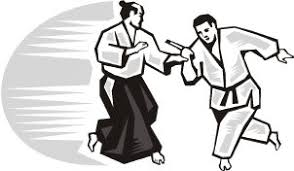
When looking for an image for this section (see left), it appears that futari dori is very much an aikido term and an aikido form of training, albeit very different to JDJ's grading referred to by the same name.

First question: did the senior instructors of the Jan de Jong Self Defence School (JDJSDS), those that graded shodan before I did, grade this section of the grading? Was it part of the original ikkyu grading? Or was it introduced when Jan de Jong (JDJ) introduced the shodan grading which led to additional gradings being added to the nikyu and ikkyu gradings? I might have been able to tell you, however, I no longer have access to the old grading sheets that I was gifted and which I regifted for the noblest of reasons. It appears that no good deed does go unpunished.

I recently saw a video posted on Facebook by a JDJ ryuha showing a nikkyu training/demonstration of this grading. (a) It was a mess, and (b) I would fail the candidate based on that performance, today.

The candidate in question should not be disheartened by those comments. Their performance was reflective of all who preceded them in this section of the grading. It was reflective of their instructor's performance in their grading, and reflective of their instructor's instructor's performance in their grading. In this case, the fault most definitely lays with the instructor, as it did in the JDJSDS.

Why is the performance in this grading always a mess. It is because the grading candidates abandon all of their training when engaged in this section of the grading. They start moving around all over the place, crouched in anticipation of an attack, and they are more inclined to move backward rather than forward in response to an attack. Was this their actions in any of the many shinken shobu no kata (practical) gradings that came before, and even the shinken shobu no kata grading that this section is a part of? The answer is a resounding, No!

George S. Patton: 'You fight like you train.' That would not appear to be the case within the JDJ tradition when the shiai-type grades are attempted. This raises a question as to the practicality of the shinken shobu no kata method of training. 


When I teach or discuss this grading, I suggest the person think Cpt Algren in The Last Samurai when he is confronted by three assailants armed with swords while he is unarmed. He stands his ground and waits for the attackers to attack, to come to him, and then he responds. The application of the 'mind of no mind' lesson in a life-and-death situation. This is representative of the shinken shobu no kata training.

The above is what should be being looked for in this grading, however, that is what is not being demonstrated in this grading. Why not? Because the instructors do not teach tactics for this grading, other than to place one opponent in front of the other. The same instruction given to 1st mon candidates, aged five or six, in the two-attacker section of their grading. This is an issue that will be taken up when the mon grades are considered.

I was going to share my experience in successfully completing this grading as there is a great deal to learn through the analysis of that experience, however, I'm trying to limit the length of these posts, unsuccessfully so as it appears.

How did I go in this grading? I passed. That is about all I can say about my performance. I, like the abovementioned JDJ ryuha demonstrator, moved 'all over the shop.' My two attackers chased me all over the dojo, and it was a large dojo. Did I execute any successful defensive techniques? A block or two, maybe. No locks, no throws, no takedowns. I didn't land any percussion techniques of my own, but then neither did my attackers. Is a pass in this grading not being hit? Is that what this grading is supposed to teach and assess? Is it simply a game of 'stay away'? I don't know, because my instructors would not appear to have known given their instruction and feedback. 

Shodan Shiai

'Free fight unarmed vs tanto, unarmed vs tanbo, then uke and tori swap roles.'

Tanto refers to a knife; tanbo a short stick.

First, it was a very different time. Occupational health and safety (OHS) did not exist, at least not in these gradings. No safety precautions were taken, other than mats. No restrictions on attacks with weapons. Head, eyes, groin where all acceptable targets for both armed and unarmed participants. No restrictions on techniques. No instructions whatsoever (for the most part).

The tanbo and tanto were usually rolled up newspaper which were then taped. Those makeshift training weapons did inflict a fair 'sting' when hit or stabbed with them, and were capable of causing injury, which they did on occasion.  

Second, this could be seen to be a relatively fair grading in that the attackers were not trained in fighting/attacking with a tanto or tanbo whereas the defender was trained in defending against tanto and tanbo attacks, to some degree.

It could be seen to be a relatively fair grading ... in theory. In practice, the armed attacker annihilates the unarmed defender. When the two candidates swap roles, the same result occurs. In order to pass the grading, the difference between the two scores has to be within a certain range otherwise both fail.

When I asked a senior instructor what the purpose of this grading was, he replied that it was to show that even with training that a person would be annihilated by an armed, relatively untrained in fighting with that weapon, attacker. And that is what the grading does show, time and time again. Good lesson. Good to know. Thanks. Cheers. 

It was a good thing that I did not take that lesson on board when I was confronted by a knife-wielding assailant on two separate occasions (the starting point of my book on a new and better understanding of our natural and learned responses to a threat).

Third, why free fighting unarmed against a knife and unarmed against a short stick? In fact, why one unarmed against two unarmed in the previous grading? Shouldn't the progression be one unarmed against one unarmed, then one against two, and then one unarmed against one armed, and then both armed with the same weapon, etc.? Where is the one unarmed against one unarmed?  

An answer to these questions might be found in Tomiki's explanation of his introduction of shiai (randori) into his aikido.

Tomiki was a student of Jigoro Kano, founder of Kodokan Judo, and was eventually graded 8th dan by the Kodokan. He became fascinated by Morihei Ueshiba’s aikido and became one his early students. In his ‘On Jujutsu and its Modernisation’, Tomiki argues for two forms of randori training:


When we analyse the essence of attacks, they fall into two general categories:
1. An opponent, from close in, tries to topple (taosu) or restrain (osaeru) you.
2. An opponent, from a distance, tries to strike, lunge at, or kick you, or with a weapon tries to cut or stab you.
...
The system of randori practice that Master Kano formulated is for the situations described in point 1 above; it is the category of nage-waza, where from close in you apply a waza at the collar and sleeve of a Japanese style judo jacket. A system of randori practice where you would avoid your opponent's attack from a distance (as in point 2 above) and then apply a technique would utilize the atemi-waza and kansetsu-waza. Against this latter attack, the attack from a distance, there is a need to establish such system of randori training.


Randori practiced in aikido usually involves two or more opponents. It is not 'free fighting' per se but simply a 'free flowing' attack and defence with no continued fighting. JDJ had relatively little experience with randori training.

Tomiki's shiai (randori) involved an attacker armed with a knife. Did JDJ adopt Tomiki's shiai to continue that the shiai form of grading included in his one-off instructor grading, ikkyu? Did he include these types of gradings in terms of introducing a randori type in ikkyu and a Tomiki type in shodan? Did he include a short stick element because of its use in his pencak silat? ... Why aren't the attackers trained in the use of the weapons in attack mode?

Lastly, my grading, or I should say, our grading. Dave Palmer and my grading, it was something that had not been seen before or since. It was a literal blood bath. Maggie de Jong had to scrub the walls and mop the mats after the grading to remove the blood that had been spilled during the grading. There was a lot of blood.

This has to be expected when you get two real fighters, not just mere martial artists, together and there are no rules, no protective equipment, and when weapons are involved, and told to 'free fight.'

Again, a great deal can be learned from an analysis of my/our grading, however, post length considerations prohibit the sharing of my/our experience and its analysis.

How did Dave and I do in our grading? We passed ... even though the grading ended with Dave being taken to emergency after I punched him in the forehead with a standing fist punch and blood cascaded down his face and the front of his gi. He was attempting to retrieve a weapon that I had knocked out of his hand, and I instinctively punched him when he advanced to do so. He was knocked back the length of a tatami and as he attempted to advance, I instinctively punched him.

We passed even though I was rendered unconscious during the grading when I landed on my head/neck from a sacrifice throw by Dave (btw, great execution of the technique, dangerous, but great nonetheless).

In terms of OHS, our weapons were not taped rolled up newspaper. The knife was a wooden training knife and the tanbo was a piece of PVS piping wrapped in cloth and then taped. When you got hit with those 'training' weapons, you got hit, and the risk of injury increased exponentially. But we wanted to test ourselves, and of course there was no guidance or supervision provided by the senior instructors.

OHS-wise, nobody from the instructors table came to see how I was when I landed on my head/neck from Dave's sacrifice throw, and when a crack from my neck was heard 'like a "roo shooter's" shot' across the dojo, and as I laid on the ground unconscious for a bit. They simply waited for me to rise and continue the grading, which I did, albeit initially by backing off as the fight had become unfair with now two armed Daves advancing on me.

There was no feedback provided at the end of the grading, however, Hymas did approach me (us?) later and said that JDJ was not happy with the grading. JDJ never expressed that sentiment to us. Even then, I thought, 'How can any of the examiners be unhappy with the grading given the complete lack of direction provided by the instructors as to the conduct and purpose of the grading. Given the complete lack of indication as to what is supposedly being assessed.'

Nidan Shiai

'Free fight with tanto vs tanto'

This is the only shiai-type grading where there is an equal footing (see above re the absence of one unarmed v one unarmed). It is an equal footing because the two participants are armed with the same weapon. It is also an equal footing because the two participants have not been trained in the use of the knife and knife fighting. 'What is going on here?'

This is indicative of an issue within the JDJ tradition that I will address in a post associated with the mon grades, and that is that the attackers in the JDJ tradition are not taught how to attack properly. This has implications for the training of defensive tactics. 

I prepared for this grading. I learned from the previous shiai-type gradings that I'd undertaken.

The two attackers in my futari dori grading in ikkyu were Hymas and Dave Palmer. I asked Hymas to be one of my attackers because I wanted to test myself against the best. My strategy was to stay away from Hymas and to focus on responding to Dave's attacks or to attack Dave when Hymas attacked me. On the face of it, it was a sound strategy, however, as it turns out, it was a floored strategy. Dave was by far the more dangerous opponent.

Dave committed to his attacks. Hymas knew everything that I knew and knew the defences that I might employ against his attack, so he provided uncommitted attacks with a focus on countering my defence. This is a problem in this type of grading. I know everything you know, and you know everything that I know, and that knowledge impacts on tactics and strategies employed in the grading. It also leads to questions regarding the practicalities of the tactics and strategies thus learned in terms of 'real world' application.

I used this insight in my grading. I would faint an attack and observe the response. I'd faint it again and observe the response. If it was the same response, I'd attack with the anticipation of the response and adjust my attack accordingly. This became a strategy that I shared when engaged in my Master of Business Administration (MBA) degree. If I can discern your strategy, I can develop ways to defeat you.

I hadn't trained the futari dori grading with Hymas and Dave prior to the grading. If I had, I might have discerned Hymas' approach to his attacking role and developed a different strategy going into the grading, e.g., stay away from Dave and focus on Hymas.

In the shodan shiai grading, Dave and I did train the grading together prior to engaging in the grading. I learned that Dave tended to not acknowledge a strike and would walk through it to attack me.

Confidence isn't necessarily everything, but it is a big thing. On a rare occasion that we 'trained' this grading in the instructors class, I was paired with Darryl Cook. Cook is a very good practitioner. He is a contemporary of mine. He is aggressive and he is taller than me, bigger than me, and stronger than me. He was armed with the knife and I was unarmed, but I was 'all over him.' He had no answers. I actually felt physically taller and bigger than him. It was as though I was looking down on him from a height. Hymas took Cook aside to give him some advice since he observed that I was 'kicking his butt,' as the Americans would say. Cook returned and raised his knife to my face. Order was restored in the universe, my perception of my size returned to reality, and there was no more butt kicking.

I knew that Dave gained confidence when he walked through my attacks and 'kicked my butt.' The strategy going into the grading was to not allow that to happen; not to allow him to gain confidence by walking through my attacks and kicking my butt. The first time he tried it, I was ready. I put him on his 'arse', held him by the throat on the ground with my fist raised ready to 'ground and pound.' He covered up and raised both feet-legs ready to kick me. 

'Matte, matte, matte', JDJ shouted as he pounded the grading table. Hymas jumped up from the grading table and pulled me back ... and all the while, Dave and I were smiling at each other. We knew what this was all about. It was setting the 'rules' for this grading. Nobody had lost control, in fact, far from it, unbeknown to JDJ, Hymas, and whoever else was sitting on the grading table.

My nidan grading involved a number of candidates, all of whom had been my instructors. I trained a little with all of them, only to see how they fought. And then I studied knife fighting, given that there was zero instruction in knife fighting provided within the JDJSDS. Then I developed strategies to defeat my opponents, my instructors.

Memorably, when paired up with Debbie Clarke, a great practitioner and a real fighter, there was a standoff, so I provided an opening by lifting my hands. You will recall this strategy when ken tai ichi no kata was discussed in a previous post. It was a genuine opening and if she was good enough, she could 'kill' me. No takers. I raised my hands a little higher to entice her into attacking. No takers. A little higher, she attacked, I 'died.' Fair enough.

You will recall from a previous post that many, and most definitely the senior instructors, did not look outside of JDJ's teachings. In preparation for this grading, I looked outside of JDJ's teachings given that there were no specific teachings regarding knife fighting within JDJ's teachings. I also thought that this might give me a competitive advantage.

Part of my study re knife fighting was reading Col. Rex Applegate's Kill or Get Killed. The description accompanying the image to the right is:

Attack With Knife From Crouch

Beware of the man who holds his knife this way and who attacks from a crouch, with the blade held close to his body and with his free arm out in front to parry or to help create an opening for a slash or thrust.

Beware me. The following was included in the text:

The trained man will use this knife, in the attack, from a crouch, with the left hand forward and the knife held ... close to the body. The outstretched left hand will act as a guard, a foil or a parry, and will help to create the opening for a slash or thrust. The left hand also may be used to distract the adversary's attention - by waving it in his face, by throwing something, or by making sudden darting motions toward him. ...

Beware me and I was a trained man. I was trained in knife fighting by Applegate and not my instructors at the JDJSDS, even though there was a knife fighting grading in the curriculum which the senior instructors (Hymas, Peter Clarke, and Paul Connolly) had successfully completed. 

I adopted Applegate's approach, at times, with one important addition. When a thrusting attack was launched, I would move from the left foot forward staggered stance (han zenkutsu dachi) to a cross-stance. Or more accurately, sempok from pencak silat (see image below).


I was well versed in this stance having trained pencak silat for quite some time. Most importantly, the training was with Richard de Bordes school in London rather that at the JDJSDS as JDJ had, as he said, Westernised his pencak silat so that it would be acceptable for a Western audience. He had in fact Japanised it so that it resembled karate to a fair degree.    

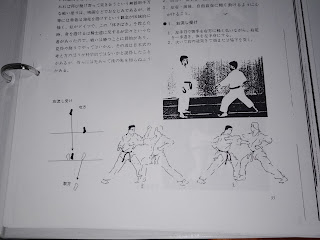
Moving into this stance from a traditional staggered stance is effectively an evasive body-movement, similar to nagashi (flowing) in JDJ and Yoseikan Budo practice. Interestingly, the image accompanying the Tomiki aikido discussion above shows both aikidoka ostensibly assuming the same stance. The same stance is seen in some karate styles, and it is seen in JDJ jujutsu teachings, however, I would argue that there is less understanding of the use and the structure of this stance in all those arenas than in pencak silat.

Another part of the transition into this stance is that it moves the back hand to the front through the turn of the shoulders. This is also used to great effect in pencak silat. 

Part of my strategy was to employ this tactic, moving from a staggered stance into sempok/cross-stance thereby executing an evasive body-movement and moving my rear knife-wielding hand to my front hand and a trusting attack. It was part of my strategy because the other candidates, my instructors, had not seen it before. 

Memorably, this tactic was employed against the abovementioned Debbie Clarke.

Debbie lunged forward and I executed the move. She was going to barrel into the now thrusting knife, which was a molded metal knife, and she was in danger of being 'impaled' on impact. I relaxed my grip and as impact occurred, the knife slide through my hand and fell to the floor. It was beautiful, it was perfect ... and it was missed by JDJ. A clean 'kill', and it was not recorded. 

JDJ took me aside after the grading and told me that I was the best in the grading. But all that meant was that I knew 'how to play the game' better than my instructors. I learned how to knife fight to some degree whereas they did not due to lack of instruction. I learned a fantastic move and had a greater appreciation for the use of sempok as a fighting tactic. But is that what this grading is designed to impart to students?

Before we leave this section, I was present when two JDJ yudansha engaged in this grading. One has since gone on to be awarded Rokudan by a JDJ ryuha principal. The other had his own ryuha and was a 'fighter.' They 'fenced' with the knives, like one would when fencing. Tapping against each other's knives as fencers tap against each other's swords. I was astounded. Why would anyone consider this approach, particularly given that they were supposedly highly experienced and graded martial artists? But here's the thing, how can you fail them, even though the performance was ludicrous, given that no training nor instruction is given in knife fighting even though this is a knife fighting grading in the grading system. 

Sandan Shiai

'Free fight with tanbo vs tanto.'

What is not included in the description of this grading is that the roles are swapped, as in the shodan shiai grading. And as in the shodan shiai grading, the person with the tanbo annihilates the person with the tanto. And as in the nidan shiai grading, the candidates are not trained in the use of fighting with either weapon.

What is the point, other than including shiai-type gradings into the dan grading system and populating the dan grading system given the relatively comprehensive ikkyu grading?

Conclusion

Unlike my instructors, I can teach students how to go about these gradings, but still, what is the point? I can, and have done, train them to defeat the students of other instructors, hands down, but what is the point? 

These gradings in the JDJ grading system are seriously floored, but here's the thing. If they are removed or 'fixed', the lessons learned through the above analysis are lost. The insights that can be gained are lost. The new and better understanding that can be derived from those insights are lost. It is a quandry, conundrum, and other such words to describe this situation.

What would you do?

Thursday, 21 December 2023

The Development of the JDJ Jujutsu Grading System Part 2.3: Shodan (Part 4.1: Ken Tai Ichi no Kata)

The previous post looked at Part 4 of the Jan de Jong (JDJ) jujutsu shodan grading. That part includes suwari waza no kata and ken tai ichi no kata. The previous post looked at suwari waza no kata (which is part of Kodokan Judo’s kime no kata). This post looks at ken tai ichi no kata.

The name ken tai ichi no kata has been translated as, ‘form of sword and body as one.’

The description of this kata in Jan de Jong: The man, his school, and his ju jitsu system is: ‘Demonstration of katana and the unarmed applications’ (Jan de Jong Self Defence School, 1997, p. 50). 

This kata as taught within the JDJ jujutsu shodan grading consists of five sword v. sword and five unarmed v. unarmed attack-defence sequences.                                                                  

The grading sheet reads:

1. Yoko Tekubi Hishigi: Tori – Seigan Kamae, Uke – Seigan Kamae

2. Ude Kujiki: Tori – Seigan Kamae, Uke – Gedan Kamae

3. Tekubi Te Nage: Tori – Seigan Kamae – Gedan Kamae, Uke – Jodan Kamae

4. Ude Hiji Nage: Tori – Hasso Kamae, Uke – Hasso Kamae

5. Ura Tai Otoshi: Tori – Gedan Kamae, Uke – Gedan Kamae

The first phrase represents the unarmed technique that is being demonstrated. The tori and uke kamae description refer to the ‘combat engagement posture’ (see Donn Dreager) for the sword attack-defence sequence.


Video Examples

An example of the JDJ kata was posted on YouTube by the Hans de Jong Self Defence School, a JDJ ryuha.

We saw in the post titled ‘Ken Tai Ichi no Kata Example’ that ken tai ichi no kata is a Yoseikan Budo (YB) kata. An example of the YB kata was posted on YouTube as part of a larger video taken from the Yoseikan Sogo Budo DVD set by Minoru Mochizuki, the founder of YB. 

The acquisition of these two DVDs by myself was the second step in my developing an understanding of just how much of JDJ’s jujutsu and aikido teachings were taken from YB. 

The ken tai ichi no kata is located at the 22:40 mark in the abovementioned YouTube video. 

The YB kata consists of five sword v. sword, five unarmed v. sword, and five unarmed v. unarmed attack-defence sequences. 

JDJ did not include the unarmed v. sword attack-defence sequence in his ken tai ichi no kata (see above). Interestingly, when looking for video examples to assist the readers of this post, I came across a YouTube video of Mochizuki demonstrating this kata in which he does not include the unarmed v. sword attack-defence sequence. 'What's going on here?'

Attack-Defence Order

JDJ had a different attack-defence order to that of the kata demonstrated in the YB videos:

JDJ's #1 = YB's #2

JDJ's #2 = YB's #1

JDJ's #3 = YB's #5

JDJ's #4 = YB's #4

JDJ's #5 = YB's #3

This ordering is provided for those that want to visually compare like-with-like as I discuss the kata in JDJ's system and that of YB.

Purpose

What is the purpose of this kata? What are the lessons to be learned from this kata? What benefits are the students supposed to derive from learning this kata, other than progression in the grading system?

I suggested in a previous post, based on what my instructors told me, that it was to demonstrate the similarities between sword and unarmed techniques. Why? What is the point?

A comment that I received to a post on Facebook that provided a link to my latest blog posts suggested that the three different parts of the YB kata represent kenjutsu, jujutsu, aikido: kenjutsu – sword v. sword, jujutsu – unarmed v. sword, and aikido – unarmed v. unarmed. Now that is a very interesting proposition, and one that I had never heard before.

The commentary on the above linked YB ken tai ichi no kata video explains that: 

The founder of Aikido Ueshiba, used to tell his followers that the principles of Aiki-jutsu came from those of Kenjutsu. But how the techniques were modified from Ken (saber) to Tai (empty hand) is not known precisely. ... Mochizuki acquired Kendo and Koryu-kenpo before learning Aiki-jutsu therefore he could figure out the technical relations between Kenjutsu and Taijutsu (Jujutsu). These kata represent his completed work out of many years of training and simple techniques that define the transition process from Ken to Tai. 

Ken tai ichi no kata in this instance would appear to suggest that Mochizuki is attempting to demonstrate the evolution from ken-ken to tai-tai, kenjutsu to aikido, and that he found the missing link: tai-ken, jujutsu.

Why would JDJ not include the 'missing link', jujutsu, in his ken tai ichi no kata in his jujutsu shodan grading?

Then, of course, the abovementioned premise has to be questioned. Did the principles of aiki-jutsu come from those of kenjutsu, or is it some attempt to link the tai with the samurai ken for some sense of superiority and credibility? And what does that have to do with JDJ's jujutsu?

Even if it is meaningless, the argument might be made that the kata is included in YB due to tradition because Mochizuki developed and taught the kata, however, can the same argument be made for the jujutsu taught by JDJ?

Eliminating Tai v. Ken

There are some possible reasons that might explain why JDJ eliminated the tai v. ken element of this kata

JDJ was above all else, for the most part*, a practical man. He was all about practical, effective techniques, for the most part*. When you see the tai v. ken element demonstrated in the above YB video, the kamae (tenchi no kamae (Guard of Heaven and Earth)) assumed by tori is, well, to be diplomatic, it does not look good. It doesn't look good and is clearly impractical in defending against an opponent armed with a sword. To the best of my knowledge, this kamae is only assumed in this kata in YB teachings and is not assumed anywhere else, even against other weapons. Would any instructor in the JDJ or YB tradition teach a practitioner to assume that kamae against an opponent armed with a sword or any other weapon, or even unarmed? If not, what is the point in teaching it?

Another Facebook comment suggested that the tai v. ken element was included in the kata in the JDJ aikido grading system. If so, why would he not include it in the kata in his jujutsu shodan grading? Was it because he was looking to make his aikido look more Yoseikan? Was it because he was just trying to populate his shodan grading given that the ikkyu grading was designed as a one-off, ultimate, instructor's grading?

A Facebook comment that was received, but which unfortunately I cannot locate, was that JDJ explained to a highly ranked aikidoka in his school that the original YB kata which included the three phases took two hours to perform. JDJ was more action oriented (not very patient) and may not have included the tai v. ken attack-defence sequence in order to reduce the time spent performing, and grading, the entire YB kata.

*The 'for the most part' will be discussed when the te nage (hand throw)/robuse (rowing throw) defence from ryo te dori (two hand grab) is discussed in a future post. 

Kata

In line with the above action orientation of JDJ comment; a senior JDJ jujutsu instructor suggested that JDJ was not a fan of kata full stop. Why not? It was suggested that it was because kata was a major form of training under his original instructors, the Saito brothers, and he was 'sick of it.'  If that is true, it raises a raft of questions (besides the question as to whether this is an example of 'shoehorning'). Why are there no Tsutsumi Hozan Ryu kata in his grading system? Why did JDJ have to go looking to other Japanese martial art traditions in order to find kata to include in his grading system? Why did he include kata in his grading system at all?

There is happoken no kata in 8th kyu (part of the mon system; see future post). Happoken no kata is another YB kata which JDJ included in his grading system to teach and train striking and blocking techniques - a practical training purpose. 

JDJ developed wakai no kata which he included in 7th kyu (part of the mon system: see future post) for the same practical purpose (also see 2nd kyu). 

The newly added revision grading in 2nd kyu included itsitsu no kata, another YB kata. It is a YB kata teaching the five basic taisabaki (evasive body-movements) of YB. This kata supported the taisabaki taught within the newly introduced mon system, which is largely based on YB teachings, as we will see in a future post.

What is the purpose of ken tai ichi no kata, and suwari waza no kata in the JDJ jujutsu grading system? Were they included in shodan simply to 'pad out' the grading given that ikkyu was designed to be a one-off instructor grading, as speculated upon in the previous post? Was it to introduce some 'traditional' teachings into his practically oriented system that was his kyu system?

Kata - Rokkyu to Sankyu

Speaking of the introduction of kata into the JDJ grading system, at the end of the 6th-3rd kyu gradings, there is a kata section: 'Examined on technical analysis and kata presentation. Refer to page 55' (Jan de Jong: the man, his school and his ju jitsu system, 1997).

Page 55: Kata - Rokkyu to Sankyu

'[JDJ] supported the AJJA by introducing the competition kata (refer page 18) into his grading system.'


Page 18: Australian Ju Jitsu Association

The Australian Ju Jitsu Association (AJJA) was founded in Brisbane in 1985 with the aim of:

... providing activity for the affiliated state ju jitsu associations on both an instructional and competitive basis;

organising and participating in both national and international seminars and competitions ...

[JDJ] and his instructors have made significant contributions to the AJJA. In 1987 [JDJ] was invited to fill the positions of President and National Coach which he accepted and held unopposed ever since.

In an effort to achieve the aims of the organisation the AJJA executive approached [JDJ] for his advice concerning the development of some form of competition. He advised that a kata competition rather than any form of free fighting would be the preferred option as it encourages good technique whilst introducing the desired competitive element. The kata competition he subsequently developed was adopted by the AJJA and has been used as the national competition ever since.

Page 55 continued:

The techniques are quite advanced and after several years use, he concluded that they imposed an additional hurdle for his students who are already engaged in a very challenging grading system. However, he had observed the students were receiving benefits from training kata. The solution he devised was to keep the kata format in the gradings but allow the students to choose the techniques.

Students are required to demonstrate five techniques in Rokkyu and Gokyu and ten techniques in Yonkyu and Sankyu. The aim of these kata is to gain the benefits of the disciplines of kata training, and to gain experience in demonstrating ju jitsu techniques.

Students select the techniques themselves from any previous grade, including their current grade. No atemi techniques are to be selected and locking to finish is required. Atemi to finish can be used once in the first two grades and twice in the next two grades but only when a lock is not appropriate.

Now that was a stroll down memory lane :).

I was the sole author of the book which was fact-checked ad nauseam by JDJ at my instance because it was representing/promoting him and his school both internally and externally.


Page 2: Acknowledgements

This book has been researched, written and edited by John Coles B.Comm., ACA, MBA, one of [JDJ's] senior instructors, to whom thanks are due for the considerable time and effort he has spent in fact-finding and writing this eagerly awaited book.

The contributions of Robert Hymas, Maggie de Jong, Greg Palmer, Paul Connelly, Peter Clarke, Debbie Clarke and Hans de Jong, all of whom are also instructors of [JDJSDS], are acknowledged and appreciated.

The other instructors' contributions primarily consisted of 'signing-off' on the content, however, Peter Clarke did provide some background on the contributions to the AJJA as he was responsible for those contributions on behalf of JDJ.

The Jan de Jong: the man, his school and his ju jitsu system book was written primarily to promote JDJ and his teachings, thus, certain license was taken with the content. For instance, the reference to JDJ concluding that the kata imposed an additional hurdle for his students who are already engaged in a very challenging grading system - that was 100% me, and the reference to the 'challenging' grading system is reference to an over cumbersome and over burdensome grading system as I have described the JDJ jujutsu grading system in a previous post

JDJ included the kata in his grading system for one reason, and one reason only - to support the AJJA kata competition that Peter Clarke had developed on his behalf (see above), even though no JDJ students participated in the competition, there was no competition in the JDJSDS, the AJJA quickly abandoned the concept, and JDJ resigned and removed his school from the AJJA, yet JDJ retained the gradings. Why? 

JDJ is a 'set and forget' sort of fellow, not prone to reflection, as I explained in a previous post. I lobbied for the removal of these kata gradings from the grading system altogether for the reasons explained above. I lobbied for a number of years for the benefit of the students. A concession was that as described above, however, the reasoning was a concession on my behalf. JDJ did not see any benefits in kata training but was reluctant to change what had been introduced in the past because he was a set-and-forget sort of person. 

Why didn't the other instructors lobby likewise for the benefit of the students? Was it a matter of teaching what is taught without question? 

My lobbying was successful, although in all honesty I did not remember that the compromise was included in the grading system. And I don't remember if I was eventually 100% successful and the entire idea was given the kibosh. I don't know if the kata gradings are included in the JDJ ryuha grading systems in whatever form.

'Those that cannot learn from history are doomed to repeat it.' 

I do know of one JDJ ryuha that has reinstated the original AJJA competition kata within their kyu grading system as per JDJ's original introduction. While it has been introduced with the intent of introducing kata training in the grading system given their association with karate, I'm hoping that an understanding of the development and change of this aspect of JDJ's grading system might make them rethink the re-introduction of an element in the grading system that simply increases the burden on the student which far outweighs any benefits that they may receive.

Next Post

These posts are lengthy, and apparently these days, reading anything beyond a few sentences is not popular (modern attention span of a brick). I was going to include a review of the attack-defence sequences in this post, however, it quickly turned out that a general discussion of the kata and kata in general in the JDJ grading system was already producing a lengthy post. The next post will consider the attack-defence sequences in detail and the lessons that can be learned from such an analysis.   


Tuesday, 12 December 2023

Inflated Timelines of JDJ Jujutsu Rank/Certificate Promotion & JDJ Endangered Species

This post will interrupt the current series of posts about the development of the Jan de Jong (JDJ) jujutsu grading system as it is very pertinent to the discussion.

The following was recently posted on Facebook by Aikido Sangenkai (The Aikido Sangenkai is a non-profit martial arts dojo (school) affiliated with the Aikikai Foundation in Tokyo Japan. We are located in Honolulu, Hawaii on the island of Oahu (https://www.aikidosangenkai.org/about.html).)

The abovementioned Facebook post has attracted a great deal of attention with most of it being supportive based on personal experience. 

Note: I have not confirmed the information detail.


Minoru Mochizuki's sho-dan certificate in Judo from Jigoro Kano, 1927.

He would begin training with Morihei Ueshiba three years later, in 1930, still a relatively junior student in Judo. One year after that, in 1931, he would open his own Yoseikan Dojo in Shizuoka. One year after that, in 1932, he would be awarded the two highest level Daito-ryu scrolls being given at the time, "Goshinyo no te" and "Hiden ogi no koto", after 2 years of training in Daito-ryu under Morihei Ueshiba and 7 years total of training in grappling arts. His fellow Daito-ryu student, Takuma Hisa, would be awarded the highest certification in Daito-ryu, the Menkyo Kaiden after around 6 years of training (3 with Morihei Ueshiba and 3 with Sokaku Takeda).

This is in line with a comment by Ellis Amdur on e-Budo:

"Records indicate menkyo kaiden in 5-7 years in the Meiji period. It is my belief and experience that koryu training takes far too long, because many teachers, greedy for power and status, withhold information or drag out the teaching."

This underlines the inflated timelines of modern day rank/certificate promotion, where such advancements normally take 30 or 40 years, or more.

Many, including myself, would suggest that the Jan de Jong (JDJ) jujutsu experience would bear out Amdur’s belief and experience in terms of koryu training taking far too long and the inflated timelines of modern-day rank/certificate promotion, however, the reason for doing so in the JDJ jujutsu case is not as Amdur suggests (see below).

How long does it take to get a black belt in jujutsu at the Jan de Jong Self Defence School (JDJSDS)? It was said that it takes at least 10 years. How did that number come about?

Peter Clarke and Robert Hymas are two of the only three that JDJ awarded rokudan. He did so shortly before he passed away in April 2003.

Clarke commenced training in 1971 (source: Jan de Jong Self Defence School, Jan de Jong: the man, his school, and his ju jutsu system, 1997) and was one of the first three to be awarded shodan (the 'first wave') in 1981 (source: Greg Palmer). That is 11 years, however, you will remember from a previous post that there were only gradings up to ikkyu until the late 70s when JDJ developed the shodan gradings so that he could have black belt instructors accompany him teaching in Europe. If there were shodan grading attached to the kyu system, would Clarke have graded shodan in less than 10 years?

Hymas commenced training in 1975 (source: see above) and was one of the first three to be awarded shodan in 1981 (source: see above). That is seven years. That is the fastest ever to be awarded shodan in the JDJ system, and it was also under the abovementioned limitation, however, Hymas also worked as a full-time instructor from 1978 to 1988 (source: abovementioned book) and he did not go through the mon system which was introduced in 1978 (source: abovementioned book).

That is something that has only come to light when researching these posts; my instructors (which included all instructors teaching at the JDJSDS in 1983) never went through the mon system. They teach it but they never went through it as it was introduced after they were already higher graded. This will become relevant when the introduction and interpretation of the mon system is explored in a future post.

I am the first shodan to have gone through the mon system. I was on track to at least match Hymas’ feat in terms of shortest time to be awarded shodan, and that was with going through the mon system and not being a full-time instructor as Hymas was, but I did have an insane training regime as I explained in a previous post. I was awarded shodan after nine years and that was with going through the mon system, spending a year backpacking through Western Europe, then a rite of passage for Australians, and engaging in the intense ‘professional year’ of the Institute of Chartered Accountants. During that time, I also obtained a Graduate Diploma in Applied Finance and Investment in which I was awarded state dux and second in Australia. I don’t say those things to aggrandise myself but to show there were other demands on my time, including working full-time, that impacted on my training and progression.

Do I or Clarke or Hymas serve as a measure of how long it takes to be awarded shodan in the JDJ jujutsu grading system? How long does it take the average person to be awarded shodan in the JDJSDS under the regime that includes mon and shodan gradings?

There are a number of JDJ jujutsuka who commenced training around the same time that I did but were awarded shodan by the principal of one of JDJ’s ryuha after JDJ passed away in 2003. That is 20 years to be awarded shodan.

There are many factors that contribute to the length of time to be awarded shodan in the JDJ tradition, however, it is safe to say, as Amdur argues above, that it takes far too long in the JDJ jujutsu grading system.

I have come to refer to JDJ's teachings and therefore his ryuha that have been established after his passing as 'endangered.' If JDJ's teachings are to survive, the issue of the grading system and its dysfunction needs to be addressed. Part of that dysfunction is the training taking far too long and the inflated timelines of modern-day rank/certificate promotion. That dysfunction is the product of the development of the JDJ jujutsu grading system. Problem solving 101: identify the problem and its root causes. That is the purpose of this series of posts.

A final word: there are many ikkyu within the late JDJ tradition that are deserving of a black belt - shodan, nidan, even sandan - because they had the expertise and knowledge the equivalent or better of most within the jujutsu world, but they are denied a black belt because of the grading system that they were engaged in.

This is often credited to intensity of training, or to intensity of contact, but when we actually examine the records of how much many people trained, and how much contact they had with their instructors, that's really not the case. In many cases the practitioners were working, and training no more than many people do in modern times, or actually had limited contact with their instructors - as little or less than modern practitioners.

Note here that Jigoro Kano himself founded the Kodokan in 1882, at the age of 22, in the same year that he graduated from university - after only 5 years of training in jujutsu.

This detailed information is verified. Kano developed his own system which went on to become known as Kodokan Judo. But here’s the thing, Kano was an ‘educator,’ aka a trained teacher.

In his professional life, Kanō was an educator. Important postings included serving as director of primary education for the Ministry of Education (文部省, Monbushō) from 1898 to 1901, and as president of Tokyo Higher Normal School from 1900 until 1920.[4] He played a key role in making judo and kendo part of the Japanese public school programs of the 1910s.

Kano developed a martial arts tradition that became a global phenomenon. Nobody ever accused Kano of being a highly proficient exponent, however, he was able to develop a true martial arts ‘system’ because he was a qualified teacher. He had insights into the techniques that nobody else possessed because he was a qualified teacher. Yoseikan budo is the product of Kano’s approach to teaching because Mochizuki was an acolyte of Kano’s. This issue will be further explored in the post regarding the introduction of the mon system.

There are many reasons behind the timelines or the awarding of certifications in modern times, but the primary reasons that come to mind are:

- Power and control within an organization.

- Student retention (which is related to the above, power and control).

- Financial reasons - the constant income stream generated by stretching promotions over a period of years with greatly inflated pricing (which is also related to student retention).

- Poor instructional ability, often associated with poor or incomplete transmission of information (this is particularly a problem in modern Aikido).

- Deliberate withholding of information, or delays in delivery of information, which is also related to the above, power and control.

Those reasons have been attributed to JDJ in relation to his not providing the possibility of a shodan grading until the late 70s when he needed black belt instructors to accompany him when teaching in Europe (see above). Those reasons were speculated upon by high ranked students and instructors within the JDJSDS and are still proposed now.

Again, NO! JDJ did develop the kyu grading system to support a business, his sole source of income that went on to provide a very comfortable lifestyle, however, he did not withhold a shodan grading for any of the abovementioned reasons. As proposed in a previous post (see previous link) in this series, JDJ did not have a shodan grading because he did not have a shodan grading and did not need a shodan grading at that stage. There were no ulterior motives.

Rationalising the Jujutsu Grading System

Why didn't JDJ rationalise his jujutsu grading system? He kept on tacking on 'bits' based on his personal needs at the time, but why didn't he then step back and rationalise his jujutsu grading system?

JDJ was not big on reflection. That was possibly/probably due of his WWII experience where it was all here-and-now and based on personal survival. Don't look forward, don't look back. Another way of saying this is 'set and forget.' One example of this was the introduction of the kata in the kyu grading system.    


JDJ was involved with the Australian Ju Jitsu Association (AJJA). They wanted a 'competition' format because competition was considered to be important, or at least something that was in demand. JDJ was not a fan of competition as a form of training, which will become the subject of a future post on his introduction of 'free fighting' gradings in his jujutsu grading system. JDJ develop a series of kata that were to be basis for a competition format. In order to support the AJJA, JDJ introduced those kata in the kyu grades of his grading system.

Even when JDJ left the AJJA, he continued with the kata being part of the kyu grades. I argued long and hard for their removal. My argument was based on multiple points, one of which was that the grading system was already overly cumbersome and overly burdensome. Why add more to it just to support the AJJA competition format even when none of JDJ's students competed and JDJ had left the AJJA - set and forget.

I did include in my argument that if JDJ wanted to introduce a kata element into the kyu grades, then all he needed to do was pick five or six of the attack-defence combinations in the shinken shobu no kata grading to be performed in a kata format. The only extra training involved would then be the kata format.  

I was a relatively junior instructor at the time, but I was arguing on behalf of the students. Why waste time training additional things that have no benefit for the students. Eventually, JDJ succumbed to my advocacy and the kata gradings were removed from the JDJ jujutsu grading system. If it were not for me, those kata would probably still be included in the JDJ jujutsu grading system that is used by the majority of the JDJ ryuha that were established after JDJ passed away. Why? Could it be that the common ethos of the JDJ instructors, with the exception of myself, was teaching what was taught without question?