Showing posts with label Insight. Show all posts

Thursday, 15 February 2024

The Development of the JDJ Jujutsu Grading System 3.8: 7th Kyu

The final grade in the mon system is 7th kyu, red belt. 

The titles of the below sections are taken from the grading sheets in Jan de Jong: the man, his school and his jujutsu system (Jan de Jong Self Defence School, 1997).

Breakfalls (Ukemi)

Bridgefall, and backwards flat, sideways flat, forwards roll, sideways roll separately over an obstacle. 

The bridge fall, aka o mae ukemi, is the same as in the previous grading.

While responding to a comment on my Facebook post sharing the previous blog post, I remembered that I neglected to explain why sideways roll is so uncommon in the martial arts. It's because most ukemi comes from judo and there is no need for a sideways roll from judo techniques.

I was also reminded that there are some (aikido) that teach a backwards roll that starts to resemble a Jan de Jong (JDJ) sideways roll. That is true, but it is more of a backwards roll than a JDJ sideways roll, however, having said that, it is worth noting because a JDJ sideways roll transitions into a backwards roll.

This is one of the aims of these series of posts, if not this entire blog, and that is to encourage those engaged in martial arts to engage in critical thinking, to seek insights that produce a new and better understanding, rather than just teaching and training what is taught.  

For progression, the o mae ukemi could have been performed over an obstacle in this grading. There is a 'trick' to performing o mae ukemi over an obstacle. 

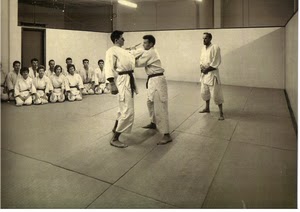
The trick to performing o mae ukemi over an obstacle, I discovered by observing John Poulton  (ikkyu) in the instructors class way back when. John Poulton is front left, beard, in this photo taken from the JDJSDS Yearbook 1986 - Hakusho. He was performing o mae ukemi over obstacles when none of the other instructors pictured could and ever did. It is simply a forwards roll that you don't come out of; a forwards roll terminating in a backwards flat. :)

There is a lot of history in that photograph. Do the current JDJ ryuha know and study that history and share it with their students? Who can name all in the photograph and their legacy? This blog is about preserving and understanding the history of the JDJ tradition.

Wakai no Kata

You will recall from the 'Historic Ikkyu Part 1' post that JDJ developed wakai no kata to replace Yoseikan Budo's (YB) happoken and sanbogeri. He then moved the kata to nikyu and included it in 7th kyu, the last of the mon grades before the kyu system. Happoken taught blocking and striking skills and sanbogeri taught kicking skills. JDJ's wakai no kata is designed to teach blocking, striking, and kicking skills.

The issue of using a block in conjunction with an evasive body-movement (EBM) that was discussed in a previous post is present in this kata.

Last year I saw a JDJ ryuha yudansha demonstrate this kata while teaching it to their students. I would fail that performance if a grading candidate presented it for their 7th kyu grading, let alone a yudansha that has supposedly performed it in two gradings. 

JDJ's wakai no kata includes pencak silat's depok and sempok stances. Same stance but looking forward or backward. It is an extremely versatile stance in terms of an EBM and setting up for strikes, kicks, and unbalancing. 

In the abovementioned performance, the performer did not perform the stances correctly (or simply did not know how to do so), which nullified their tactical effectiveness.

Then of course there was the issue that the kicks were poorly executed, wafting upwards rather than 'shooting' in and out, and the timing of the defensive combinations was all wrong. Basically, it was a blur from start to finish interrupted only by the performer being unbalanced when performing the depok and sempok stances. 

These issues were also common with the performances within the Jan de Jong Self Defence School (JDJSDS), including that of most of the instructors.

The abovementioned JDJ ryuha refers to this stance as a 'cross stance' (kosa dachi). That is a reference to a Japanese karate stance which is 'similar' to the pencak silat depok and sempok except that karate does not realise or understand the potential of this stance.

I attended a seminar co-jointly hosted by Wally Jay and George Dillman while I was living in London. Dillman was on the pressure point bandwagon at that stage, but he also presented his 'study' of karate kata which included a Shotokan kata where this stance is performed. He explained that this stance is entirely useless but that it was a 'secret' of the kata because it was part of a turning move when executing what the JDJ tradition knows as hachi mawashi (hair-chin turning). When Dillman asked what is the point of this stance before his 'explanation', I wanted to put my hand up and say that it was a major feature of a very effective martial art taught to one of the most populous nations on the earth, but I didn't.

Throwing Techniques (Nage Waza)

This is the first time in the mon system that throwing techniques have been introduced. There are four throwing techniques from specified attacks: single lapel grip (low) - hip throw; single lapel grip (high) - shoulder throw; low punch - minor inner reaping; and low punch - minor outer reaping.

Body Movements (Taisabaki)

'Defender's choice of attack, using any block.' 

The issue of 'blocks' and the demonstration of these body-movements as defences has been discussed in previous posts.

All five of YB's basic body-movements are included in this section, along with dodging (kawashi).

The dodging body-movement was included in this grading due to Greg Palmer's lobbying. I argued that dodging was simply a variation of either flowing or sliding body-movements, which I went on to demonstrate in my taisabaki no kata grading in sandan. It was a 'teach the teacher' moment, however, even though they agreed with me, it is still retained in this grading.

To challenge the reader's understanding of this body-movement that they are either training and grading or teaching, is the dodging body-movement as taught a variation of flowing or sliding? Even though JDJ used a dodging body-movement often in his demonstrations, why and how is it different to the one included in this grading? Also, identify the defences in the kyu and dan grades where this dodging body-movement is used in a defence.

Unbalancing (Kuzushi)

Normal single wrist grip - Normal and same side unbalancing

Reverse single wrist grip - Reverse and same side unbalancing

Same side single wrist grip - Normal and same side unbalancing

The unbalancing from single wrist grips is taken straight from YB, however, JDJ is building on YB's teachings. What is JDJ trying to teach/impart with the two forms of unbalancing from the same single wrist grip? Did the instructors (a) understand this lesson, and (b) teach this lesson along with the techniques?

In his later years, JDJ was teaching this lesson and referred to kuzushi and hazushi for the two types of unbalancing. Hazushi means disengagement or release according to the glossary in Jan de Jong: the man, his school and his jujutsu system (Jan de Jong Self Defence School, 1997). 

The basic idea is that with normal and reverse unbalancing, the captured hand is disengaged whereas with same side unbalancing it is not. This then facilitates one of the nine basic joint-locking techniques taught by the JDJ tradition and which is demonstrated in the mon grades. Same side unbalancing does not necessarily disengage the hand grip, turns the elbow up, thus facilitating straight arm lock, side wrist lock, and wrist crust. Normal and reverse unbalancing disengages the hand grip and keeps the elbow down thus facilitating the other six joint-locking techniques. 

This is a valuable and sophisticated lesson in versatile tactics, a unique one developed by JDJ, that is often not understood within the JDJ tradition. This leads to the question, should it be included in the relatively lowly grades of the mon system?

Locking Techniques (Kansetsu Waza)

'Two attackers defender's choice of attack.' 

The issue of the appropriateness of this stress element in these early gradings has been discussed in numerous pervious posts in this series.

The three kansetsu waza in this grading are arm entanglement (ude garami), side wrist lock (yoko tekubi hishigi), and wrist hand throw (tekubi te nage). The latter two are known by different names in aikido. This completes the nine basic kansetsu waza taught within the JDJ tradition.

Basic Blocks and Attacks (Uke and Atemi)

Three punches and one kick - four basic karate-style blocks. 

There is no unbalancing - blocking section as included in 9th kyu

These blocks are often taught in conjunction with an EBM. As has continually been questioned in numerous posts, e.g., The Mon System and Blocking Techniques, what is the purpose of the block when used in conjunction with an EBM. It's not to avoid injurious contact with the body because the EBM takes care of that problem. This is a question that should be asked and answered as it would demonstrate insight and understanding.

The defences in this section include a karate-style block followed by a punch. This should be taught as an alternative to the singular use of EBMs, or just avoiding an attack. It would be a useful tactic to employ in the free fighting gradings of ikkyu and the dan grades.

Reflex (Shinken Shobu no Kata)

Fifteen defences from holding, strangulation, punching, kicking, stick, and knife attacks. There are two 'restraining techniques' included in the 15 defences, which is to say a pre-emptive application of a joint-locking technique.

All of the defences have been demonstrated in this or previous gradings, as they should be.

There is a 'stick-overhead attack.' 

Last year, I observed a number of classes of a JDJ ryuha where this same attack was used in the lessons. It would appear that uke did not know how to hit a person with a stick. If they made contact with tori, it would be with the butt of the stick held in the hand of uke. This obviously affects the distancing of the defence. With a lot of practice, the student would become proficient at defending themselves against an attack that was trying to hit them in the head with the butt of the stick, however, if someone was actually trying to hit them with a stick, they would literally fall short. 

This was also a common fault in the JDJSDS.

The lesson to be learned here is to teach the students how to attack properly first, and then teach the defence.

This was something lacking in the JDJSDS as well.

Saturday, 3 February 2024

The Development of the Jan de Jong Jujutsu Grading System: Curriculum vs Examination (Grading) Question

The following is a comment that was posted on one of my Facebook posts sharing one of the posts about the development of the Jan de Jong jujutsu grading system:

Earlier I made an implied minor criticism of one aspect of the approach taken in these analyses. I said something along the lines of the need to clearly differentiate between an examination set or system and a curriculum. I added a vague comment stating that designing teaching outlines / lesson plans around test questions is a really bad idea.

I could not locate the earlier implied criticism regarding examinations and curriculum, although I vaguely remember it. 

The criticism was vague and lacked a practical explanation, however, it did sow a seed that I initially resisted but then succumbed to my natural curiosity (curiosity being one of Klein's five paths to insight that can lead to a new and better understanding).

I consulted a 40-year veteran educator who has also been involved in curriculum development for the Department of Education WA. This is an extract from his response:

Thanks for the email. An interesting question. Lots of detailed arguments can be made but essentially exams and tests are about eliciting information from the candidate that reflects their understanding of the curriculum that has been taught. ...

The tests and assessments (at least the major summative ones) cannot hope to cover the whole curriculum (i.e. everything that is taught) and so tend to be testing only the “core” or important parts of the course. They also test both skills (e.g mapping) and content understanding and application. Questions and the required format of answers (e.g. – multi choice, short answer, math problems, essay arguments etc.) relate to the level of answer required from simple recall/understanding through to application and then evaluation.

I then asked my education expert to apply the theory to martial arts practice:

Essentially, if I was to link the idea to martial arts, the curriculum would be the skills and knowledge taught during a block of learning, and the “grading” would be the test to see if the student could demonstrate that he/she/they knows the curriculum. In the Martial Arts case, I assume the curriculum is about the throws, blocks etc, that you learn and practise. These are then tested appropriately with demonstrations. I don’t know if you can test everything in the curriculum in a grading or whether, like in education, you just do the core of the curriculum. The nature of your curriculum (if its just practical skills) means that the gradings are just physical tests looking for technical demonstration of the curriculum. If there are other aspects to the course/curriculum, you may be able to add other ways to test the students.

In terms of teaching to pass examinations (gradings), my education expert had this to say:

In education, “teaching to the test”, means just focusing on how to pass the test or exam, through the explicit teaching of exam techniques and a focus on core areas and just past papers. The goal here (and we have become this unfortunately) is to prepare the kids to pass the exam at a high level. That is now an industry across Australia – revision seminars, practice books on NAPLAN etc. But the tests are not the curriculum – that is much bigger and wider. 

I am all about using theory to inform practice in a practical way. This idea was first enunciated for me in my first lecture during my MBA (Master of Business Administration) at the University of Western Australia's Graduate School of Management - using theory to inform practice in a practical way. This has been the basis for the first book that I wrote on the science behind all fighting techniques. It is the basis for the second book on a new and better understanding of our natural and learned responses to a threat. It was the basis for the articles that have been published in various national and international magazines based on the work within those two books. It is the basis of this blog and that of the Kojutsukan blog.

What, if anything, can we extract from the above discussion in terms of theory informing practice in a practical way?

The first thing that comes to my mind is: is the grading system the curriculum for the jujutsu taught by JDJ and the JDJ tradition?

Here I invite the readers to express an opinion either way. If you believe that there is a curriculum separate from the grading system, please provide details.
 
Both the abovementioned critic and the education expert adviser express the view that 'teaching to the test' is not a good thing. Towards the end of my teaching tenure at the Jan de Jong Self Defence School, I taught to the test, and I was very good at it. In fact, JDJ said that I was the best instructor in the school based on my student's performances in their gradings. They consistently excelled in their gradings to the point that at times JDJ would stop marking so as not to miss any of the performance.

When thinking about it, the traditional approach to advancement was for the instructor to determine one day that the student was ready for advancement without any formal testing. Is there a distinction between curriculum and examination in that tradition?

The abovementioned critic referred to teaching plans and lesson outlines. If the refer to anything other than copies of the grading sheets, then they were absent in the Jan de Jong Self Defence School. 

Remember, that while we are focused on one martial arts school here, the detailed examination enables us to learn something about all martial arts schools, as Friday argues in Legacies of the Sword: 'One can, therefore, learn something of broad value about the physiology of traditional Japanese martial art by carefully dissecting one school, in much the same way one can draw broad insights about the physiology of all species of all mammals by dissecting any one' (p. 10). Also see Shodan Requirement: History of Jujutsu post.

Of course the core of all learning, the identification of similarities and differences, are at the heart of this process. 

And here I would like to invite readers of other martial arts schools to share their distinction between curriculum and examinations/gradings, if there is one. In this way we can learn by comparing, one of the proven highly effective ways of identifying similarities and differences, and on of Klein's paths to insight that can lead to a new and better understanding.

Friday, 26 January 2024

The Development of the Jan de Jong Jujutsu Grading System Part 1.2: Historic Ikkyu Part 1: Basics and Current Nikyu Part 1: Kime no Kata

This post follows on from the post, Part 1: The Kyu System.

You will recall from that post that the original Jan de Jong (JDJ) grading system consisted of only the kyu grades, which was a one-off grading system when it was developed. Start to finish, nothing else to follow or precede. That is it! Done and dusted (in the voice of Al Pacino in The Heat).

The image to the right is of a historic grading sheet regarding the requirements of the ikkyu grade which the recipient of my gifting of historical records was kind enough to forward to me based on this series of posts.

In the above linked post, I argued that the ikkyu grading was an instructor grading. That argument is supported by the heading to the above historic grading sheet: Ikkyu (Kyoshi) Instructor. 

All those that attained ikkyu are instructors in JDJ's original grading system, and it could/should be argued that they are instructors under the current system which includes the dan grades. It could/should be argued that they should be referred to as sensei rather than sempai as they are now, given that that is how the ikkyu grading was developed.

Part 1: Basics in the above ikkyu grading requirements reflects the Yoseikan Budo (YB) influence introduced into the grading system, therefore, this grading was introduced post 1969 when JDJ trained for a short time at the YB dojo in Japan (also see below). 

At some stage, the ikkyu Part 1: Basics became nikyu Part 1: Kime no Kata. 

Kime no kata is referred to as 'revision' in JDJ's jujutsu grading system. So the ikkyu Part 1: Basics became a revision grading when it was moved to nikyu, but what is it revising? It is revising the YB inspired mon grades with the ikkyu Part 2: Kime no Kata in the above image being a true revision of the kyu grades. That grading requires the grading candidate to select defences from the kyu grades in the nominated sections in that gradings. 

All of the techniques in Part 1: Basics are YB techniques, including Itsutsu no Kata, Happoken, and Sambogeri. When ikkyu Part 1: Basics becomes nikyu Part 1: Kime no Kata, Happoken and Sambogeri were replaced by Wakai no Kata.

Happoken is a YB kata designed to teach striking and blocking skills.


Sambogeri is a YB kata/exercise designed to teach kicking skills (see image right from Mochizuki's book). In future posts, I will be suggesting that Sambogeri and derivations thereof be introduced into the mon grades to improve the kicking skills of JDJ jujutsuka, which are generally substandard unless the student trained in a percussion based martial art.

Wakai no Kata is a kata that JDJ developed to teach striking, blocking, and kicking skills, along with different stances. Wakai no Kata will be the subject of a future post when exploring the mon system. In that post I will explain why it tends to be poorly performed in the JDJ tradition, even by the majority of instructors.

The abovementioned generous provider of the historic grading sheets also commented:

After doing the nikyu revision, Greg Palmer came up to me and said "you have me to thank for that grading". The Boss has tasked him with developing an assessment for those who hadn't done the mons. Further cementing the case for Greg to have been a yondan on completion of sandan.

I argued in the first post of this series that Greg Palmer was the best teacher at the school because he was a trained and qualified teacher, and I don't mean in a martial arts system which is basically amateurish. I was unaware that Greg developed this grading, however, it makes sense because it is a coherent introduction, not revision as suggested above, to the YB system that forms the basis of the mon grades.

With regards to Greg and the awarding of yondan upon completion of the 'technical' grades in the JDJ jujutsu grading system. I would go further than the above commentor and argue that Greg was entitled to be graded rokudan along with the anointed trio

Greg's contribution to the grading system far exceeded that of any of the trio, including introducing JDJ to a mindset of progressive gradings. It is generally acknowledged that his understanding of techniques and how to teach them exceeded that of the trio. He also selflessly taught for JDJ for nearly 40 years with no remuneration, unlike two of the trio. He was also the first and only to have established a branch outside the metropolitan area for JDJ.

You will recall in a previous post that I shared an insight that I had gained through studying the development of the JDJ jujutsu grading system, and that is that the instructors teaching the mon grades may not have actually gone through the mon grades. The above comment would appear to confirm that.

In that case, the nikyu revision, as the above provider described it, was not a revision grading for those that did not go through the mon system. It is an introduction to the mon system. It features the YB division of a defence into phases: taisabaki, kuzushi, waza (body-movement, unbalancing, technique). It features the five basic YB taisabaki, their basic kuzushi from hand grips, and their nine basic kansetsu waza (joint-locking techniques) as waza

Did the instructors who did not go through the mon system understand that these were phases in a defence? Did JDJ? This might explain some/many of the issues that I have and will be raising in connection with the mon grades and the teaching thereof.


Wednesday, 17 January 2024

The Development of the JDJ Jujutsu Grading System Part 3.5: The Mon System and JDJ's Blocking Techniques Classification

This post follows on from the previous post concerning blocking techniques in the Jan de Jong (JDJ) jujutsu mon grading system. Specifically, this post looks at JDJ's classification of blocking techniques that he introduced into the mon grades.

Classification

You will recall from a previous post that the core of all learning is the identification of similarities and differences. One of the proven highly effective means of identifying similarities and differences is classification. Many in the martial arts think of classification as simply being an administrative exercise. They could not be more wrong, as I explain in my book on the science behind all fighting techniques:

Lackoff (1987) warns against such a dismissive attitude. He suggests that there is nothing more basic to our thought, perception, action, and speech than classification and that without the ability to classify we would not function at all, either in the physical world or in our social and intellectual lives.'

JDJ's Classification of Blocking Techniques

JDJ's classification of blocking techniques involves six categories: hard, soft, pushing, pulling, grabbing, and empty. Exploring those categories and the classification system itself is revealing.

Yoseikan Budo Kuzushi and JDJ's Classification of Blocking Techniques

You will recall from a previous post that JDJ included unbalancing (kuzushi) sections in his mon grades. These sections involved unbalancing techniques from hand grabs: e.g., normal single wrist grip - normal unbalancing. These attacks and techniques are taken straight from Yoseikan Budo (YB).

The JDJ classification of blocking techniques was introduced into the mon system to complement the unbalancing from hand grips, but for moving attacks. This is seen in their use in the various sections in the mon grades, however, it is explicitly seen in the Unbalancing (Kuzushi) - Blocking (Uke) sections in 5th mon and 9th kyu (both part of the mon system; see previous post).

You will recall from the previous post that one of Nakayama's blocking possibilities is unbalancing the opponent with a block. Do the blocks in JDJ's classification unbalance an opponent with the blocking technique?

JDJ's Classification of Blocking Techniques, Unbalancing, and Pencak Silat

JDJ did not originally develop his classification of blocking techniques to compliment the tehodoki kuzushi. He developed it to classify the response to an attack in the pencak silat he taught. This classification was then introduced into his pencak silat grading system. In this way, JDJ was conceptualising 'blocking techniques' as being uke waza.

Uke Waza

Uke waza is often translated in karate as being blocking techniques, however, it actually translates as receiving techniques; techniques used to receive an attack.

In this way, uke waza includes evasive body-movements (EBM), aka taisabaki, and so-called blocking techniques.

There are three ways of dealing with a moving attack in order to avoid injurious contact with the body: (1) 'block' the attack (see below), (2) move the attacking limb or object off the line of attack (deflection), or (3) move off the line of attack (EBM). There are three ways of repositioning oneself to execute a counterattack from a moving attack: (1) 'block' the attack, (2) move the attacking limb off the line of attack (deflection), or (3) move off the line of attack.

The last sentence was in response to a comment received on my Facebook post sharing the previous blog post. I share their conception of taisabaki in that it repositions tori to execute a technique, however, they are only half right. The avoiding injurious contact with the body from an attack aspect of taisabaki can never be forgotten or minimised.

Taisabaki is taught within the JDJ teachings in terms of an EBM to avoid injurious contact with the body. In doing so, it does not necessarily reposition tori in an optimum position to execute a decisive technique. When I began instructing my students that taisabaki is used to avoid injurious contact with the body and to reposition in order to attack, the positioning, distancing, and timing problems they experienced previously tended to sort themselves out. It also changed their mindset from being prey trying to avoid being eaten to being a counterattacker, a fighter.

PS: Uke means to receive. Ukemi is often translated as breakfalls, however, it actually means to receive through or with the body. In this case, ukemi is a biomechanically accurate description of breakfalling techniques. The force applied to the body when landing from a fall is based on Newton's third law of motion: for every action there is an equal and opposite reaction. Newton's 'action' and 'reaction' means mechanical force. In the case of ukemi, the falling body applies force to the landing surface upon impact, and the landing surface applies a reaction force to the falling/landing body, which ukemi is designed to absorb in a way that reduces the risk of injury (see my book on the science behind all fighting techniques).

Unbalancing (Kuzushi) - Blocking (Uke

You will recall from the previous post that an Unbalancing (Kuzushi) - Blocking (Uke) section was included in the 5th mon and 9th kyu gradings. Included in these sections were the demonstration of pushing, pulling, and grabbing block against a low punch and a brushing block against a downwards hit.

A pushing block involves an EBM (irimi) and a pushing force being applied to the opponent's attacking arm to unbalance the opponent (see first image above). A pulling block is the same except the EBM is either nagashi or irimi senkai and a pulling force is applied to the opponent's attacking arm for the same purpose (see image to the right). 

As explained in my book on the science behind all fighting techniques, mechanical force is defined as a push or a pull (see my post published in 2013 that explained the use of the mechanical concept of force to understand all techniques). Whenever an 'object' starts, stops, speeds up, slows down, or changes direction, a force caused that change in motion. As I explain in the aforementioned book, Jigoro Kano, founder of Kodokan Judo, was the quintessential martial arts biomechanist when he described kuzushi as being a push or a pull in his Kodokan Judo.

A grabbing block involves an EBM and 'grabbing' the opponent's attacking arm (see image to right). Unbalancing occurs when the EBM positions tori a small distance away for uke's attacking arm and the grabbing motion pulls said arm to tori's body thereby unbalancing uke. In force-related terms, this involves a pulling force being applied to uke's attacking arm at right angles.

I cannot remember any defence included in the JDJ jujutsu grading system that uses this type of 'block', not in its purest form at least. An example of its practical use might be in a grabbing-pulling motion when unbalancing uke in a circular motion which is a common tactic in YB and aikido, and JDJ's jujutsu and aikido. If so, why not demonstrate that in the grading rather than a technique that is never used?


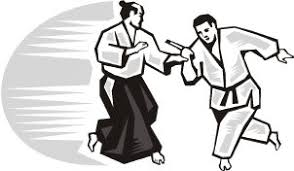
Brushing block is as described. It brushes the opponent's attacking arm, like brushing dirt of their sleeve. It does not deflect the attacking arm. It doesn't have to because the EBM has taken care of the problem of avoiding injurious contact with the body (see previous post) The attacking arm stays on course without interruption. See below for an illustration of a brushing block (ignoring the strike to the throat).

There is no 'grabbing'. There is no pulling. There is no pushing. How does a brushing block unbalance an opponent? After all, it is included in the section of the grading in which the grading candidate demonstrates unbalancing an opponent using a block? When I asked two of the senior instructors this question, it was suggested that the unbalancing comes from the 'brush' slightly adding to uke's forward motion thereby slightly unbalancing them in that direction. Being polite, that is the very definition of a shoehorned answer/explanation.

If that was a shoehorned answer/explanation, then the answer to the same question in relation to empty blocks is a shoehorned answer/explanation par excellence.

PS: I challenge all students who are engaged in training with JDJ ryuha were these gradings are still employed to ask their instructor how a brushing block unbalances an opponent, which it is supposed to do given that it is included in a section of the grading that examines unbalancing techniques.

Empty Block

JDJ's empty block is no block at all. It is an EBM used to avoid injurious contact with the body. Empty block is part of JDJ's blocking techniques classification but is never mentioned in JDJ's jujutsu grading system. Why not?

JDJ's classification of blocking techniques was used in the JDJ jujutsu grading system to classify unbalancing techniques used against moving attacks. How does an empty block, no block at all and only an EBM, unbalance an opponent? When I asked this question of the senior instructors, it was suggested that by not being where the opponent expected, the opponent would topple forward having not met the expected resistance to the force applied by their attack. That may well happen, however, are you going to base your tactics in a physical confrontation on that assumption?

Hard and Soft Blocks

The hard-soft blocking techniques dichotomy is an oft discussed dichotomy in the martial arts and martials arts literature. It is usually discussed in terms of explaining the superiority of soft blocks over karate hard blocks. Often this argument is supported scientifically with the aid of the concept of forces, an argument that is flawed and shows the lack of understanding in terms of theory that many in the martial arts have.

Examples of the hard karate blocks are the basic high, middle, and low blocks of karate. The example given of soft blocks is deflections. It is suggested that more force is required to be applied with the hard karate blocks than with the soft deflections.

Karate Moves for Beginners

What the arguers do not understand is that these hard karate blocks are in fact deflections (for the most part; see below).

The argument is often that the hard karate blocks apply force against force whereas deflections do not, thus the latter being more efficient. The hard karate blocks do not apply force against force. The apply force at an angle to the attacking limb, thus deflecting the trajectory of the attacking limb. More force is applied to deflect the attacking limb in this case, therefore the only question is, why is more force applied in the case of hard blocks than soft blocks? Is the answer found in Nakayama's blocking possiblity #1 which is the block being used as an attack to discourage further attacks (see previous post)?

What is a 'block'?

Let's go back to the beginning ask the basic question: what is a block? The general definition is to make the movement or flow difficult or impossible. It's to put something in the way of something. 

3 Techniques to Defeat a Block | Joe Daniel Football

The martial arts has a tendency of using terms without reference to their general meaning. There is no better example than that of throws and takedowns in the martial arts. A definitive distinction between these two classes of techniques is abscent in martial arts theory, and those proposed are either incomprehensible or plain wrong, until the one that I proposed in my book on the science behing all fighting techniques. My definition is supported by the general definition of throw and takedown, which the martial arts seem to have ignored.

The abovementioned argument in support of the superiority of soft deflections over hard karate blocks is that the latter apply force against force. The above presented a counter-argument, however, there are exceptions.

Are there true blocks in the martial arts, ones that apply force against force, ones that are put in front of an attack? A shin block is one. 

Gracie and Danaher distinguish between evasion and blocking in their Mastering Jujitsu (2003):

Evasive skills allow you to avoid strikes without contact. There are easy on your body and require proficient motion skills. Blocking allows you to safely absorb impact (rather than avoid it), and it requires sound conditioning and stance skills. (p. 77)

Their blocks include covering block, palm block, double-forearm block, and shin block. The shin block is referred to above as a true block. The double-forearm block (see right image) will be the only other Gracie and Danaher block considered here:

From your fighting stance, turn toward the incoming blow as you simultaneoulsy step away from it slightly. Bring your forearms together and tuck your chin, crunching your upper body inward, like a turtle retreating into a shell. (p. 78)

Aside from never having seen this block used or taught, other than in boxing where huge gloves provide the protection, why is the double-forearm block being used when the step away, the EBM, has taken the defender out of range of the attacker? Even if there is a valid answer, that question should always be asked when a block is used in conjunction with an EBM.

Returning to karate hard blocks. In addition to being deflections, they can also be true blocks depending on the direction of the attack and the body position of the defender. For instance, age uke (rising block, aka high block) is a deflection against a punch but is a true block against a downard hit with no EBM employed. A low block is a true block employed against a low roundhouse kick.

The Dog's Breakfast

You can see that the concept of blocking techniques as applied in the JDJ jujutsu mon grading system is a bit of a dog's breakfast, as it is in the martial arts in general (as I demonstrated in the chapter on blocking techniques in my book on the science behind all fighting techniques). But what to do about it? That is the question that is being raised throughout this examination of the development of the JDJ jujutsu grading system. What would you do?


Friday, 5 January 2024

The Development of the JDJ Jujutsu Grading System Part 3.1: The Mon System Introduction

The following introduction to the mon system is taken from Jan de Jong: The Man, His School and His Ju Jitsu System (Jan de Jong Self Defence School, 1995) (the 'JDJ book'):

The Tsutsumi Hozan ryu ju jitsu system originally commenced at Rokku (6th kyu - yellow belt). Jan de Jong has made incremental changes in the techniques and the system over the years, however, the most substantial change was the introduction of the 'mon system' in 1978. (p. 12)

The introduction of the kyu system was discussed in a previous post

That post included that the individual levels and colour belt system of Jan de Jong's (JDJ) kyu system reflected that of Tsutsumi Hozan Ryu (THR) included in Tsutsumi Masao and Higashi Katsukuma's Die Selbstverteidigung (Jiu-Jitsu): nebst einem Anhange über Kuatsu (Wissenschaft der Wiederbelebung Verunglückter): mit 72 Abbildungen nach dem Leben (Self-defense (Jiu-Jitsu): along with an appendix on Kuatsu (science of resuscitation of casualties): with 72 illustrations based on life) published in Germany in 1906. It is unknown whether the content of the two grading systems were the same. It is unknown if the JDJ kyu grading system is the THR jujutsu kyu grading system.

It should be noted that a former JDJ jujutsu instructor who ended up teaching for him full-time has stated that during his time (1963-1974), JDJ did not discuss THR in classes or that what was being taught was THR jujutsu.

The mon system was introduced at the front end of the JDJ grading system, however, it will be seen that the same influence had a major impact on the development of the dan system at the back end. How it fits with the kyu system in the middle, well ...

The mon system is comprised of 1st mon to 7th kyu. Why did JDJ refer to the last three gradings in the mon system as kyu grades? From the abovementioned JDJ book (p. 31):

Entry Levels
Age Requirements and First Grading
Under 12 years - 1st Mon
12-15 years - 3rd Mon
Over 15 years - 9th Kyu 

It would appear that JDJ considered mon grades, junior grades and kyu grades, adult grades, when he developed the mon system.

Until the introduction of the 'mon system' (refer pate 12) in 1978, people of all ages attempted the yellow belt grading first. Paul Connolly (refer page 19) started under the old system at the age of twelve. Two years later he was the youngest person to grade purple belt showing that it was a challenge but not an insurmountable one. (JDJ Book, p. 27)

The mon grades opened up a whole new market for JDJ - kids and youths/teenagers. Before the mon system, there was only 6th kyu that was trained by and with adults. The above statement concerning the 'old system' being a challenge but not insurmountable is being generous to an extreme.

The 'mon system' is a series of gradings that supplement the original grading system and primarily examine the fundamentals of ju jitsu. It is a rational, scientific approach to the teaching and learning of ju jitsu.

By providing novice ju jitsuka (ju jitsu students) with a basic framework of ju jitsu skills and understanding at the beginning of their training, they are better prepared to tackle the demanding grading system and attain a higher level of proficiency more quickly. The outcome of this bold move has proved extremely successful with the graduates of this system having a deeper understanding of ju jitsu earlier.

These fundamentals link all the techniques and provide a 'system' of self defence rather than a collection of unrelated 'tricks'. Armed with an understanding of these fundamentals, an experienced ju jitsuka could develop their own style of ju jitsu. In ancient times this could mean the loss of likelihood for the original master, or even a challenge for his position or life. Thus these fundamentals were closely guarded secrets and only revealed to very advanced and trained yudansha (black belt holder).

The JDJ book was researched, written, and edited by me, with contributions by the senior instructors of the school and with extensive consultation with JDJ, as acknowledged at the start of the book. The book was based on my understanding of the grading system back in 1995. That understanding has changed significantly in the meantime with further study and reflection, as these series of posts demonstrate.

The gist of the above understanding was derived from Greg Palmer (one of five to complete the JDJ technical grades and be awarded sandan before being awarded yondan for his contributions to JDJ and his school). Greg was able to gain those insights that lead to a new and better understanding because he was a professional trained teacher. How much of those insights were shared by the other instructors and their teaching of the mon system and application to the teaching of the kyu system is open to question.

The reference to 'system' and 'tricks' is reference to systems theory. In the context of systems theory, a system refers to a complex whole, comprised of interconnected and interdependent parts or elements. Systems thinking is an approach to understanding and solving problems that emphasises the examination of the entire system, rather than focusing on its individual components. 

Another way of understanding this approach is contained in the chapter on analysis in my book on the science behind all fighting techniques. In that chapter I refer to Gerry Carr, Sports Mechanics for Coaches, 2edn, 2004:

Carr explains how it is easy to be overwhelmed by the complexity and speed of a skill when it is performed in its entirety. He suggests that when the skill is divided into phases it is far easier to analyse each phase of the skill separately rather than concentrate on the total skill. Dividing a skill into phases also allows us to teach, learn and train each phase separately before combining them to perform the complete skill. It enables us to identify the similarities and differences between different skills which has been described as the core of all learning. Identifying the similarities between techniques and defences means that by training the similar phases we are training a part of a number of techniques or defences rather than just the technique or defence in question. This produces efficiencies in training and produces a system rather than just a collection of techniques.

The reference to 'tricks' in the above JDJ book excerpt, and which has been discussed in a previous post, is reference to skills being considered in their entirety and independent of all other skills. The reference to 'system' is reference to the phases in the performance of a defence; the fundamentals of ju jutsu as the above JDJ book excerpt refers to them as. These phases/fundamentals form the basis for the mon grades, however, how they fit with the kyu grades is another matter.

The idea that these fundamentals in the mon system were the 'secrets' of the THR grading system that JDJ chose to go against tradition and share with novice students was a myth that grew out of JDJ's penchant for not acknowledging the source of his teachings. 

What is missing from the above description of the mon system is that it is based in large part on Yoseikan Budo (YB) teachings. JDJ adopted those teachings and developed the mon system based on those teachings without acknowledging the source of those teachings. Anyone from the YB tradition could comfortably pass all of the mon grades without any instruction from the JDJ tradition. They would also do pretty well with a lot of the gradings in the dan grades.

In terms of the comment in the above extract regarding attaining a higher level of proficiency more quickly and that the outcome of this bold move of introducing the mon system at the front end of the grading system, and how it has proved extremely successful, I will refer to an interview that JDJ participated in. The interviewer asked if JDJ thought it was a good idea to change the system to suit the students.

Yes, I know what you're saying, but you know you can learn all the time. And if the results are better one way than the other, why carry on in a way that gives poorer results? I'll give you an example. In 1978 a Major Greg Mawkes MBE asked me if I would go and teach the army self-defence. I said okay and soon afterwards found myself teaching members of the SAS and the Commandoes. Shortly after I had started to do this the Major and I had a discussion about things. He told me that he thought the method of fighting was really good and he was pleased with that. But he said the men were having some difficulty understanding it all. I said this was the usual way of things and that my students were the same. He then explained the army did not have unlimited time to spend on this and that what he needed was quick results.

So it was at that point I had to think things through and see what I could come up with. I looked at the usual way the army taught things and decided I would alter the way I was teaching and come more in line with the army way of doing things. Well, do you know, the people started to pick things up much faster than before, and they could do the techniques much better than before! So I had a talk with my Instructors and said I thought that we should change things so that we were teaching everyone like this. And at that time we changed the way we taught the students. The techniques were still the same, it was only the method of teaching them that was different. And since then things have been much better.

The JDJ ryuha that are teaching JDJ's grading system in any large degree should take note of JDJ's comment regarding carrying on in a way that gives poorer results. I have long argued that JDJ's grading system is 1.0 and is in need of revision. It is overly cumbersome, overly burdensome, and disjointed, not to mention the faults that are contained therein. The grading system is in need of rationalisation and integration. Without it, the JDJ tradition will die, which can be seen through the ever-diminishing JDJ ryuha since JDJ's passing.

If grading system 2.0 is to be realised, one must understand how system 1.0 was developed or evolved. That is one of the main purposes of these series of posts.

JDJ's reference to Mawke's comment that his men (SAS troopers) were having difficulties understanding JDJ's teachings is reference to the kyu system approach. The reference to the Army way of doing things is reference to the mon system approach, which is basically a YB system approach, and which involves the division of a skill into phases (see Carr above). An understanding of this approach can produce the abovementioned improved outcomes, however, as will be demonstrated in the following posts, that understanding is lacking in many of the instructors within the JDJ tradition, including to a large extent JDJ.

Is that understanding lacking, at least in part, due to the way the mon system was introduced? The mon system was introduced into the JDJ grading system in 1978 when the senior instructors were already the instructors to which JDJ referred to in the above interview extract. The ones he referred to talking with about the introduction of the mon grades. In which case, did the senior instructors go through the mon grades? Were their introductory sessions that enabled the instructors who would be teaching these grades to gain an understanding of their content? It has to be understood that the mon grades are a significantly different system to the kyu grades. They are different in the very basis of their conception.

Am I the first black belt to have gone through the mon system? In which case, I am the first to complete the technical grades in the JDJ jujutsu grading system that included the mon grades (only five complete the technical grades and were awarded shodan; me and four of my instructors).

The next post will start to delve into the mon grades in some detail.

Tuesday, 2 January 2024

The Development of the JDJ Jujutsu Grading System Part 2.6: Shodan (Part 5: Shiai)

SHODAN PART 5: SHIAI

Part 5 of Jan de Jong's (JDJ) jujutsu shodan grading is shiai

The translation of shiai in Jan de Jong: The man, his school and his ju jitsu system (Jan de Jong Self Defence School, 1995) is 'a game, match, or contest.' 

There are a number of shiai gradings in the higher grades (ikkyu to sandan inclusive). Insights, or greater insights, (see Klein) may be gained that lead to a new and better understanding by studying these shiai gradings together rather than separately.

Why Shiai Gradings?

The first question that has to be asked is, why did JDJ include shiai gradings in his jujutsu grading system? That question needs to be asked in the context of the fact that JDJ did not see much of value in shiai as a training method. 

I know this for a fact because he specifically told me so and discouraged the practice when I was 'sparring' with a training partner when orange or purple belt. It was reinforced by Robert Hymas, a senior jujutsu instructor at the Jan de Jong Self Defence School (JDJSDS) and who was one of the three that JDJ ultimately awarded Rokudan, when he reiterated JDJ's views from the JDJ perspective.

So why did JDJ introduce shiai gradings into his jujutsu grading system? 

One explanation is that he was unfamiliar with grading systems, as has previously been mentioned, and he saw others were including shiai-type gradings into their grading systems. Kodokan Judo for instance. Then there was Tomiki Aikido/Shodokan Aikido and their competition aikido. Karate. Kyokushin karate and their x-man kumite. All of those forms of training were to be found in books, which as previously stated, were a great source of JDJ's 'continuous professional development.' And, of course, the Australian Ju Jitsu Association were lobbying for him to develop a competition format for the organisation given his role as President and National Coach of the organisation.

Given all of that, the second question is, did JDJ know what he was trying to teach or assess in the shiai gradings? What was the purpose of those gradings, other than including them because others were and, of course, to populate the higher grades given his one-off development of the kyu grades as his grading system?

I suggest that JDJ did not know what he was trying to teach or assess in these types of gradings. Sacrilege, I know, however, as will be seen below, that view is supported by the fact that there was virtually no instruction provided by JDJ nor his senior instructors as to what to do in these gradings; what they are trying to teach the student; what is being assessed. This is also supported by the fact that JDJ saw very little of value in this type of training. In this, I agree, which will also be seen below.

But, as always, there is a lot to learn by studying JDJ's shiai-type grades and their introduction, even if they serve no useful purpose ... other than to provide those lessons (see conclusion below).

Ikkyu: Futari Dori

At the end of the ikkyu shinken shobu no kata grading (practical grading) there is a section titled Futari Dori (attacks featuring two opponents). The description of the grading refers to two attackers, five attacks in total, and unarmed vs unarmed.

When looking for an image for this section (see left), it appears that futari dori is very much an aikido term and an aikido form of training, albeit very different to JDJ's grading referred to by the same name.

First question: did the senior instructors of the Jan de Jong Self Defence School (JDJSDS), those that graded shodan before I did, grade this section of the grading? Was it part of the original ikkyu grading? Or was it introduced when Jan de Jong (JDJ) introduced the shodan grading which led to additional gradings being added to the nikyu and ikkyu gradings? I might have been able to tell you, however, I no longer have access to the old grading sheets that I was gifted and which I regifted for the noblest of reasons. It appears that no good deed does go unpunished.

I recently saw a video posted on Facebook by a JDJ ryuha showing a nikkyu training/demonstration of this grading. (a) It was a mess, and (b) I would fail the candidate based on that performance, today.

The candidate in question should not be disheartened by those comments. Their performance was reflective of all who preceded them in this section of the grading. It was reflective of their instructor's performance in their grading, and reflective of their instructor's instructor's performance in their grading. In this case, the fault most definitely lays with the instructor, as it did in the JDJSDS.

Why is the performance in this grading always a mess. It is because the grading candidates abandon all of their training when engaged in this section of the grading. They start moving around all over the place, crouched in anticipation of an attack, and they are more inclined to move backward rather than forward in response to an attack. Was this their actions in any of the many shinken shobu no kata (practical) gradings that came before, and even the shinken shobu no kata grading that this section is a part of? The answer is a resounding, No!

George S. Patton: 'You fight like you train.' That would not appear to be the case within the JDJ tradition when the shiai-type grades are attempted. This raises a question as to the practicality of the shinken shobu no kata method of training. 


When I teach or discuss this grading, I suggest the person think Cpt Algren in The Last Samurai when he is confronted by three assailants armed with swords while he is unarmed. He stands his ground and waits for the attackers to attack, to come to him, and then he responds. The application of the 'mind of no mind' lesson in a life-and-death situation. This is representative of the shinken shobu no kata training.

The above is what should be being looked for in this grading, however, that is what is not being demonstrated in this grading. Why not? Because the instructors do not teach tactics for this grading, other than to place one opponent in front of the other. The same instruction given to 1st mon candidates, aged five or six, in the two-attacker section of their grading. This is an issue that will be taken up when the mon grades are considered.

I was going to share my experience in successfully completing this grading as there is a great deal to learn through the analysis of that experience, however, I'm trying to limit the length of these posts, unsuccessfully so as it appears.

How did I go in this grading? I passed. That is about all I can say about my performance. I, like the abovementioned JDJ ryuha demonstrator, moved 'all over the shop.' My two attackers chased me all over the dojo, and it was a large dojo. Did I execute any successful defensive techniques? A block or two, maybe. No locks, no throws, no takedowns. I didn't land any percussion techniques of my own, but then neither did my attackers. Is a pass in this grading not being hit? Is that what this grading is supposed to teach and assess? Is it simply a game of 'stay away'? I don't know, because my instructors would not appear to have known given their instruction and feedback. 

Shodan Shiai

'Free fight unarmed vs tanto, unarmed vs tanbo, then uke and tori swap roles.'

Tanto refers to a knife; tanbo a short stick.

First, it was a very different time. Occupational health and safety (OHS) did not exist, at least not in these gradings. No safety precautions were taken, other than mats. No restrictions on attacks with weapons. Head, eyes, groin where all acceptable targets for both armed and unarmed participants. No restrictions on techniques. No instructions whatsoever (for the most part).

The tanbo and tanto were usually rolled up newspaper which were then taped. Those makeshift training weapons did inflict a fair 'sting' when hit or stabbed with them, and were capable of causing injury, which they did on occasion.  

Second, this could be seen to be a relatively fair grading in that the attackers were not trained in fighting/attacking with a tanto or tanbo whereas the defender was trained in defending against tanto and tanbo attacks, to some degree.

It could be seen to be a relatively fair grading ... in theory. In practice, the armed attacker annihilates the unarmed defender. When the two candidates swap roles, the same result occurs. In order to pass the grading, the difference between the two scores has to be within a certain range otherwise both fail.

When I asked a senior instructor what the purpose of this grading was, he replied that it was to show that even with training that a person would be annihilated by an armed, relatively untrained in fighting with that weapon, attacker. And that is what the grading does show, time and time again. Good lesson. Good to know. Thanks. Cheers. 

It was a good thing that I did not take that lesson on board when I was confronted by a knife-wielding assailant on two separate occasions (the starting point of my book on a new and better understanding of our natural and learned responses to a threat).

Third, why free fighting unarmed against a knife and unarmed against a short stick? In fact, why one unarmed against two unarmed in the previous grading? Shouldn't the progression be one unarmed against one unarmed, then one against two, and then one unarmed against one armed, and then both armed with the same weapon, etc.? Where is the one unarmed against one unarmed?  

An answer to these questions might be found in Tomiki's explanation of his introduction of shiai (randori) into his aikido.

Tomiki was a student of Jigoro Kano, founder of Kodokan Judo, and was eventually graded 8th dan by the Kodokan. He became fascinated by Morihei Ueshiba’s aikido and became one his early students. In his ‘On Jujutsu and its Modernisation’, Tomiki argues for two forms of randori training:


When we analyse the essence of attacks, they fall into two general categories:
1. An opponent, from close in, tries to topple (taosu) or restrain (osaeru) you.
2. An opponent, from a distance, tries to strike, lunge at, or kick you, or with a weapon tries to cut or stab you.
...
The system of randori practice that Master Kano formulated is for the situations described in point 1 above; it is the category of nage-waza, where from close in you apply a waza at the collar and sleeve of a Japanese style judo jacket. A system of randori practice where you would avoid your opponent's attack from a distance (as in point 2 above) and then apply a technique would utilize the atemi-waza and kansetsu-waza. Against this latter attack, the attack from a distance, there is a need to establish such system of randori training.


Randori practiced in aikido usually involves two or more opponents. It is not 'free fighting' per se but simply a 'free flowing' attack and defence with no continued fighting. JDJ had relatively little experience with randori training.

Tomiki's shiai (randori) involved an attacker armed with a knife. Did JDJ adopt Tomiki's shiai to continue that the shiai form of grading included in his one-off instructor grading, ikkyu? Did he include these types of gradings in terms of introducing a randori type in ikkyu and a Tomiki type in shodan? Did he include a short stick element because of its use in his pencak silat? ... Why aren't the attackers trained in the use of the weapons in attack mode?

Lastly, my grading, or I should say, our grading. Dave Palmer and my grading, it was something that had not been seen before or since. It was a literal blood bath. Maggie de Jong had to scrub the walls and mop the mats after the grading to remove the blood that had been spilled during the grading. There was a lot of blood.

This has to be expected when you get two real fighters, not just mere martial artists, together and there are no rules, no protective equipment, and when weapons are involved, and told to 'free fight.'

Again, a great deal can be learned from an analysis of my/our grading, however, post length considerations prohibit the sharing of my/our experience and its analysis.

How did Dave and I do in our grading? We passed ... even though the grading ended with Dave being taken to emergency after I punched him in the forehead with a standing fist punch and blood cascaded down his face and the front of his gi. He was attempting to retrieve a weapon that I had knocked out of his hand, and I instinctively punched him when he advanced to do so. He was knocked back the length of a tatami and as he attempted to advance, I instinctively punched him.

We passed even though I was rendered unconscious during the grading when I landed on my head/neck from a sacrifice throw by Dave (btw, great execution of the technique, dangerous, but great nonetheless).

In terms of OHS, our weapons were not taped rolled up newspaper. The knife was a wooden training knife and the tanbo was a piece of PVS piping wrapped in cloth and then taped. When you got hit with those 'training' weapons, you got hit, and the risk of injury increased exponentially. But we wanted to test ourselves, and of course there was no guidance or supervision provided by the senior instructors.

OHS-wise, nobody from the instructors table came to see how I was when I landed on my head/neck from Dave's sacrifice throw, and when a crack from my neck was heard 'like a "roo shooter's" shot' across the dojo, and as I laid on the ground unconscious for a bit. They simply waited for me to rise and continue the grading, which I did, albeit initially by backing off as the fight had become unfair with now two armed Daves advancing on me.

There was no feedback provided at the end of the grading, however, Hymas did approach me (us?) later and said that JDJ was not happy with the grading. JDJ never expressed that sentiment to us. Even then, I thought, 'How can any of the examiners be unhappy with the grading given the complete lack of direction provided by the instructors as to the conduct and purpose of the grading. Given the complete lack of indication as to what is supposedly being assessed.'

Nidan Shiai

'Free fight with tanto vs tanto'

This is the only shiai-type grading where there is an equal footing (see above re the absence of one unarmed v one unarmed). It is an equal footing because the two participants are armed with the same weapon. It is also an equal footing because the two participants have not been trained in the use of the knife and knife fighting. 'What is going on here?'

This is indicative of an issue within the JDJ tradition that I will address in a post associated with the mon grades, and that is that the attackers in the JDJ tradition are not taught how to attack properly. This has implications for the training of defensive tactics. 

I prepared for this grading. I learned from the previous shiai-type gradings that I'd undertaken.

The two attackers in my futari dori grading in ikkyu were Hymas and Dave Palmer. I asked Hymas to be one of my attackers because I wanted to test myself against the best. My strategy was to stay away from Hymas and to focus on responding to Dave's attacks or to attack Dave when Hymas attacked me. On the face of it, it was a sound strategy, however, as it turns out, it was a floored strategy. Dave was by far the more dangerous opponent.

Dave committed to his attacks. Hymas knew everything that I knew and knew the defences that I might employ against his attack, so he provided uncommitted attacks with a focus on countering my defence. This is a problem in this type of grading. I know everything you know, and you know everything that I know, and that knowledge impacts on tactics and strategies employed in the grading. It also leads to questions regarding the practicalities of the tactics and strategies thus learned in terms of 'real world' application.

I used this insight in my grading. I would faint an attack and observe the response. I'd faint it again and observe the response. If it was the same response, I'd attack with the anticipation of the response and adjust my attack accordingly. This became a strategy that I shared when engaged in my Master of Business Administration (MBA) degree. If I can discern your strategy, I can develop ways to defeat you.

I hadn't trained the futari dori grading with Hymas and Dave prior to the grading. If I had, I might have discerned Hymas' approach to his attacking role and developed a different strategy going into the grading, e.g., stay away from Dave and focus on Hymas.

In the shodan shiai grading, Dave and I did train the grading together prior to engaging in the grading. I learned that Dave tended to not acknowledge a strike and would walk through it to attack me.

Confidence isn't necessarily everything, but it is a big thing. On a rare occasion that we 'trained' this grading in the instructors class, I was paired with Darryl Cook. Cook is a very good practitioner. He is a contemporary of mine. He is aggressive and he is taller than me, bigger than me, and stronger than me. He was armed with the knife and I was unarmed, but I was 'all over him.' He had no answers. I actually felt physically taller and bigger than him. It was as though I was looking down on him from a height. Hymas took Cook aside to give him some advice since he observed that I was 'kicking his butt,' as the Americans would say. Cook returned and raised his knife to my face. Order was restored in the universe, my perception of my size returned to reality, and there was no more butt kicking.

I knew that Dave gained confidence when he walked through my attacks and 'kicked my butt.' The strategy going into the grading was to not allow that to happen; not to allow him to gain confidence by walking through my attacks and kicking my butt. The first time he tried it, I was ready. I put him on his 'arse', held him by the throat on the ground with my fist raised ready to 'ground and pound.' He covered up and raised both feet-legs ready to kick me. 

'Matte, matte, matte', JDJ shouted as he pounded the grading table. Hymas jumped up from the grading table and pulled me back ... and all the while, Dave and I were smiling at each other. We knew what this was all about. It was setting the 'rules' for this grading. Nobody had lost control, in fact, far from it, unbeknown to JDJ, Hymas, and whoever else was sitting on the grading table.

My nidan grading involved a number of candidates, all of whom had been my instructors. I trained a little with all of them, only to see how they fought. And then I studied knife fighting, given that there was zero instruction in knife fighting provided within the JDJSDS. Then I developed strategies to defeat my opponents, my instructors.

Memorably, when paired up with Debbie Clarke, a great practitioner and a real fighter, there was a standoff, so I provided an opening by lifting my hands. You will recall this strategy when ken tai ichi no kata was discussed in a previous post. It was a genuine opening and if she was good enough, she could 'kill' me. No takers. I raised my hands a little higher to entice her into attacking. No takers. A little higher, she attacked, I 'died.' Fair enough.

You will recall from a previous post that many, and most definitely the senior instructors, did not look outside of JDJ's teachings. In preparation for this grading, I looked outside of JDJ's teachings given that there were no specific teachings regarding knife fighting within JDJ's teachings. I also thought that this might give me a competitive advantage.

Part of my study re knife fighting was reading Col. Rex Applegate's Kill or Get Killed. The description accompanying the image to the right is:

Attack With Knife From Crouch

Beware of the man who holds his knife this way and who attacks from a crouch, with the blade held close to his body and with his free arm out in front to parry or to help create an opening for a slash or thrust.

Beware me. The following was included in the text:

The trained man will use this knife, in the attack, from a crouch, with the left hand forward and the knife held ... close to the body. The outstretched left hand will act as a guard, a foil or a parry, and will help to create the opening for a slash or thrust. The left hand also may be used to distract the adversary's attention - by waving it in his face, by throwing something, or by making sudden darting motions toward him. ...

Beware me and I was a trained man. I was trained in knife fighting by Applegate and not my instructors at the JDJSDS, even though there was a knife fighting grading in the curriculum which the senior instructors (Hymas, Peter Clarke, and Paul Connolly) had successfully completed. 

I adopted Applegate's approach, at times, with one important addition. When a thrusting attack was launched, I would move from the left foot forward staggered stance (han zenkutsu dachi) to a cross-stance. Or more accurately, sempok from pencak silat (see image below).


I was well versed in this stance having trained pencak silat for quite some time. Most importantly, the training was with Richard de Bordes school in London rather that at the JDJSDS as JDJ had, as he said, Westernised his pencak silat so that it would be acceptable for a Western audience. He had in fact Japanised it so that it resembled karate to a fair degree.    

Moving into this stance from a traditional staggered stance is effectively an evasive body-movement, similar to nagashi (flowing) in JDJ and Yoseikan Budo practice. Interestingly, the image accompanying the Tomiki aikido discussion above shows both aikidoka ostensibly assuming the same stance. The same stance is seen in some karate styles, and it is seen in JDJ jujutsu teachings, however, I would argue that there is less understanding of the use and the structure of this stance in all those arenas than in pencak silat.

Another part of the transition into this stance is that it moves the back hand to the front through the turn of the shoulders. This is also used to great effect in pencak silat. 

Part of my strategy was to employ this tactic, moving from a staggered stance into sempok/cross-stance thereby executing an evasive body-movement and moving my rear knife-wielding hand to my front hand and a trusting attack. It was part of my strategy because the other candidates, my instructors, had not seen it before. 

Memorably, this tactic was employed against the abovementioned Debbie Clarke.

Debbie lunged forward and I executed the move. She was going to barrel into the now thrusting knife, which was a molded metal knife, and she was in danger of being 'impaled' on impact. I relaxed my grip and as impact occurred, the knife slide through my hand and fell to the floor. It was beautiful, it was perfect ... and it was missed by JDJ. A clean 'kill', and it was not recorded. 

JDJ took me aside after the grading and told me that I was the best in the grading. But all that meant was that I knew 'how to play the game' better than my instructors. I learned how to knife fight to some degree whereas they did not due to lack of instruction. I learned a fantastic move and had a greater appreciation for the use of sempok as a fighting tactic. But is that what this grading is designed to impart to students?

Before we leave this section, I was present when two JDJ yudansha engaged in this grading. One has since gone on to be awarded Rokudan by a JDJ ryuha principal. The other had his own ryuha and was a 'fighter.' They 'fenced' with the knives, like one would when fencing. Tapping against each other's knives as fencers tap against each other's swords. I was astounded. Why would anyone consider this approach, particularly given that they were supposedly highly experienced and graded martial artists? But here's the thing, how can you fail them, even though the performance was ludicrous, given that no training nor instruction is given in knife fighting even though this is a knife fighting grading in the grading system. 

Sandan Shiai

'Free fight with tanbo vs tanto.'

What is not included in the description of this grading is that the roles are swapped, as in the shodan shiai grading. And as in the shodan shiai grading, the person with the tanbo annihilates the person with the tanto. And as in the nidan shiai grading, the candidates are not trained in the use of fighting with either weapon.

What is the point, other than including shiai-type gradings into the dan grading system and populating the dan grading system given the relatively comprehensive ikkyu grading?

Conclusion

Unlike my instructors, I can teach students how to go about these gradings, but still, what is the point? I can, and have done, train them to defeat the students of other instructors, hands down, but what is the point? 

These gradings in the JDJ grading system are seriously floored, but here's the thing. If they are removed or 'fixed', the lessons learned through the above analysis are lost. The insights that can be gained are lost. The new and better understanding that can be derived from those insights are lost. It is a quandry, conundrum, and other such words to describe this situation.

What would you do?