
A big part of the
Jan de Jong story is his logo. His logo was based on an
ex libris he commissioned during WWII. An Ex libris, or bookplate, is a small graphic label or print that is glued to the inside cover of a book with the purpose of identifying its owner. The Latin phrase 'Ex libris ...', means 'the books of...', and is usually followed by the name of the owner of the book. The designer De Jong commissioned to design his ex libris was
Wim Zwiers. In researching this blog, and yes, I do research these blogs, I came across this explanation of why an ex libris is made:
Ex-libris have been a constant tradition for over five hundred years. They are a challenge to an artist to produce a small graphic art work for a friend, for a customer or for himself with a special purpose: identifying the owner of a book. Pasting a beautiful ex-libris in one's books not only discourages theft and reminds borrowers that a book must be returned, but is also a way of paying tribute to the book, which despite modern communication technology remains a primary vehicle for the transmission of knowledge and a constant source of pleasure and interest. As an object of collection, ex-libris are a wonderful way of acquiring, with time and patience and without being a millionaire, a small-format art museum which reflect the artist's skills and the collector's taste.
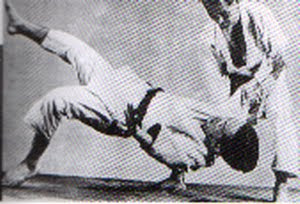
The theme or image of De Jong's ex libris speaks volumes. It is a graphic representation of his original jujutsu instructors, and reflects his love of, and identification with, the art of jujutsu. The image is based on a photo taken of his original instructors, the
Saito brothers.
Zwiers was born in 1922, and would have been in his late teens when De Jong commissioned his ex libris. He went on to become a teacher of fine arts after WWII and is a respected artist utilising many mediums. There are so many stories like this associated with De Jong. Zwiers reconnected with De Jong through an amazing coincidence. They had not had any contact with each other since WWII, but, for whatever reason, in the mid 1990s, Zwiers was visiting Perth, 'the most isolated capital in the world'. He was on a train and saw a van through the window. The van had the ex libris image he'd designed 50 years ago on it, along with a phone number. He phoned the number, and, he and De Jong were reconnected nearly 50 years after their initial meeting, and half a world apart. De Jong would always try and visit Zwiers each year he visited Europe to conduct his seminars. I had the absolute pleasure of meeting Zwiers. He showed me how he created his copper engraved ex libris. He engraves them into a copper plate, backwards, and uses a hand cranked press to print off a limited edition.
The image above of De Jong's ex libris was taken from the ex libris
Harry Hartman generously sent me. The fact that the ex libris are printed in a limited edition, by necessity, tells me the esteem with which De Jong held Hartman.
Zwiers is an amazing character. He looks like your traditional grandfather, albeit your traditional Dutch grandfather. But five minutes with him will tell you he is
different. He is a true artist in that he has a different view of the world, but, he doesn't have to dress or act
different to advertise his different perspective. He lives in this great old house, with a basement that is built into a dyke. The art on the wall of his main living room, a two story affair without the second story, was split 50:50 between his art and those that had been gifted to him by fellow artists when his wife passed away. Those artists had drawn, painted, etc their expressions of grief for a fellow artist. Amazing! And his art ... he told me the story behind many of the pieces he'd chosen to hang on his wall, the art was incredible, but the stories even more so. Obviously, I am a fan ... and I'm proud to say that I have a piece of his work taking pride of place in my home.

De Jong used his ex libris-based logo for his school from when he first started teaching in the early 1940s until 2002. He used it on his badges, as the badge that Hartman sent me shows.

He used it on the membership cards as Hartman's membership card shows from the 1950s when De Jong first started teaching in Australia.

He used it on his badges which signified his gradings rather than belts (see previous blog).

Hartmen sent me a photo where I think that De Jong is attempting to replicate the original Saito photograph.
Given I'm a business/strategy professional, I find it interesting that the
new management of the Jan de Jong Self Defence School
rebranded the school with a new name and identifying logo. It is now called
Jan de Jong Martial Arts Fitness and thier website explains that this change was introduced in 2002 to reflect a
new direction. The new direction is not expanded upon. Possibly, the new direction is reflected in the new name,
Martial Arts Fitness. De Jong was only ever interested in the practicality of what he taught; fitness only facilitated the practical. I recall De Jong questioning the idea of going to the gym to become better at what you were doing. His opinion was, do what you do, and you'll become fit doing what you do by doing what you do.
It is most definitely a coincidence that the new logo is very similar to the woolblend logo; which symbolises a blend between 50% wool and synthetics. Having said that, is this an unintentional symbol of the
new direction that the
new management of De Jong school has taken? A blend between self defence and fitness.
Why would you change your logo when your logo has equity? Would you consider changing the Coca Cola logo? You would, if you were persuing a
new direction. Putting some distance between yourself and your origins. While De Jong was present at the 2002 meeting, I would suggest that he supported rather than initiated the
new direction and the symbols thereof. I recall the many discussions I had with him concerning
succession planing. I'm a business/strategy professional, so of course I talked to him about succession planning. He wasn't interested. The way he saw it, what happened after he passed, happened. He lived for the moment. As I've discussed with Hartman, that's not a perspective that is uncommon for those who have experienced war.
'Don't walk behind me, I may not lead. Don't walk in front of me, I may not follow. Just walk beside me and be my friend.' That to me was De Jong, and it reflects his perspective on succession planning. He wasn't in the game to be followed; to inflate his ego. If you ever had the privilege of talking to De Jong or his former students/instructors, you'll find
friendship is the concept that most often comes up. All of the
old guys I've had the privilege of speaking to, focus on the relationships, the experiences, and not the quality of the instruction. This reinforces my argument that
culture is the key to a successful martial arts school.
It seems appropriate that when De Jong died, the 996 Hay Street dojo was demolished. The name of his school, and his logo/symbol, his ex libris Saito brothers logo/symbol, was replaced. He wanted those who came after him, did so uniquely. He was not in the business of creating clones or librarians; he was in the business of creating teachers of a unique
school of thought. But it also seems appropriate that his son,
Hans de Jong, went on to use a very similar name and the symbol/logo of his father's school. After all, Hans is probably the longest serving student of his father having commenced training with him in 1955.


