Showing posts with label Tsutsumi Hozan Ryu. Show all posts

Saturday, 3 May 2025

From Feudal Japan to Modern Australia: The Legacy of Jan de Jong Jujutsu


From Feudal Japan to Modern Australia: The Legacy of Jan de Jong Jujutsu (Daniel Newcombe 2025) unveils the untold story of a martial arts lineage that bridges centuries and continents. For the first time, Western audiences are introduced to the rich history connecting Jan de Jong's renowned jujutsu system to its roots in Tsutsumi Hōzan-ryū, one of Japan's oldest and most secretive samurai traditions.

Through the translation of the meticulously researched work by Sakae Morita, 堤寶山流秘書 (The Confidential Records of the Tsutsumi Hōzan-ryū), combined with the Authors 40 years and 3 family generations of experience with the de Jong jujutsu system in Australia , this detailed study delves into the lives of key historical figures who shaped the system, offering a detailed and fascinating exploration of their techniques, philosophies, and enduring contributions. From the samurai era of feudal Japan to the thriving martial arts communities of modern Australia, this book illuminates the journey of a profound legacy.

Perfect for martial artists, historians, and enthusiasts, this book provides a rare glimpse into the cultural and historical evolution of a jujutsu tradition that continues to inspire practitioners worldwide.


I worked with Daniel on this book and so I know the impressive efforts that went into researching and writing it.

I have been asked to provide a review of the finished product, which I am currently working on.

This work features the work on this blog telling the Jan de Jong story as well as that in my Jan de Jong: the man, his school and his jiu jitsu system (1997).

This book should be of interest to the many thousands who have been taught and are being taught within the Jan de Jong tradition dating back to the 1950s.

Tuesday, 26 November 2024

Clarifying My Critique of the JDJ Grading System

Introduction

Recently, I published a post critiquing aspects of the jujutsu grading system developed by Jan de Jong (JDJ). This critique has drawn some criticism, with some interpreting it as an attack on JDJ’s legacy or his teachings. However, my intention was never to undermine JDJ or his work but rather to spark a conversation about how his system can be adapted and improved for the benefit of current and future students.

This post clarifies my rationale for the critique, addresses the concerns raised, and elaborates on the importance of critical analysis in martial arts traditions.

Responding to Criticism

The critique in my earlier post focused on the grading system itself, not JDJ’s broader legacy or accomplishments. I acknowledged in that post—and continue to believe—that there is much to admire in JDJ’s achievements. However, I also believe that to honour his principles, we must remain open to rethinking elements of his system when they no longer serve their purpose effectively.

Those who criticised my post may have missed this nuance. Instead, they seemed to conflate a critique of the grading system with a broader rejection of JDJ’s teachings. This reaction reflects a tendency, common in many traditions, to defend what exists rather than question it critically. My aim was to challenge this mindset, not out of disrespect, but out of a desire to see JDJ’s work evolve in ways that benefit students.

Correcting the Record

For many years, I actively supported JDJ’s grading system. In fact, in 1997, I authored Jan de Jong: The Man, His School, and His Ju Jitsu System, which described the grading system as a superior model. I repeated this view in posts on this blog. However, after years of study and reflection, I now see significant issues with the system that I failed to recognise at the time.

My earlier endorsements may have contributed to an uncritical acceptance of the grading system. Given that these endorsements are referenced in promotional materials and discussions about JDJ’s teachings, I feel a responsibility to set the record straight.

The Importance of Critical Analysis

Critical analysis—questioning assumptions and rigorously examining evidence—has been largely absent in discussions about the JDJ grading system. This is understandable to an extent; JDJ’s teachings were extensive, and he maintained secrecy about the origins of his techniques and gradings. However, 21 years after his passing, it is time to ask the hard questions.

Peter Clarke stands out as a rare example of someone who has conducted such an analysis and made meaningful changes to the grading system. This demonstrates that thoughtful critique can lead to positive outcomes.

Reflections on the Grading System

My previous post highlighted some specific shortcomings of the JDJ grading system. While it serves as a valuable repository of techniques, it lacks a clear focus or goal. For example, as Peter Clarke has noted, the system emphasises amassing techniques without sufficient attention to their strategic, real-world application. This creates a 'library' of knowledge that is impressive but not always practical.


Another issue lies in the significant influence of Yoseikan teachings on the grading system. Many instructors outside the Jan de Jong Self Defence School who claim to follow JDJ’s gradings are, often unknowingly, adhering to a Yoseikan-based system that JDJ had incorporated. This raises important questions about the authenticity of what is being preserved under the guise of JDJ’s original approach.

In response, the leader of one JDJ ryuha has attempted to address this issue by removing Yoseikan elements entirely, aiming to 'return' to the original Tsutsumi Hozan ryu jujutsu. While well-intentioned, this approach introduces its own set of challenges and limitations, as it assumes a fixed historical authenticity that may not align with modern needs or the evolution of the system under JDJ. Nor may it actually reflect Tsutsumi Hozan ryu jujutsu teachings.

My Perspective and Limitations

While I have identified issues with JDJ’s grading system and its development, I am not in a position to propose a definitive replacement. I find myself paralysed by the complexity of creating a new system that balances tradition with practicality. However, I hope that my analysis inspires others to take up this challenge.

The grading system’s greatest potential lies in its adaptability. JDJ himself recognised the value of change when he said:

"If the results are better one way than the other, why carry on in a way that gives poorer results?"

This mindset, focused on outcomes rather than dogma, should guide any future revisions.

Opportunities for Growth

Critics of my earlier post might ask: What is the way forward? There are several paths to consider:

  1. Preservation: Maintaining the current system as-is, though this risks stagnation, especially given the small number of practitioners who have completed the full grading system.
  2. Modernisation: Following Peter Clarke’s example by simplifying the system and focusing on real-world applications.
  3. Reconnection with Roots: Revisiting the original Tsutsumi Hozan ryu jujutsu to refine the system’s core principles.
  4. Informed Innovation: Using JDJ’s teachings as a foundation to create a modern framework that better serves today’s students.

Closing Thoughts

My critique of the JDJ grading system was never intended to disparage JDJ’s legacy. Instead, it was a call to action for practitioners to critically evaluate what we teach and how we teach it. By embracing critical analysis and thoughtful innovation, we can honour JDJ’s legacy while ensuring his teachings remain relevant and effective.

I hope this clarification helps to refocus the conversation on what truly matters: the development of a system that serves students to the best of its ability, in the spirit of JDJ’s own commitment to improvement.

Sunday, 5 May 2024

JDJ Jujutsu Ikkyu Holders Register

It should be noted that I never set out to create a register of Jan de Jong's (JDJ) jujutsu yudansha, ikkyu holders, and/or instructors. That only came about through a comment received on a previous post asking about a register in relation to a person not affiliated with the Jan de Jong Self Defence School (JDJSDS) claiming that they were awarded yondan by JDJ.

I had a register of yudansha that was created by Greg Palmer. I didn't have a register of ikkyu holders, however, I thought it was important as ikkyu was the instructor's grade in JDJ's original grading system, the kyu system

As the above kyu system link showed, JDJ developed the kyu system with no thought of any extension; no thought of a dan system. That grading was designed as a one-off grading system with instructors being graded ikkyu. I would put some of the ikkyu holders who were instructors up against any of subsequent dan graded instructors and would say they either matched or surpassed them in all respects.

Of course, the obvious question is, why didn't JDJ consider dan grades when he developed his original grading system? 

Was it because there was no mention of black belts in Tsutsumi Masao and Higashi Katsukuma's Die Selbstverteidigung (Jiu-Jitsu): nebst einem Anhange über Kuatsu (Wissenschaft der Wiederbelebung Verunglückter): mit 72 Abbildungen nach dem Leben (Self-defense (Jiu-Jitsu): along with an appendix on Kuatsu (science of resuscitation of casualties): with 72 illustrations based on life) published in Germany in 1906. All of the belts in JDJ's kyu system are included in Tsutsumi and Higashi's list, but there is no mention of black belts by Tsutsumi and Higashi as there is no mention of black belts in JDJ's original list of gradings.

When shodan, and then nidan and sandan were subsequently developed, ikkyu came to be thought of as an 'assistant instructor's' grading. That belittles the previous ikkyu holders who were the instructors of the school. They deserve more respect from the post-1980s generations than to be considered 'assistant instructors.' That is why I have developed a JDJ ikkyu holder register.

Based on my analysis of the development of the JDJ jujutsu grading system that has been explored in these posts, an interesting proposition has been put forward by a reader who was a former instructor who was graded ikkyu. One that is well worth considering. Does JDJ ikkyu = Saito sandan?

DOES JDJ IKKYU = SAITO SANDAN?

Are the JDJ ikkyu holders the equivalent of JDJ's original instructors, the Saitos, sandan? Are they the equivalent of JDJ at sandan under the Saitos?

The idea behind this is that when JDJ developed his kyu system which was designed as a standalone one-off grading system, that was all he knew from the Saitos. That was his sandan, plus whatever else he picked up in his limited training in Europe during WWII. That is not an unreasonable assumption.

The following are the JDJ ikkyu holders whose names I have been able to ascertain todate. Thank you to the readers who have contributed to the compilation of this list.

The names are presented in no particular order. Those included in this register of JDJ ikkyu holders did not go on to grade shodan. Those that did are shown separately in the JDJ yudansha register. There are 34 in all, with 30 males and 4 females.

The first to be awarded ikkyu were Alan Robson and Rodney Miller according to the JDJSDS Hakusho (1986, 20).

JDJ Ikkyu Holders

1. Margaret de Jong (front right of JDJ)

2. Vass D'Esterre (back second left)

3. Robert Kirby

4. Peter Canavan

5. Rodney Miller

6. Dennis Dunn

7. Warwick 'Zak' Jaggard

8. John Poulton (front left)

9. David Palmer

10. David Green

11. Michael Boland

12. Heidi Romundt

13. Steve Moller

14. Gerald Woods

15. Adrienne Barlow

16. Alan Robson

17. Ross Allanson

18. Paul Lang (?)

19. Michael Simpson

20. Glenny Savy

21. Ian Thomason

22. Paul Amyes

23. Marcus Seabrook

24. David Skender

25. Peter Hegarty

26. Mick Rendall

27. Don Berryman

28. Jean Roebuck

29. Dean Cahill

30. Warren Holdway

31. Harry ? (trained with Rendall and Cahill)

32. Craig Ma’ha

33. Jason Stirbinskis

34. Dale Elsdon


A number of the above went on to become yudansha under Hans de Jong in his Hans de Jong Self Defence School ryuha following JDJ's death in April, 2003.

If you know of anyone missing from the above list, please forward their name to me for inclusion.


Monday, 25 March 2024

How Long Does It Take to Complete the Jan de Jong Jujutsu Grading System to Sandan?

The recent series of posts have explored the development of the Jan de Jong (JDJ) jujutsu grading system.

JDJ had three grading systems at his school, the Jan de Jong Self Defence School (JDJSDS): jujutsu, aikido, and pencak silat. For the sake of not repeating for the sake of technical specificity, the following will refer to JDJ's jujutsu grading system as JDJ's grading system.

Within those posts, we saw that the technical grades within the JDJ grading system finish at sandan (3rd dan). All higher grades are honorary. 

The idea that the technical grades in JDJ's grading system finish at sandan is based on JDJ's reported experience with his original instructors, the Saito brothers. The narrative is that the technical grades finish at sandan in the Tsutsumi Hozan Ryu grading system that the Saito brothers taught, and that JDJ completed them and was awarded sandan by the Saito brothers in 1939 (Jan de Jong: the man, his school and his ju jitsu system, Jan de Jong Self Defence School, 1997 (JDJ book)).

The adult technical grades in JDJ's final grading system commence with 9th kyu (of the mon system) and finish with sandan. From nikyu (2nd kyu) to sandan, there are multiple parts to the gradings, as the recent series of posts explain and explore.

The total number of gradings and their individual parts from 9th kyu to sandan is 46. Forty-six gradings for an adult to complete the technical grades in JDJ's grading system. 

JDJ recognised that his grading system was far more extensive and comprehensive than any other going around and wanted to acknowledge the efforts of his successful students by including a list of the parts of the gradings on their certificates. I pointed out that the list would only be included on the back of the certificate, which nobody would see, and that in and out of the martial arts, a black belt is perceived as being a black belt no matter the grading system from which it came from. 

A relatively common question that is asked is: how long does it take to get a black belt in JDJ's grading system? The commonly conceived wisdom is 10 years. Where did that number come from?

This post explores the question of, how long does it take to complete the technical grades in JDJ's grading system and to subsequently be awarded sandan?

There are five people who have completed the technical grades in JDJ's grading system and been awarded sandan by JDJ (and those five are also the only ones to have completed nidan (2nd dan) under JDJ): Peter Clarke, Robert Hymas, Paul Connolly, Greg Palmer, and myself, however, there is also JDJ under the Saito brothers.

According to the JDJ book, JDJ commenced training in 1928 and was awarded sandan in 1939 = 12 years. He started training at the age of seven, which makes him 18-19 when he was awarded sandan under the Saito brothers. That timeline raises many questions, which thankfully are beyond the scope of this post.

The following training commencement dates are taken from the JDJ book. The date of the awarding of sandan is taken from Greg Palmer's records:


What can be made of those numbers?

You will recall from a previous post that the original JDJ grading system was the kyu system. The shodan grading was developed so that JDJ could have some black belt instructors accompany him to Europe to advance his European teaching ambitions. I don't know the date of the introduction of the shodan grading(s), but it has to have been in the very late 70s.

Clarke and Hymas were awarded shodan in 1981, Connolly in 1982, and Palmer in 1984. The latter two's numbers are distorted because there was no shodan to grade during their earlier years. Hymas' numbers are distorted because he was working full-time as an instructor at the JDJSDS at that time.

Clarke's numbers would probably be the most representative of the first four given that he commenced training not long before the shodan gradings were introduced and he didn't work full-time at the JDJSDS. What makes his achievement even more remarkable is the fact that he was a partner in a leading law firm in the city at the time, and as such was time poor, however, he and Hymas (and possibly Connolly) did the shodan shinken shobu no kata as a demonstration whereas all those that followed had to perform it in true reflex fashion (see this post regarding this issue).

In addition, none of the first four had to go through the mon grades as those grades were introduced when they were instructors (who then went on to teach the mon grades that they had not undertaken). 

So, I might be the most indicative of the five sandans that were graded under JDJ given that I went through the mon system and shodan shinken no kata reflex style, and the nidan and sandan gradings were developed before I was a qualifying candidate. 

My Shodan

I commenced training on the third Wednesday in April 1983 in Ian Lloyd's class and was awarded shodan in February 1993 - a little shy of 10 years. That would appear to support the commonly conceived wisdom of a minimum of 10 years to be awarded shodan. Or does it?

When I commenced training, I started off by attending two lessons a day, six days a week, and engaging in a lot of extra training (see this post). That is 12+ hours a week, 48+ hours a month, and based on a 45-week year, 540+ hours a year. Most people start off, and often continue with, one or two lessons a week and maybe a little extra training. That is 1-2+ hours a week, 4-8+ hours a month, and based on a 45-week year, 45-90+ hours a year. 

A ludicrous calculation based on the above, but if we say that it takes 540 hours training a year to be awarded shodan in 10 years, then the average person training 90 hours a year can expect to be awarded shodan in 60 years. :)

There were other factors in my 10-year shodan qualification. 

During that time, I engaged in what was then an Australian rite of passage in backpacking in Europe for a year. I also completed the Chartered Accountants 'professional year,' which was actually 18 months, where candidates do not see the light of day for that period of time, and completed the Securities Institute of Australia graduate diploma in which I was awarded State Dux, which was another 18-month commitment. That had to have slowed down my progress to shodan.

What is obvious is that I, along with the other four sandans, am not an indicative example of the time it takes to be awarded shodan in the JDJ jujutsu grading system.

My Nidan
I was awarded nidan in December 1998, five years after I was awarded shodan. I had to reflect on those years as training and undergoing the nidan grades does not stand out in my memory. As it turns out, I was a little busy at the time.

Did I train for nidan for those five years with the same intensity as described above?  No, however, I was working full-time as an instructor at the JDJSDS from mid-90s to 2000. 

To counter that, I also engaged in the UWA (University of Western Australia) Master of Business Administration (MBA), an elite, time-intensive, business course, in the mid-90s. I worked full-time while studying the MBA full-time (nobody does that), and at that time it was an 18-month course rather than the 12-month course as most MBAs are these days. And now that I remember it, I also lived and worked in London for between nine months and a year shortly after grading shodan.

Completing the nine parts of the nidan grading would probably have taken me more like two years or more likely less. 

I had to go back over the nidan gradings to remember them as I said above, they do not stand out in my memory. In doing so, I remember that I did those grades with Greg Palmer. 

Greg had a long-held ambition/dream to complete JDJ's grading system. He initially started training with Clarke, Hymas, and Connolly, however, they quickly left him behind because they were in a race to the finish line. Greg approached me to help him realise his ambition/dream. I had no ambition to be awarded shodan, let alone nidan and sandan, but Greg being Greg would not allow me to help him in realising his ambition/dream unless I graded too. 

Looking back on the records, Greg had already graded nidan by the time we started working on my nidan. I had to be graded nidan before Greg would consider training for sandan, in Greg's eyes. In all honesty, I was happy to remain shodan but would still train with Greg for him to realise his ambition/dream, and I said/argued as much. Nonetheless, Greg taught me what needed to be taught to be awarded nidan before we started preparing for sandan.

The nidan grading and its component parts are discussed in this linked post. The following are comments on some of those parts.

Part 2 Ju Jitsu no Jitsuen: 'Arrange a demonstration using up to eight lower grades to show some aspect of jujutsu. Twenty minutes of explanation type demonstration and ten minutes of fast action are required to be shown.' Given that this grading is intended to examine a candidate's knowledge and ability to arrange a demonstration that informs the public what jujutsu is and in particular what Jan de Jong jujutsu is, I convinced JDJ to judge me on a 'real' demonstration that I had arranged for an open day at Wesley College.

How long did it take to prepare? Not long. If you know your stuff, know your students, and choose skilled and trained students, it doesn't require much training at all. By that stage, I had been part of and organised more demonstrations locally, nationally, and internationally than I can remember.

Part 3 Shinken Shobu no Kata: 'Reflex grading.' You will recall from the above 'nine parts' link that the number of attack-defence combination in nidan was reduced from 140 in shodan to 52 in nidan. Given that I was highly trained and highly proficient, and the attack-defence combinations are all just variations on a theme from previous gradings, not a lot of training was required to master the attack-defence combinations in this grading. 

Part 7 Shiai: 'Free fight with tanto vs tanto.' A group of us attempted this grading together. If I recall, the group included myself, Debbie Clarke, Ian Lloyd, and Hans de Jong. Maybe John Martyr.

How long does it take to train this grading? Given that knife fighting was not taught at the JDJSDS and given that no instructions were provided as to what is sought and graded in this grading, as long or as short as the candidate wants. My training consisted of a little training with the fellow candidates in order to determine their abilities and tactics, and then to devise tactics to defeat them. I didn't train those tactics, however, I successfully employed them.

Part 8 Jutsuri no Kata: 'Oral examination conducted with at least two other candidates, discussing the technical aspects on any technique selected by Shihan Jan de Jong.' No 'training' necessary in order to attempt this grading. No 'training' necessary in my case given that my mentor was Greg Palmer, who JDJ acknowledged as having the best technical knowledge of the techniques and tactics taught at the JDJSDS, and because of my natural and learned analytical nature and capabilities.

Part 9 Ju Jitsu Rekishi: 'Candidates are required to submit an essay with no less than 3000 words on a topic to be approved by Shihan Jan de Jong.' JDJ credited me with this part of the grading based on the international franchise proposal that I had prepared for him after accompanying him to Jakarta, Indonesia to meet with a Chinese-Indonesian entrepreneur who was prepared to fully fund the start-up. A lost opportunity if ever there was one.

I imagine that JDJ would have likewise credited Clarke with this part of the grading given his many contributions to JDJ's efforts over the years, including developing the AJJA dan grading system and their competition format, and providing a comprehensive explanation of both for AJJA consumption. Greg could have been credited with this part of the grading for his development ken no michi grading that was introduced by JDJ into his ikkyu grading. It would be interesting to know what Hymas and Connolly did to satisfy the requirements of this part of the nidan grading.

My Sandan
I completed nidan in December 1998 and sandan in May 2000, approximately 16 months to successfully complete 12 gradings - the fastest ever (Clarke 8yrs, Hymas and Connolly 7yrs, Palmer 4yrs).

The above linked '12 gradings' post explores and discusses the parts that make up the sandan grading. The following are some comments on some of those parts.

Part 1 Kime no Kata: 'Explain the theory and answer questions on demonstrated techniques.' The demonstrated techniques are simply variations on a theme, so no real training is required, and if anyone is going to successfully answer theory questions raised on those techniques, it was Greg and myself. In fact, I explained in the sandan post that Greg was disappointed when JDJ didn't ask us any questions and confronted him about it. JDJ said he knew that we knew the theory about the techniques.

Part 2 Ju Jitsu no Jitsuen: 'Arrange a ten-minute demonstration on a topic given by Shihan Jan de Jong using only yudansha. Twenty minutes preparation time will be allowed.' No training possible for this grading.

I cannot remember what my topic was, however, I do remember that JDJ and some others being kind enough to suggest that my demonstration was the best presented out of all five sandans. If memory serves, Connolly's subject was 'ground techniques.' I would suggest that JDJ was taking the opportunity to explore 'ground techniques' at the time as this was about the time of the emergence of so-called Brazilian jiu-jitsu and their emphasis on 'ground techniques.' We have techniques to defend while on the ground, however, it cannot be said that we teach 'ground techniques' as it came to be understood.

Even though I had the likes of Clarke, Hymas, and Greg included in my demonstration, Connolly was not included, the difficult part was in catering for their limitations as they were not the most athletic of jujutsuka.

Part 3 Taisabaki no Kata: 'Prepare a kata to show the different variations of the body movements.' In reality, no training is required. It should be expected at this level that the required kata could be developed on the spot let alone using a similar/the same format as the previous grading.

Part 4 Sutemi no Kata and Taoshiwaza no Kata: demonstrate 20 sacrifice throws and 20 takedown techniques and answer theory questions thereon. The training for the sacrifice throws only needed to be brushed up because they had been taught and trained throughout the grading/training experience, beginning with tomoe nage in 6th kyu, yellow belt.

There were new takedown techniques included in the grading, although technically 25 percent are throws based on my biomechanical distinction between throws and takedowns in my as yet unpublished The Science Behind All Fighting Techniques, but again, most are simply variations on a theme. It is interesting that a JDJ ryuha has omitted this part of this part of this part of their syllabus, probably because the head of that ryuha did not grade beyond shodan and was unfamiliar with the techniques and their variations.

Part 5 Kodachi no Kata: 'Demonstration of kodachi (wakizashi) techniques against katana.' The techniques are relatively simple so not a lot of training is required to be grading-ready.

Part 6 Hojo Jutsu: 'Demonstrate use of rope to tie up an opponent.' As explained in a previous post, the demonstration is not from an attack but simply tying up (gift wrapping) a compliant uke. Greg had studied and taught these techniques to Clarke, Hymas, and Connolly before they graded this part of the sandan grading without him, however, I too was a beneficiary of Greg's knowledge and expertise in this regard. Much to Greg's and my surprise, I quickly mastered the techniques. I'm not the most 'handy' of people.

Part 7 Taiho Jutsu: 'Demonstrate various arresting techniques from standing and sitting positions.' The techniques are variations on a theme and there are only six of them. Enough said.

Part 8 Toshu Kakuto Jutsu: 'Demonstrate searching and hand cuffing techniques.' As explained in the previous post on the nidan grading, these techniques are taken straight from Col. Rex Applegate's Kill or Get Killed, and they are not complicated.

Part 11 Shiai: 'Free fight with tanbo vs tanto.' As with all the shiai gradings in the JDJ jujutsu grading system, there is no training of fighting with the weapons used, very little training re tactics, and no information provided as to what is being graded. Consequently, no real training is required to successfully complete this part of the grading. 

Part 12 Ju Jitsu Keikaku: 'Candidates are assigned a project by Shihan Jan de Jong which will be of benefit for the students of the dojo, ryu or ju jitsu.' JDJ credited me with this part with the writing of the JDJ book. There are numerous contributions that Clarke and Palmer could be credited with to satisfy the requirements of this part of the grading (see above), and again, it would be interesting to know what Hymas and Connolly did to satisfy the requirements of this part of the grading.

Historical Records
With regards to the comments for nidan part 9 and sandan part 12, all of the essays and projects required in the dan grades (including shodan) would have been included in JDJ's records. Those records were inherited by Margaret de Jong (JDJ's wife), Maggie de Jong (JDJ's daughter), and presumably Paul Connolly (Maggie's eventual husband). It would appear that no use has been made of those records to date, not publicly at least. Have those efforts and records been consigned to oblivion? If so, that would be a shame.

Comments
How long does it take to complete the technical grades of the Jan de Jong grading system? I have been asked that question and this post explored the issue in order to provide an answer. 

It would be interesting to ask the same question of the other three living graduates who graded sandan under JDJ and who now are responsible for technical aspect of separate JDJ ryuha (in two out of the three cases, not necessarily being the principal of the school). What would their answer be? What is their answer in their modified/changed grading systems of their JDJ ryuha?

The above exploration suggests that it is difficult, if not impossible, to provide an authoritative answer to the question as to how long it takes to get sandan in the JDJ grading system. What I can say, based on the above exploration, and a great deal of resultant reflection, is that most of the work to undertake nidan and sandan is done in grading shodan in the JDJ jujutsu grading system. The work to complete shodan commences in ikkyu, which is the original instructor's grading.


The above graph has been used in a number of previous posts. It shows the number of attack-defence combinations in the shinken shobu no kata gradings from rokkyu to sandan. It could also be representative of the degree of difficulty for each grading level, which is reflected in the amount of time required to successfully complete those grades. In such a case, the ikkyu level would rise significantly as it was the original instructor's grade. What this illustrates is that ikkyu and shodan are the top of the mountain in JDJ's grading system, and it's all downhill after that. This then begs the question: why were there not more nidans and sandans in JDJ's school?

There is another aspect of the above exploration with regards to what is required to grade sandan, if not ikkyu and  shodan itself, in the JDJ grading system, and that is intelligence. Proficiency alone is not enough.

This exploration also makes me think: is shodan reflective of the 'level' of the likes of John Copley, Ian Lloyd, Tony Chiffings, Debbie Clarke, Hans de Jong, Darryl Cook, Justin Palandri, Steve Moller? Is ikkyu reflective of the 'level' of the likes of Robert Kirby, Vass D'Esterre (deceased), Peter Canavan, Warwick 'Zak' Jaggard, John Polton, Emma Glasson (nee Wouts), Gerald Wouts, Keith 'Keef' Hickey, Dave Palmer, Rodney Miller? All were instructors for JDJ at one time or another. Technically, under the JDJ grading system, yes, but is that an accurate reflection of their abilities, knowledge, and understanding, in particular when you consider what the nidan and sandan grades contribute to the yudansha's abilities, knowledge, understanding, and teaching abilities, and of course when the JDJ grading system is compared to that of many/most other martial arts grading systems.

This series continues with either an exploration of how to improve JDJ's grading system, which would involve significantly reducing the time to grade dan grades and become instructors without sacrificing standards, in fact, while increasing standards, or, comparing historic grading sheets that have come into my possessionto the final grading sheets within the JDJ grading system. 



Thursday, 14 March 2024

The Development of the Jan de Jong Jujutsu Grading System 5.1: Sandan Part 2

Previously ...

This post will be done in two parts because the sandan grading contains 12 parts, whereas shodan and nidan were long enough with nine parts.

You will recall from previous posts that the structure of the dan grades was set with JDJ's initial grading system, the kyu grades, with ikkyu being the instructor grade. 

Note: There is no shinken shobu no kata part in sandan. This is the only grading in JDJ's grading system that does not contain a reflex/shinken shobu no kata part to the grading.

The grading requirements and description of the different parts are taken from Jan de Jong: the man, his his school and his ju jitsu system (Jan de Jong Self Defence School, 1997 (p.52)).

This is part two of the two parts discussing the Jan de Jong (JDJ) jujutsu sandan grading.

Part 7 Taiho Jutsu

'Demonstrate various arresting techniques from standing and sitting positions.'

'Taiho' is defined in the abovementioned book as 'arrest, apprehend, seize.'

There are six techniques to this grading. Six.

Part 8 Toshu Kakuto Jutsu

'Demonstrate searching and hand cuffing techniques.'

JDJ said that he included this part in the sandan grading to share with his instructors what he taught the Special Air Service Regiment (SAS). 

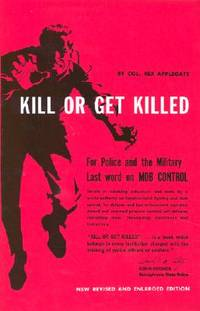
The Australian Defence Force (ADF) could have saved themselves some money by buying Kill or Get Killed: Riot Control Techniques, Manhandling, and Close Combat for Police and the Military by Rex Applegate (1976) because all of the techniques in this part of the sandan grading are taken straight from this book. Even the order of the techniques is the same.

I alone, among the instructors, found this out because I alone did not rely wholly and solely on the teachings of JDJ. I came to research the subject matter of the gradings.


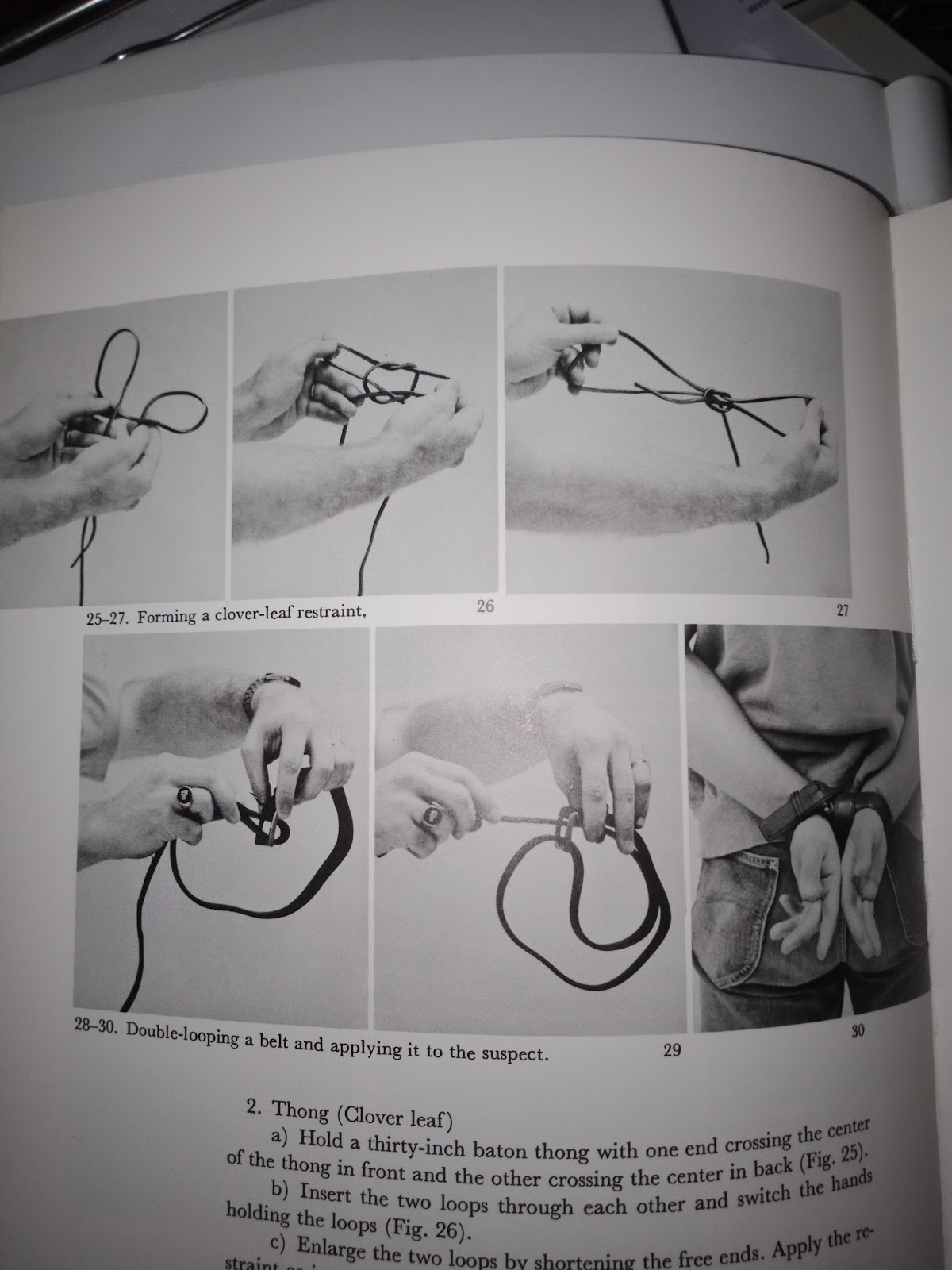
I found a book, Techniques of Vigilance: A Textbook for Police Self-Defence by Kevin Parsons (1980). The photographs are 'interesting' given that the 'models' are dressed like the motorcycle cops in the TV series CHiPs with Eric Estrada. That having been said, it is still a very authoritative book. 

In that book there is a technique to restrain a suspect with a belt by securing their wrists (see bottom sequence in photo to the right). When Greg Palmer and I were training for this part of the sandan grading, I showed him this alternative to that in the grading/Kill or Get Killed. Easy as, but we found that we might have to get a knife to cut the belt in order to release the hands. Which is a good thing when restraining someone.

I showed this to JDJ during the grading. He wasn't interested, even though it was a far superior technique to the one he was teaching.

The top sequence of images in the photograph to the right is also a very simple and effective use of a shoelace or string/rope to make a pair of handcuffs. It is also included in the sandan grading via Kill or Get Killed. I taught this technique to my neighbour's young daughter, who would go on to become my stepdaughter. This then became her 'show and tell' at primary school where she handcuffed one of her fellow primary school students. Needless to say, her mother was called in for a parent-teacher conference.

Part 9 Jo Jutsu

'Demonstrate the use of tobitanbo and jo against various attacks.'

Tobi tanbo is defined/translated in the glossary of the abovementioned JDJ book as being 'jumping stick.' I will let the late Greg Palmer provide the description:

The short answer to your question is perhaps. The Tsutsumi Ryu Ju Jutus (sic) has a set of techniques in which the jo is used to catch and lock or throw the attacker. We do not use it for striking at all pretty much.

We also train techniques with the keibo (keijo) - about 22" long which, our sensei told us, were originally police techniques. These we refer to as Tobitanbo (Jumping Stick) techniques. The stick is held downwards along the leg and as a person punches the stick is flicked up to hit the inside of the wrist or elbow, locks or strangles are then done from this position. The hanbo is used in a similar manner but some of the jo techniques are possible with the hanbo. We generally never strike with any of the sticks we use - tanbo, hanbo, keibo and jo. I was shown one or two locking techniques with the yawara stick but our sensei passed away before he taught them to us.

Whether or not these techniques are taught or used by Japanese police I don't know. Apparently the ones we learnt were used by the equivilant of the police in the past.

Hope this answers your question about the possibility of locks etc being done with sticks of various lengths.

Greg Palmer

Tsutsumi Ryu Ju Jutsu

(E-Budo forum, 16 August, 2006)

The use of this weapon in this way, I have never seen before. It would appear unique to JDJ's teachings. It would be interesting to know where it came from.

Btw, note Greg's use of 'Tsutsumi Ryu' and not 'Tsutsumi Hozan Ryu.' The badges for JDJ's school also referred to Tsutsumi Ryu, as did the grading certificates. Why not Tsutsumi Hozan Ryu?

There are nine defences with tobi tanbo against a backhand strike (haishu), 16 against jodan tsuki (high punch), and two against a front kick. There are 14 defences with jo against jodan tsuki and five against a front kick.

The photograph to the right is JDJ demonstrating a jo technique on a '(apparently) hapless instructor John Coles' as Jenny Armstrong described me in an article published in Blitz.

There was also the time that JDJ was demonstrating defences with a jo at the end of a Norway summer camp (or what passes for summer in Norway) where JDJ fractured the hyoid bone in my throat which could have had fatal consequences. He missed the initial deflection and so applied the final technique to my throat a little too vigorously to make up for it.

A JDJ ryuha includes this part in their sandan grading, however, the participants have to make up their own defences against the same attacks for a good part of the grading because the head of that ryuha did not grade nidan nor sandan under JDJ and did not train this grading to any great degree.

Part 10 Manriki-gusari Jutsu

'Demonstrate the use of manriki-gusari defences against various attacks.'

In the grading there are defences against tehodoki, kitori, kubitsukamshime, tsuki, tsuki-mawashi tsuki, uraken, and keri, and there is a section for sutemiwaza.

Many of the defences were not specified; the candidates had to make them up for themselves.

Criticisms of this grading would be, (a) there are no striking techniques, therefore, the candidate is not learning to 'fight' with this weapon but just todemonstrate a series of 'tricks,' and (b) the weapon is held in a ready position rather than concealed in one hand as it should be. Having said that, it was a fun grading to train for.

When we accompanied JDJ to a three-day seminar in Germany, organised by Herr Teichmann (?) who was reportedly later involved in some diamond smuggling operation that was investigated by the legal authorities, and who provided the diamond for the fund-raising raffle at the seminar, Peter Clarke was the designated manriki-gusari demonstrator.

When we arrived at Hamburg airport, I, being the lowest ranked among our group (ikkyu), carried the weapons bag - a very large bag with swords, bokken, jo, tanbo, knives, replica guns, etc., through the airport, without question. Imagine doing that today. 

Peter Clarke, he would walk down the main streets of Munich twirling his manriki-gusari around, as a women emerged from a secured jewelry shop with a monkey wearing a nappy on her shoulder. As John Lennon said, 'strange days indeed.'

When Peter Clarke went to board the plane to return home via Bangkok, which is a whole other story, he took his manriki-gusari out of the pocket in his jacket and put it in the tray as he walked through the metal detector and then picked it up on the other side, put it in his pocket and boarded the airplane. Again, imagine doing that these days.

Part 11 Shiai

'Free fight with tanbo vs tanto.'

The issue of the free fighting gradings in the JDJ jujutsu grading system has been discussed ad nauseum, including in this previous post.

Again, the candidates in this grading were not how to fight with a tanbo or a tanto and there was no instruction as what is expected of the candidates or what is supposed to be learned from this part of the sandan grading.

Typically, if the candidates were actual 'fighters,' the one with the tanbo would beat the living daylights out of the one with the tanto. Was that the supposed lesson?

Part 12 Ju Jitsu Keikaku

'Candidates are assigned a project by Shihan Jan de Jong which will be of benefit for the students of the dojo, ryu, or ju jitsu.'

I was credited with the writing of Jan de Jong: the man, his school and his ju jitsu system for this part of the sandan grading.