Showing posts with label Greg Palmer. Show all posts

Sunday, 12 May 2024

JDJ Jujutsu Instructors Register

It should be noted that I never set out to create a register of Jan de Jong's (JDJ) jujutsu yudansha, ikkyu holders, and/or instructors. That only came about through a comment received on a previous post asking about a register in relation to a person not affiliated with the Jan de Jong Self Defence School (JDJSDS) claiming that they were awarded yondan by JDJ.

Greg Palmer provided the yudansha register. I developed the ikkyu holder's register because ikkyu was the instructor's grading with JDJ's grading system (kyu system). When JDJ developed that system, there was no thought of a dan grading system (see previous link). The JDJ jujutsu instructors register arose out of the fact that many of JDJ's early instructors were not graded ikkyu, let alone shodan, and they were as good as, if not better than at times, those that followed with higher grades.

Here is something that just occurred to me. I have explained in previous posts that JDJ asked me to take over the Melville branch when I was only orange belt (sankyu (3rd kyu)) and after less than two years training even though there were many shodan, ikkyu, and nikyu students that were available. Through my research, I found that Peter Clarke, one of the three that JDJ promoted to rokudan , was also teaching after two years of training. What grade was Clarke when he was teaching at that time?

The following is the JDJ jujutsu instructors register that has been compiled todate. If you have any other instructors, not assistant instructors, who taught for JDJ at the JDJSDS, please forward their names to me to be included on the register.

1.      Peter Clarke

2.      Robert Hymas

3.      Paul Connolly

4.      Greg Palmer

5.      Ian Lloyd

6.      Robert Kirby

7.      Hans de Jong

8.      Debbie Clarke

9.      John Copley

10.  John Coles

11.  Peter Templeman

12.  Maggie de Jong

13.  Vass D'Esterre

14.  Warwick 'Zak' Jaggard

15.  Heidi Romundt

16.  Darryl Cook

17.  David Green

18.  Joe Fantasia

19.  Manfred ? (instructed Kirby)

20.  Tony Chiffings

21.  Rodney Miller

22.  Steve Moller

23.  Les Periera

24.  Craig Ma’ha

25.  Mike Rendell

26.  Terry Ginnane

27.  Paul Jones

28.  David Green

29.  Rodney Robinson

30.  Alan Robson

31.  Jason Stirbinskis

32.  Cyril Boutsis

33.  Michael Riessen

34.  Simon Blytheway

35.  George Clarke (first full-time instructor other than JDJHakusho 1988-89, JDJSDS, 1)

36.  Dennis Dunn

37.  David Palmer


In the above list: 37 instructors, excluding JDJ, 34 male, 3 female.

I have to mention Robert 'Rob' 'Kirbs' Kirby. His career in the police force deprived us of his continued instruction and he was in the unfortunate era were shodan was only being introduced. He never got to complete the shodan grading but is well worthy of that status and more.


He knew his 'stuff' and his Saturday classes were both enjoyable and challenging. He alone among the instructors knew how to train students and not just teach them. That probably came from his training with the Western Australian Police Force. Most, if not all, of the other instructors had very little training experience outside of the JDJSDS.

Kirby could make the training serious and lighthearted at the same time. His classes included laughter, exertion, and sweat. His class was the only one where I pushed myself so hard that I was at risk of throwing up, but I would have been there for the next class without a second thought.

Given my training regime, I trained extensively under every senior instructor in the JDJSDS during the 1980s, however, upon review of the above list, I did not train much if at all under John Copley. Copley was obviously a good teacher as numerous of his students went on to become instructors, ikkyu, and yudansha.

Copley taught at the Morley branch, which was the only dojo that JDJ bought outright. If only JDJ had bought 996 Hay Street, the hombu. Students today will never know the 'charm' of the 996 Hay Street hombu. To be fair, they will also not know the occ health and saftey threat they exposed to training at the 996 Hay Street hombu. No fire extinguishers in a fire trap (until I lobbied for them). Rain water cascading down over open fuse boxes. Dojos with an undulating surface rather than a smooth surface. ... ah, the good old days. :)


Of course, there was always the brothel across the road in those days, the Scarlet Garter.


Parking was always at a premium for the JDJSDS given that it was located in the CBD, albeit on the outer fringe of the CBD, and I used to park behind this building in the Scarlet Garter's parking. Interesting patronage to say the least. Not a lot of eye contact between parking patrons.

Someone from the Scarlet Gater came into the JDJSDS to ask for protection at one stage. A bouncer or some such. Not sure if anyone took up that offer. 

Anyway, when I compiled these registers, it is always a walk down memory lane. An era that will not be repeated and for which the current JDJ ryuha students are the poorer for.

Sunday, 28 April 2024

JDJ Jujutsu Yudansha Register

You will recall from the previous post that a commentor to that post referred to a register of Jan de Jong (JDJ) senior grades. That inspired me to develop such a register.

My intention is to develop a register of JDJ jujutsu yudansha, ikkyu holders, and instructors. Ultimately, the register will be a permanent feature of this blog located on the right border (if I can remember how to do that again).

Greg Palmer developed a register of JDJ jujutsu yudansha which is presented below with comments:

Shodan

Robert Hymas (1981)

Peter Clarke (1981)

John Copley (1981)

Ian Lloyd

Tony Chiffings

Debbie Clarke

Paul Connolly

Greg Palmer

Hans de Jong

Steve Moller

John Martyr

Jim Downing

Bob Bruscher

John Coles

Darryl Cook

Justin Palandri

Janet Lake

Peter Templeman

Maggie de Jong

Cyril Boutis

Jamie Francis

Only the dates of the first to be awarded shodan have been included in the above list.

If we take as a beginning date when JDJ commenced teaching in Perth, 1952, JDJ awarded 21 shodans in 51 years of teaching before his passing in 2003. The first, 29 years after he started teaching in Perth.

Males: 18; Females: 3.

Nidan

Peter Clarke (1991)

Robert Hymas (1992)

Paul Connolly (1992)

Greg Palmer (1996)

John Coles (1999)

Males: 5; Females: 0.

Time between shodan and nidan: Clarke 10yrs, Hymas 11yrs, Connolly 10yrs, Palmer 12yrs, Coles 7yrs.

This puts the available nidan gradings in the late 1980s.

Given the above, is my 7yrs more indicative of the average time to successfully complete the nidan gradings? The answer to that question is compromised in that I was working full-time as an instructor at the Jan de Jong Self Defence School from 1995 to 2000 inclusive.

Sandan

Peter Clarke (1999)

Robert Hymas (1999)

Paul Connolly (1999)

Greg Palmer (2000)

John Coles (2000)

Males 5; Females 0.

Time between nidan and sandan: Clarke 8yrs, Hymas and Connolly 7yrs, Palmer 4yrs, Coles 1yr.

The timing for the first four may have been impacted in that JDJ was developing the sandan grades, however, my 1yr from nidan to sandan ... 12 parts to the sandan grading as we've seen in previous posts to this blog on the development of the JDJ jujutsu grading system. And Greg and I were not training all that intensively. A couple of nights a week at his home dojo at best. The gradings are not easy (see previous blog posts) and no standards were compromised.

Yondan

Peter Clarke (1999)

Greg Palmer (2002)

Clarke was promoted to yondan immediately upon completion of sandan.

Robert Hymas and Paul Connolly were promoted directly to godan from sandan.

Godan

Peter Clarke (Nov 2002)

Robert Hymas (Nov 2002)

Paul Connolly (Nov 2002)

Time between yondan or sandan as applicable: Clarke 3yrs, Hymas and Connolly 3yrs.

Rokudan

Peter Clarke (Mar 2003)

Robert Hymas (Mar 2003)

Paul Connolly (Mar 2003)

Time between godan and rokudan: five months.

JDJ passed away 5th April 2003.


PS: Why did JDJ stop at rokudan? Why did he rush to rokudan for Clarke, Hymas, and Connolly? Is it because he had learned post the development of his grading system to ikkyu and shodan that many/most other Japanese martial arts grading systems complete their 'technical' grades at rokudan and then honorary grades are only issued after rokudan? This and other related propositions will be explored in future posts.

PPS: Added to the shodan list is Micheal Rendell thanks to a reader. That makes 22 shodans in 51 years, and 19 males, 3 females.

Thursday, 25 April 2024

JDJ Registries: Yudansha, Ikkyu holders, and Instructors

A comment from Anonymous was published on the previous blog post: 'Is there a registry of senior grades awarded by JDJ? There are people around claiming they were awarded 4th dans by him (https://amahof.asn.au/members/2022-inductees/tom-bellamy-2022/).'

That got me thinking.

I have a registry of jujutsu dan grades awarded by Jan de Jong (JDJ) that was prepared by Greg Palmer. I would like to develop a registry of jujutsu ikkyu grades and JDJ jujutsu instructors, two separate registries.


The ikkyu grade registry would include those who were awarded ikkyu by JDJ but did not go on to grade shodan. The instructor registry would be those that instructed for JDJ as instructors and not assistant instructors. I will eventually publish all three registries. I'll start.

Before I start, I have come to realise that I have been remiss in my, what I now realise is an incomplete understanding of the 'JDJ tradition.' I have been focused on the JDJ jujutsu tradition, however, there is also the JDJ aikido tradition and the JDJ pencak silat tradition. They are also relevant and significant, and just as innovative, and just as controversial, as his jujutsu tradition. 

Even though I was graded shodan in aikido by JDJ and assisted him in redeveloping his aikido grading system, and I graded highly in his pencak silat and was included in his pencak silat instructor's class after introducing JDJ to a new 'type' of pencak silat that he then went on to teach and include in his grading system, it is jujutsu where I was most highly graded and experienced. If anyone wants to start off a JDJ aikido or pencak silat tradition series, I'll be more than happy to post it on this blog. In the meantime, JDJ's jujutsu tradition: 

JDJ Ikkyu Holders:

Margaret de Jong

Vass D'Esterre

Robert Kirby

Peter Canavan

Rodney Miller

Dennis Dunn

Warwick 'Zak' Jaggard

John Poulton

David Palmer

David Green

Michael Boland

Heidi Romundt

Steve Moller

David Green

Gerald Woods

Adrienne Barlow

Alan Robson

Ross Allanson


JDJ Jujutsu Instructors

Peter Clarke

Robert Hymas

Paul Connolly

Greg Palmer

Ian Lloyd

Robert Kirby

Hans de Jong

Debbie Clarke

John Copley

John Coles

Peter Templeman

Maggie de Jong

Vass D'Esterre

Warwick 'Zak' Jaggard

Heidi Romundt

Darryl Cook

David Green

Joe Fantasia

Manfred (?)

Tony Chiffings

Rodney Miller


Please, dear readers, contribute to these lists if you can. 

Btw, this gathering of names is an attempt at preserving and strengthening the JDJ culture which will enhance the prospects of that culture and the current JDJ ryuha surviving. This idea of 'JDJ culture' will be the subject of a future blog post.


Monday, 25 March 2024

How Long Does It Take to Complete the Jan de Jong Jujutsu Grading System to Sandan?

The recent series of posts have explored the development of the Jan de Jong (JDJ) jujutsu grading system.

JDJ had three grading systems at his school, the Jan de Jong Self Defence School (JDJSDS): jujutsu, aikido, and pencak silat. For the sake of not repeating for the sake of technical specificity, the following will refer to JDJ's jujutsu grading system as JDJ's grading system.

Within those posts, we saw that the technical grades within the JDJ grading system finish at sandan (3rd dan). All higher grades are honorary. 

The idea that the technical grades in JDJ's grading system finish at sandan is based on JDJ's reported experience with his original instructors, the Saito brothers. The narrative is that the technical grades finish at sandan in the Tsutsumi Hozan Ryu grading system that the Saito brothers taught, and that JDJ completed them and was awarded sandan by the Saito brothers in 1939 (Jan de Jong: the man, his school and his ju jitsu system, Jan de Jong Self Defence School, 1997 (JDJ book)).

The adult technical grades in JDJ's final grading system commence with 9th kyu (of the mon system) and finish with sandan. From nikyu (2nd kyu) to sandan, there are multiple parts to the gradings, as the recent series of posts explain and explore.

The total number of gradings and their individual parts from 9th kyu to sandan is 46. Forty-six gradings for an adult to complete the technical grades in JDJ's grading system. 

JDJ recognised that his grading system was far more extensive and comprehensive than any other going around and wanted to acknowledge the efforts of his successful students by including a list of the parts of the gradings on their certificates. I pointed out that the list would only be included on the back of the certificate, which nobody would see, and that in and out of the martial arts, a black belt is perceived as being a black belt no matter the grading system from which it came from. 

A relatively common question that is asked is: how long does it take to get a black belt in JDJ's grading system? The commonly conceived wisdom is 10 years. Where did that number come from?

This post explores the question of, how long does it take to complete the technical grades in JDJ's grading system and to subsequently be awarded sandan?

There are five people who have completed the technical grades in JDJ's grading system and been awarded sandan by JDJ (and those five are also the only ones to have completed nidan (2nd dan) under JDJ): Peter Clarke, Robert Hymas, Paul Connolly, Greg Palmer, and myself, however, there is also JDJ under the Saito brothers.

According to the JDJ book, JDJ commenced training in 1928 and was awarded sandan in 1939 = 12 years. He started training at the age of seven, which makes him 18-19 when he was awarded sandan under the Saito brothers. That timeline raises many questions, which thankfully are beyond the scope of this post.

The following training commencement dates are taken from the JDJ book. The date of the awarding of sandan is taken from Greg Palmer's records:


What can be made of those numbers?

You will recall from a previous post that the original JDJ grading system was the kyu system. The shodan grading was developed so that JDJ could have some black belt instructors accompany him to Europe to advance his European teaching ambitions. I don't know the date of the introduction of the shodan grading(s), but it has to have been in the very late 70s.

Clarke and Hymas were awarded shodan in 1981, Connolly in 1982, and Palmer in 1984. The latter two's numbers are distorted because there was no shodan to grade during their earlier years. Hymas' numbers are distorted because he was working full-time as an instructor at the JDJSDS at that time.

Clarke's numbers would probably be the most representative of the first four given that he commenced training not long before the shodan gradings were introduced and he didn't work full-time at the JDJSDS. What makes his achievement even more remarkable is the fact that he was a partner in a leading law firm in the city at the time, and as such was time poor, however, he and Hymas (and possibly Connolly) did the shodan shinken shobu no kata as a demonstration whereas all those that followed had to perform it in true reflex fashion (see this post regarding this issue).

In addition, none of the first four had to go through the mon grades as those grades were introduced when they were instructors (who then went on to teach the mon grades that they had not undertaken). 

So, I might be the most indicative of the five sandans that were graded under JDJ given that I went through the mon system and shodan shinken no kata reflex style, and the nidan and sandan gradings were developed before I was a qualifying candidate. 

My Shodan

I commenced training on the third Wednesday in April 1983 in Ian Lloyd's class and was awarded shodan in February 1993 - a little shy of 10 years. That would appear to support the commonly conceived wisdom of a minimum of 10 years to be awarded shodan. Or does it?

When I commenced training, I started off by attending two lessons a day, six days a week, and engaging in a lot of extra training (see this post). That is 12+ hours a week, 48+ hours a month, and based on a 45-week year, 540+ hours a year. Most people start off, and often continue with, one or two lessons a week and maybe a little extra training. That is 1-2+ hours a week, 4-8+ hours a month, and based on a 45-week year, 45-90+ hours a year. 

A ludicrous calculation based on the above, but if we say that it takes 540 hours training a year to be awarded shodan in 10 years, then the average person training 90 hours a year can expect to be awarded shodan in 60 years. :)

There were other factors in my 10-year shodan qualification. 

During that time, I engaged in what was then an Australian rite of passage in backpacking in Europe for a year. I also completed the Chartered Accountants 'professional year,' which was actually 18 months, where candidates do not see the light of day for that period of time, and completed the Securities Institute of Australia graduate diploma in which I was awarded State Dux, which was another 18-month commitment. That had to have slowed down my progress to shodan.

What is obvious is that I, along with the other four sandans, am not an indicative example of the time it takes to be awarded shodan in the JDJ jujutsu grading system.

My Nidan
I was awarded nidan in December 1998, five years after I was awarded shodan. I had to reflect on those years as training and undergoing the nidan grades does not stand out in my memory. As it turns out, I was a little busy at the time.

Did I train for nidan for those five years with the same intensity as described above?  No, however, I was working full-time as an instructor at the JDJSDS from mid-90s to 2000. 

To counter that, I also engaged in the UWA (University of Western Australia) Master of Business Administration (MBA), an elite, time-intensive, business course, in the mid-90s. I worked full-time while studying the MBA full-time (nobody does that), and at that time it was an 18-month course rather than the 12-month course as most MBAs are these days. And now that I remember it, I also lived and worked in London for between nine months and a year shortly after grading shodan.

Completing the nine parts of the nidan grading would probably have taken me more like two years or more likely less. 

I had to go back over the nidan gradings to remember them as I said above, they do not stand out in my memory. In doing so, I remember that I did those grades with Greg Palmer. 

Greg had a long-held ambition/dream to complete JDJ's grading system. He initially started training with Clarke, Hymas, and Connolly, however, they quickly left him behind because they were in a race to the finish line. Greg approached me to help him realise his ambition/dream. I had no ambition to be awarded shodan, let alone nidan and sandan, but Greg being Greg would not allow me to help him in realising his ambition/dream unless I graded too. 

Looking back on the records, Greg had already graded nidan by the time we started working on my nidan. I had to be graded nidan before Greg would consider training for sandan, in Greg's eyes. In all honesty, I was happy to remain shodan but would still train with Greg for him to realise his ambition/dream, and I said/argued as much. Nonetheless, Greg taught me what needed to be taught to be awarded nidan before we started preparing for sandan.

The nidan grading and its component parts are discussed in this linked post. The following are comments on some of those parts.

Part 2 Ju Jitsu no Jitsuen: 'Arrange a demonstration using up to eight lower grades to show some aspect of jujutsu. Twenty minutes of explanation type demonstration and ten minutes of fast action are required to be shown.' Given that this grading is intended to examine a candidate's knowledge and ability to arrange a demonstration that informs the public what jujutsu is and in particular what Jan de Jong jujutsu is, I convinced JDJ to judge me on a 'real' demonstration that I had arranged for an open day at Wesley College.

How long did it take to prepare? Not long. If you know your stuff, know your students, and choose skilled and trained students, it doesn't require much training at all. By that stage, I had been part of and organised more demonstrations locally, nationally, and internationally than I can remember.

Part 3 Shinken Shobu no Kata: 'Reflex grading.' You will recall from the above 'nine parts' link that the number of attack-defence combination in nidan was reduced from 140 in shodan to 52 in nidan. Given that I was highly trained and highly proficient, and the attack-defence combinations are all just variations on a theme from previous gradings, not a lot of training was required to master the attack-defence combinations in this grading. 

Part 7 Shiai: 'Free fight with tanto vs tanto.' A group of us attempted this grading together. If I recall, the group included myself, Debbie Clarke, Ian Lloyd, and Hans de Jong. Maybe John Martyr.

How long does it take to train this grading? Given that knife fighting was not taught at the JDJSDS and given that no instructions were provided as to what is sought and graded in this grading, as long or as short as the candidate wants. My training consisted of a little training with the fellow candidates in order to determine their abilities and tactics, and then to devise tactics to defeat them. I didn't train those tactics, however, I successfully employed them.

Part 8 Jutsuri no Kata: 'Oral examination conducted with at least two other candidates, discussing the technical aspects on any technique selected by Shihan Jan de Jong.' No 'training' necessary in order to attempt this grading. No 'training' necessary in my case given that my mentor was Greg Palmer, who JDJ acknowledged as having the best technical knowledge of the techniques and tactics taught at the JDJSDS, and because of my natural and learned analytical nature and capabilities.

Part 9 Ju Jitsu Rekishi: 'Candidates are required to submit an essay with no less than 3000 words on a topic to be approved by Shihan Jan de Jong.' JDJ credited me with this part of the grading based on the international franchise proposal that I had prepared for him after accompanying him to Jakarta, Indonesia to meet with a Chinese-Indonesian entrepreneur who was prepared to fully fund the start-up. A lost opportunity if ever there was one.

I imagine that JDJ would have likewise credited Clarke with this part of the grading given his many contributions to JDJ's efforts over the years, including developing the AJJA dan grading system and their competition format, and providing a comprehensive explanation of both for AJJA consumption. Greg could have been credited with this part of the grading for his development ken no michi grading that was introduced by JDJ into his ikkyu grading. It would be interesting to know what Hymas and Connolly did to satisfy the requirements of this part of the nidan grading.

My Sandan
I completed nidan in December 1998 and sandan in May 2000, approximately 16 months to successfully complete 12 gradings - the fastest ever (Clarke 8yrs, Hymas and Connolly 7yrs, Palmer 4yrs).

The above linked '12 gradings' post explores and discusses the parts that make up the sandan grading. The following are some comments on some of those parts.

Part 1 Kime no Kata: 'Explain the theory and answer questions on demonstrated techniques.' The demonstrated techniques are simply variations on a theme, so no real training is required, and if anyone is going to successfully answer theory questions raised on those techniques, it was Greg and myself. In fact, I explained in the sandan post that Greg was disappointed when JDJ didn't ask us any questions and confronted him about it. JDJ said he knew that we knew the theory about the techniques.

Part 2 Ju Jitsu no Jitsuen: 'Arrange a ten-minute demonstration on a topic given by Shihan Jan de Jong using only yudansha. Twenty minutes preparation time will be allowed.' No training possible for this grading.

I cannot remember what my topic was, however, I do remember that JDJ and some others being kind enough to suggest that my demonstration was the best presented out of all five sandans. If memory serves, Connolly's subject was 'ground techniques.' I would suggest that JDJ was taking the opportunity to explore 'ground techniques' at the time as this was about the time of the emergence of so-called Brazilian jiu-jitsu and their emphasis on 'ground techniques.' We have techniques to defend while on the ground, however, it cannot be said that we teach 'ground techniques' as it came to be understood.

Even though I had the likes of Clarke, Hymas, and Greg included in my demonstration, Connolly was not included, the difficult part was in catering for their limitations as they were not the most athletic of jujutsuka.

Part 3 Taisabaki no Kata: 'Prepare a kata to show the different variations of the body movements.' In reality, no training is required. It should be expected at this level that the required kata could be developed on the spot let alone using a similar/the same format as the previous grading.

Part 4 Sutemi no Kata and Taoshiwaza no Kata: demonstrate 20 sacrifice throws and 20 takedown techniques and answer theory questions thereon. The training for the sacrifice throws only needed to be brushed up because they had been taught and trained throughout the grading/training experience, beginning with tomoe nage in 6th kyu, yellow belt.

There were new takedown techniques included in the grading, although technically 25 percent are throws based on my biomechanical distinction between throws and takedowns in my as yet unpublished The Science Behind All Fighting Techniques, but again, most are simply variations on a theme. It is interesting that a JDJ ryuha has omitted this part of this part of this part of their syllabus, probably because the head of that ryuha did not grade beyond shodan and was unfamiliar with the techniques and their variations.

Part 5 Kodachi no Kata: 'Demonstration of kodachi (wakizashi) techniques against katana.' The techniques are relatively simple so not a lot of training is required to be grading-ready.

Part 6 Hojo Jutsu: 'Demonstrate use of rope to tie up an opponent.' As explained in a previous post, the demonstration is not from an attack but simply tying up (gift wrapping) a compliant uke. Greg had studied and taught these techniques to Clarke, Hymas, and Connolly before they graded this part of the sandan grading without him, however, I too was a beneficiary of Greg's knowledge and expertise in this regard. Much to Greg's and my surprise, I quickly mastered the techniques. I'm not the most 'handy' of people.

Part 7 Taiho Jutsu: 'Demonstrate various arresting techniques from standing and sitting positions.' The techniques are variations on a theme and there are only six of them. Enough said.

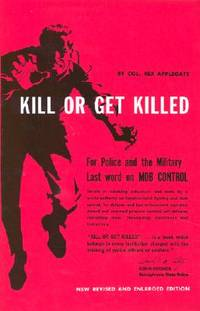
Part 8 Toshu Kakuto Jutsu: 'Demonstrate searching and hand cuffing techniques.' As explained in the previous post on the nidan grading, these techniques are taken straight from Col. Rex Applegate's Kill or Get Killed, and they are not complicated.

Part 11 Shiai: 'Free fight with tanbo vs tanto.' As with all the shiai gradings in the JDJ jujutsu grading system, there is no training of fighting with the weapons used, very little training re tactics, and no information provided as to what is being graded. Consequently, no real training is required to successfully complete this part of the grading. 

Part 12 Ju Jitsu Keikaku: 'Candidates are assigned a project by Shihan Jan de Jong which will be of benefit for the students of the dojo, ryu or ju jitsu.' JDJ credited me with this part with the writing of the JDJ book. There are numerous contributions that Clarke and Palmer could be credited with to satisfy the requirements of this part of the grading (see above), and again, it would be interesting to know what Hymas and Connolly did to satisfy the requirements of this part of the grading.

Historical Records
With regards to the comments for nidan part 9 and sandan part 12, all of the essays and projects required in the dan grades (including shodan) would have been included in JDJ's records. Those records were inherited by Margaret de Jong (JDJ's wife), Maggie de Jong (JDJ's daughter), and presumably Paul Connolly (Maggie's eventual husband). It would appear that no use has been made of those records to date, not publicly at least. Have those efforts and records been consigned to oblivion? If so, that would be a shame.

Comments
How long does it take to complete the technical grades of the Jan de Jong grading system? I have been asked that question and this post explored the issue in order to provide an answer. 

It would be interesting to ask the same question of the other three living graduates who graded sandan under JDJ and who now are responsible for technical aspect of separate JDJ ryuha (in two out of the three cases, not necessarily being the principal of the school). What would their answer be? What is their answer in their modified/changed grading systems of their JDJ ryuha?

The above exploration suggests that it is difficult, if not impossible, to provide an authoritative answer to the question as to how long it takes to get sandan in the JDJ grading system. What I can say, based on the above exploration, and a great deal of resultant reflection, is that most of the work to undertake nidan and sandan is done in grading shodan in the JDJ jujutsu grading system. The work to complete shodan commences in ikkyu, which is the original instructor's grading.


The above graph has been used in a number of previous posts. It shows the number of attack-defence combinations in the shinken shobu no kata gradings from rokkyu to sandan. It could also be representative of the degree of difficulty for each grading level, which is reflected in the amount of time required to successfully complete those grades. In such a case, the ikkyu level would rise significantly as it was the original instructor's grade. What this illustrates is that ikkyu and shodan are the top of the mountain in JDJ's grading system, and it's all downhill after that. This then begs the question: why were there not more nidans and sandans in JDJ's school?

There is another aspect of the above exploration with regards to what is required to grade sandan, if not ikkyu and  shodan itself, in the JDJ grading system, and that is intelligence. Proficiency alone is not enough.

This exploration also makes me think: is shodan reflective of the 'level' of the likes of John Copley, Ian Lloyd, Tony Chiffings, Debbie Clarke, Hans de Jong, Darryl Cook, Justin Palandri, Steve Moller? Is ikkyu reflective of the 'level' of the likes of Robert Kirby, Vass D'Esterre (deceased), Peter Canavan, Warwick 'Zak' Jaggard, John Polton, Emma Glasson (nee Wouts), Gerald Wouts, Keith 'Keef' Hickey, Dave Palmer, Rodney Miller? All were instructors for JDJ at one time or another. Technically, under the JDJ grading system, yes, but is that an accurate reflection of their abilities, knowledge, and understanding, in particular when you consider what the nidan and sandan grades contribute to the yudansha's abilities, knowledge, understanding, and teaching abilities, and of course when the JDJ grading system is compared to that of many/most other martial arts grading systems.

This series continues with either an exploration of how to improve JDJ's grading system, which would involve significantly reducing the time to grade dan grades and become instructors without sacrificing standards, in fact, while increasing standards, or, comparing historic grading sheets that have come into my possessionto the final grading sheets within the JDJ grading system. 


Thursday, 14 March 2024

The Development of the Jan de Jong Jujutsu Grading System 5.1: Sandan Part 2

Previously ...

This post will be done in two parts because the sandan grading contains 12 parts, whereas shodan and nidan were long enough with nine parts.

You will recall from previous posts that the structure of the dan grades was set with JDJ's initial grading system, the kyu grades, with ikkyu being the instructor grade. 

Note: There is no shinken shobu no kata part in sandan. This is the only grading in JDJ's grading system that does not contain a reflex/shinken shobu no kata part to the grading.

The grading requirements and description of the different parts are taken from Jan de Jong: the man, his his school and his ju jitsu system (Jan de Jong Self Defence School, 1997 (p.52)).

This is part two of the two parts discussing the Jan de Jong (JDJ) jujutsu sandan grading.

Part 7 Taiho Jutsu

'Demonstrate various arresting techniques from standing and sitting positions.'

'Taiho' is defined in the abovementioned book as 'arrest, apprehend, seize.'

There are six techniques to this grading. Six.

Part 8 Toshu Kakuto Jutsu

'Demonstrate searching and hand cuffing techniques.'

JDJ said that he included this part in the sandan grading to share with his instructors what he taught the Special Air Service Regiment (SAS). 

The Australian Defence Force (ADF) could have saved themselves some money by buying Kill or Get Killed: Riot Control Techniques, Manhandling, and Close Combat for Police and the Military by Rex Applegate (1976) because all of the techniques in this part of the sandan grading are taken straight from this book. Even the order of the techniques is the same.

I alone, among the instructors, found this out because I alone did not rely wholly and solely on the teachings of JDJ. I came to research the subject matter of the gradings.


I found a book, Techniques of Vigilance: A Textbook for Police Self-Defence by Kevin Parsons (1980). The photographs are 'interesting' given that the 'models' are dressed like the motorcycle cops in the TV series CHiPs with Eric Estrada. That having been said, it is still a very authoritative book. 

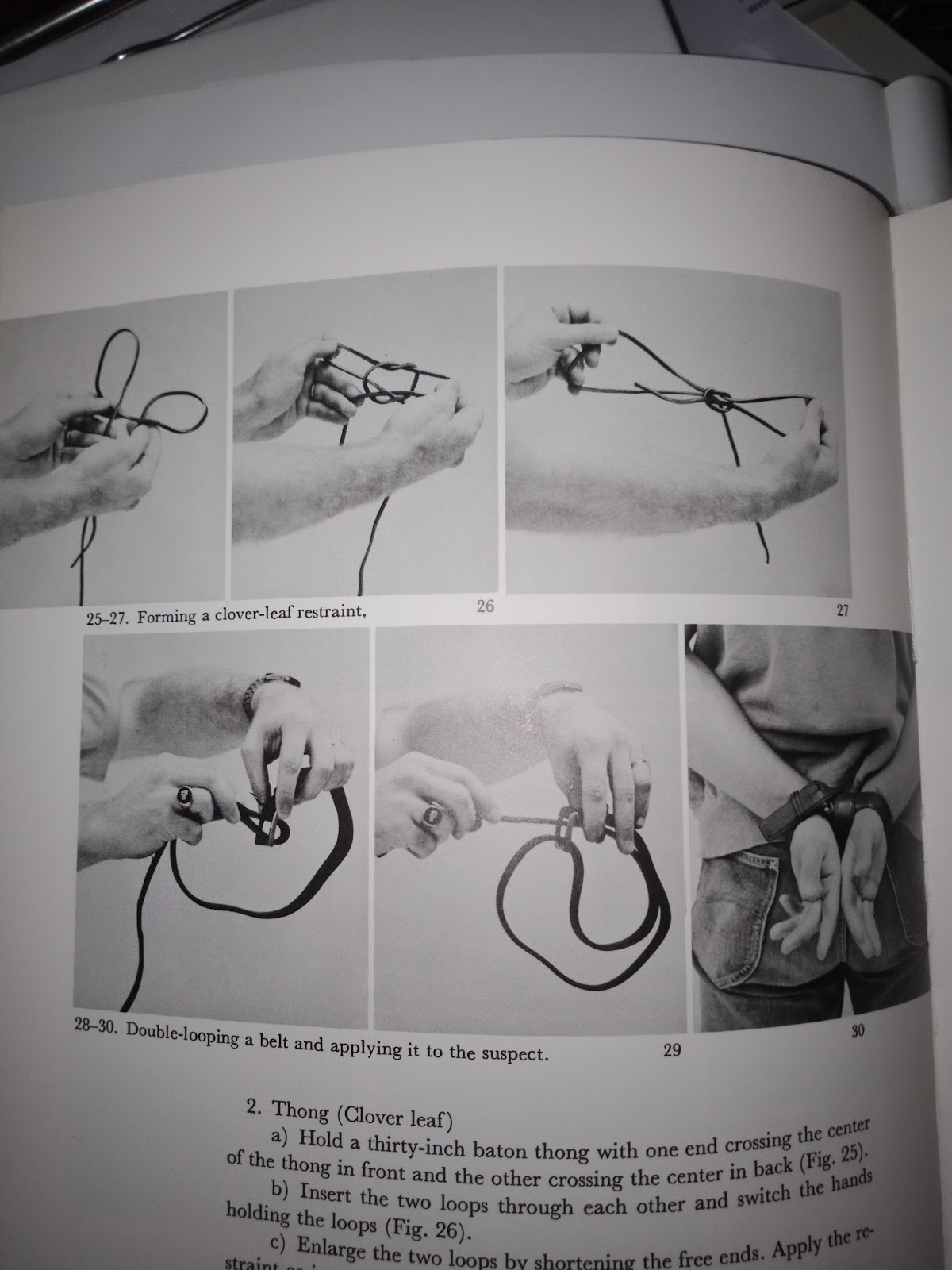
In that book there is a technique to restrain a suspect with a belt by securing their wrists (see bottom sequence in photo to the right). When Greg Palmer and I were training for this part of the sandan grading, I showed him this alternative to that in the grading/Kill or Get Killed. Easy as, but we found that we might have to get a knife to cut the belt in order to release the hands. Which is a good thing when restraining someone.

I showed this to JDJ during the grading. He wasn't interested, even though it was a far superior technique to the one he was teaching.

The top sequence of images in the photograph to the right is also a very simple and effective use of a shoelace or string/rope to make a pair of handcuffs. It is also included in the sandan grading via Kill or Get Killed. I taught this technique to my neighbour's young daughter, who would go on to become my stepdaughter. This then became her 'show and tell' at primary school where she handcuffed one of her fellow primary school students. Needless to say, her mother was called in for a parent-teacher conference.

Part 9 Jo Jutsu

'Demonstrate the use of tobitanbo and jo against various attacks.'

Tobi tanbo is defined/translated in the glossary of the abovementioned JDJ book as being 'jumping stick.' I will let the late Greg Palmer provide the description:

The short answer to your question is perhaps. The Tsutsumi Ryu Ju Jutus (sic) has a set of techniques in which the jo is used to catch and lock or throw the attacker. We do not use it for striking at all pretty much.

We also train techniques with the keibo (keijo) - about 22" long which, our sensei told us, were originally police techniques. These we refer to as Tobitanbo (Jumping Stick) techniques. The stick is held downwards along the leg and as a person punches the stick is flicked up to hit the inside of the wrist or elbow, locks or strangles are then done from this position. The hanbo is used in a similar manner but some of the jo techniques are possible with the hanbo. We generally never strike with any of the sticks we use - tanbo, hanbo, keibo and jo. I was shown one or two locking techniques with the yawara stick but our sensei passed away before he taught them to us.

Whether or not these techniques are taught or used by Japanese police I don't know. Apparently the ones we learnt were used by the equivilant of the police in the past.

Hope this answers your question about the possibility of locks etc being done with sticks of various lengths.

Greg Palmer

Tsutsumi Ryu Ju Jutsu

(E-Budo forum, 16 August, 2006)

The use of this weapon in this way, I have never seen before. It would appear unique to JDJ's teachings. It would be interesting to know where it came from.

Btw, note Greg's use of 'Tsutsumi Ryu' and not 'Tsutsumi Hozan Ryu.' The badges for JDJ's school also referred to Tsutsumi Ryu, as did the grading certificates. Why not Tsutsumi Hozan Ryu?

There are nine defences with tobi tanbo against a backhand strike (haishu), 16 against jodan tsuki (high punch), and two against a front kick. There are 14 defences with jo against jodan tsuki and five against a front kick.

The photograph to the right is JDJ demonstrating a jo technique on a '(apparently) hapless instructor John Coles' as Jenny Armstrong described me in an article published in Blitz.

There was also the time that JDJ was demonstrating defences with a jo at the end of a Norway summer camp (or what passes for summer in Norway) where JDJ fractured the hyoid bone in my throat which could have had fatal consequences. He missed the initial deflection and so applied the final technique to my throat a little too vigorously to make up for it.

A JDJ ryuha includes this part in their sandan grading, however, the participants have to make up their own defences against the same attacks for a good part of the grading because the head of that ryuha did not grade nidan nor sandan under JDJ and did not train this grading to any great degree.

Part 10 Manriki-gusari Jutsu

'Demonstrate the use of manriki-gusari defences against various attacks.'

In the grading there are defences against tehodoki, kitori, kubitsukamshime, tsuki, tsuki-mawashi tsuki, uraken, and keri, and there is a section for sutemiwaza.

Many of the defences were not specified; the candidates had to make them up for themselves.

Criticisms of this grading would be, (a) there are no striking techniques, therefore, the candidate is not learning to 'fight' with this weapon but just todemonstrate a series of 'tricks,' and (b) the weapon is held in a ready position rather than concealed in one hand as it should be. Having said that, it was a fun grading to train for.

When we accompanied JDJ to a three-day seminar in Germany, organised by Herr Teichmann (?) who was reportedly later involved in some diamond smuggling operation that was investigated by the legal authorities, and who provided the diamond for the fund-raising raffle at the seminar, Peter Clarke was the designated manriki-gusari demonstrator.

When we arrived at Hamburg airport, I, being the lowest ranked among our group (ikkyu), carried the weapons bag - a very large bag with swords, bokken, jo, tanbo, knives, replica guns, etc., through the airport, without question. Imagine doing that today. 

Peter Clarke, he would walk down the main streets of Munich twirling his manriki-gusari around, as a women emerged from a secured jewelry shop with a monkey wearing a nappy on her shoulder. As John Lennon said, 'strange days indeed.'

When Peter Clarke went to board the plane to return home via Bangkok, which is a whole other story, he took his manriki-gusari out of the pocket in his jacket and put it in the tray as he walked through the metal detector and then picked it up on the other side, put it in his pocket and boarded the airplane. Again, imagine doing that these days.

Part 11 Shiai

'Free fight with tanbo vs tanto.'

The issue of the free fighting gradings in the JDJ jujutsu grading system has been discussed ad nauseum, including in this previous post.

Again, the candidates in this grading were not how to fight with a tanbo or a tanto and there was no instruction as what is expected of the candidates or what is supposed to be learned from this part of the sandan grading.

Typically, if the candidates were actual 'fighters,' the one with the tanbo would beat the living daylights out of the one with the tanto. Was that the supposed lesson?

Part 12 Ju Jitsu Keikaku

'Candidates are assigned a project by Shihan Jan de Jong which will be of benefit for the students of the dojo, ryu, or ju jitsu.'

I was credited with the writing of Jan de Jong: the man, his school and his ju jitsu system for this part of the sandan grading.


Wednesday, 13 March 2024

The Development of the Jan de Jong Jujutsu Grading System 5.0: Sandan Part 1

The final technical grading in the Jan de Jong (JDJ) jujutsu grading system is sandan.

This fits with the narrative that the final technical grading in the Tsutsumi Hozan Ryu (THR) jujutsu grading system that JDJ was involved in with his original jujutsu instructors, the Saito brothers, was sandan.

There are only five people who have completed the technical grading system of the jujutsu taught by JDJ under JDJ, and which is apparently part of the THR tradition, are Peter Clarke, Robert Hymas, Paul Connolly, Greg Palmer, and myself. Me - their student. The only 'student' to complete the JDJ jujutsu grading system under JDJ.

Left to right: Peter Clarke, JDJ, Robert Hymas, and Paul Connolly.

Standing and not standing, Greg Palmer and me respectively.

There are some other 'students' that have been graded sandan, and higher, in the JDJ tradition through a JDJ ryuha, however, that grading system is compromised in relation to JDJ's grading system because the head of that ryuha did not grade above shodan under JDJ. Consequently, their nidan and sandan grades contain less and are different to that taught by JDJ. And even in that ryuha's shodan grading, there are mistakes.

You will recall from previous posts that Clarke, Hymas, and Connelly were the first through the nidan and sandan gradings because they were to be JDJ's legacy. Greg and I came through after the first trio. It is important to remember that fact because, among other things, it gave JDJ a chance to review the nidan and sandan gradings that he had developed and to change (improve) upon them. 

This post will be done in two parts because the sandan grading contains 12 parts, whereas shodan and nidan were long enough with nine parts.

You will recall from previous posts that the structure of the dan grades was set with JDJ's initial grading system, the kyu grades, with ikkyu being the instructor grade. 

Note: There is no shinken shobu no kata part in sandan. This is the only grading in JDJ's grading system that does not contain a reflex/shinken shobu no kata part to the grading.

The grading requirements and description of the different parts are taken from Jan de Jong: the man, his his school and his ju jitsu system (Jan de Jong Self Defence School, 1997 (p.52)).

Part 1 Kime no Kata

'Explain the theory and answer questions on demonstrated defences.'

You will recall from previous posts that kime no kata is generally considered to be a revision grading within the JDJ jujutsu grading system. According to the glossary in the abovementioned book, it means 'form of agreement (attack and defences are agreed upon and so form a demonstration)' (p.58).
This grading consists of 57 attack-defence combinations, none of which have been included in any other grading within the JDJ jujutsu grading system; they are all new attack-defence combinations.

When Greg and I did this grading, JDJ asked no questions. Greg was disappointed because he was prepared and wanted to discuss the theory behind the defences. He asked JDJ why he hadn't asked us any questions. JDJ said that he didn't have to because he knew that we know the theory.

I would have liked to have heard any questions that he asked of Clarke, Hymas, and Connolly, and their answers.

Part 2 Ju Jitsu no Jitsuen

'Arrange a 10 minute demonstration on a topic given by Shihan Jan de Jong using only yudansha. Twenty minutes preparation time will be allowed.'

This part follows on from the ju jitsu no jitsuen part in the nidan grading.

The way JDJ conducted this grading was, during the Friday night instructor's class, he'd simply inform the candidate (Clarke, Hymas, Connolly, Palmer, or myself) that they would be putting on a demonstration using yudansha that were attending the class that night. Literally, only 20 minutes to prepare on a subject of JDJ's choosing with the performers present that night.

It was an interesting grading for me as I was instructing my former instructors what to do. I was assessing their capabilities in terms of what they could perform adequately. That was a challenge in itself.

Part 3 Taisabaki no Kata

'Prepare a kata to show the different variations of the body movements.'

The five body-movements are the five main body-movements (taisabaki) taught by Yoseikan Budo (YB).

I did a bit of 'teach the teacher' in this grading. You will recall from a previous post:

The dodging body-movement was included in this grading due to Greg Palmer's lobbying. I argued that dodging was simply a variation of either flowing or sliding body-movements, which I went on to demonstrate in my taisabaki no kata grading in sandan. It was a 'teach the teacher' moment, however, even though they agreed with me, it is still retained in this grading.

Part 4 Sutemiwaza no Kata and Taoshiwaza no Kata

Sutemiwaza no Kata: 'Demonstration and full explanation of the theory of 20 different sacrifice throws and their variations.'

Taoshiwaza no Kata: 'Demonstration and full explanation of the theory of 20 different takedown techniques and their variation.'

This part of the grading is pure YB. 

You will recall from a previous post that I obtained a copy of Minoro Mochizuki's book, Nihonden Jujutsu, from Jan-Erik Karlsson while assisting JDJ teaching for him in Sweden. I gave a copy of that book to JDJ.

The book has many hand-drawn images of techniques. JDJ photocopied 20 of those techniques for each part of this part of the grading and handed them out in the instructors class on a Friday night. This was this part of the sandan grading - taken straight from Mochizuki's book.

The abovementioned JDJ ryuha does not include the taoshiwaza no kata section in their sandan grading. I would suggest that it is because the principal of that ryuha did not learn or grade this part of the grading. On the other hand, the YB sutemiwaza had been taught and trained ad nauseum within the Jan de Jong Self Defence School (JDJSDS).

A joint element of this grading is the theory behind the techniques. What is the first theory question that should be asked?

Given that the two parts are sacrifice throws and takedown techniques, the first question that should be asked is: what is the difference between a throw and a takedown?

As I discuss in my as yet unpublished book, The Science Behind All Fighting Techniques, there is no definitive distinction between throwing and takedown techniques in the martial arts literature or teachings, except the one that I provide based on biomechanics. Based on that definition and classification, about 25% of the takedown techniques in the takedown techniques section of this part of the grading are in fact throws.

There is one technique in the takedown section of this part of the grading: oshi otoshi. JDJ said that it meant 'aggressive push-down.' Every time JDJ taught it in the instructors class, he taught it differently. I was confused, not the least because none of what JDJ was teaching worked. I asked Clarke and Hymas separately, 'What are we supposed to be doing here?' They both replied that they didn't know.

At that time, the priority for JDJ and Clarke, Hymas, and Connolly was to get through the grading system so that JDJ could promote them with honorary grades. One technique that did not work - what does it matter.

Mea culpa: I too adopted the same approach as Clarke, Hymas, and Connolly, and did something in the grading, not knowing what I was supposed to be doing, knowing that it was one technique, and it would not affect my overall makes in the grading. I, like them, were going to pass this grading with or without this technique.

After JDJ passed away, and when YouTube came online, I finally saw oshi otoshi being performed by a YB school in Belgium. It is an amazing YB technique, and one which nobody in the JDJSDS has ever performed correctly, even though it is in the grading system.

JDJ did not know how to perform oshi otoshi. It looked similar to other techniques, but it wasn't that technique, and in this instance, it did not work. It was ineffective. 

A similar situation can be found in JDJ's shodan shinken shobu no kata grading with te nage. When I was taught this technique, way back when, I said even then that it did not make sense. Unbalance forward and down, and then up and back to the opposite rear corner, and then forward and down again, and then around the corner - there are so many changes in direction that you get dizzy. And why? It's because it looks like hand-set arm breaking, but that is not the takedown technique. 

When I was assisting two prospective yudansha for the abovementioned ryuha to prepare for their shinken shobu no kata grading, I again encountered JDJ's te nage and its teaching by the instructors of the ryuha. And after all these years, I still thought it was ridiculous, but this time, when searching for an answer, there are so many more resources available. JDJ's te nage should be aikido's ikkyo or nikyo. It is a great technique, when performed correctly, and one that I could perform even in my physical condition.

Part 5 Kodachi no Kata

'Demonstration of kodachi (wakizashi) techniques against katana.'

The kata is taken straight from Michael Finn's Kendo-no-Kata (1986). No deviations whatsoever, and the order is the same.


Part 6 Hojo Jutsu

'Demonstrate use of rope to tie up an opponent.'


This was an interesting grading, and an impractical grading. The techniques were taken from various sources and consisted of tying up a person in intricate ways. The impractical aspect was that the grading did not involve restraining uke before the tying up commenced. They just stood there. It was like a demonstration of wrapping a gift.

Next Post

The next post will discuss the final six parts to the sandan grading.