This post will take a break from the Jan de Jong jujutsu grading system analysis per se and focus on an element present throughout the shinken shobu no kata (SSnK) gradings: kubitsukami shime.
Kubitsukami shime is a category of attack that is included in JDJ's jujutsu SSnK gradings.
You will recall from the first post that the format of JDJ's SSnK gradings is primarily based on attack-types, e.g., kubi shime (neck strangle), tsuki (punching), sukui (scooping), keri (kicking), etc. ... kubitsukami shime.
You will also recall from that post that the shodan SSnK grading is unique in being based on a matrix of attack and defence types. The kubitsukami shime attack-type category in that grading includes atemi waza, kansetsu waza, and nage waza defence-types.
NB: There is no kubitsukami shime defence category in that grading.
Google '"kubitsukami shime"' and you will get zero (0) results. Google 'kubitsukami shime' and you will get 66 results, the only one of which is relevant pertains to Yoseikan aikido in which it is translated as 'neck strangle.'
The more common kubi shime used in the martial arts is translated as neck strangle. What is the difference between kubitsukami shime and kubi shime?
Kubi is translated as 'neck' and tsukami as 'grip' or 'grasp'. Kubitsukami means to grip or grasp a person's neck, in this case with one's hands.

Kubi shime is most often used to refer to a class of technique taught in the martial arts, combat sports, and close combat that does not involve strangling by placing one's hands around another's neck.
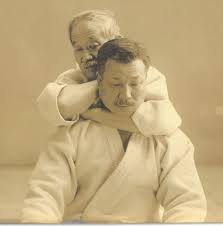
There is another difference between kubitsukami shime and kubi shime in this case. Kubi shime techniques are trained as defensive techniques. There are no kubitsukami shime techniques taught as defensive techniques. There are no 'throttling' techniques with the hands taught as defensive techniques.
So what, you may ask? So what indeed.
I observed a class being taught a defence against a straight-arm kubitsukami shime on the ground in the shodan grading to senior students. They were all struggling to perform the defence. 'What's going on here?'*
I was mentoring two of the abovementioned students for their shodan grading. Following the abovementioned class, I asked those two students to demonstrate the defence from yellow (rokkyu, sixth kyu, the first grading in the kyu system) from ostensibly the same attack. They struggled to perform the defence. 'What's going on here?'*
I demonstrated the effective attack for the yellow defense on one of the students and (a) the look of surprise and fear on his face was something to (sadistically) behold, and (b) it facilitated the effective performance of the defensive technique. It made it work and it made it easy to make it work.
In this case it was a straight-arm strangle from the side on the ground. The ineffective attack involved uke sitting back on their heels with their arms at less than 90 degrees and the hands placed half-and-half on tori's neck and triceps. The effective attack involved uke's hands on tori's throat with uke being positioned directly over tori's throat, pushing downward over arms at 90 degrees, thus applying their bodyweight behind the attack. Uke was no longer sitting back on their heels which opened up the area under their body for tori's knee to be inserted.
The ineffective attack prevented tori from executing the defence. The performance problem was not in the defence, it was in the attack. This was a light-bulb, eye-opening moment for these two prospective black belts. It was a revelation; a moment of insight*: performance problems may reside in the attack and not in the defence.
The same was true for the shodan defence, except that the attack was similar but different. The students in the abovementioned class were struggling with the shodan defence because, once again, the attack was ineffective. The question they (and the instructor) should have been asking themselves is, why are they doing a different defence from ostensibly the same attack? In this case it was because the attack, the effective attack for yellow, involves uke's bodyweight being positioned slightly differently in the case of the shodan defence (although they were still making the same mistakes as in the yellow attack).
This is an issue that is present in this particular ryuha. It is present in the ryuha from which this ryuha was derived. It was present in the Jan de Jong Self Defence School. The students did/do not know how to attack properly in these circumstances, and they were/are not taught how to attack properly.
This is not an issue most of the time. The defensive techniques that students are taught are often used as attacking techniques as well. The classic in this case is that the defensive kubi shime techniques students are taught are used as attacking techniques. This of course raises other issues concerning what students are being taught to defend against; an issue that will not be explored here.
Recently I saw a photo on Facebook of a class being taught defences from a standing bent-arm strangle. Sure enough, the hands of the attacker were positioned more towards tori's triceps than around their throat. Great for a massage but not so much for a 'throttling' action intended to do harm. This has implications for the defence as taught and trained in terms of its effectiveness against a 'real' attack. Will the defence as taught and trained against an ineffective attack be effective against a real attack intent on doing harm?
Towards the end of my teaching for JDJ, he said that my students performed the best in the school in their gradings. Part of the reason for that was (a) I identified the above issue, and (b) I taught the attack before I taught the defence. The defence is not only effective in that case, it is also easy to perform because that is what the defence is designed to defend against.
In addition, I taught the student that performance problems can reside in the attack and not the defence and the first place to look to correct performance problems is in the attack. This is insight that leads to a new and better understanding of all of the teachings being taught*.
This same issue is, frustratingly, illustrated in downward strikes with a short stick/baton/tanbo. More times than not, I've seen uke attempting to strike tori with the butt of the weapon closest to their hand rather than the end of the weapon. This at the very least creates a distancing issue. The trained, instinctive, response to the attack will be 'short' of an actual attack meaning that the defence is more than likely to be ineffective in a 'real life' attack.
In this case, this is the odd thing. Get the student to hit an inanimate object and they'll do so properly. Get them to attack another person in the training environment and their attacks are as described above.
The lesson is simple: teach students how to attack properly! The product of this change in teaching will be better students who progress faster and suffer less frustration due to poor teaching. This of course requires instructors to know how to attack properly for the defence being taught. This is a separate issue.
*Insight leads to a new and better understanding. It is a new understanding because it did not exist before, and it is a better understanding because it is more accurate, more comprehensive, and more useful than the one that existed before.
One of the paths to gaining insight that leads to a new and better understanding is curiosity, which is described in terms of a 'What's going on here?' reaction.
(Klein, G. 2013. Seeing What Others Don’t: The Remarkable Way We Gain Insights. New York: Public Affairs.)

