Monday, 8 January 2024

The Development of the JDJ Jujutsu Grading System Part 3.2: 1st Mon

As Maria says in The Sound of Music, let's start at the very beginning, a very good place to start. The beginning, now, in Jan de Jong's (JDJ) jujutsu grading system is 1st mon.

The first grading in the mon system is a good place to start because it reveals/raises some of the issues associated with the mon grades.

You will recall from the previous chapter that the age requirement for 1st mon is under 12 years. It is the first grading for new students aged five and six years old.

The following is the grading reproduced in Jan de Jong: The Man, His School and His Ju Jitsu System (Jan de Jong Self Defence School, 1995):


1ST MON: YELLOW AND WHITE BELT

Breakfalls (Ukemi)

Forwards roll

Backwards roll

Body Movements (Taisabaki)

Flowing

Entering

Basic Blocks and Attacks (Uke and Atemi)

Punch - with kick

Front snap kick

Unbalancing (Kuzushi)

Normal single wrist grip - Normal unbalancing

Locking Techniques (Kansetsu Waza)

Two attackers

Top strike - Wrist twist

Low punch - Wrist twist

The use of Japanese terminology can be seen coming into play in the very first grading, which is part of the reason why there is a terminology grading in ikkyu and shodan. JDJ introduced the use of Japanese terminology, as he explained, so that his students could understand the use of it in texts about Japanese martial arts that use Japanese terminology. JDJ being an avid collector and reader of martial arts texts, and which were a great source of his continuous professional development as previously explained.

You will recall from the previous post, the advice in Gary Carr's Sports Mechanics for Coaches to divide the skill into phases and the reasons why to do so. This grading, and the following mon grades, reflect that advice.

Yoseikan Budo (YB) divides their defences into the following phases: taisabaki, kuzushi, waza (body-movement, unbalancing, technique). You can see that this grading, and all of the mon grades, is based on the YB defence phase division. The specific elements in those sections are also taken from YB (see below).

The idea of the division of skills into phases by Minoru Mochizuki, founder of YB, was probably taken from Jigoro Kano, founder of Kodokan Judo (KJ), Mochizuki being an acolyte of Kano's. 

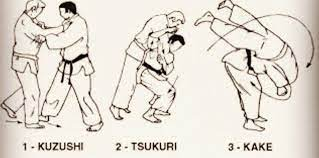
Kano divided his throwing techniques into the follow phases: kuzushi, tsukuri, kake (unbalancing, fitting-in, execution). 


When including the comments of various judo masters in Judo Formal Techniques: A Complete Guide to Kodokan Randori no Kata, T. Otaki and D.F. Draeger (1983), some recognise taisabaki but are not sure where to put it into Kano's division of phases in throwing techniques.

Otaki and Draeger also suggest that grappling include a comparable set of components. Grappling meaning those techniques that end with joint-locking techniques (kansetsu waza).

One of the things that sets KJ apart is Kano's teachings, which involves the division of judo skills into phases. This conceptualisation of techniques and the teaching thereof is relatively unique in the martial arts. This unique conceptualisation and teaching of martial arts techniques was probably due to Kano being a professional teacher. Mochizuki, being an acolyte of Kano's, adopted the same approach when developing his YB.

An issue that arises within the mon grades is that this systems approach, this division of a defence/technique into phases, does not appear to have been fully understood by JDJ and the senior instructors at the Jan de Jong Self Defence School (JDJSDS).

With the senior instructors, a part of the problem might have been that they did not go through the mon system. They are products of the original kyu system, which is a totally different system, in that the mon system is based on systems thinking and the kyu system is based on 'tricks.'

Taisabaki (Body-Movements)

 Flowing (nagashi): the following image of nagashi is taken from Mochizuki's book(Giho Nihonden Jujutsu (Traditional Japanese Jujutsu)).


I was going to make a point about how JDJ had the right idea drawn from YB but his execution was flawed, and then I went and got the above image from Mochizuki's book to include in this post. As it turns out, the demonstration of nagashi in this grading is similar to the YB demonstration and so my point was not made.

I thought I had mentioned it in another (previous) post, but I cannot find any such mention. Some/many of the issues associated with the mon grades come to light when attempting to write a book based on or about JDJ's grading system, or producing videos of the requirements of the grading system to aid those engaged in the grading system. I have been involved in both processes.

You will recall the Tsutsumi and Higashi book discussed in a previous post. All of the defences/techniques in that book are referred to as 'tricks.' They are described/explained in full, wholly independent of all other defences/techniques. They are described/explained in terms that do not refer to any similarities or differences (the core of all learning) with other defences/techniques. But what happens when there are commonalities in defences/techniques? At the very least, it is inefficient to have to describe/explain the same thing over and over again.

When adopting a systems approach, such as that adopted by YB, it is more efficient to describe/explain the common elements once and then refer to that description/explanation. A glossary, if you will. Whenever nagashi is used in a defence/technique, it would be more efficient to refer to the one defining example of nagashi, a 'protypical' example of nagashi in this case. Even when the nagashi is different in another defence/technique, it is still more efficient to refer to the one prototyical example and then refer to the differences, e.g., it is the same except that ...  

The problem here is that the nagashi is demonstrated as a defence in-and-of itself (see image above). It is not a demonstration of the prototypical nagashi that forms part of many other defences/techniques in the YB system. This is an example of teaching 'tricks' rather than teaching a 'system' of defences/techniques. This is an example of not understanding that demonstrating taisabaki (and kuzushi) is not demonstrating a defence.

The same is true of entering (irimi) in this grading.


The taisabaki is part of the taisabaki-kuzushi-waza phase division of defences/techniques (see above). These taisabaki are used time and time again in defences. Imagine making videos of the elements in the grading system. Would it not be smart/efficient,to provide a glossary of these common elements in their prototypical form that could be explained in detail once rather than doing so with each and every defence where they are present? If not a glossary, than when they are demonstrated in the mon grades. 

Kuzushi (Unbalancing)

The second phase in the YB division of techniques after taisabaki is kuzushi (unbalancing). 

The demonstration of unbalancing in the mon grades is done from hand grips. There are four basic unbalancings from four basic handgrips, however, there is an element of confusion as they are referred to by the same name. 

Jun katate dori (normal single handgrip), dosoku katate dori (same side single handgrip), gyaku katate dori (reverse single handgrip), and ushiro ryote dori (rear both hands handgrip). The prototypical unbalancings are jun kuzushi (normal unbalancing) from jun katate dori, dosoku kuzushi (same side unbalancing) from dosoku katate dori, gyaku kuzushi (reverse unbalancing) from gyaku katate dori, and ushiro kuzushi (rear unbalancing) from ushiro ryote dori.

There are variations of these basic unbalancings as examined in the kime no kata grading in the nikyu grading.    

In his later years, JDJ taught these forms of unbalancing using a kuzushi-hazushi dichotomy. The basic idea was the kuzushi type was where uke held on whereas the hazushi (disengagement, release) was where the hold was disengaged. 

This kuzushi-hazushi dichotomy was used in relation to the nine basic kansetsu waza (joint-locking techniques). Kuzushi involved the elbow being turned upwards during the unbalancing which facilitated ude kujuki (arm breaking), tekubi hishigi (wrist crush), and yoko tekubi hishigi (side wrist lock). The hazushi variant involved the elbow being turned during the unbalancing facilitating the other six basic kansetsu waza to be executed. The kuzushi and hazushi variations could be used with any of the abovementioned basic handgrips and was demonstrated and taught as such.

But here again, this element in this grading is taught and demonstrated as a defence in-and-of itself. Taught and demonstrated as a 'trick' and not as a prototypical example of a technique used in multiple defences/techniques.

Kansetsu Waza (Locking Techniques)

Given that it's just after Xmas, I'll refer to Love Actually and Rufus (Rowan Atkincson) when wrapping the present for the cheating Harry (Alan Rickman): 'Oh, this isn't a bag sir. This is so much more than a bag.'  

The final element in the YB phase division of defences is waza (taisbaki, kuzushi, waza). This section of the grading ostensibly examines a particular type of waza, kansetsu waza (joint-locking techniques), but it examines so much more than the kansetsu waza.

The following is from an interview with Hans de Jong (HDJ) published in the Blitz magazine:

While people tend to focus on techniques, tactics are also an important part of jujutsu training. Without employing the correct tactics, there's often no opportunity to use the techniques successfully, at least. Our very first grading involves dealing with two attackers, who attack one by one in quick succession, or simultaneously. The student is not only examined on technique, but how they are able to avoid the second attacker while dealing with the first. So how the body movement is used and how the attacker is placed in front of the other is looked at during the grading ...

HDJ's explanation of this format in the mon grades is an accurate explanation of its use in the JDJSDS. This is how the instructors described this section in the mon grades. But really????

A five or six year old, in their very first grading, and they are going to be assessed on their tactical abilities in relation to two attackers. Really?

This is JDJ's attempt at introducing randori into his grading system.

Randori is a term used in various martial arts, particularly in disciplines like Judo and Aikido. It refers to a training exercise where a person or a group of people face multiple opponents in a relatively free-form manner. The word 'randori' is of Japanese origin, where 'ran' means chaos or disorder, and 'dori' means taking or grasping.

Without going into a detailed discourse on the concept of randori, it is a form of stress training. The kyu grades employ shinken shobu no kata as the form of stress training with no demonstration of techniques under non-stress conditions. JDJ became aware of randori as a form of training/stress training and given that shinken shobu no kata was used in the kyu grades, he included this form of training in the mon grades without any real understanding of this form of training.

What do you think is more stressful, more reminiscent of 'real' fighting: two attackers in a free-form manner or shinken shobu no kata? If the former, why include the more 'stressful' form of training for beginners then ease off for the adult kyu and dan grades?

In terms of progression, where is the one attacker free-form training before jumping to two attackers?

How would you go about developing this grading (and the other mon grades) based on this analysis and the fact that it is based on the taisabaki, kuzushi, waza phase division approach? You would include a demonstration of the taisabaki, and then the kuzushi, and then the waza, separately. You would then include a demonstration of the three phases put together, and then, and only then, you might include a stress element.

Not only is this section flawed because of the absurdity of the two attackers and its purpose, the defence involving the wrist twist from a top strike and a low punch involve irimi senkai (entering rotation) taisabaki and a 'grabbing block' (see future post on blocks) as a form of unbalancing used in conjunction with the body-movement, both of which are not demonstrated in the taisabaki and kuzushi sections.

If a five- or six-year-old grading candidate is struggling with this section of the grading, is it because of the stress element or is it because they cannot perform the wrist twist? Taking the grading as it is, we don't even know if the student can perform a wrist twist technique.

When I asked what was supposed to be taught and examined in this section of the grading, the answer by the senior instructors was the same as HDJ's explanation above. I ignored that instruction. Even way back when, I recognised it was a nonsense. All I wanted to see from the five- and six-year-old grading candidates was that they could perform the kansetsu waza, wrist twist. The same was true of the taisabaki and kuzushi techniques. All I wanted to see is if they could perform those techniques and not if they could perform a defence involving some variant of those techniques.


Friday, 5 January 2024

The Development of the JDJ Jujutsu Grading System Part 3.1: The Mon System Introduction

The following introduction to the mon system is taken from Jan de Jong: The Man, His School and His Ju Jitsu System (Jan de Jong Self Defence School, 1995) (the 'JDJ book'):

The Tsutsumi Hozan ryu ju jitsu system originally commenced at Rokku (6th kyu - yellow belt). Jan de Jong has made incremental changes in the techniques and the system over the years, however, the most substantial change was the introduction of the 'mon system' in 1978. (p. 12)

The introduction of the kyu system was discussed in a previous post

That post included that the individual levels and colour belt system of Jan de Jong's (JDJ) kyu system reflected that of Tsutsumi Hozan Ryu (THR) included in Tsutsumi Masao and Higashi Katsukuma's Die Selbstverteidigung (Jiu-Jitsu): nebst einem Anhange über Kuatsu (Wissenschaft der Wiederbelebung Verunglückter): mit 72 Abbildungen nach dem Leben (Self-defense (Jiu-Jitsu): along with an appendix on Kuatsu (science of resuscitation of casualties): with 72 illustrations based on life) published in Germany in 1906. It is unknown whether the content of the two grading systems were the same. It is unknown if the JDJ kyu grading system is the THR jujutsu kyu grading system.

It should be noted that a former JDJ jujutsu instructor who ended up teaching for him full-time has stated that during his time (1963-1974), JDJ did not discuss THR in classes or that what was being taught was THR jujutsu.

The mon system was introduced at the front end of the JDJ grading system, however, it will be seen that the same influence had a major impact on the development of the dan system at the back end. How it fits with the kyu system in the middle, well ...

The mon system is comprised of 1st mon to 7th kyu. Why did JDJ refer to the last three gradings in the mon system as kyu grades? From the abovementioned JDJ book (p. 31):

Entry Levels
Age Requirements and First Grading
Under 12 years - 1st Mon
12-15 years - 3rd Mon
Over 15 years - 9th Kyu 

It would appear that JDJ considered mon grades, junior grades and kyu grades, adult grades, when he developed the mon system.

Until the introduction of the 'mon system' (refer pate 12) in 1978, people of all ages attempted the yellow belt grading first. Paul Connolly (refer page 19) started under the old system at the age of twelve. Two years later he was the youngest person to grade purple belt showing that it was a challenge but not an insurmountable one. (JDJ Book, p. 27)

The mon grades opened up a whole new market for JDJ - kids and youths/teenagers. Before the mon system, there was only 6th kyu that was trained by and with adults. The above statement concerning the 'old system' being a challenge but not insurmountable is being generous to an extreme.

The 'mon system' is a series of gradings that supplement the original grading system and primarily examine the fundamentals of ju jitsu. It is a rational, scientific approach to the teaching and learning of ju jitsu.

By providing novice ju jitsuka (ju jitsu students) with a basic framework of ju jitsu skills and understanding at the beginning of their training, they are better prepared to tackle the demanding grading system and attain a higher level of proficiency more quickly. The outcome of this bold move has proved extremely successful with the graduates of this system having a deeper understanding of ju jitsu earlier.

These fundamentals link all the techniques and provide a 'system' of self defence rather than a collection of unrelated 'tricks'. Armed with an understanding of these fundamentals, an experienced ju jitsuka could develop their own style of ju jitsu. In ancient times this could mean the loss of likelihood for the original master, or even a challenge for his position or life. Thus these fundamentals were closely guarded secrets and only revealed to very advanced and trained yudansha (black belt holder).

The JDJ book was researched, written, and edited by me, with contributions by the senior instructors of the school and with extensive consultation with JDJ, as acknowledged at the start of the book. The book was based on my understanding of the grading system back in 1995. That understanding has changed significantly in the meantime with further study and reflection, as these series of posts demonstrate.

The gist of the above understanding was derived from Greg Palmer (one of five to complete the JDJ technical grades and be awarded sandan before being awarded yondan for his contributions to JDJ and his school). Greg was able to gain those insights that lead to a new and better understanding because he was a professional trained teacher. How much of those insights were shared by the other instructors and their teaching of the mon system and application to the teaching of the kyu system is open to question.

The reference to 'system' and 'tricks' is reference to systems theory. In the context of systems theory, a system refers to a complex whole, comprised of interconnected and interdependent parts or elements. Systems thinking is an approach to understanding and solving problems that emphasises the examination of the entire system, rather than focusing on its individual components. 

Another way of understanding this approach is contained in the chapter on analysis in my book on the science behind all fighting techniques. In that chapter I refer to Gerry Carr, Sports Mechanics for Coaches, 2edn, 2004:

Carr explains how it is easy to be overwhelmed by the complexity and speed of a skill when it is performed in its entirety. He suggests that when the skill is divided into phases it is far easier to analyse each phase of the skill separately rather than concentrate on the total skill. Dividing a skill into phases also allows us to teach, learn and train each phase separately before combining them to perform the complete skill. It enables us to identify the similarities and differences between different skills which has been described as the core of all learning. Identifying the similarities between techniques and defences means that by training the similar phases we are training a part of a number of techniques or defences rather than just the technique or defence in question. This produces efficiencies in training and produces a system rather than just a collection of techniques.

The reference to 'tricks' in the above JDJ book excerpt, and which has been discussed in a previous post, is reference to skills being considered in their entirety and independent of all other skills. The reference to 'system' is reference to the phases in the performance of a defence; the fundamentals of ju jutsu as the above JDJ book excerpt refers to them as. These phases/fundamentals form the basis for the mon grades, however, how they fit with the kyu grades is another matter.

The idea that these fundamentals in the mon system were the 'secrets' of the THR grading system that JDJ chose to go against tradition and share with novice students was a myth that grew out of JDJ's penchant for not acknowledging the source of his teachings. 

What is missing from the above description of the mon system is that it is based in large part on Yoseikan Budo (YB) teachings. JDJ adopted those teachings and developed the mon system based on those teachings without acknowledging the source of those teachings. Anyone from the YB tradition could comfortably pass all of the mon grades without any instruction from the JDJ tradition. They would also do pretty well with a lot of the gradings in the dan grades.

In terms of the comment in the above extract regarding attaining a higher level of proficiency more quickly and that the outcome of this bold move of introducing the mon system at the front end of the grading system, and how it has proved extremely successful, I will refer to an interview that JDJ participated in. The interviewer asked if JDJ thought it was a good idea to change the system to suit the students.

Yes, I know what you're saying, but you know you can learn all the time. And if the results are better one way than the other, why carry on in a way that gives poorer results? I'll give you an example. In 1978 a Major Greg Mawkes MBE asked me if I would go and teach the army self-defence. I said okay and soon afterwards found myself teaching members of the SAS and the Commandoes. Shortly after I had started to do this the Major and I had a discussion about things. He told me that he thought the method of fighting was really good and he was pleased with that. But he said the men were having some difficulty understanding it all. I said this was the usual way of things and that my students were the same. He then explained the army did not have unlimited time to spend on this and that what he needed was quick results.

So it was at that point I had to think things through and see what I could come up with. I looked at the usual way the army taught things and decided I would alter the way I was teaching and come more in line with the army way of doing things. Well, do you know, the people started to pick things up much faster than before, and they could do the techniques much better than before! So I had a talk with my Instructors and said I thought that we should change things so that we were teaching everyone like this. And at that time we changed the way we taught the students. The techniques were still the same, it was only the method of teaching them that was different. And since then things have been much better.

The JDJ ryuha that are teaching JDJ's grading system in any large degree should take note of JDJ's comment regarding carrying on in a way that gives poorer results. I have long argued that JDJ's grading system is 1.0 and is in need of revision. It is overly cumbersome, overly burdensome, and disjointed, not to mention the faults that are contained therein. The grading system is in need of rationalisation and integration. Without it, the JDJ tradition will die, which can be seen through the ever-diminishing JDJ ryuha since JDJ's passing.

If grading system 2.0 is to be realised, one must understand how system 1.0 was developed or evolved. That is one of the main purposes of these series of posts.

JDJ's reference to Mawke's comment that his men (SAS troopers) were having difficulties understanding JDJ's teachings is reference to the kyu system approach. The reference to the Army way of doing things is reference to the mon system approach, which is basically a YB system approach, and which involves the division of a skill into phases (see Carr above). An understanding of this approach can produce the abovementioned improved outcomes, however, as will be demonstrated in the following posts, that understanding is lacking in many of the instructors within the JDJ tradition, including to a large extent JDJ.

Is that understanding lacking, at least in part, due to the way the mon system was introduced? The mon system was introduced into the JDJ grading system in 1978 when the senior instructors were already the instructors to which JDJ referred to in the above interview extract. The ones he referred to talking with about the introduction of the mon grades. In which case, did the senior instructors go through the mon grades? Were their introductory sessions that enabled the instructors who would be teaching these grades to gain an understanding of their content? It has to be understood that the mon grades are a significantly different system to the kyu grades. They are different in the very basis of their conception.

Am I the first black belt to have gone through the mon system? In which case, I am the first to complete the technical grades in the JDJ jujutsu grading system that included the mon grades (only five complete the technical grades and were awarded shodan; me and four of my instructors).

The next post will start to delve into the mon grades in some detail.

The Development of the JDJ Grading System Part 2.8: Shodan (Part 7 Ju Jitsu Rekishi (History), Part 8 Kyoji (Teaching), and Part 9 (Examining)

This post will complete the review of the Jan de Jong shodan jujutsu grading.

The final three parts to the grading are all teaching oriented.

The translation of the Part title and the Part descriptions are taken from Jan de Jong: The man, his school and his ju jitsu system (Jan de Jong Self Defence School, 1995).

SHODAN PART 7: JU JITSU REKISHI

Rekishi is translated as 'history.'

'Candidates are required to submit an essay with no less than 1500 words on the history of ju jitsu and no less than 1500 words on any one aspect of ju jitsu.'

This Part carries on from ikkyu part 4 of the same name: 'Oral examination of the history of ju jitsu and a general history of Asian martial arts.'

The recommended reading for the shodan grading were:

Beginning Ju-Jitsu by James Shortt

Comprehensive Asian Fighting Arts by Donn Dreager and Robert Smith

Classical Budo by Donn Dreager

Modern Budo and Modern Bujitsu by Donn Dreager

Secrets of the Samurai by Ratti and Westbrook

The Fighting Spirit of Japan by E. Harrison

Zen Combat by Jay Gluck

There have been some authoritative books published since Jan de Jong (JDJ) devised this grading and compiled the above recommended reading list. Two that should be compulsory reading are:

Legacies of the Sword: The Kashima-Shinryu and Samurai Martial Culture by Karl F. Friday (1997)

Armed Martial Arts of Japan: Swordsmanship and Archery by G. Cameron Hurst III (1998)

Friday is associate professor of Japanese history at the University of Georgia. Hurst was a historian of Japan and Korea holding academic posts at various universities in the U.S. and Japan. Unfortunately Hurst passed away before he could publish his promised accompanying Unarmed Martial Arts of Japan.

Friday had this to say in the introduction to his book and martial arts literature:

Errors ... persist in Western writings due in large measure to the insularity of both the audience and the authors. The overwhelming majority of the literature on Japanese martial art has been directed at practitioners and other afficionados, and penned by journalists, martial art teachers, and others without formal academic training in premodern Japanese culture or history. Not surprisingly then, most English-language books and articles on the topic have relied almost exclusively on other English-language martial art books and articles, supplemented by survey histories. Thus, mistakes and misinformation tend to circulate and recirculate largely because those with the wherewithal to correct them - the community of experts versed in Japanese history and thought, and trained to read primary sources - have generally viewed the bugei with little more than bemused condescension. (p.8)

The English-language literature on the traditional bugei includes how-to manuals, biographies of master swordsmen, translations and commentaries on classical texts, and broadly synthesizing historical or analytical studies. Much of this work suffers from historical naivete, flawed by errors of fact or conception, but most is useful in one way or another and some is quite excellent. Even the best, however, suffers from limitations imposed by the sheer diversity of the bugei. (p.9)

JDJ introduced the history grading into both his initial instructor gradings because, as he explained, an instructor needs to be able to explain what jujutsu is to prospective students and others.

My writing journey began around 2000 when I started writing a book on the jujutsu that JDJ taught. The first chapter was, 'What is Jujutsu?' Answering that question was JDJ's intent when he introduced the history grades into ikkyu and shodan, however, I found knowledge of the history of jujutsu did not answer that question.

Instead, I found Draeger was the most thorough in answering that question. Dreager consistently analysed and explained jujutsu in terms of the generic nature of the term, its history, its technical content, and the practical application of the philosophical concept of ju.

Understanding the generic nature of the term is a must in understanding what jujutsu is. When martial artists say that jujutsu is [ ], there are always exceptions. Friday has this to say about attempting to understand phenomena in generic terms:

Analysing and explaining the bugei in generic terms is a bit like conceptualising world history, world literature, or world religion in similar fashion. Standing back far enough to examine the phenomenon in toto permits one to describe its outlines, but seeking deeper insights about its essence forces one to grapple with a volume of diversity and detail that quickly becomes overwhelming. (p.9)

In addition to the generic issue above, I found that the history of jujutsu, if there is even such a thing, did not add much to the understanding of jujutsu. Instead, I found an evolutionary approach was far more informative. An evolutionary approach looks at the same historical period but with a clear focus on function. It has a clear focus on explaining how what is under investigation came to be what it is today.

An important book in this regard is Giving Up the Gun: Japan's Reversion to the Sword, 1543-1879 by Noel Perrin (1988). This book uses the evolutionary concept of speciation, albeit not explicitly, to explain the uniqueness of the Japanese warrior arts compared to that of European knights.

Another book that looks at the evolution of the Japanese warrior that is also helpful in understanding the generic nature of the Japanese warrior arts is Heavenly Warriors: The Evolution of Japan's Military, 500-1300 by William Wayne Ferris (1996). In fact, Ferris' principles of counter-response and symmetry - the tendency of one antagonist to reproduce the same kind of weapon as the enemy, which he suggests dominated much of martial thinking in the premodern era as it does today, explains the development of the modern phenomena that is 'mixed martial arts' as a martial art in itself and which destroyed the original concept of those competitions.

The technical content of jujutsu reflects the evolution of the Japanese warrior which is explained in the last four-mentioned books. Friday compares the Japanese warrior arts to the Chinese, Korean, and Okinawan boxing arts:

Japan, however, had no counterpart to Chinese boxing - at least not until modern times. The bugei practiced in Japan today descend directly from arts developed for the battlefield. Furthermore, until modern times the Japanese fighting arts were more or less the exclusive property of the samurai, the ruling class throughout the period in which the disciplines matured. Chinese, Okinawan, and Korean boxing forms, by contrast, were created by tradesmen, peasants, ascetics, entertainers, monks, rebels, bandits, and other political have-nots. (p.6)

The final element in Dreager's explanation of jujutsu is the practical application of the philosophical concept of ju. Dreager explains that the principle has been interpreted in highly individual and technically differentiated ways, all of which are subsumed under the generic concept of jujutsu. I won't go into a discussion on the subject, but I will note that it is an important part of an explanation of jujutsu and that it serves as a point of differentiation between different jujutsu methods.

You will recall from the description of this grading at the beginning of this section that the essay is to be comprised of one half on the history of jujutsu and the other half on one aspect of jujutsu. I cannot remember what my aspect was. 

One of my training partners, Gerald Woods, a very funny person, informed me that he'd submitted his essay. I asked what aspect of jujutsu did he write about? He was perplexed. He hadn't read the instructions thoroughly and wrote the entire essay on the history of jujutsu. When I point out his error, he said au contraire. The first half of his essay was on the history of jujutsu and the second half on an aspect of jujutsu was on the aspect of the history of jujutsu. I've got to give him that.

SHODAN PART 8: KYOGI

Kyogi means 'teaching.'

'Examination of the candidate's ability to teach all grades to Ikkyu. Candidates will be judged on manner of presentation, explanation, demonstration, correction, technical knowledge and attitude to and handling of students.'

This grading follows on from part 6 of ikkyu which is exactly the same except the grades are from ichimon (1st mon) to gyoku (5th kyu).

The 'sheepdog' approach was adopted to teaching prospective teachers at the Jan de Jong Self Defence School (JDJSDS). What I mean by that is that the candidates would assist an instructor in teaching classes and would basically learn to teach by observation, with very little if any instruction. 

There were no requirements regarding minimum time assisting before being eligible to attempt the teaching grading in the JDJSDS. A JDJ ryuha has introduced a minimum time assisting requirement before being eligible to attempt the teaching grade.  

In a previous post, I explained that JDJ asked me to take over a branch of his school after 1.5 years training, graded 3rd kyu (orange belt), and after having never assisted any instructor in the school. Maggie de Jong once attempted to 'explain' to me the the high calibre of our instructors was because they all had assisting experience and were graded shodan (conveniently forgetting that instructors were ikkyu when there was no shodan grading). I reminded her that her father had asked me to take over a branch of his school when I was 3rd kyu and that I had never assisted any instructor. She backtracked and said that I was the exception. I was the exception, but why?

I didn't stop teaching from the time I started, and I only ever assisted two instructors at the JDJSDS. One was Peter Clarke, who was one of the trio that JDJ awarded rokudan (6th dan). I requested to assist him because I thought I could learn something from him. The other was JDJ who asked me to assist him in his classes. I also assisted him teaching throughout Western Europe, the Eastern States, and Java, Indonesia. I came to be the main instructor at the JDJSDS teaching more classes and private lessons than any other instructor there at the time (mid-90s).

I also assisted Debbie Clarke when she was teaching the women's self defence courses that she developed and taught for the JDJSDS. I was the only male to do so for any extended period and I learned a great deal assisting her. One thing I learned that being a martial arts instructor does not necessarily prepare you for teaching women's self defence.

There was no consistency in teaching standards or methods at the JDJSDS. Teaching martial arts is still an amateurish affair. It is patently obvious that teaching prospective teachers how to teach would lift the teaching standard within the school and introduce some sort of consistency in terms of teaching standards and methods that can only benefit students.

SHODAN PART 9: EXAMINING

'Candidates are required to assist with 40 hours of gradings in an assistant examiner capacity. Twenty (20) hours must be completed with Shihan Jan de Jong. An official record signed by the head examiner is to be submitted.'

There is no similar grading in ikkyu. You will recall from a previous post that ikkyu was the instructor grading in the one-off kyu system that JDJ initially developed. Why is there no examining requirement in ikkyu

If there was no consistency in teaching standards within the JDJSDS there was absolutely no consistency in examining standards. The standard varied so widely that no candidate for this grading could have developed an understanding for what standard is required for any grading in the JDJSDS.

There was one senior instructor who was so lenient in his marking that it was nigh on impossible to fail a grading under him (in terms of teaching standards, it was his students who tended to fail gradings). There were other senior instructors who considered JDJ too lenient and so tended to mark a lot harder than JDJ. In fact, one of the instructors went out of his way to show me what a 'high standard' he imposes on grading performances when I was 'assisting' him that he was in danger of failing the student who did not deserve to fail. In the second half of the grading, he overly compensated but passed the responsibility for those marks over to me, his supposed assistant.  

On a grading table, there is the examiner with either one or two 'assistants' sitting there with them. For the most parts, the assistants are 'bookends.' The do nothing, are taught nothing by the examiner, and learn nothing. I'm not a 'bookend' type of person.

The senior instructors who openly considered JDJ to be too lenient in his marking of gradings, I figured JDJ couldn't be that bad because he graded them, and they are not too shabby. So I decided to teach myself to grade to JDJ's standard.

I would assess the grading performance in my head and compare my marks to that of JDJ. If there were major differences, I would ask JDJ about them when the grading and awarding had been completed. In time, I got so good at this that I would regular get within one or two marks of JDJ's assessment. I can confidently say that I can grade to the same standard as JDJ. That is how I know that the other instructors were inconsistent with their marking, when it came to the standard being set by the head of the school, JDJ.

The current approach to this grading is generally a waste of time. There are better ways to develop examiners. For instance, formalise my approach. Have the assistants mark a grading sheet and then compare them with the examiner. Alternatively, technology can assist. Get examiner candidates to watch videos of gradings, grade them, and compare them to the standard set by the principal of the school. In this way, differences can be identified and clarified in real time (remember, this cannot be done during gradings as it would interrupt gradings).  


Thursday, 4 January 2024

The Development of the JDJ Grading System Part 2.7: Shodan (Part 6: Jutsuri no Kata (Theory) and Kotoba no Hyogen (Terminology))

SHODAN PART 6: JUTSURI NO KATA AND KOTOBA NO HYOGEN

Part 6 of Jan de Jong's (JDJ) jujutsu shodan grading includes two parts: jutsuri no kata and kotoba no hyogen.

Jutsuri no Kata

According to Jan de Jong: The man, his school and his ju jitsu system (Jan de Jong Self Defence School, 1995), jutsuri no kata means 'kata of the reason of the art, theory.'

The description of the jutsuri no kata in the abovementioned book is: 'Oral examination on technical aspects on any technique in all the grades up to and including Ikkyu.'

This grading follows on from Part 5 of the ikkyu grading: 'Oral examination on technical aspects on any technique in Ichimon to Gokyu.'

These gradings are indicators of the instructor element in JDJ's jujutsu grading system. They are indicators that ikkyu and shodan gradings were designed by JDJ to produce high quality instructors as well as high quality practitioners, if not more so. These gradings are a major innovation that was introduced by JDJ into his grading system.

These gradings are known as 'theory gradings.' While the idea is laudable, it's execution was, and is in all JDJ ryuha, flawed because the theory was/is lacking. I can now provide the theory that fulfills the promise of JDJ's innovative theory gradings.

Here I'll defer to my chapter on forces in my as yet unpublished book on the science behind all fighting techniques. The following is the introduction to that chapter:


You will recall from chapter one that Gracie and Gracie suggest that a black belt is a fully qualified teacher who knows why a given move works in addition to knowing how to perform the move. That is, they suggest, a black belt understands the biomechanical principles that underlie the move. Biomechanics is the study of forces and their effects on living systems (McGinnis 2005), therefore, a black belt is expected to understand the mechanical concept of force and its effect on humans in the martial arts. This chapter provides that understanding which is sorely lacking in the martial arts.  

There is a bit to unpack in the above extract.

Gracie and Gracie are right, and they are wrong, when suggesting that a black belt is a fully qualified teacher. They are right in terms of the general perception by the public (and maybe Brazilian Jiu-Jitsu), but they are wrong for two reasons: (1) Most Japanese martial arts consider shodan to be a 'beginner's' grading in that the student has mastered the basics. They are not considered to be teachers of any description until 3rd-5th dan. (2) Most martial arts do not teach students/practitioners to be teachers. Teaching requires a different set of skills and knowledge to that of a practitioner. That is why I argued that Greg Palmer was the best teacher at the Jan de Jong Self Defence School (JDJSDS) - because he was a trained teacher. However, Greg also lacked an understanding of biomechanical principle that underlie techniques.

Greg used to say that this is where the JDJ jujutsu grading system was different to most other martial arts grading systems. In the Japanese martial arts, shodan is considered to be a beginner-type grading (see above) whereas in the JDJ jujutsu system, shodan is the equivalent of a 'master' grading in most other grading systems because of the teaching (including theory) elements, and the extensive kyu grading system that came before. In fact, the same may be said of ikkyu given that JDJ developed the kyu system as a one-off grading system with ikkyu being the instructor grade.

In this way, Gracie and Gracie are correct in terms of JDJ shodans (and ikkyus) being fully qualified teachers, at least compared to most martial arts, because there are teaching elements in those gradings. But there is room for significant improvement in those elements, and those improvements are relatively easy to introduce and implement, with the aid of my teachings on the science behind all fighting techniques.

Gracie and Gracie describe the basis of the theory grades in JDJ's grading system. The basis lies in understanding how a technique works. Gracie and Gracie go on to explain that this basis involves an understanding of the biomechanical principles that underlie techniques. I can categorically state that that understanding is missing in the JDJ tradition and in most, if not all, martial arts. My book on the science behind all fighting techniques is designed to fill that void.

The theory grades are no theoretical exercise. They form the basis for teaching, learning, and correcting techniques and performances. It can be done better and provide a consistent standard of instruction for the organisation and its offshoots (see below). 

In the section on 'Force' in the abovementioned chapter in my book:

Kreighbaum and Barthels (1996) suggest that the visualisation of forces is a necessary skill for, among others, teachers and coaches because forces account for the changes in the motion and shape of all things in the environment. It would also be a beneficial skill for students for the same reason.

After a brief introduction to the mechanical concept of force:

Think about every technique taught by martial arts and you will see that they are designed to change the motion of an opponent’s body and/or to cause the deformation of their bodily tissues in order to cause pain and/or injury. Forces cause those changes. Forces are responsible for the effectiveness of every technique taught by martial arts and other activities associated with preparing a person to engage in a violent encounter and those used in violence generally, therefore, it is important for those that teach and study those techniques to understand what forces are and how they can be pictured as they are applied to or by a body. The beauty of it all is that the mechanical concept of force is very easy for the layperson to understand and apply.

The last sentence has been emphasised for obvious reasons.

After explaining the mechanical concept of force that is very easy for the layperson to understand and apply, the following is an extract from the section that refers to JDJ's theory gradings:

The black belt grades in the jujutsu grading system developed by Shihan Jan de Jong OAM 9th Dan (see chapter one) are as much about producing proficient teachers as they are about producing proficient practitioners. Each of the black belt grades include theory gradings, which reflects Gracie and Gracie’s suggestion that a black belt is a fully qualified teacher that is expected to know why a technique works in addition to knowing how to perform it (see chapter one). The theory grading in shodan (first dan) requires the candidate to answer questions on techniques without demonstration. A favourite question of de Jong’s was: ‘What are the forces involved with tai gatame ude kujuki (body-set arm breaking)?’ 

Figure 4.1 Tai gatame ude kujuki (body-set arm breaking). Photo courtesy of Paul Amyes. Reprinted by permission.

De Jong had an intuitive understanding that forces are what makes techniques work, however, neither he nor the grading candidates possessed knowledge of the mechanical concept of force. Their lack of knowledge often resulted in convoluted explanations by grading candidates that may or may not have focused on the essential elements of the technique. De Jong and the grading candidates would have been better served if they had an understanding of the mechanical concept of force when asking and answering those most insightful of questions.

Given the above insight, this is a question that I have asked many of JDJ's and JDJ ryuha ikkyu and yudansha and I have never been disappointed in not receiving an accurate and concise answer; an accurate and concise explanation of what makes the technique work. An accurate and concise explanation is available, as I've suggested above, and that accurate and concise explanation is easily understood by a recipient of said explanation and who has no knowledge of the concept of mechanical force.

I then go on to explain teaching with forces:

The learning of students will be accelerated if they are first taught how to learn. First teach them the mechanical concept of force. Explain that forces are what makes every technique work; that a force is either a push or a pull and that it has a PoA, direction, and magnitude; that the purpose of applying a force is to change the motion of an opponent or to deform their tissues in order to cause pain and/or injury; and then consistently teach techniques using this force-based approach. The students will learn to look for forces when a technique is taught; to look for the essence of the technique. When they come to identify and correct errors in their own or other’s performance, they will go directly to the heart of the technique. 

First, there is an obvious lack of content given that the elements of force have not been shared here but are the subject of the chapter in question. Second, if anyone is interested in learning the concept of force which goes directly to the heart of every technique taught in the martial arts or used in violence generally, please feel free to contact me.

The above extract refers to the learning by students and teaching them how to learn. The following is an extract from the introduction to my book on the science behind all fighting techniques:

The title of Carr’s (2004) Sport Mechanics for Coaches might imply that it is only for coaches, however, Carr explains that his book is written for coaches, teachers, athletes, and sports fans. After explaining how a knowledge of sport mechanics helps produce better sporting performances, Carr explains that his book will help those who coach to become better coaches. That is in line with Gracie and Gracie’s assertion that a knowledge of the why of techniques makes for far better martial arts teachers. Carr also suggests that athletes will discover that the information contained in his book will help improve their performances. Even though I led with Gracie and Gracie’s teacher reference, The Science Behind All Fighting Techniques is written for both martial arts teachers and students (and anyone interested in fighting techniques generally). It will make for far better teachers, as Gracie and Gracie, and Carr suggest. It will also make for far better students. It will make for far better students because (a) they will have far better teachers, and (b) their own knowledge of why a technique works will mean that they will not be as reliant on their teacher’s knowledge of why a technique works and they can take greater responsibility for their own learning experience.

The theory, an understanding of what makes every technique work, does not necessarily need to be the sole province of instructors. It can be shared with students so that they know what to look for when learning and correcting techniques before they even enter a class. However, this cannot be shared with said students if the instructors do not know that theory.

Another of JDJ's favourite theory grading questions was: what is the difference between o soto gari, o soto guruma, and o soto otoshi? All those who answered this question in the JDJ tradition have got the answer at least partially wrong, and they will continue to do so without help.

You will recall from a previous post that the core of all learning is the identification of similarities and differences. A more complete question would have been, what are the similarities and differences between these three techniques? 

One of the similarities is that all three techniques are designed to apply forces in order to cause uke to fall to the ground/mats. A difference is in the application of forces in each of the three techniques, and the difference between throws and takedowns.

In my chapter on throws and takedowns, I demonstrate that there is no accurate, definitive distinction between throws and takedowns in the martial arts and martial arts literature. For instance, the three abovementioned techniques are included in the Kodokan Judo (KJ) syllabus. A unique feature of KJ is the classification of their techniques. Classification is one of the proven highly effective means of identifying similarities and differences. In the KJ classification, there is a throwing class (nage waza) but no takedown class (taoshi waza). Does that mean that KJ does not teach takedown techniques/taoshi waza?

In my book, I have developed a biomechanical definition (which is classification; see above) of throwing techniques and takedown techniques. An answer to the abovementioned question would include classifying the three techniques as either a throw or a takedown, which in turn would feature an explanation on the application of applied forces to achieve the objective of the technique.

From my chapter on throws and takedowns in the abovementioned book:

What does a student know when they are told that they are about to learn a particular throw or takedown when no distinction is made between those two types of techniques? They know that they are about to learn a technique where forces are applied to cause an opponent to fall to the ground. What does a student know when they have been taught the above biomechanical difference between throws and takedowns, and they are told that they are about to learn a two-legged takedown? They know that forces will be applied (see chapter four) to the opponent that: ...

They know all of this before they even know the name of the technique let alone having seen it demonstrated, just because of the biomechanical classification of throwing and takedown techniques. They know what the gist of the technique is, what makes it work, and they can look for those elements when the technique is demonstrated. When they come to correct errors in their or other’s performance, they know where to start because they know the mechanical elements that make the technique work.

This is also called previewing. Previewing involves using the known to understand the unknown. An example of previewing would be teaching o soto otsohi: 'o soto otoshi is like o soto gari except that ...' Here we run into another small problem. JDJ did not know how to perform o soto otoshi, even though the technique is included as a defence in the gradings a number of times. If JDJ did not know, nor did his instructors and nor did his students. 

I came to know by studying outside of JDJ's teachings. I came to know after reading Toshiro Daido's Kodokan Judo: Throwing Techniques which is the best book by far on the subject, and which liberally uses the identification of similarities to teach throwing techniques and their variations. 

There was no consistency in teachers in the JDJSDS. The development of a theory body of knowledge as suggested above would provide some consistency in the teachers and their teaching in the JDJSDS and the JDJ ryuha. It would also provide a point of differentiation for marketing purposes and produce superior results faster.

Kotoba no Hyogen

The translation of kotoba no hyogen according to the abovementioned JDJSDS book is 'expression (hyogen) of the language (kotoba), terminology.'

The description of the grading in the same book is: 'Oral examination of Japanese terminology used in Ichimon and Ikkyu . General Japanese terminology for weapons will also be examined, e.g., bo, jo, nunchaku, etc.'

This part of the grading is carried on from part 4 of the ikkyu grading which included ju jitsu rekishi (history) and kotoba no hyogen. Jutsuri no kata was a separate grading in ikkyu (part 5).

The description of the kotoba no hyogen part of part 4 of the ikkyu grading is: 'Oral examination of Japanese terminology used in Ichimon to Gokyu. General Japanese terminology for weapons will also be examined, e.g., bo, jo, nunchaku, etc.'

Why did JDJ include these types of gradings in his grading system?

His original grading sheets were all in English so there was no need for translation. Later on, the grading sheets were recast using Japanese terminology. The obvious reason for the necessity of terminology gradings is that the recasting required an understanding of Japanese terminology to understand the grading sheets.

Zak, a full-time instructor for JDJ before my instructors, informed me that JDJ used Japanese terminology for techniques 'always.' He also informed me that things were a lot less formal in his day (1963-1974) and there was no kneeling (seiza), bowing, and 'sensei ni rei' to start classes.

For those JDJ ryuha who have reverted to producing grading sheets using English terms, why then persist with the kotoba no hyogen gradings? It is user friendly to produce grading sheets using English terms, but what is the point of this grading in that case?

JDJ once told me that the reason he introduced these gradings into his grading system was so that his instructors could understand the terms when used in books outside of his system of jujutsu. There are two problems with that explanation: (1) the instructors did not tend to study anything outside of JDJ's teachings as previously explained, and (2) JDJ used different terms at times than are commonly used. For instance, the commonly used shiho nage is JDJ's tekubi te nage, kote geashi is JDJ's tekubi hineri, etc.

Conclusion

JDJ's theory gradings are a major innovation and contribution to all martial arts gradings. It focuses on producing qualified teachers, which is generally lacking in the martial arts. Unfortunately, the theory is lacking, which is where my work comes in to fill that void, and in an easily accessible and useful way.  


Tuesday, 2 January 2024

The Development of the JDJ Jujutsu Grading System Part 2.6: Shodan (Part 5: Shiai)

SHODAN PART 5: SHIAI

Part 5 of Jan de Jong's (JDJ) jujutsu shodan grading is shiai

The translation of shiai in Jan de Jong: The man, his school and his ju jitsu system (Jan de Jong Self Defence School, 1995) is 'a game, match, or contest.' 

There are a number of shiai gradings in the higher grades (ikkyu to sandan inclusive). Insights, or greater insights, (see Klein) may be gained that lead to a new and better understanding by studying these shiai gradings together rather than separately.

Why Shiai Gradings?

The first question that has to be asked is, why did JDJ include shiai gradings in his jujutsu grading system? That question needs to be asked in the context of the fact that JDJ did not see much of value in shiai as a training method. 

I know this for a fact because he specifically told me so and discouraged the practice when I was 'sparring' with a training partner when orange or purple belt. It was reinforced by Robert Hymas, a senior jujutsu instructor at the Jan de Jong Self Defence School (JDJSDS) and who was one of the three that JDJ ultimately awarded Rokudan, when he reiterated JDJ's views from the JDJ perspective.

So why did JDJ introduce shiai gradings into his jujutsu grading system? 

One explanation is that he was unfamiliar with grading systems, as has previously been mentioned, and he saw others were including shiai-type gradings into their grading systems. Kodokan Judo for instance. Then there was Tomiki Aikido/Shodokan Aikido and their competition aikido. Karate. Kyokushin karate and their x-man kumite. All of those forms of training were to be found in books, which as previously stated, were a great source of JDJ's 'continuous professional development.' And, of course, the Australian Ju Jitsu Association were lobbying for him to develop a competition format for the organisation given his role as President and National Coach of the organisation.

Given all of that, the second question is, did JDJ know what he was trying to teach or assess in the shiai gradings? What was the purpose of those gradings, other than including them because others were and, of course, to populate the higher grades given his one-off development of the kyu grades as his grading system?

I suggest that JDJ did not know what he was trying to teach or assess in these types of gradings. Sacrilege, I know, however, as will be seen below, that view is supported by the fact that there was virtually no instruction provided by JDJ nor his senior instructors as to what to do in these gradings; what they are trying to teach the student; what is being assessed. This is also supported by the fact that JDJ saw very little of value in this type of training. In this, I agree, which will also be seen below.

But, as always, there is a lot to learn by studying JDJ's shiai-type grades and their introduction, even if they serve no useful purpose ... other than to provide those lessons (see conclusion below).

Ikkyu: Futari Dori

At the end of the ikkyu shinken shobu no kata grading (practical grading) there is a section titled Futari Dori (attacks featuring two opponents). The description of the grading refers to two attackers, five attacks in total, and unarmed vs unarmed.

When looking for an image for this section (see left), it appears that futari dori is very much an aikido term and an aikido form of training, albeit very different to JDJ's grading referred to by the same name.

First question: did the senior instructors of the Jan de Jong Self Defence School (JDJSDS), those that graded shodan before I did, grade this section of the grading? Was it part of the original ikkyu grading? Or was it introduced when Jan de Jong (JDJ) introduced the shodan grading which led to additional gradings being added to the nikyu and ikkyu gradings? I might have been able to tell you, however, I no longer have access to the old grading sheets that I was gifted and which I regifted for the noblest of reasons. It appears that no good deed does go unpunished.

I recently saw a video posted on Facebook by a JDJ ryuha showing a nikkyu training/demonstration of this grading. (a) It was a mess, and (b) I would fail the candidate based on that performance, today.

The candidate in question should not be disheartened by those comments. Their performance was reflective of all who preceded them in this section of the grading. It was reflective of their instructor's performance in their grading, and reflective of their instructor's instructor's performance in their grading. In this case, the fault most definitely lays with the instructor, as it did in the JDJSDS.

Why is the performance in this grading always a mess. It is because the grading candidates abandon all of their training when engaged in this section of the grading. They start moving around all over the place, crouched in anticipation of an attack, and they are more inclined to move backward rather than forward in response to an attack. Was this their actions in any of the many shinken shobu no kata (practical) gradings that came before, and even the shinken shobu no kata grading that this section is a part of? The answer is a resounding, No!

George S. Patton: 'You fight like you train.' That would not appear to be the case within the JDJ tradition when the shiai-type grades are attempted. This raises a question as to the practicality of the shinken shobu no kata method of training. 


When I teach or discuss this grading, I suggest the person think Cpt Algren in The Last Samurai when he is confronted by three assailants armed with swords while he is unarmed. He stands his ground and waits for the attackers to attack, to come to him, and then he responds. The application of the 'mind of no mind' lesson in a life-and-death situation. This is representative of the shinken shobu no kata training.

The above is what should be being looked for in this grading, however, that is what is not being demonstrated in this grading. Why not? Because the instructors do not teach tactics for this grading, other than to place one opponent in front of the other. The same instruction given to 1st mon candidates, aged five or six, in the two-attacker section of their grading. This is an issue that will be taken up when the mon grades are considered.

I was going to share my experience in successfully completing this grading as there is a great deal to learn through the analysis of that experience, however, I'm trying to limit the length of these posts, unsuccessfully so as it appears.

How did I go in this grading? I passed. That is about all I can say about my performance. I, like the abovementioned JDJ ryuha demonstrator, moved 'all over the shop.' My two attackers chased me all over the dojo, and it was a large dojo. Did I execute any successful defensive techniques? A block or two, maybe. No locks, no throws, no takedowns. I didn't land any percussion techniques of my own, but then neither did my attackers. Is a pass in this grading not being hit? Is that what this grading is supposed to teach and assess? Is it simply a game of 'stay away'? I don't know, because my instructors would not appear to have known given their instruction and feedback. 

Shodan Shiai

'Free fight unarmed vs tanto, unarmed vs tanbo, then uke and tori swap roles.'

Tanto refers to a knife; tanbo a short stick.

First, it was a very different time. Occupational health and safety (OHS) did not exist, at least not in these gradings. No safety precautions were taken, other than mats. No restrictions on attacks with weapons. Head, eyes, groin where all acceptable targets for both armed and unarmed participants. No restrictions on techniques. No instructions whatsoever (for the most part).

The tanbo and tanto were usually rolled up newspaper which were then taped. Those makeshift training weapons did inflict a fair 'sting' when hit or stabbed with them, and were capable of causing injury, which they did on occasion.  

Second, this could be seen to be a relatively fair grading in that the attackers were not trained in fighting/attacking with a tanto or tanbo whereas the defender was trained in defending against tanto and tanbo attacks, to some degree.

It could be seen to be a relatively fair grading ... in theory. In practice, the armed attacker annihilates the unarmed defender. When the two candidates swap roles, the same result occurs. In order to pass the grading, the difference between the two scores has to be within a certain range otherwise both fail.

When I asked a senior instructor what the purpose of this grading was, he replied that it was to show that even with training that a person would be annihilated by an armed, relatively untrained in fighting with that weapon, attacker. And that is what the grading does show, time and time again. Good lesson. Good to know. Thanks. Cheers. 

It was a good thing that I did not take that lesson on board when I was confronted by a knife-wielding assailant on two separate occasions (the starting point of my book on a new and better understanding of our natural and learned responses to a threat).

Third, why free fighting unarmed against a knife and unarmed against a short stick? In fact, why one unarmed against two unarmed in the previous grading? Shouldn't the progression be one unarmed against one unarmed, then one against two, and then one unarmed against one armed, and then both armed with the same weapon, etc.? Where is the one unarmed against one unarmed?  

An answer to these questions might be found in Tomiki's explanation of his introduction of shiai (randori) into his aikido.

Tomiki was a student of Jigoro Kano, founder of Kodokan Judo, and was eventually graded 8th dan by the Kodokan. He became fascinated by Morihei Ueshiba’s aikido and became one his early students. In his ‘On Jujutsu and its Modernisation’, Tomiki argues for two forms of randori training:


When we analyse the essence of attacks, they fall into two general categories:
1. An opponent, from close in, tries to topple (taosu) or restrain (osaeru) you.
2. An opponent, from a distance, tries to strike, lunge at, or kick you, or with a weapon tries to cut or stab you.
...
The system of randori practice that Master Kano formulated is for the situations described in point 1 above; it is the category of nage-waza, where from close in you apply a waza at the collar and sleeve of a Japanese style judo jacket. A system of randori practice where you would avoid your opponent's attack from a distance (as in point 2 above) and then apply a technique would utilize the atemi-waza and kansetsu-waza. Against this latter attack, the attack from a distance, there is a need to establish such system of randori training.


Randori practiced in aikido usually involves two or more opponents. It is not 'free fighting' per se but simply a 'free flowing' attack and defence with no continued fighting. JDJ had relatively little experience with randori training.

Tomiki's shiai (randori) involved an attacker armed with a knife. Did JDJ adopt Tomiki's shiai to continue that the shiai form of grading included in his one-off instructor grading, ikkyu? Did he include these types of gradings in terms of introducing a randori type in ikkyu and a Tomiki type in shodan? Did he include a short stick element because of its use in his pencak silat? ... Why aren't the attackers trained in the use of the weapons in attack mode?

Lastly, my grading, or I should say, our grading. Dave Palmer and my grading, it was something that had not been seen before or since. It was a literal blood bath. Maggie de Jong had to scrub the walls and mop the mats after the grading to remove the blood that had been spilled during the grading. There was a lot of blood.

This has to be expected when you get two real fighters, not just mere martial artists, together and there are no rules, no protective equipment, and when weapons are involved, and told to 'free fight.'

Again, a great deal can be learned from an analysis of my/our grading, however, post length considerations prohibit the sharing of my/our experience and its analysis.

How did Dave and I do in our grading? We passed ... even though the grading ended with Dave being taken to emergency after I punched him in the forehead with a standing fist punch and blood cascaded down his face and the front of his gi. He was attempting to retrieve a weapon that I had knocked out of his hand, and I instinctively punched him when he advanced to do so. He was knocked back the length of a tatami and as he attempted to advance, I instinctively punched him.

We passed even though I was rendered unconscious during the grading when I landed on my head/neck from a sacrifice throw by Dave (btw, great execution of the technique, dangerous, but great nonetheless).

In terms of OHS, our weapons were not taped rolled up newspaper. The knife was a wooden training knife and the tanbo was a piece of PVS piping wrapped in cloth and then taped. When you got hit with those 'training' weapons, you got hit, and the risk of injury increased exponentially. But we wanted to test ourselves, and of course there was no guidance or supervision provided by the senior instructors.

OHS-wise, nobody from the instructors table came to see how I was when I landed on my head/neck from Dave's sacrifice throw, and when a crack from my neck was heard 'like a "roo shooter's" shot' across the dojo, and as I laid on the ground unconscious for a bit. They simply waited for me to rise and continue the grading, which I did, albeit initially by backing off as the fight had become unfair with now two armed Daves advancing on me.

There was no feedback provided at the end of the grading, however, Hymas did approach me (us?) later and said that JDJ was not happy with the grading. JDJ never expressed that sentiment to us. Even then, I thought, 'How can any of the examiners be unhappy with the grading given the complete lack of direction provided by the instructors as to the conduct and purpose of the grading. Given the complete lack of indication as to what is supposedly being assessed.'

Nidan Shiai

'Free fight with tanto vs tanto'

This is the only shiai-type grading where there is an equal footing (see above re the absence of one unarmed v one unarmed). It is an equal footing because the two participants are armed with the same weapon. It is also an equal footing because the two participants have not been trained in the use of the knife and knife fighting. 'What is going on here?'

This is indicative of an issue within the JDJ tradition that I will address in a post associated with the mon grades, and that is that the attackers in the JDJ tradition are not taught how to attack properly. This has implications for the training of defensive tactics. 

I prepared for this grading. I learned from the previous shiai-type gradings that I'd undertaken.

The two attackers in my futari dori grading in ikkyu were Hymas and Dave Palmer. I asked Hymas to be one of my attackers because I wanted to test myself against the best. My strategy was to stay away from Hymas and to focus on responding to Dave's attacks or to attack Dave when Hymas attacked me. On the face of it, it was a sound strategy, however, as it turns out, it was a floored strategy. Dave was by far the more dangerous opponent.

Dave committed to his attacks. Hymas knew everything that I knew and knew the defences that I might employ against his attack, so he provided uncommitted attacks with a focus on countering my defence. This is a problem in this type of grading. I know everything you know, and you know everything that I know, and that knowledge impacts on tactics and strategies employed in the grading. It also leads to questions regarding the practicalities of the tactics and strategies thus learned in terms of 'real world' application.

I used this insight in my grading. I would faint an attack and observe the response. I'd faint it again and observe the response. If it was the same response, I'd attack with the anticipation of the response and adjust my attack accordingly. This became a strategy that I shared when engaged in my Master of Business Administration (MBA) degree. If I can discern your strategy, I can develop ways to defeat you.

I hadn't trained the futari dori grading with Hymas and Dave prior to the grading. If I had, I might have discerned Hymas' approach to his attacking role and developed a different strategy going into the grading, e.g., stay away from Dave and focus on Hymas.

In the shodan shiai grading, Dave and I did train the grading together prior to engaging in the grading. I learned that Dave tended to not acknowledge a strike and would walk through it to attack me.

Confidence isn't necessarily everything, but it is a big thing. On a rare occasion that we 'trained' this grading in the instructors class, I was paired with Darryl Cook. Cook is a very good practitioner. He is a contemporary of mine. He is aggressive and he is taller than me, bigger than me, and stronger than me. He was armed with the knife and I was unarmed, but I was 'all over him.' He had no answers. I actually felt physically taller and bigger than him. It was as though I was looking down on him from a height. Hymas took Cook aside to give him some advice since he observed that I was 'kicking his butt,' as the Americans would say. Cook returned and raised his knife to my face. Order was restored in the universe, my perception of my size returned to reality, and there was no more butt kicking.

I knew that Dave gained confidence when he walked through my attacks and 'kicked my butt.' The strategy going into the grading was to not allow that to happen; not to allow him to gain confidence by walking through my attacks and kicking my butt. The first time he tried it, I was ready. I put him on his 'arse', held him by the throat on the ground with my fist raised ready to 'ground and pound.' He covered up and raised both feet-legs ready to kick me. 

'Matte, matte, matte', JDJ shouted as he pounded the grading table. Hymas jumped up from the grading table and pulled me back ... and all the while, Dave and I were smiling at each other. We knew what this was all about. It was setting the 'rules' for this grading. Nobody had lost control, in fact, far from it, unbeknown to JDJ, Hymas, and whoever else was sitting on the grading table.

My nidan grading involved a number of candidates, all of whom had been my instructors. I trained a little with all of them, only to see how they fought. And then I studied knife fighting, given that there was zero instruction in knife fighting provided within the JDJSDS. Then I developed strategies to defeat my opponents, my instructors.

Memorably, when paired up with Debbie Clarke, a great practitioner and a real fighter, there was a standoff, so I provided an opening by lifting my hands. You will recall this strategy when ken tai ichi no kata was discussed in a previous post. It was a genuine opening and if she was good enough, she could 'kill' me. No takers. I raised my hands a little higher to entice her into attacking. No takers. A little higher, she attacked, I 'died.' Fair enough.

You will recall from a previous post that many, and most definitely the senior instructors, did not look outside of JDJ's teachings. In preparation for this grading, I looked outside of JDJ's teachings given that there were no specific teachings regarding knife fighting within JDJ's teachings. I also thought that this might give me a competitive advantage.

Part of my study re knife fighting was reading Col. Rex Applegate's Kill or Get Killed. The description accompanying the image to the right is:

Attack With Knife From Crouch

Beware of the man who holds his knife this way and who attacks from a crouch, with the blade held close to his body and with his free arm out in front to parry or to help create an opening for a slash or thrust.

Beware me. The following was included in the text:

The trained man will use this knife, in the attack, from a crouch, with the left hand forward and the knife held ... close to the body. The outstretched left hand will act as a guard, a foil or a parry, and will help to create the opening for a slash or thrust. The left hand also may be used to distract the adversary's attention - by waving it in his face, by throwing something, or by making sudden darting motions toward him. ...

Beware me and I was a trained man. I was trained in knife fighting by Applegate and not my instructors at the JDJSDS, even though there was a knife fighting grading in the curriculum which the senior instructors (Hymas, Peter Clarke, and Paul Connolly) had successfully completed. 

I adopted Applegate's approach, at times, with one important addition. When a thrusting attack was launched, I would move from the left foot forward staggered stance (han zenkutsu dachi) to a cross-stance. Or more accurately, sempok from pencak silat (see image below).


I was well versed in this stance having trained pencak silat for quite some time. Most importantly, the training was with Richard de Bordes school in London rather that at the JDJSDS as JDJ had, as he said, Westernised his pencak silat so that it would be acceptable for a Western audience. He had in fact Japanised it so that it resembled karate to a fair degree.    

Moving into this stance from a traditional staggered stance is effectively an evasive body-movement, similar to nagashi (flowing) in JDJ and Yoseikan Budo practice. Interestingly, the image accompanying the Tomiki aikido discussion above shows both aikidoka ostensibly assuming the same stance. The same stance is seen in some karate styles, and it is seen in JDJ jujutsu teachings, however, I would argue that there is less understanding of the use and the structure of this stance in all those arenas than in pencak silat.

Another part of the transition into this stance is that it moves the back hand to the front through the turn of the shoulders. This is also used to great effect in pencak silat. 

Part of my strategy was to employ this tactic, moving from a staggered stance into sempok/cross-stance thereby executing an evasive body-movement and moving my rear knife-wielding hand to my front hand and a trusting attack. It was part of my strategy because the other candidates, my instructors, had not seen it before. 

Memorably, this tactic was employed against the abovementioned Debbie Clarke.

Debbie lunged forward and I executed the move. She was going to barrel into the now thrusting knife, which was a molded metal knife, and she was in danger of being 'impaled' on impact. I relaxed my grip and as impact occurred, the knife slide through my hand and fell to the floor. It was beautiful, it was perfect ... and it was missed by JDJ. A clean 'kill', and it was not recorded. 

JDJ took me aside after the grading and told me that I was the best in the grading. But all that meant was that I knew 'how to play the game' better than my instructors. I learned how to knife fight to some degree whereas they did not due to lack of instruction. I learned a fantastic move and had a greater appreciation for the use of sempok as a fighting tactic. But is that what this grading is designed to impart to students?

Before we leave this section, I was present when two JDJ yudansha engaged in this grading. One has since gone on to be awarded Rokudan by a JDJ ryuha principal. The other had his own ryuha and was a 'fighter.' They 'fenced' with the knives, like one would when fencing. Tapping against each other's knives as fencers tap against each other's swords. I was astounded. Why would anyone consider this approach, particularly given that they were supposedly highly experienced and graded martial artists? But here's the thing, how can you fail them, even though the performance was ludicrous, given that no training nor instruction is given in knife fighting even though this is a knife fighting grading in the grading system. 

Sandan Shiai

'Free fight with tanbo vs tanto.'

What is not included in the description of this grading is that the roles are swapped, as in the shodan shiai grading. And as in the shodan shiai grading, the person with the tanbo annihilates the person with the tanto. And as in the nidan shiai grading, the candidates are not trained in the use of fighting with either weapon.

What is the point, other than including shiai-type gradings into the dan grading system and populating the dan grading system given the relatively comprehensive ikkyu grading?

Conclusion

Unlike my instructors, I can teach students how to go about these gradings, but still, what is the point? I can, and have done, train them to defeat the students of other instructors, hands down, but what is the point? 

These gradings in the JDJ grading system are seriously floored, but here's the thing. If they are removed or 'fixed', the lessons learned through the above analysis are lost. The insights that can be gained are lost. The new and better understanding that can be derived from those insights are lost. It is a quandry, conundrum, and other such words to describe this situation.

What would you do?