Thursday, 15 February 2024

The Development of the JDJ Jujutsu Grading System 3.8: 7th Kyu

The final grade in the mon system is 7th kyu, red belt. 

The titles of the below sections are taken from the grading sheets in Jan de Jong: the man, his school and his jujutsu system (Jan de Jong Self Defence School, 1997).

Breakfalls (Ukemi)

Bridgefall, and backwards flat, sideways flat, forwards roll, sideways roll separately over an obstacle. 

The bridge fall, aka o mae ukemi, is the same as in the previous grading.

While responding to a comment on my Facebook post sharing the previous blog post, I remembered that I neglected to explain why sideways roll is so uncommon in the martial arts. It's because most ukemi comes from judo and there is no need for a sideways roll from judo techniques.

I was also reminded that there are some (aikido) that teach a backwards roll that starts to resemble a Jan de Jong (JDJ) sideways roll. That is true, but it is more of a backwards roll than a JDJ sideways roll, however, having said that, it is worth noting because a JDJ sideways roll transitions into a backwards roll.

This is one of the aims of these series of posts, if not this entire blog, and that is to encourage those engaged in martial arts to engage in critical thinking, to seek insights that produce a new and better understanding, rather than just teaching and training what is taught.  

For progression, the o mae ukemi could have been performed over an obstacle in this grading. There is a 'trick' to performing o mae ukemi over an obstacle. 

The trick to performing o mae ukemi over an obstacle, I discovered by observing John Poulton  (ikkyu) in the instructors class way back when. John Poulton is front left, beard, in this photo taken from the JDJSDS Yearbook 1986 - Hakusho. He was performing o mae ukemi over obstacles when none of the other instructors pictured could and ever did. It is simply a forwards roll that you don't come out of; a forwards roll terminating in a backwards flat. :)

There is a lot of history in that photograph. Do the current JDJ ryuha know and study that history and share it with their students? Who can name all in the photograph and their legacy? This blog is about preserving and understanding the history of the JDJ tradition.

Wakai no Kata

You will recall from the 'Historic Ikkyu Part 1' post that JDJ developed wakai no kata to replace Yoseikan Budo's (YB) happoken and sanbogeri. He then moved the kata to nikyu and included it in 7th kyu, the last of the mon grades before the kyu system. Happoken taught blocking and striking skills and sanbogeri taught kicking skills. JDJ's wakai no kata is designed to teach blocking, striking, and kicking skills.

The issue of using a block in conjunction with an evasive body-movement (EBM) that was discussed in a previous post is present in this kata.

Last year I saw a JDJ ryuha yudansha demonstrate this kata while teaching it to their students. I would fail that performance if a grading candidate presented it for their 7th kyu grading, let alone a yudansha that has supposedly performed it in two gradings. 

JDJ's wakai no kata includes pencak silat's depok and sempok stances. Same stance but looking forward or backward. It is an extremely versatile stance in terms of an EBM and setting up for strikes, kicks, and unbalancing. 

In the abovementioned performance, the performer did not perform the stances correctly (or simply did not know how to do so), which nullified their tactical effectiveness.

Then of course there was the issue that the kicks were poorly executed, wafting upwards rather than 'shooting' in and out, and the timing of the defensive combinations was all wrong. Basically, it was a blur from start to finish interrupted only by the performer being unbalanced when performing the depok and sempok stances. 

These issues were also common with the performances within the Jan de Jong Self Defence School (JDJSDS), including that of most of the instructors.

The abovementioned JDJ ryuha refers to this stance as a 'cross stance' (kosa dachi). That is a reference to a Japanese karate stance which is 'similar' to the pencak silat depok and sempok except that karate does not realise or understand the potential of this stance.

I attended a seminar co-jointly hosted by Wally Jay and George Dillman while I was living in London. Dillman was on the pressure point bandwagon at that stage, but he also presented his 'study' of karate kata which included a Shotokan kata where this stance is performed. He explained that this stance is entirely useless but that it was a 'secret' of the kata because it was part of a turning move when executing what the JDJ tradition knows as hachi mawashi (hair-chin turning). When Dillman asked what is the point of this stance before his 'explanation', I wanted to put my hand up and say that it was a major feature of a very effective martial art taught to one of the most populous nations on the earth, but I didn't.

Throwing Techniques (Nage Waza)

This is the first time in the mon system that throwing techniques have been introduced. There are four throwing techniques from specified attacks: single lapel grip (low) - hip throw; single lapel grip (high) - shoulder throw; low punch - minor inner reaping; and low punch - minor outer reaping.

Body Movements (Taisabaki)

'Defender's choice of attack, using any block.' 

The issue of 'blocks' and the demonstration of these body-movements as defences has been discussed in previous posts.

All five of YB's basic body-movements are included in this section, along with dodging (kawashi).

The dodging body-movement was included in this grading due to Greg Palmer's lobbying. I argued that dodging was simply a variation of either flowing or sliding body-movements, which I went on to demonstrate in my taisabaki no kata grading in sandan. It was a 'teach the teacher' moment, however, even though they agreed with me, it is still retained in this grading.

To challenge the reader's understanding of this body-movement that they are either training and grading or teaching, is the dodging body-movement as taught a variation of flowing or sliding? Even though JDJ used a dodging body-movement often in his demonstrations, why and how is it different to the one included in this grading? Also, identify the defences in the kyu and dan grades where this dodging body-movement is used in a defence.

Unbalancing (Kuzushi)

Normal single wrist grip - Normal and same side unbalancing

Reverse single wrist grip - Reverse and same side unbalancing

Same side single wrist grip - Normal and same side unbalancing

The unbalancing from single wrist grips is taken straight from YB, however, JDJ is building on YB's teachings. What is JDJ trying to teach/impart with the two forms of unbalancing from the same single wrist grip? Did the instructors (a) understand this lesson, and (b) teach this lesson along with the techniques?

In his later years, JDJ was teaching this lesson and referred to kuzushi and hazushi for the two types of unbalancing. Hazushi means disengagement or release according to the glossary in Jan de Jong: the man, his school and his jujutsu system (Jan de Jong Self Defence School, 1997). 

The basic idea is that with normal and reverse unbalancing, the captured hand is disengaged whereas with same side unbalancing it is not. This then facilitates one of the nine basic joint-locking techniques taught by the JDJ tradition and which is demonstrated in the mon grades. Same side unbalancing does not necessarily disengage the hand grip, turns the elbow up, thus facilitating straight arm lock, side wrist lock, and wrist crust. Normal and reverse unbalancing disengages the hand grip and keeps the elbow down thus facilitating the other six joint-locking techniques. 

This is a valuable and sophisticated lesson in versatile tactics, a unique one developed by JDJ, that is often not understood within the JDJ tradition. This leads to the question, should it be included in the relatively lowly grades of the mon system?

Locking Techniques (Kansetsu Waza)

'Two attackers defender's choice of attack.' 

The issue of the appropriateness of this stress element in these early gradings has been discussed in numerous pervious posts in this series.
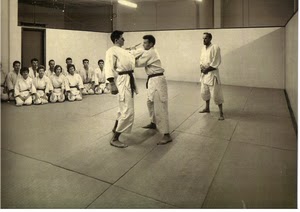
The three kansetsu waza in this grading are arm entanglement (ude garami), side wrist lock (yoko tekubi hishigi), and wrist hand throw (tekubi te nage). The latter two are known by different names in aikido. This completes the nine basic kansetsu waza taught within the JDJ tradition.

Basic Blocks and Attacks (Uke and Atemi)

Three punches and one kick - four basic karate-style blocks. 

There is no unbalancing - blocking section as included in 9th kyu

These blocks are often taught in conjunction with an EBM. As has continually been questioned in numerous posts, e.g., The Mon System and Blocking Techniques, what is the purpose of the block when used in conjunction with an EBM. It's not to avoid injurious contact with the body because the EBM takes care of that problem. This is a question that should be asked and answered as it would demonstrate insight and understanding.

The defences in this section include a karate-style block followed by a punch. This should be taught as an alternative to the singular use of EBMs, or just avoiding an attack. It would be a useful tactic to employ in the free fighting gradings of ikkyu and the dan grades.

Reflex (Shinken Shobu no Kata)

Fifteen defences from holding, strangulation, punching, kicking, stick, and knife attacks. There are two 'restraining techniques' included in the 15 defences, which is to say a pre-emptive application of a joint-locking technique.

All of the defences have been demonstrated in this or previous gradings, as they should be.
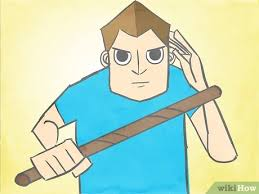
There is a 'stick-overhead attack.' 

Last year, I observed a number of classes of a JDJ ryuha where this same attack was used in the lessons. It would appear that uke did not know how to hit a person with a stick. If they made contact with tori, it would be with the butt of the stick held in the hand of uke. This obviously affects the distancing of the defence. With a lot of practice, the student would become proficient at defending themselves against an attack that was trying to hit them in the head with the butt of the stick, however, if someone was actually trying to hit them with a stick, they would literally fall short. 

This was also a common fault in the JDJSDS.

The lesson to be learned here is to teach the students how to attack properly first, and then teach the defence.

This was something lacking in the JDJSDS as well.

Saturday, 3 February 2024

The Development of the Jan de Jong Jujutsu Grading System: Curriculum vs Examination (Grading) Question

The following is a comment that was posted on one of my Facebook posts sharing one of the posts about the development of the Jan de Jong jujutsu grading system:

Earlier I made an implied minor criticism of one aspect of the approach taken in these analyses. I said something along the lines of the need to clearly differentiate between an examination set or system and a curriculum. I added a vague comment stating that designing teaching outlines / lesson plans around test questions is a really bad idea.

I could not locate the earlier implied criticism regarding examinations and curriculum, although I vaguely remember it. 

The criticism was vague and lacked a practical explanation, however, it did sow a seed that I initially resisted but then succumbed to my natural curiosity (curiosity being one of Klein's five paths to insight that can lead to a new and better understanding).

I consulted a 40-year veteran educator who has also been involved in curriculum development for the Department of Education WA. This is an extract from his response:

Thanks for the email. An interesting question. Lots of detailed arguments can be made but essentially exams and tests are about eliciting information from the candidate that reflects their understanding of the curriculum that has been taught. ...

The tests and assessments (at least the major summative ones) cannot hope to cover the whole curriculum (i.e. everything that is taught) and so tend to be testing only the “core” or important parts of the course. They also test both skills (e.g mapping) and content understanding and application. Questions and the required format of answers (e.g. – multi choice, short answer, math problems, essay arguments etc.) relate to the level of answer required from simple recall/understanding through to application and then evaluation.

I then asked my education expert to apply the theory to martial arts practice:

Essentially, if I was to link the idea to martial arts, the curriculum would be the skills and knowledge taught during a block of learning, and the “grading” would be the test to see if the student could demonstrate that he/she/they knows the curriculum. In the Martial Arts case, I assume the curriculum is about the throws, blocks etc, that you learn and practise. These are then tested appropriately with demonstrations. I don’t know if you can test everything in the curriculum in a grading or whether, like in education, you just do the core of the curriculum. The nature of your curriculum (if its just practical skills) means that the gradings are just physical tests looking for technical demonstration of the curriculum. If there are other aspects to the course/curriculum, you may be able to add other ways to test the students.

In terms of teaching to pass examinations (gradings), my education expert had this to say:

In education, “teaching to the test”, means just focusing on how to pass the test or exam, through the explicit teaching of exam techniques and a focus on core areas and just past papers. The goal here (and we have become this unfortunately) is to prepare the kids to pass the exam at a high level. That is now an industry across Australia – revision seminars, practice books on NAPLAN etc. But the tests are not the curriculum – that is much bigger and wider. 

I am all about using theory to inform practice in a practical way. This idea was first enunciated for me in my first lecture during my MBA (Master of Business Administration) at the University of Western Australia's Graduate School of Management - using theory to inform practice in a practical way. This has been the basis for the first book that I wrote on the science behind all fighting techniques. It is the basis for the second book on a new and better understanding of our natural and learned responses to a threat. It was the basis for the articles that have been published in various national and international magazines based on the work within those two books. It is the basis of this blog and that of the Kojutsukan blog.

What, if anything, can we extract from the above discussion in terms of theory informing practice in a practical way?

The first thing that comes to my mind is: is the grading system the curriculum for the jujutsu taught by JDJ and the JDJ tradition?

Here I invite the readers to express an opinion either way. If you believe that there is a curriculum separate from the grading system, please provide details.
 
Both the abovementioned critic and the education expert adviser express the view that 'teaching to the test' is not a good thing. Towards the end of my teaching tenure at the Jan de Jong Self Defence School, I taught to the test, and I was very good at it. In fact, JDJ said that I was the best instructor in the school based on my student's performances in their gradings. They consistently excelled in their gradings to the point that at times JDJ would stop marking so as not to miss any of the performance.

When thinking about it, the traditional approach to advancement was for the instructor to determine one day that the student was ready for advancement without any formal testing. Is there a distinction between curriculum and examination in that tradition?

The abovementioned critic referred to teaching plans and lesson outlines. If the refer to anything other than copies of the grading sheets, then they were absent in the Jan de Jong Self Defence School. 

Remember, that while we are focused on one martial arts school here, the detailed examination enables us to learn something about all martial arts schools, as Friday argues in Legacies of the Sword: 'One can, therefore, learn something of broad value about the physiology of traditional Japanese martial art by carefully dissecting one school, in much the same way one can draw broad insights about the physiology of all species of all mammals by dissecting any one' (p. 10). Also see Shodan Requirement: History of Jujutsu post.

Of course the core of all learning, the identification of similarities and differences, are at the heart of this process. 

And here I would like to invite readers of other martial arts schools to share their distinction between curriculum and examinations/gradings, if there is one. In this way we can learn by comparing, one of the proven highly effective ways of identifying similarities and differences, and on of Klein's paths to insight that can lead to a new and better understanding.

Monday, 29 January 2024

The Development of the JDJ Jujutsu Grading System Part 3.7: 8th Kyu

Okay, back on track.

The previous post (before the last post) looked at the first grading in the mon system for adults - 9th kyu. This post looks at the second grading in that system - 8th kyu, red and white belt.

Btw, if you're looking for quality belts and gi for your students at reasonable prices, see Ray Hana's Martial Arts Superstore.

Breakfalls (Ukemi)

Forwards roll, backwards roll, sideways roll, bridgefall, backwards roll over an obstacle, forwards roll over an obstacle, backwards flat over an obstacle, and sideways flat over an obstacle.

The new introduction is bridgefall, also referred to by Jan de Jong (JDJ) as o mae ukemi (major front breakfall). This technique was the subject of a 2010 post in which a video of the technique is posted.

Just as with sideways roll, this technique would appear to be relatively unique to JDJ's teachings, following a Google search and personal experience. 

In a 2010 post, I tell of an experience while teaching with JDJ in Sweden. JDJ demonstrated a 'hip turn' technique which I 'broke my fall' with o mae ukemi. During the break (no pun intended), I was approached by the seminar organiser, an instructor of a jujutsu school, and asked to teach him, not the hip-turn technique but the o mae ukemi to land safely from the execution of the technique. He had never heard of it or seen it before.

A point of differentiation that might be emphasised in the teachings of the jujutsu taught by JDJ, if it is understood by those teaching the jujutsu taught by JDJ.

The introduction of an obstacle for some of the breakfalls demonstrated in the previous grading is an increase in degree of difficulty over the previous grading.

Basic Blocks and Attacks (Uke and Atemi)

Front roundhouse kick, back side drive kick, and front side drive kick. Solo demonstrations. No blocks are included in this section.

A useful inclusion/replacement in this section could be Yoseikan Budo's (YB) sambo geri or yonbo (?) geri. These are exercise or kata that are used to teach three and four kicks respectively. I have found it a very useful exercise to teach, particularly in that it necessitates lifting the knee to stay balanced. Kicking skills are not great in most of those who trained exclusively within the JDJ jujutsu tradition. These kicking skills could be enhanced, based on experience, by training to lift the knee when initiating a kick, which the correct teaching of this kata teaches.

Last year I was assisting ikkyu graded jujutsuka in the JDJ tradition and introduced sambo geri to them. They could not perform the kata/kicks. This is representative of the kicking skills in the JDJ jujutsu, and aikido, tradition. Train your kicks people, and you might have to look outside your school to learn and train how to kick, as I did.

You will recall from the previous post, sambo geri was included in the ikkyu 'Basics' grading which then became the nikyu kime no kata/revision grading. Sambo geri was replaced by JDJ's wakai no kata which is included in the next grading, 7th kyu (part of the mon system), red belt.

Happoken no Kata

As has been stated before in numerous posts, this is a straight-up YB kata. JDJ changed the stances used in the kata which led to questions about the first block. Why is the middle block used when the taisbaki, evasive body-movement, has taken care of the injurious contact with body problem (see post 3.4)?

Last year, I saw a JDJ ryuha yudansha teaching this kata. They clearly had no understanding of the kata. The kata has four different strikes and four different blocks. The aforementioned yudansha was using basically the same striking technique for three of the four strikes.

Said yudansha also had no concept of the timing of the kata. It should be, 1,2 stop. 1,2 stop. 1,2,3,4 stop. Not 1,2,3,4,5,6,7,8 stop. This was a common problem with the kata and kambangan (pencak silat kata) in JDJ's school. It was a race from the beginning to the end. This compromised techniques and what the exercise was supposed to be teaching. Taking the lead from the Setia Hati pencak silat that I introduced JDJ to and which he began to teach his pencak silat instructors and through them his students, the kata and kambangan were broken down into their constituent parts and trained separately before being put back together again for the complete kata/kambangan. In this way the timing was corrected and the techniques improved.

Another issue is that happoken no kata is only taught and trained as a grading requirement. Once completed, it is hardly, if ever, trained again. Should happoken no kata be examined at the end of the kyu system, ikkyu, to see if the candidate has improved their technique and understanding?

Body Movements (Taisabaki)

'Defender's choice of attack, using any block'

The issue of 'blocks' has been covered in a number of previous emails.

Flowing with front snap kick, entering, entering rotation, major entering rotation, sliding. The first three taisabaki were demonstrated in the previous grading. A progression with the flowing technique is the inclusion of a front snap kick. The final two taisabaki are new inclusions and complete the YB basic taisabaki.

Unbalancing (Kuzushi)

Normal single grip on sleeve (low) - Normal unbalancing - atemi

Normal single grip on sleeve (high) - Reverse unbalancing - atemi

Front both wrists grip - Same side unbalancing - atemi

Rear single wrist grip and strangle - Rear unbalancing - atemi

Normal, same side, reverse, and rear unbalancing are the basic unbalancing techniques from hand grips taught by YB.

Why is atemi included with each unbalancing? What is being examined in this unbalancing section? This is a classic example of a lack of understanding re the YB division of a defence into phases. The stance and positioning when executing the atemi means that this unbalancing demonstration is not necessarily helping when these unbalancing techniques are used within the grading system, other than when finishing with an atemi.

Locking Techniques (Kansetsu Waza)

'Two attackers, defender's choice of attack'

The inappropriateness of this stress grading to demonstrate the learned kansetsu waza has been discussed in a previous post.

The previous grading included wrist twist, arm turning, and body set arm breaking techniques. This grading includes wrist crush, variant arm entanglement, forearm twist. These techniques cover six of the nine basic kansetsu waza taught by JDJ jujutsu (and YB). 

Basic Blocks and Attacks (Uke and Atemi)

Different moving attack with flowing-brushing block-punch, entering-brushing block-punch, entering-double block-punch, flowing-brushing block-punch.

This is not the Unbalancing (Kuzushi) - Blocking (Uke) section introduced in the previous grading, even though brushing block was included in that section in the previous grading. As it is, this is a demonstration of a defence and not a part of the division of defences into phases.

Reflex (Shinken Shobu no Kata)

There are 10 attack-defence combinations included in this section of the grading. Nine of the 10 defences require a joint-locking technique to be demonstrated. The joint-locks include the three demonstrated in the previous grading and the three demonstrated in the above section in this grading, albeit against two attackers and so not assessed for their technical proficiency on their own.

The final defence is agains a stick - overhead attack. Last year I observed a JDJ ryuha class on multiple occasions where a stick - overhead attack was included in the training. The attacker had no idea what they were doing. They were attacking with the butt end of the stick, thus changing the distancing which in term affects the defence. 

The attack should be taught first and then teach the defence. If the attack is flawed, so will be the defence. The defender will become really proficient in defending against a flawed attack, which will probably mean that it will be ineffective against a real attack that is intended to do harm.


Friday, 26 January 2024

The Development of the Jan de Jong Jujutsu Grading System Part 1.2: Historic Ikkyu Part 1: Basics and Current Nikyu Part 1: Kime no Kata

This post follows on from the post, Part 1: The Kyu System.

You will recall from that post that the original Jan de Jong (JDJ) grading system consisted of only the kyu grades, which was a one-off grading system when it was developed. Start to finish, nothing else to follow or precede. That is it! Done and dusted (in the voice of Al Pacino in The Heat).

The image to the right is of a historic grading sheet regarding the requirements of the ikkyu grade which the recipient of my gifting of historical records was kind enough to forward to me based on this series of posts.

In the above linked post, I argued that the ikkyu grading was an instructor grading. That argument is supported by the heading to the above historic grading sheet: Ikkyu (Kyoshi) Instructor. 

All those that attained ikkyu are instructors in JDJ's original grading system, and it could/should be argued that they are instructors under the current system which includes the dan grades. It could/should be argued that they should be referred to as sensei rather than sempai as they are now, given that that is how the ikkyu grading was developed.

Part 1: Basics in the above ikkyu grading requirements reflects the Yoseikan Budo (YB) influence introduced into the grading system, therefore, this grading was introduced post 1969 when JDJ trained for a short time at the YB dojo in Japan (also see below). 

At some stage, the ikkyu Part 1: Basics became nikyu Part 1: Kime no Kata. 

Kime no kata is referred to as 'revision' in JDJ's jujutsu grading system. So the ikkyu Part 1: Basics became a revision grading when it was moved to nikyu, but what is it revising? It is revising the YB inspired mon grades with the ikkyu Part 2: Kime no Kata in the above image being a true revision of the kyu grades. That grading requires the grading candidate to select defences from the kyu grades in the nominated sections in that gradings. 

All of the techniques in Part 1: Basics are YB techniques, including Itsutsu no Kata, Happoken, and Sambogeri. When ikkyu Part 1: Basics becomes nikyu Part 1: Kime no Kata, Happoken and Sambogeri were replaced by Wakai no Kata.

Happoken is a YB kata designed to teach striking and blocking skills.


Sambogeri is a YB kata/exercise designed to teach kicking skills (see image right from Mochizuki's book). In future posts, I will be suggesting that Sambogeri and derivations thereof be introduced into the mon grades to improve the kicking skills of JDJ jujutsuka, which are generally substandard unless the student trained in a percussion based martial art.

Wakai no Kata is a kata that JDJ developed to teach striking, blocking, and kicking skills, along with different stances. Wakai no Kata will be the subject of a future post when exploring the mon system. In that post I will explain why it tends to be poorly performed in the JDJ tradition, even by the majority of instructors.

The abovementioned generous provider of the historic grading sheets also commented:

After doing the nikyu revision, Greg Palmer came up to me and said "you have me to thank for that grading". The Boss has tasked him with developing an assessment for those who hadn't done the mons. Further cementing the case for Greg to have been a yondan on completion of sandan.

I argued in the first post of this series that Greg Palmer was the best teacher at the school because he was a trained and qualified teacher, and I don't mean in a martial arts system which is basically amateurish. I was unaware that Greg developed this grading, however, it makes sense because it is a coherent introduction, not revision as suggested above, to the YB system that forms the basis of the mon grades.

With regards to Greg and the awarding of yondan upon completion of the 'technical' grades in the JDJ jujutsu grading system. I would go further than the above commentor and argue that Greg was entitled to be graded rokudan along with the anointed trio

Greg's contribution to the grading system far exceeded that of any of the trio, including introducing JDJ to a mindset of progressive gradings. It is generally acknowledged that his understanding of techniques and how to teach them exceeded that of the trio. He also selflessly taught for JDJ for nearly 40 years with no remuneration, unlike two of the trio. He was also the first and only to have established a branch outside the metropolitan area for JDJ.

You will recall in a previous post that I shared an insight that I had gained through studying the development of the JDJ jujutsu grading system, and that is that the instructors teaching the mon grades may not have actually gone through the mon grades. The above comment would appear to confirm that.

In that case, the nikyu revision, as the above provider described it, was not a revision grading for those that did not go through the mon system. It is an introduction to the mon system. It features the YB division of a defence into phases: taisabaki, kuzushi, waza (body-movement, unbalancing, technique). It features the five basic YB taisabaki, their basic kuzushi from hand grips, and their nine basic kansetsu waza (joint-locking techniques) as waza

Did the instructors who did not go through the mon system understand that these were phases in a defence? Did JDJ? This might explain some/many of the issues that I have and will be raising in connection with the mon grades and the teaching thereof.


Friday, 19 January 2024

The Development of the Jan de Jong Jujutsu Grading System Part 3.6: 9th Kyu (First Adult Grading in Mon System)

Amazon.com: MACS Martial Arts 1.75" Wide Karate/Taekwondo Double Wrap  Striped Color Belts (Brown with White Stripe, 0) : Clothing, Shoes & Jewelry

The beginning of the mon system for adults is 9th kyu, brown and white belt. This post will look at the 9th kyu grading.

You will recall from a previous post that the grading is made up of various sections. The following will consider each section. The initial reference point will be the gradings published in Jan de Jong: the man, his school and his ju jitsu system (Jan de Jong Self Defence School, 1995).

Breakfalls (Ukemi)

Six types of ukemi are demonstrated: (1) forwards, backwards, and sideways rolls, and (2) forwards, backwards, and sideways flats.

1. All of the ukemi, except for sideways roll, are taught in judo (see point 5 below). Most jujutsu schools take their ukemi from judo.

2. Sideways roll is unique to the jujutsu taught by Jan de Jong (JDJ), and it should be taught as such. This is a clear point of differentiation between the jujutsu taught by JDJ and that of all other jujutsu, aikido, and judo teachings. (Marketing 101 - differentiate the product).

I found a 'sideways roll' included in the door-stopper of a book by Marc Tedeschi, Hapkido: Traditions, Philosophy, Technique (2000; 1136 pages, over 9000 photographs). The sideways roll included in Tedschi's book is a barrel roll: starting on all fours, roll sideways and back up to on all fours.

3. Sideways roll as taught by JDJ is best described in terms of the old-school parachute landing involving sequential impact with the landing surface of body parts from the ankle to the shoulder thus reducing the force to be absorbed by the body per unit area and per unit time (see my book on the science behind all fighting techniques).

I did find a similar roll in Kreighbaum and Barthels (1996), Biomechanics: A Qualitative Approach for Studying Human Movement. Apparently this type of sideways roll is taught in volleyball.

4. Sideways roll is generally taught and demonstrated very poorly in the JDJ tradition. Starting off the roll on a flat foot generally results in a sideways flat that transitions into a backwards roll. Jumping into the roll often ends up with the same result. I teach to start off on the edge of the foot with the body arced in a 'C' position with the hip leading and shoulders leaning away from the direction of the fall. This forces the person to have sequential body parts impact (ankle, calf, thigh, hip, shoulder) before transitioning into a backwards roll. An important factor is, as with so many techniques, the direction the practitioner looks when executing the technique. Look at the ground and the body turns forward towards the ground. Look straight ahead or slightly to the other side, and the body stays side-on, thus executing a true sideways roll.

5. Kaiten ukemi (rolling breakfalls) are taught within the JDJ tradition such that the technique ends with the individual facing their opponent. This is a jujutsu approach compared to a judo approach, according to Pat Harrington in Principles of Jujutsu (1997) and Eddie Ferrie in Ju-Jitsu: Classical and Modern (1990):

The major difference between the forward breakfall in judo and jujutsu is the way jujutsu exponents come to their feet facing in the direction from which they have just fallen. It is standard practice to roll and come to your feet, simultaneously turning to face your opponent in a defensive guard. Judoka, on the other hand, roll, stand up and usually carry on walking. (Ferrie 1990, 33)

Judo teaches to walk away (not face the attacker) with kaiten ukemi. It has been suggested that this reflects the lack of combative focus in judo teachings. Do rather than jutsu. The same suggestion has been raised with respect to aikido when kaiten ukemi is taught in the same fashion.

JDJ included the 'judo' approach to kaiten ukemi in the instructors class. Why not include the judo approach in the mon grades? If nothing else, it increases the tactical options for students when regaining one's feet from a kaiten ukemi.

One of the exercises I use when teaching kaiten ukemi involves a person pushing another who executes the kaiten ukemi while the 'pusher' walks towards that person. This demonstrates that one needs to rise to their feet rapidly when used in a defensive situation. Often the person was very close when the person rose to their feet, because of the execution of the kaiten ukemi. One option is to adopt the judo approach in order to create distance between the 'attacker' and defender before turning to face them. The other is the slow rise to the feet is often a product of where the person is looking when they are exiting the roll. Throw your head back to immediately seek out the attacker and the body follows.

Greg Palmer and Peter Templeman (two JDJ yudansha instructors) told of how they did not sustain injuries when coming off a motorcycle at speed because of their kaiten ukemi training. The told of mae kaiten ukemi, ushiro kaiten ukemi, ushiro kaiten ukemi, yoko kaiten ukemi, etc. Only one mae kaiten ukemi - why? Because if the only way you've been taught kaiten ukemi is the 'jujutsu way', it rules out mae kaiten ukemi after any initial use as the person will always be facing the direction from which the fall commenced.

The secret for teaching the jujutsu and judo kaiten ukemi ways? Either a figure-4 or parallel leg arrangement. It's as simple as that. And don't forget where the performer looks.

Basic Blocks and Attacks (Uke and Atemi)

The four blocks are karate style blocks demonstrated solo (high, middle x 2, low: see a previous post).

The two attacks are front snap kick and punch with step. 

I recently saw a video prepared for student instruction where the JDJ ryuha yudansha was demonstrating a front snap kick/front kick. Their attempt to kick high resulted in their toes not being pulled back so as to kick with the ball of the foot. This is what the kick should look like (btw, it is not a 'snap' kick):

Kicking techniques do not tend to be taught too well in the JDJ tradition. For those in the JDJ tradition demonstrating for students or  publishing instruction manuals and/or videos, remember, students will study those images ad nauseum in an attempt to replicate them. If the images are of poor technique, they will work hard to produce poor technique.

Body Movements (Taisabaki)

'Defender's choice of attack, using any block'

The issue of 'any block' was discussed in the previous two posts.

Unbalancing (Kuzushi)

Normal single wrist grip - Normal unbalancing

Same side single wrist grip - Same side unbalancing 

Reverse single wrist grip - Reverse unbalancing

Rear both wrists grip - Rear unbalancing

Front both wrists grip - same side unbalancing

The first four attacks and unbalancings are pure Yoseikan Budo (YB).

The fourth attack and unbalancing is an extension of the basic unbalancings from wrist grips. Why is an extension being added into this section in the first grading an adult will be attempting? Shouldn't the first grading at least just be examining basic techniques. Variations can be introduced in later gradings.

Unbalancing (Kuzushi) - Blocking (Uke)

This section of the grading was discussed in the previous post where the issue of JDJ's classification of blocking techniques as being unbalancing techniques was explored.

Note that the above demonstrated blocks, karate style blocks, are not included in the unbalancing use of blocks in this section of the grading.

It is also worth noting that the required brushing block against a downwards hit in no way, ever, unbalances an opponent. Ever! (see previous post)

Locking Techniques (Kansetsu Waza)

'Two attackers, defender's choice of attack'

This is the first grading for an adult, and they are being expected to defend using a specified kansetsu waza against two attackers. It is their first grading. The inappropriateness of this stress element in this and in all of the mon grades was discussed in a previous post

Reflex (Shinken Shobu no Kata)

Shinken shobu no kata is explained and discussed in this post. This grading and training method is another unique aspect of JDJ's teaching and should be appreciated and shared as such (Marketing 101: differentiate the product).

This is an adult's first grading; is there any need for this (or any other) stress element? Maybe it's to acclimatise the student to shinken shobu no kata gradings given that this is the principal form of grading from the kyu grades onwards. Fair enough, but does this mean they are given a lot of leeway in this grading due to the stress element (ditto for the above stress element) and the fact that it is their very first grading?

#1 Normal single grip on the sleeve (low) - Body set arm breaking.

In the above unbalancing section, normal single wrist grip is demonstrated with normal unbalancing. In this defence sequence, body set arm breaking is facilitated by 'same side unbalancing' from a normal single grip on the sleeve (low). Why? Why complicate things in the first grading? Surely it should be to apply the whole taisabaki, kuzushi, waza phases of a technique that the grading seems to be based upon to bring the phases together in a defence?! A systems thinking approach.

#3 High punch - Atemi - body set arm breaking.

The use of atemi to unbalance an opponent, in the kuzushi phase of a defence, has not been introduced to the student in the grading as yet. Why include this new element in this stress section of the grading when other unbalancing methods have been demonstrated in the grading?

#5 Front snap kick - Brushing block - punch.

I would teach a grading candidate to use an 'empty block', no block at all, when executing this defence as a 'teach-the-teacher' exercise (see above re brushing blocks). Would the JDJ ryuha instructors mark the grading candidate down if they did not use a brushing block but simply an evasive body-movement and a decisive punch?

Comment

It may seem like I'm being overly critical of JDJ's efforts, however, it's more about learning from his efforts. First, how would you go about developing a grading system when you have no real experience with a grading system? How you go about introducing a systems based element into a 'collection of defences' grading system when you have no real understanding of systems based thinking? JDJ did a remarkable job given the circumstances, however, it behoves those that follow him to study what he did in order to improve on what he did; to see further by standing on the shoulders of a giant. It behoves them to gain insights and understanding rather than simply to imitate.