Saturday, 1 August 2020

Jan de Jong Side-Drive Kick

You will recall from my last post that Sensei Dan Newcombe, founder of Self Defence Central Dojo and Tsutsumi Hozan Ryu International, forwarded a number of photographs taken in the 1950s when his father and uncle trained under JDJ to me. This is the latest installment.


JDJ executing a side-drive kick. JDJ was never keen on the knife-edge for the foot, preferring instead to use the heel with the body weight behind the kick.

The other person's posture is interesting. It appears to be silat-like, however, JDJ had not formally begun to teach silat at that time. It may be a flowing bodymovement (nagashi) with a brushing block but JDJ had not traveled to Japan to train under Mochizuki where the taisabaki taught in his system originated.

The dojo is the Swan River Rowing Club. The mat is handmade by JDJ's first wife, as were the gis, as no martial arts products were available for purchase at that time.

JDJ often told the story of how when he first started teaching at the SRRC, they trained on floorboards and that after the first session or two, and when a student put both feet through the floorboards when executing a bridge fall, the class shrank to a few people. Obviously this mat was then brought out to encourage students to continue with their jujutsu.

Harry Hartman trained at this dojo and he informed me that the mat was rolled up and stored in a storeroom at the SRRC.

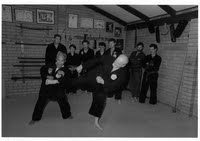
This is a photo for comparison over the years. The first photo was taken in the 1950s while the above photo was taken in the late 1980s. JDJ was in his 30s in the first photo and in his 60s in the second. The person executing the defence is JDJ's Indonesian pencak silat guru, Soehadi. This photo is taken in JDJ's home dojo with his silat senior students in the background, including Peter Clarke, fourth from the right.

Sunday, 26 July 2020

Demos in the 50s

You will recall from my last post that Sensei Dan Newcombe, founder of Self Defence Central Dojo and Tsutsumi Hozan Ryu International, forwarded a number of photographs taken in the 1950s when his father and uncle trained under JDJ to me. This is the latest installment.

Jan de Jong and his school have been performing public demonstrations since the 1950s. Anyone who has gone through the Jan de Jong School and who were proficient would have participated in these demonstrations. There was a time in the 1990s when a formal demonstration team was attempted to be established and whose inclusion was by invitation only, however, that formality soon phased out.

The above photo is of JDJ performing a straight arm lock on the ground. The person sitting to the extreme left in the foreground is Dan's uncle and next to him is a young Margaret Kellond, later Margaret de Jong after she married Jan de Jong.


No mats for these intrepid jujutsuka.


This is Margaret Kellond performing in the demonstration. Not actually sure what is going on there. Margaret must have been a good practitioner as she is only a teenager in this photo.


This is a photo of the demonstration team. Not sure if Dan's uncle in present. Note the belts. I don't know what colour those belts were. At that time the rank was signified by coloured badges sewn onto the gis. Also note that the knots in the belts are not uniformly positioned. It may have been that they are as Mr Miagi suggested in The Karate Kid, just something to hold your pants up, or in this case the top of your gi closed.

Also, as I understand it, the gis were handmade by JDJ's first wife as no martial arts products could be purchased in Perth at that time. It would appear that three-quarter pants were the go in the 1950s.

Friday, 24 July 2020

Old School Wrist Twist Technique

This blog has become a lightening rod for sharing memories about Jan de Jong and his martial arts teaaching.

The latest is by Sensei Dan Newcombe, founder of Self Defence Central Dojo and Tsutsumi Hozan Ryu International, who forwarded a number of photographs taken in the 1950s when his father and uncle trained under JDJ.

Dan is the second of three generations of his family that have trained/studied the jujutsu taught by Jan de Jong. He is continuing on in the truest tradition of JDJ by establishing his own school, modifying the grading system so as to improve the outcomes for students, upholding the integrity and standards that JDJ espoused, and attempting to internationalise JDJ teachings.


Dan described the above photo as an 'interesting wrist twist knife pinning on the ground.'

Here is a history lesson for students of the JDJ tradition. That is the original finishing position of a wrist twist technique that JDJ taught. The wrist twist joint locking technique was applied to take the opponent to the ground and then continued in order to apply a wrist twist lock on the ground.

A similar technique is seen in Jiu-Jitsu: El Efectivo Metodo Japones de Autodefensa by Katsukuma Higashi in the early 1900s.

EN3. Higashi began his professional wrestling career in New York City, where he became the subject of articles and books by Irving Hancock and Robert Edgren. See, for example, H. Irving Hancock and Katsukuma Higashi, The Complete Kano Jiu-jitsu (New York: G.P. Putnam's Sons, 1924) and Robert Edgren, "The Fearful Art of Jiujitsu," http://ejmas.com/jcs/jcsart_edgren1_0300.htm. Higashi's style, by the way, was not Kodokan judo but Tsutsumi Hozan Ryu jujutsu. 


JDJ changed the finishing to this technique because of the risks inherent in the opponent being on their back with legs and one arm free to attack if the joint lock is not applied expediently and effectively. He changed it to the current form where the opponent is turned over onto their front.

Now for the technical lesson. The evolved/tactically improved/later version of the wrist twist technique means that the wrist twist joint locking technique is now solely a takedown technique and the finishing technique is either a wrist crush or straight arm lock while the opponent is prone (lying on their front).

FYI. The wrist twist technique is never in itself a throwing technique as Shioda increasingly described in his books on aikido. One of his earliest books explained that tori had to jump to avoid injuring their wrist, which is technically not a throw.

Wednesday, 15 July 2020

O Soto Otoshi

This post is primarily aimed at all who are currently teaching the jujutsu taught by Shihan Jan de Jong OAM 9th Dan. Given that I may never teach my own classes again, it is time to pass on certain insights that improves on JDJ's teachings. It is time to see further then the giant that was JDJ by standing on his shoulders.

The JDJ jujutsu grading system uniquely includes theory questions in order to examine a student's understanding of techniques. This and other similar gradings is aimed at preparing a person to become an instructor. One of the questions that JDJ would commonly ask was, 'What is the difference between o soto gari, o soto guruma, and o soto otosh?'

Firstly, a more complete question would have been, 'What are the similarities and differences' between those three techniques? The second chapter in my The Science Behind All Fighting Techniques concerns the 'core of all learning.' The core of all learning is the identification of similarities and differences. JDJ is using the core of all learning, in part, to examine the student's understanding of the techniques that they have learned.

Secondly, not one person in the Jan de Jong Self Defence School who attempted this grading and who were asked this question would have gotten the answer to this question technically right. Why? Because o soto otoshi was not taught correctly in the JDJSDS.

Wikipedia provides an adequate description of this technique for our purposes.

O soto otoshi is similar to o soto gari in that one leg of uke's is targeted, however, they are different in that with the latter the 'throwing' leg projects upward and with the former it projects downward. In wrestling it is called a lariat-leg sweep whereas in common parlance it may be termed a trip.

Another similarity and difference between o soto otoshi and o soto gari is that they are both techniques where forces are applied to cause uke to fall to the ground/mat, however, the former is a takedown whereas the latter is a throw. My biomechanically based distinction between throws and takedowns included in The Science Behind All Fighting Techniques is that with a throw, forces are applied to cause both of the opponent's feet to leave the supporting surface while with the latter they are not.

O soto otoshi is a takedown, however, it is included in Judo's nage waza, throwing techniques, category because judo does not include a takedown category in their classification of techniques; an issue explored in The Science Behind All Fighting Techniques.

The best book by far on judo 'throwing' techniques is Toshiro Daigo's Kodokan Judo Throwing Techniques. In that book, Daigo explains the basic technique and then provides various variations of that technique. One of the variations of o soto otoshi is to target both of uke's legs. This technique is similar to o soto guruma in targeting both of uke's legs but different in that tori's leg projects upward with o soto guruma but downward with the variation of o soto otoshi.

Interestingly, Daigo compares this variation of o soto otoshi to tai otoshi, body drop (although it is far more devastating taking the opponent backward rather than forward). In the judo classification, tai otoshi is classified as a te waza, hand technique, and o soto otoshi a ashi waza, leg technique, thereby illustrating the flaw in the judo classification of techniques.

Wednesday, 22 April 2020

Training and COVID-19 Restrictions

Jujutsu involves contact. Throwing techniques, takedown techniques, joint-locking techniques, strangulation techniques, unbalancing techniques - they all involve physical contact. Does that mean that you cannot train them during the COVID-19 isolation restrictions?No! In fact, you can use this time to become more efficient and effective when you have the opportunity to train with a partner again.

When I reconnected with Shihan John Beckman over Facebook, he remembered me because I was extremely precise in my movements when executing defences. He was not wrong. I was very precise in executing my defences. I'd trained to be very precise. The way I trained was a very efficient training method which did not necessarily involve any other physical presence.

During my work annual leave I would go to the 996 Hay Street dojo and practice by myself. I'd practice the defences without the physical presence of an 'attacker.' Wrist twist from a low punch. Enter rotate rotate. Enter rotate rotate. Enter rotate rotate. Over and over again. By myself.

I built so-called muscle memory of the movements involved. I trained myself to move fluently and precisely. When it came to executing that defence against a physically present attacker, I didn't have to think about those movements. All I had to focus on was fitting in with the attack and applying the force in the right place in the right direction.

It's like learning to drive a car. Everyone should start off with an automatic. That way you can focus on the road without worrying about how to change gears. When you've got driving on the road down pat then you start learning to drive with a manual because you no longer have to think about driving on the road. It's automatic.

Train your grading. Go over each defence over and over again. This way you won't have to try and remember your grading, the defences in your grading. Top to bottom, over and over and over again.

'It's boring.' Training only begins when it is boring. If it is still exciting then you haven't done it enough. If you want to be entertained go and watch Netflix or play on your game console. If you want to train, train until it's boring and then train a lot more. Train until it becomes 'mindlessness.'

Take this opportunity to become better at what you do and to be more efficient and effective in your training when the isolation restrictions are lifted.

Thursday, 27 February 2020

Did Jan de Jong Possess Insight?

Due to 'overwhelming demand' I have decided not to take down this blog.

I am currently working on the conclusion to Fear and Fight: Understanding Our Natural and Learned Responses to a Threat. The driving theme of that conclusion is that the book shares my insights into our natural and learned responses to a threat.

Having an insight is an act of creation. Each insight is the creation of a new idea that didn’t exist before, often in opposition to defective ideas that formerly prevailed. No one expected this new idea to emerge, and other people who possessed the same information were unaware of its existence (Klein 2013, Seeing What Others Don't)
That describes the insights I share in Fear and Fight about our natural and learned responses to a threat.

Klein explains that there are five strategies for gaining insights: connections, coincidences, curiosities, contradictions, and creative desperation. My path to gaining insights into our natural and learned responses to a threat was through curiosity: Why didn't I experience a fight-or-flight/stress response which is evolutionarily designed to promote an individual's survival when my survival was threatened by a knife-wielding assailant on two separate occasions? Klein explains that curiosity does not contain the insight, but it does put a person on the path to gaining insights. My question regarding my lack of a fight-or-flight/stress response when my survival was threatened put me on the path to gaining insights into our natural and learned responses to a threat.

The Jan de Jong Martial Arts Fitness recently used what would have been Jan de Jong's 99th birthday to promote their school. This led me to thinking given that I'm working on insights for my conclusion, did JDJ possess insight(s) and if so into what?

Insight means an accurate and deep understanding of someone or something. It could be argued that based on this definition that JDJ did possess insight into martial arts techniques. However, when you consider Klein's explanation that insights shift us towards a new, better idea/story that didn't exist before; did JDJ shift us towards a new, better idea/story that didn't exist before? What is unique in his teachings?

Jigoro Kano most definitely possessed insight. His analytical approach to teaching and understanding judo techniques is most definitely a new idea that produces a new, accurate and deep understanding of judo techniques. Minoru Mochizuki's division of a tactic into taisabaki, kuzushi, and waza elements could rank up there with Kano's efforts as being unique and insightful. JDJ adopted Mochizuki's methods.

Some may seen this post as being some sort of attack on JDJ. It is nothing of the sort. It is simply a meditation or reflection on JDJ's work and legacy. I have a unique appreciation of JDJ's grading system which he developed and which I have tried to share with the readers of this blog, however, does the development of the grading system qualify as insight?

This leads to the broader question, do you need to possess insight in order to be considered great? Did Gichin Funakoshi, founder of Shotokan karate, possess insight and if so into what? The founder of a new style or type of martial art might qualify as possessing insight. For instance, Yip Man and Wing Chun. It might be argues that the Gracies and their ground fighting strategies that drove the development of Brazilian Jiu Jitsu might be an example of insight.

It's just a musing as I struggle with the conclusion to Fear and Fight.


Thursday, 19 December 2019

'Let's don't think that we can learn this in 20 days'

My plans to terminate this blog are not going according to plan.

This blog accumulating the information and telling the story of Jan de Jong has and is attracting contributions from those who knew him and/or trained under him. The latest is a membership card from JDJ's school in Rotterdam in 1946.


Would love a current photo, and even a 1940s photo, of Leede 60, Rotterdam Zuid.

 The left hand side says: Please bring this card with you every first lesson of the month.

The right hand side says: The development of jiu jitsu has taken 20 decades. So lets don’t think that we can learn this in 20 days.

The card is dated 1946 and is number 69. 

The card is for Kees (Cees) Kranendonk. The Nationale Veteranen Commissie Budo in Holland published a eulogy for Kees on their Facebook page as he passed away this month. It would appear that he was still active in judo in Holland. Nearly 75 years in jujutsu and judo starting with JDJ right after WWII ended. JDJ would be chuffed.

 This photo is apparently a young Piet Hesselink who JDJ handed his school over to when he left Holland for Indonesia. Hesselink was reputedly the first shodan that JDJ graded.

This photo is reproduced for atmospherics about the time period we are discussing. It is of JDJ and Rienier Hulsk who he trained with when he arrived in Holland in 1940 before teaching for him and ultimately branching out with his own school.

One of the photos in the set with JDJ and RH has been reproduced in Naverteld verleden: Jiujitsu in het verzet in Nederland 1940-1945 (Retold past: Jiujitsu in the 1940-1945 resistance) by J.H.G. Smits. Most of the information in that book about JDJ was taken from this blog.